Solenidiasolenidion:
(pl. solenidia) a hollow, optically inactive chemosensory seta on the limbs of acariform mites appearing to have transverse rows of minute pores (actually pore canals) under light microscopy, (the transverse pattern is often not apparent in SEM); often bulbous or otherwise modified; sometimes associated with a companion seta. Solenidia are designated with Greek letters by leg segment: Ω (omega) on the tarsus, Φ (phi) on the tibia, and Σ (sigma) on the genu.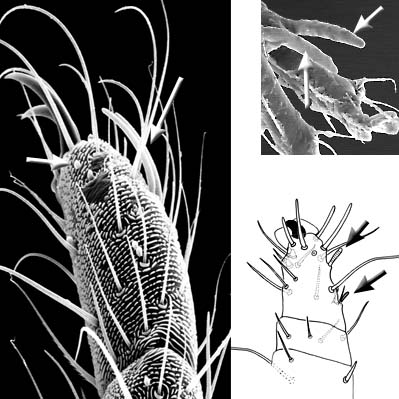 are chemosensory (olfactory) structures that are
usually thick, blunt setae with immovable bases and banded patterns of minute
'pores' (or thin areas of cuticle) when viewed at high magnification on a light
microscope. Some solenidiasolenidion:
are chemosensory (olfactory) structures that are
usually thick, blunt setae with immovable bases and banded patterns of minute
'pores' (or thin areas of cuticle) when viewed at high magnification on a light
microscope. Some solenidiasolenidion:
(pl. solenidia) a hollow, optically inactive chemosensory seta on the limbs of acariform mites appearing to have transverse rows of minute pores (actually pore canals) under light microscopy, (the transverse pattern is often not apparent in SEM); often bulbous or otherwise modified; sometimes associated with a companion seta. Solenidia are designated with Greek letters by leg segment: Ω (omega) on the tarsus, Φ (phi) on the tibia, and Σ (sigma) on the genu. are minute, slender, or globoseglobose:
spherical.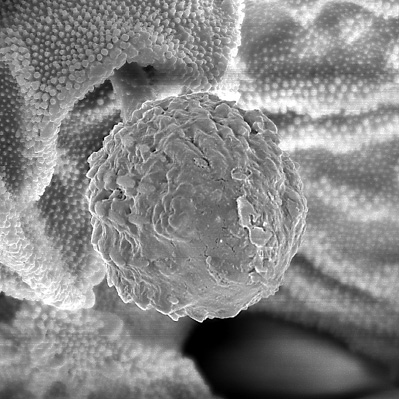 in shape, and
typically occur on the tarsitarsus:
in shape, and
typically occur on the tarsitarsus:
(pl. tarsi) the subdistal leg segment between the tibia and the pretarsus (apotele).
, especially of legs I and II (and legs IV of some
males). In some early derivative acariform mites, the genuagenu:
(pl. genua) (= patella) the 4th leg segment, between the femur and tibia.
, tibiaetibia:
(pl. tibiae) the leg segment between the genu and the tarsus.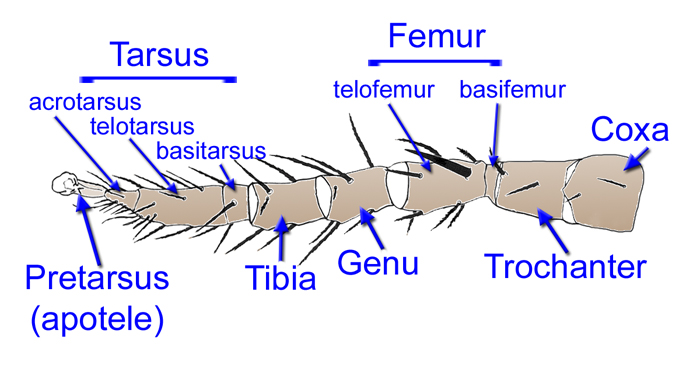 , and even
femora may bear solenidiasolenidion:
, and even
femora may bear solenidiasolenidion:
(pl. solenidia) a hollow, optically inactive chemosensory seta on the limbs of acariform mites appearing to have transverse rows of minute pores (actually pore canals) under light microscopy, (the transverse pattern is often not apparent in SEM); often bulbous or otherwise modified; sometimes associated with a companion seta. Solenidia are designated with Greek letters by leg segment: Ω (omega) on the tarsus, Φ (phi) on the tibia, and Σ (sigma) on the genu. as well.
Parasitiform mites do not have solenidiasolenidion:
(pl. solenidia) a hollow, optically inactive chemosensory seta on the limbs of acariform mites appearing to have transverse rows of minute pores (actually pore canals) under light microscopy, (the transverse pattern is often not apparent in SEM); often bulbous or otherwise modified; sometimes associated with a companion seta. Solenidia are designated with Greek letters by leg segment: Ω (omega) on the tarsus, Φ (phi) on the tibia, and Σ (sigma) on the genu., except on legs I of
ticks. Instead, most parasitiformans have specialized 'contact chemoreceptor'
setae, each of which has a 'pore' at its tip.
Solenidiasolenidion:
(pl. solenidia) a hollow, optically inactive chemosensory seta on the limbs of acariform mites appearing to have transverse rows of minute pores (actually pore canals) under light microscopy, (the transverse pattern is often not apparent in SEM); often bulbous or otherwise modified; sometimes associated with a companion seta. Solenidia are designated with Greek letters by leg segment: Ω (omega) on the tarsus, Φ (phi) on the tibia, and Σ (sigma) on the genu. that are recumbent (as opposed to erect) and lie in
furrows on tarsustarsus:
(pl. tarsi) the subdistal leg segment between the tibia and the pretarsus (apotele).
I are characteristic of the Rhagidiidae and a few related
families of Eupodina and are called rhagidial organsrhagidial organs:
recumbent solenidia in shallow depressions on the distal segments of legs I-II in Eupodoidea (Prostigmata).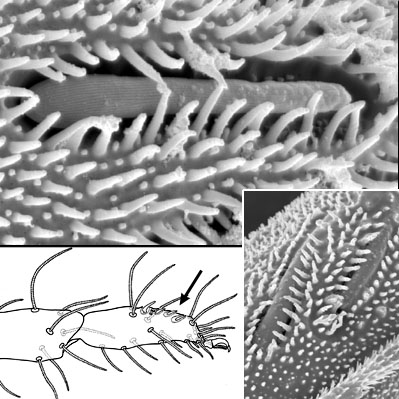 .
.
Haller's Organ is a specialized sensory area with chemosensory
setae and usually consists of a deep pit (ticks, holothyrans) and/or a shallow
depression on tarsustarsus:
(pl. tarsi) the subdistal leg segment between the tibia and the pretarsus (apotele).
I (some mesostigmatans).
Author: David E. Walter
Content last updated Sept. 2006, unless indicated otherwise
Lucid key player updated Sept. 2025
idtools.org