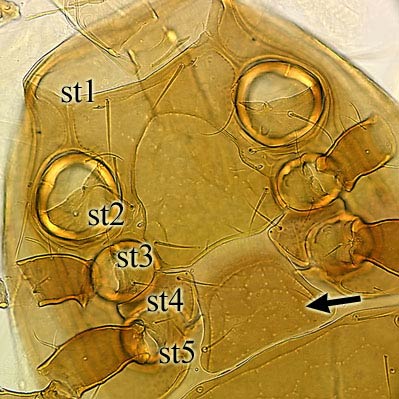
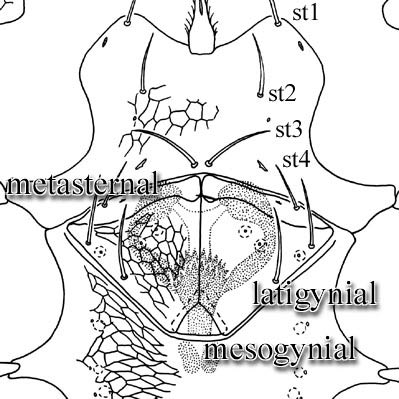
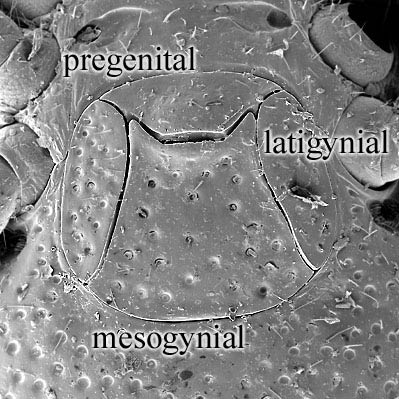
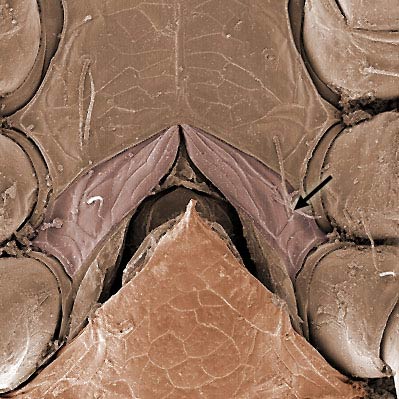
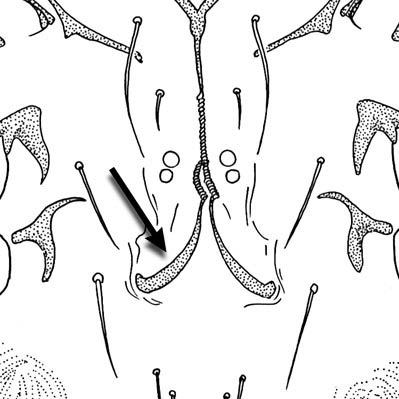
Genital shields are sclerotized plates that protect the genital opening/ovipore on the venterventer:
the lower or under side; opposed to dorsum.
of mites. Although called genital shields (also epigynialepigynal:
(also epigynial) of or relating to the female genital opening or a shield protecting it.
shields), in many mite lineages insemination occurs via a secondary system that is no longer associated with the ovipore and the true genital opening in the adult female is removed from the ovipore. Nevertheless, the form of the so-called genital shieldgenital shield:
a shield or shields covering the genital opening; in female mongynaspine Mesostigmata this shield is usually called the epigynal (epigynial) shield.
in the female is often diagnostic for major mite groups.
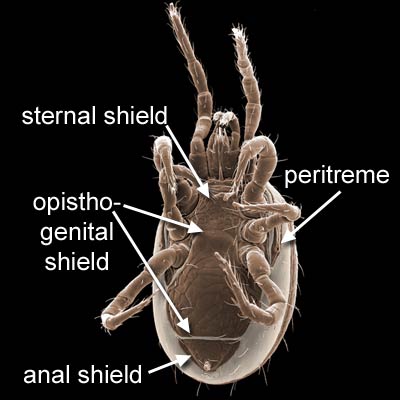
In the Mesostigmata, the genital opening is transverse and protected by 1–4 separate sclerites. The median, and usually largest or only, scleritesclerite:
A component section of an exoskeleton; a plate forming the skeleton of an arthropod.
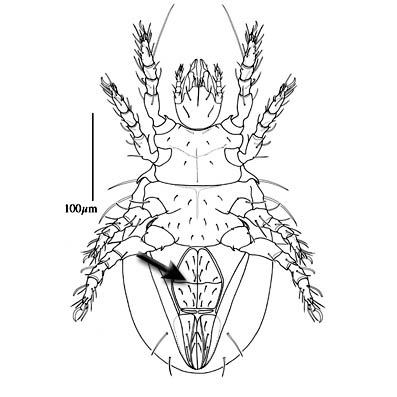
is hinged posteriorly and opens like an anteriorly directed trap door. In the Monogynaspida and Sejida there is only a single median genital (or 'epigynial') monogynaspid shield, but in the Trigynaspida there are usually 2–3 distinct shields (trigynaspid condition), and sometimes 4 shields (i.e., quadrigynaspid—also found in Holothyrida). One family of Monogynaspida (Parasitidae) have large secondary sternal sclerites that flank an anteriorly acuminate monogynaspidmonogynaspine:
(monogynaspid) representative of the mesostigmatan suborder Monogynaspida, characterized by having a single genital shield in the adult female that usually bears one pair of setae (st5) or may be nude.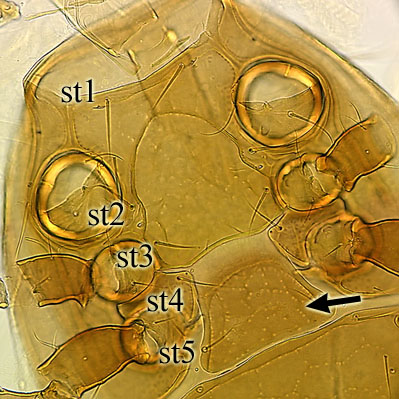 genital shield, a condition called parasitoid that could be confused with the trigynaspid condition. In some monogynaspids, an opisthogenital shield is present, i.e., the genital shieldgenital shield:
a shield or shields covering the genital opening; in female mongynaspine Mesostigmata this shield is usually called the epigynal (epigynial) shield.
is fused to a ventral shieldventral shield:
in Mesostigmata, any shield or shields in the ventral region; often fused with the anal shield to form a ventrianal shield. [Back to Top]
bearing one or more pairs of setae. Most Mesostigmata feed only on fluids (usually externally digested prey) and have a fairly small anal opening covered by a pair of small sclerites and well removed from the genital opening.
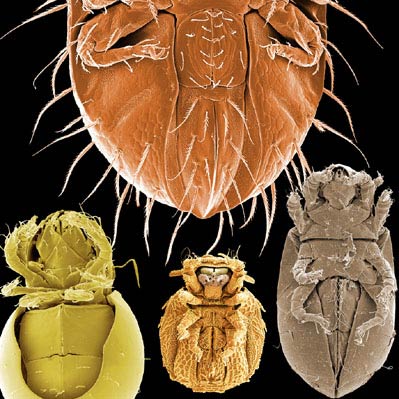
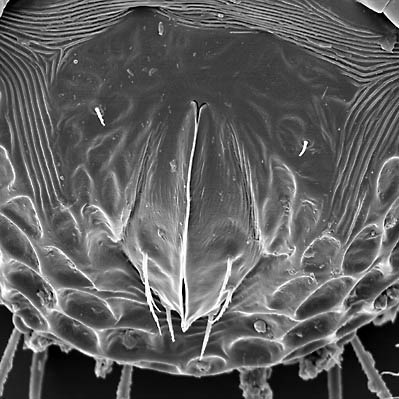
In Sarcoptiformes, the genital and anal openings both tend to be large (most sarcoptiform mites ingest solid food). If they have separate adgenital and adanal plates lateral to the genital and anal shields, respectively, the condition is called macropyline. The typical macropyline complex of shields covers most of the post-coxal venterventer:
the lower or under side; opposed to dorsum.
of the mite. Both genital and anal shields meet along the midline and sometimes the genital shields are divided transversely to form four shields. In derived oribatid mites the genital and anal plates are surrounded by a large ventral shieldventral shield:
in Mesostigmata, any shield or shields in the ventral region; often fused with the anal shield to form a ventrianal shield. [Back to Top]
composed of aggenital and adanal elements, a condition called brachypyline. Although traditionally used only for oribatid mites, the brachypylinebrachypyline:
having separate genital and anal plates surrounded by a large ventral plate (composed of aggenital and adanal elements); usage usually restricted to traditional oribatid mites (see macropyline).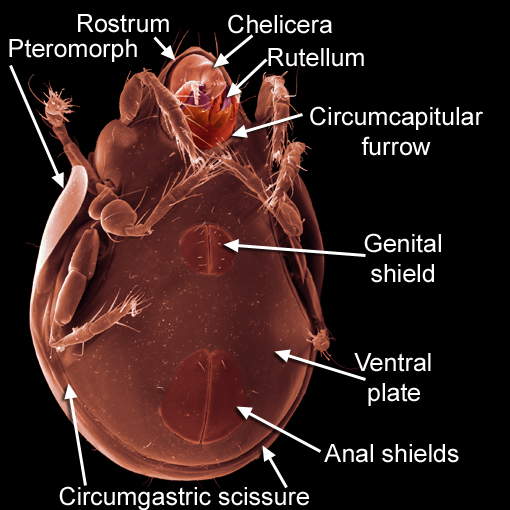 condition is also found in many other acariform mites with longitudinally divided genital and anal shields.
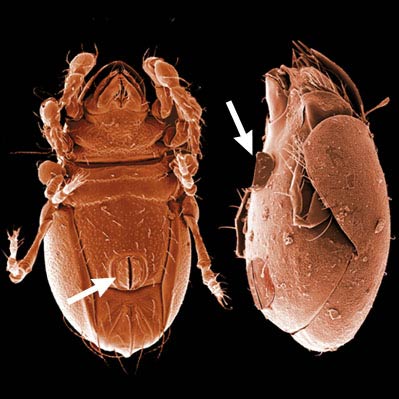
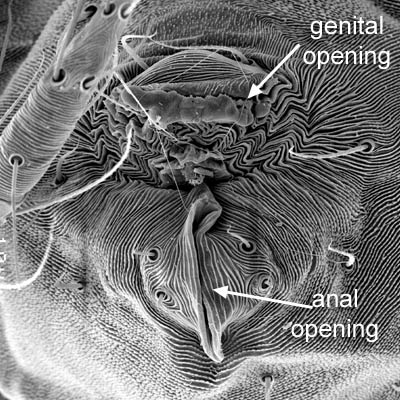
In addition to the above general conditions, other forms of genital opening are distinctive. In the Astigmata, the female's genital shields often converge anteriorly in an inverted-V form. In spider mites, sclerotized genital shields are absent and the large and transverse genital opening is surrounded by wrinkled, soft plicateplicate:
with a pattern of raised, narrowly aligned ridges like a fingerprint; used to describe the soft cuticle of many mites.
cuticle. In other Prostigmata, the genital and anal plates are coalesced into a single unit.
Author: David E. Walter
Content last updated Sept. 2006, unless indicated otherwise
Lucid key player updated Sept. 2025
idtools.org