Adult mites are usually octopod (i.e., 8-legged), but typically larval (and when they occur, prelarval) stages of mites are hexapodhexapod:
with three pairs of legs (i.e. 6 legs), as in the larvae of mites or the larviform stages of others.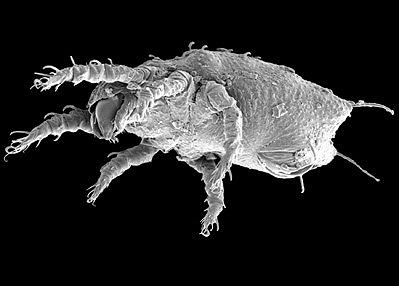 (i.e., with 6 legs). Leg IV is usually added in the protonymphal stagestage:
a distinct developmental form, e.g., the egg, larval, nymphal and adult stages. Since mite instars are usually morphologically distinct, they are also stages (and see stase). Some authors, however, insist that instar should be apolysis to apolysis and stage ecdysis to ecdysis. Since apolysis can be a discontinuous process and, in any case, is difficult to determine, in practice the difference between a stage and an instar is abstract and of importance only if you have a contentious referee.
and retained through the adult stagestage:
a distinct developmental form, e.g., the egg, larval, nymphal and adult stages. Since mite instars are usually morphologically distinct, they are also stages (and see stase). Some authors, however, insist that instar should be apolysis to apolysis and stage ecdysis to ecdysis. Since apolysis can be a discontinuous process and, in any case, is difficult to determine, in practice the difference between a stage and an instar is abstract and of importance only if you have a contentious referee.
. Some exceptions occur. For example, hexapodhexapod:
with three pairs of legs (i.e. 6 legs), as in the larvae of mites or the larviform stages of others. adults are found in some plant-parasitic Prostigmata (Eleutherengona: Tenuipalpidae), in some parasites of insects (Eleutherengona: Heterostigmata), and rarely in some vertebrate parasites (Eleutherengona: Cheyletoidea). An additional and important exception is the Eriophyoidea (Endeostigmata: Nematalycina), the minute mites that cause galls, witches' brooms, erinose patches and russet damage to plants: they are all quadruped (4 legged) in all active stages.
Author: David E. Walter
Content last updated Sept. 2006, unless indicated otherwise
Lucid key player updated Sept. 2025
idtools.org