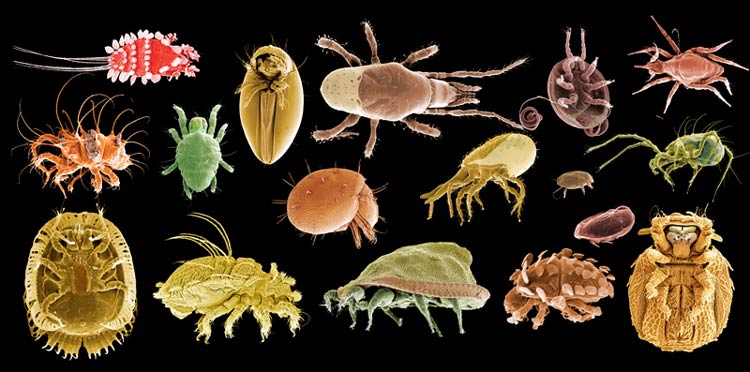
Although experienced APHIS inspectors are unlikely to ask this question, often, identification of the Subclass Acari
Factsheet for:Acari
Glossary:Opilioacariformes:
an obsolescent supraordinal term used for the Opilioacarida.
or Acarina (Class Arachnida) is not always easy. Mites are so small, morphologically diverse, and often bizarrely modified, that even specialists can occasionally make an incorrect first diagnosis. There is even a case in the literature of a mite having been misdescribed as a new species of spider. The Is it a Mite key and fact sheets in this tool are provided in the hopes that if a suspicious-looking tiny arthropod is encountered in an inspection, it can quickly be determined if it is a mite. A second, objective of these resources is to begin introducing and explaining the terminology that will be used in other keys under development. Morphological terms are illustrated in the key's feature-state images and in the tool's Glossary. Ideally, when new inspection officers are trained, this key and its successors can be their introduction to the world of mites.
Is it a Mite fact sheets and key separate mites (subclass Acari
Factsheet for:Acari
Glossary:Opilioacariformes:
an obsolescent supraordinal term used for the Opilioacarida.
) from other arachnids and small invertebrates.
Based on personal experience, confusion is most likely with those tiny hexapods and arachnids that overlap mites in size (mostly those with bodybody:
the idiosoma of mites.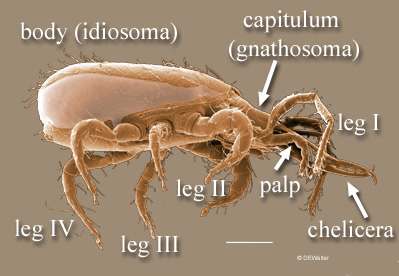 lengths of less than a few millimeters), especially when obvious characters such as wings, antennae, and primary segmentationsegmentation:
in mites distinct external segments have been lost but remnants of segmentation may be represented by hysterosomal folds or transverse arrays of setae and other cuticular sense organs. In theory, all chelicerates have a prosoma composed of 6 segments (cheliceral, pedipalpal, and four leg-bearing segments = body segments I-VI). Ventrally the positions of the prosomal segments can be identified by the insertions of their appendages, but dorsally they are obscured. The opisthosoma is thought to comprise an additional 12-13 segments (body segments VII-XVIII or XIX), but appears to be somewhat to much reduced in most mites, except possibly Opilioacarida. In early derivative Acariformes (e.g., many Endeostigmata), hysterosomal folds are thought to represent segmentation and in the Grandjean system are designated (from the sejugal furrow to the anus): C, D, E, F, H, PS AD, AN, PA. There is disagreement in the literature over the origin of 'segments' C and D. Adherents of Grandjean consider them to be opisthosomatic (with C probably representing a fusion of the pregenital [body segment VII] and genital [VIII] segments). Others believe that C and D are the dorsal regions of the last two prosomal segments that bear leggs III and IV (i.e., body segments V & VI).
are obscure or absent. Even usually large arachnids like scorpions and whipscorpions, however, may have small stages that could be confused with mites and often harbor mites.
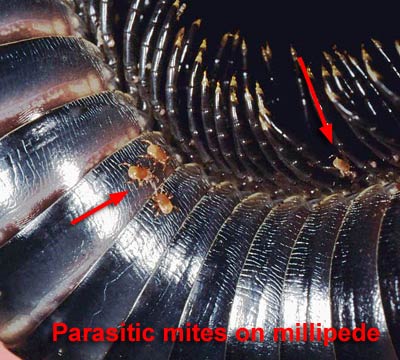
Although the primary purpose of Is it a Mite is to separate mites from other arthropods, it will also identify most other arachnids to order and distinguish several groups of mandibulate 'microarthropods.' Although few of these groups have species of high quarantine importance, many are common and likely to be intercepted, especially if the shipment contains soil, vegetation or forest products. Some of these groups are rare and contain species of potential conservation concern, and some (e.g., scorpions, spiders, centipedes, millipedes, insects) have large species popular in the pet trade. It is important to note that many of these larger arthropods have their own mite fauna that may be of quarantine concern.
Author: David E. Walter
Content last updated Sept. 2006, unless indicated otherwise
Lucid key player updated Sept. 2025
idtools.org