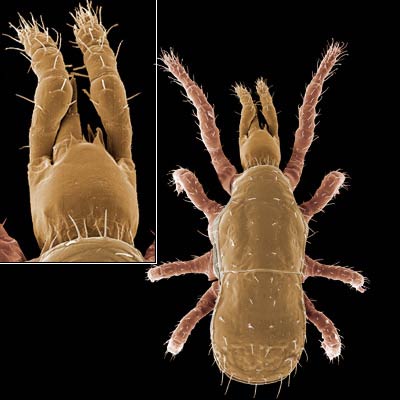
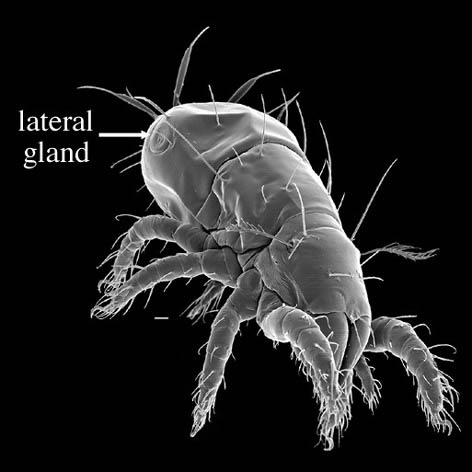
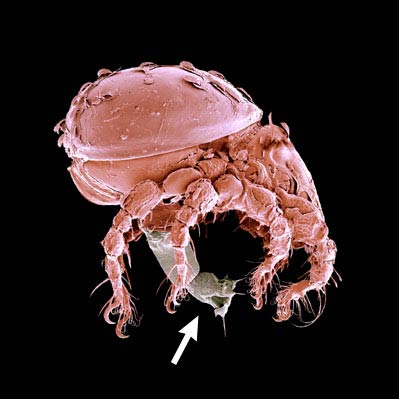
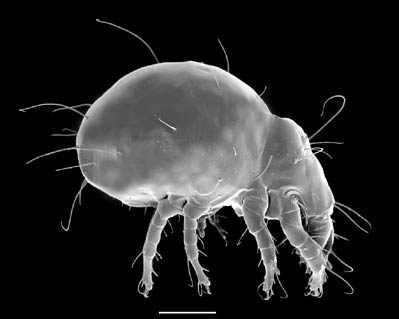
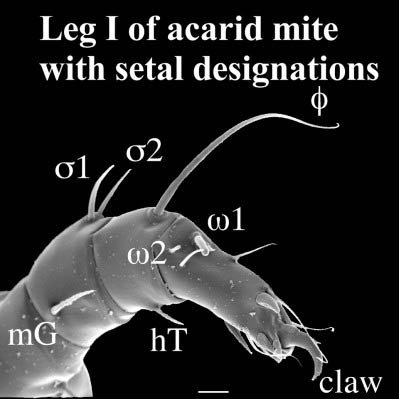
Almost any kind of mite could be found in a quarantine intercept, but only some groups contain species of particular interest. The major groups of mites of quarantine concern are listed below.
If you already know which of these groups your mite belongs to, you can choose that group and eliminate the rest. If you then use the 'Prune Redundants' button, Lucid will remove those features that are no longer relevant to identifying the specimen.
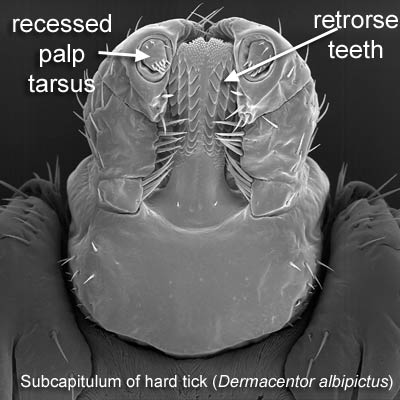
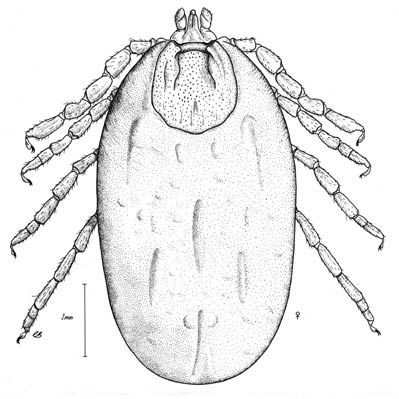
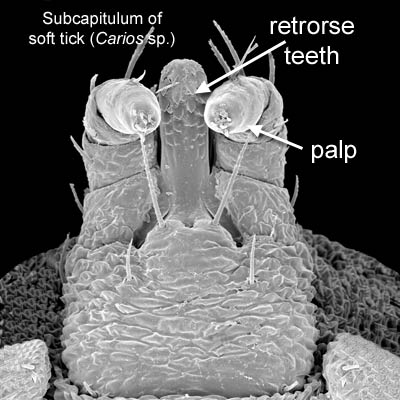
Ticks are easily distinguished from other mites by their
distinctive subcapitulumsubcapitulum:
(also infracapitulum) the venter of the capitulum; the ventral faces of the fused palpcoxae; apparently formed independently in the two superorders of mites.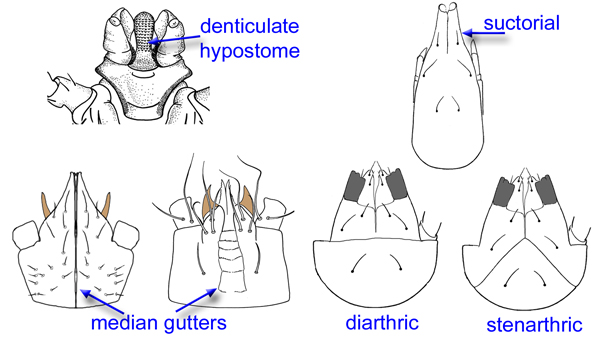 which is covered by
retrorse teeth that ticks use to
anchor their mouthparts in the skin when feeding. The capitulumgnathosoma:
which is covered by
retrorse teeth that ticks use to
anchor their mouthparts in the skin when feeding. The capitulumgnathosoma:
(= capitulum) the anteriormost part of a mite or ricinuleid, composed of the cheliceral and pedipalpal segments and separated from the body (idiosoma) by a ring of soft cuticle.
is
visible from above in hard ticks, but
usually more or less covered by the bodybody:
the idiosoma of mites.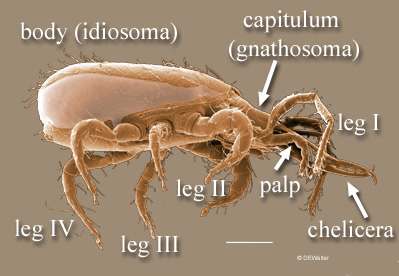 is
soft ticks. The distal palppalp:
is
soft ticks. The distal palppalp:
(= pedipalp) the second pair of limbs in arachnids, used in feeding and originating on either side of the chelicerae. In mites, the palps may be vestigial, with only a few segments, or have a maximum of 5 freely articulating segments (rarely the femur is subdivided) and a distal or subdistal apotele.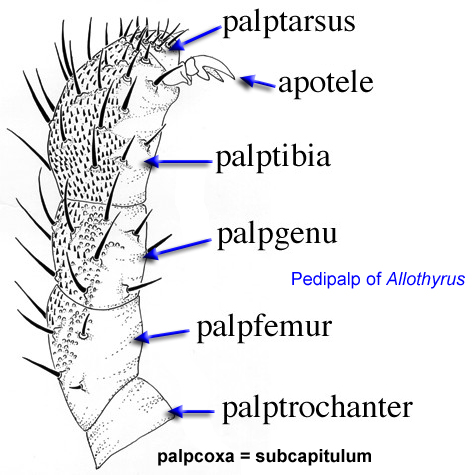 segment is usually well developed in soft
ticks (Argasidae), but reduced and
recessed in most hard ticks (Ixodidae).
The subcapitilum is anarthric (without a labiogenial suturesuture:
segment is usually well developed in soft
ticks (Argasidae), but reduced and
recessed in most hard ticks (Ixodidae).
The subcapitilum is anarthric (without a labiogenial suturesuture:
an inflexible juncture between two body parts; line of fusion between two formerly separate body parts or regions. This term is often misused for flexible articulations.
) and often has more
than 4 pairs of setae. The chelicerae
are highly modified for cutting skin and appear 2-segmented.
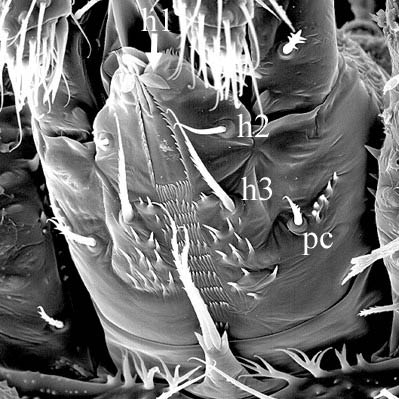
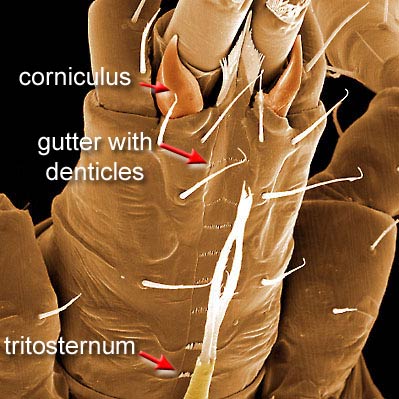
Mesostigmatans could be confused with ticks since they have a
tick-like capitulum completely encircled by
a band of cuticle (the basis capitulumgnathosoma:
(= capitulum) the anteriormost part of a mite or ricinuleid, composed of the cheliceral and pedipalpal segments and separated from the body (idiosoma) by a ring of soft cuticle.
), but they lack the retrorse teethretrorse teeth:
(also hypostomal denticles or teeth) the backwardly directed tooth-like projections on the elongate hypostome of ticks that are used to anchor the capitulum to skin while feeding.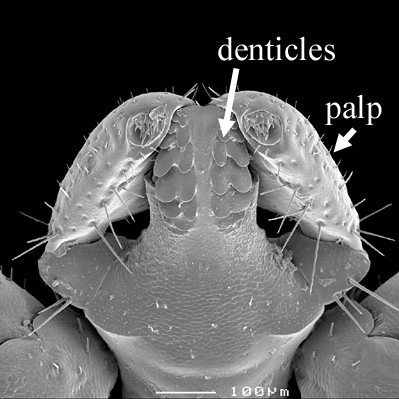 on the
subcapitulum, and usually have a median gutter
with rows of denticlesdenticles:
on the
subcapitulum, and usually have a median gutter
with rows of denticlesdenticles:
small tooth-like processes, e.g., on the subcapitula of ticks and many mesostigmatans.
, a tritosternum,
and a pair of corniculi.
Additionally, the lateral stigmatal opening is usually associated with a
microtuberculate groove called the peritremeperitreme:
a groove or gutter on the surface connecting to a stigmatal opening. In Mesostigmata the peritremes are lateral and run above the coxae of the legs and usually run to near the anterior margin of the idiosoma, but they may be very short or vestigial. In Prostigmata peritremes are usually found on the anterior margin of the idiosoma, as short processes to either side of the capitulum (emergent peritremes), or as simple to complex lines or reticulations of short, connected chambers on the dorsal surface of the chelicerae or stylophore.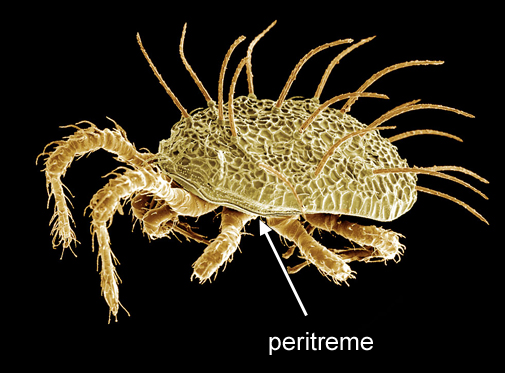 . Each of these particular
structures is unique to the Mesostigmata.
. Each of these particular
structures is unique to the Mesostigmata.
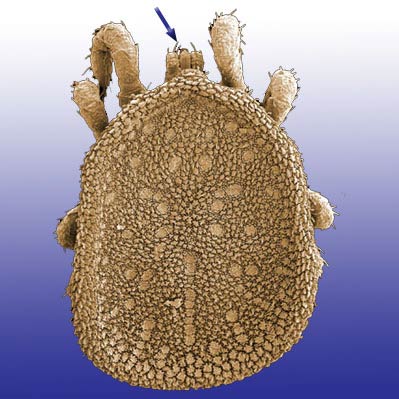
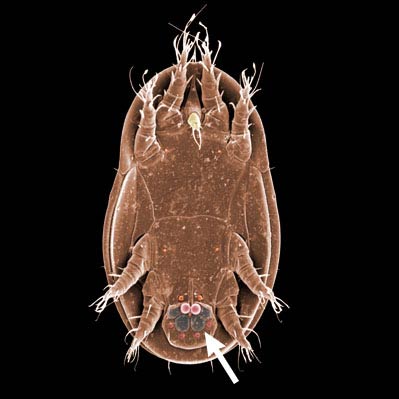
Most mites of the suborder Endeostigmata are inconspicuous dwellers of forest litter, topsoil, deep soil, and mosses, with no quarantine importance. However, one lineage—the superfamily Eriophyoidea (four-legged mites)—is of major economic significance as plant pests and pathogen vectors. Among all mites, they are unique in having only two pairs of legs in all life stages.
The suborder Oribatida includes the traditional oribatid
mites and the well known hyporder (and former suborder) Astigmata. In this
more general sense, the Oribatida includes all of the members of the order
Sarcoptiformes that are likely to be of
quarantine concern, leaving out only the early derivative lineages of the
suborder Endeostigmata. Characterizing such a large assemblage of mites is
difficult, but their capitulumgnathosoma:
(= capitulum) the anteriormost part of a mite or ricinuleid, composed of the cheliceral and pedipalpal segments and separated from the body (idiosoma) by a ring of soft cuticle.
is easily distinguished from that of the
Mesostigmata and Ixodida by the lack of the basis capitulumgnathosoma:
(= capitulum) the anteriormost part of a mite or ricinuleid, composed of the cheliceral and pedipalpal segments and separated from the body (idiosoma) by a ring of soft cuticle.
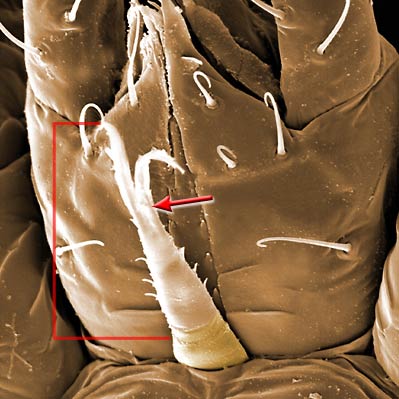
, tritosternumtritosternum:
the sternum of the 3rd body segment (between legs I); produced as a biflagellate structure in Mesostigmata, although sometimes the flagellae (laciniae) are partially or completely fused. 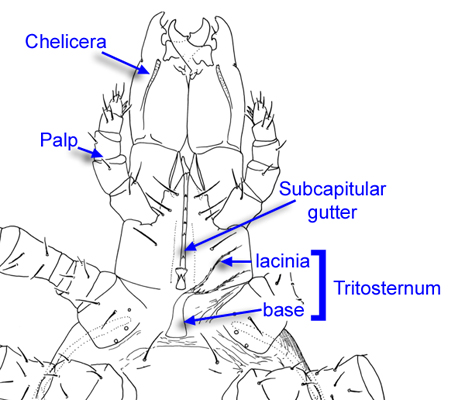 ,
corniculi, median gutter, and retrorse teethretrorse teeth:
,
corniculi, median gutter, and retrorse teethretrorse teeth:
(also hypostomal denticles or teeth) the backwardly directed tooth-like projections on the elongate hypostome of ticks that are used to anchor the capitulum to skin while feeding.. The bases of the chelicerae
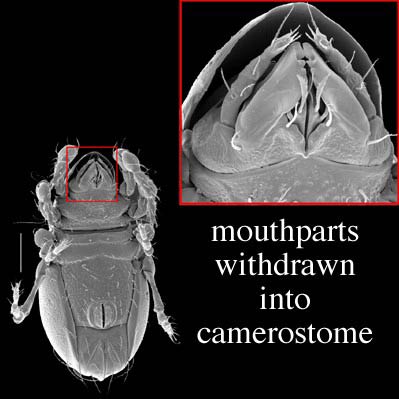
are always exposed, but in many oribatid mites the capitulumgnathosoma:
(= capitulum) the anteriormost part of a mite or ricinuleid, composed of the cheliceral and pedipalpal segments and separated from the body (idiosoma) by a ring of soft cuticle.
is folded away in a
camerostome. Oribatidsoribatidmites:
are a member of the sarcoptiform suborder Oribatida (=Cryptostigmata, Oribatei); some academics consider the use of 'oribatid' as a noun to be low class, but others consider that attitude pedantic.
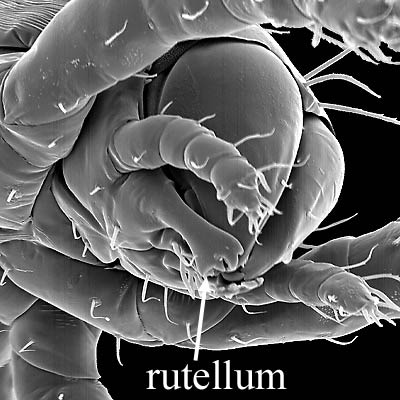
also
usually have well developed rutella and,
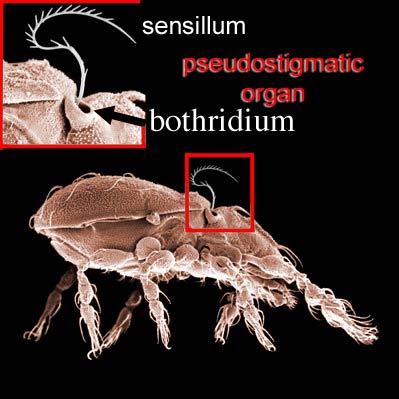
except in the Astigmata, one pair of prodorsal
trichobothria in adults. Most
traditional oribatidsoribatidmites:
are a member of the sarcoptiform suborder Oribatida (=Cryptostigmata, Oribatei); some academics consider the use of 'oribatid' as a noun to be low class, but others consider that attitude pedantic.
and Astigmata also have a pair of
opisthosomal glands, and most
traditional oribatidsoribatidmites:
are a member of the sarcoptiform suborder Oribatida (=Cryptostigmata, Oribatei); some academics consider the use of 'oribatid' as a noun to be low class, but others consider that attitude pedantic.
have a well developed
ovipositor.
The former suborder Astigmata (Astigmatina, Acaridida) has been reduced
to a hyporder in the suborder Oribatida in the current classification in recognition
of their close relationship to traditional oribatid mites. Most
Astigmata resemble the immature stages of
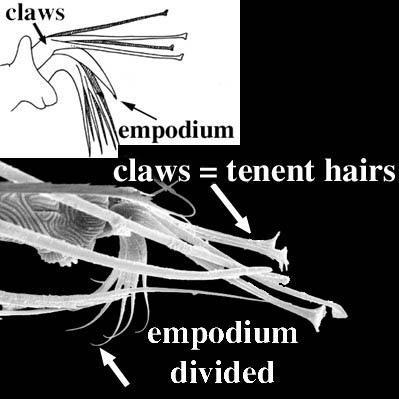
oribatid mites in having monodactyl claws,
but lack prodorsal trichobothriatrichobothrium:
(pl. trichobothria) (= bothridial sensillum) an often elaborately modified seta set in a cup-like base; forms include filiform, ciliate, pectinate or variously thickened or clubbed (bat-like to globose or capitate).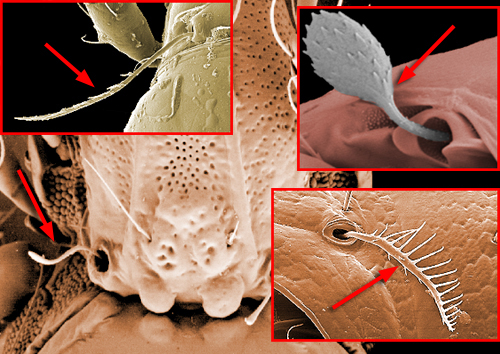 and have only 2-segmented palps. However, unlike traditional Oribatida, which rely on spermatophoric insemination, astigmatidastigmatid:
incorrectly formed, but commonly used, adjectival form of Astigmata; an astigmatan.
males achieve direct insemination using an aedeagus, while females possess a copulatory porepore:
a pore-like opening or structure in the cuticle. In Mesostigmata, lyrifissures and true pore openings are often difficult to separate and both tend to be called 'pores', e.g., the sternal pores stp1-3.
on the posteriorposterior:
the back part of the body or towards that region in comparison, e.g., 'posterior to'.
body. The
Astigmata heteromorphicheteromorphic:
having different morphological forms; referring either to different forms within a particular life stage (e.g., normal and heteromorphic deutonymphs in some Mesostigmata; protogynes vs. deutogynes in Eriophyoidea; heteromorphic vs. homeomorphic males in the Astigmata) or to a developmental stage that differs radically from other stages (e.g., the heteromorphic deutonymph or hypopus in the Astigmata).
stages: deutonymphs (hypopi) of many Astigmata are distinctive dispersal stages. These can always be
distinguished from other mites by their regressive capitulumgnathosoma:
(= capitulum) the anteriormost part of a mite or ricinuleid, composed of the cheliceral and pedipalpal segments and separated from the body (idiosoma) by a ring of soft cuticle.
and usually by
possessing a ventralventral:
relating to the lower or under side; opposed to dorsal.
attachment organ sucker plate.
Because the many important acarine pests of plants belong
to the Prostigmata, many of the mites encountered in quarantine will belong to
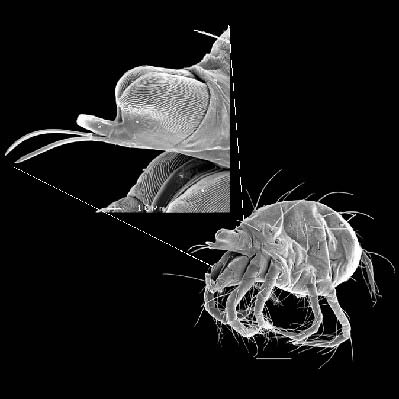
this very large suborder. Spider mites and their relatives
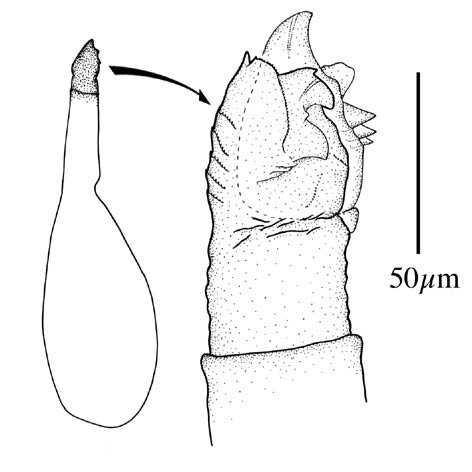
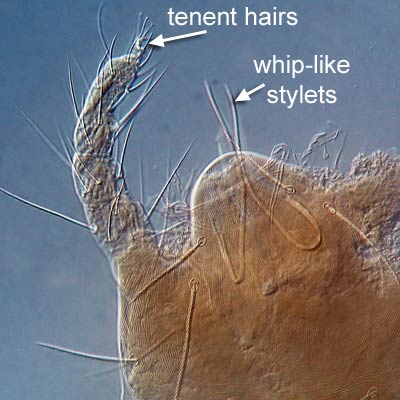
(Tetranychoidea) are easily identified because they have highly modified
chelicerae that are produced into
whip-like structures that may be
withdrawn into the bodybody:
the idiosoma of mites.. Most prostigmatans have anterior stigmatal
openings, but these are often very difficult to see. They sometimes have
tenent hairs on their feet, are often
soft-bodied, and are sometimes highly colorful. They never have
tritosterna, rutellarutellum:
(pl. rutella) In Sarcoptiformes, the hypertrophied setae on the hypostome, often toothed; not to be confused with a corniculus (although possibly a homologue). In Astigmata, the rutellum may be referred to as a pseudorutellum, although it is the same structure. Various forms of rutella are recognized, including the atelebasic and pantelebasic.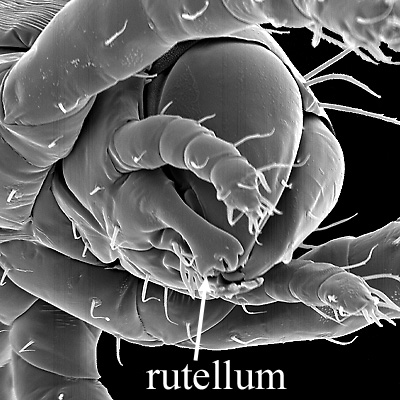 or corniculicorniculus:
(pl. corniculi) (also, external malae) a usually horn-like process (sometimes toothed, bifurcate, trifurcate, spine-like, spatulate, or membranous) on the subcapitulum of parasitiform mites that usually supports the salivary styli. A toothed corniculus could be confused with a rutellum, a possibly homologous structure in Acariformes and Opilioacarida. Phytoseiid image is spatulate corniculus.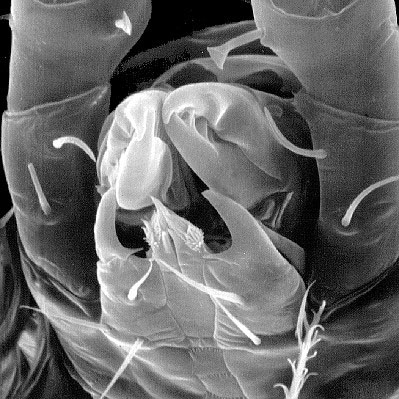 , but some have trichobothriatrichobothrium:
(pl. trichobothria) (= bothridial sensillum) an often elaborately modified seta set in a cup-like base; forms include filiform, ciliate, pectinate or variously thickened or clubbed (bat-like to globose or capitate). and genital
papillae.
Author: David E. Walter
Content last updated Sept. 2006, unless indicated otherwise
Lucid key player updated Sept. 2025
idtools.org