Content updated 2025.
Because mites are small and ubiquitous, almost any mite species could be found in a quarantine intercept. However, only certain mite groups are of particular quarantine concern. These are reviewed below.
Major acarine crops pests are restricted to the order Trombidiformes, suborder Prostigmata and the order Sarcoptiformes, suborder Endeostigmata.
The infraorder Eupodina contains crop pests in the Penthaleidae (red-legged earth mites, oat and pea mites). Some species of the family Tydeidae (e.g., Lorryia formosa) may occasionally feed on leaf cell contents, but there is no proof that any are economic pests and most appear to be neutral to highly beneficial fungivores, omnivores, and predators.
The infraorder EleutherengonaEleutherengona:
(also Eleutherengonida, Eleutherengonina, Eleutherengonides) an infraorderwithin the Prostigmata consisting of the two hyporders Raphignathina and Heterostigmata. Eleutherengona includes many of the most important plant-parasitic mites, e.g., spider mites, broad mite, cyclamen mite.
contains major crop pests in the Tetranychoidea (spider mites, false spider mites, peacock mites), and to a lesser extent, TarsonemoideaTarsonemoidea:
(also Tarsonemina) a superfamily within Prostigmata > infraorder Eleutherengona > hyporder Heterostigmata consisting of two families: Tarsonemidae and Podapolipidae.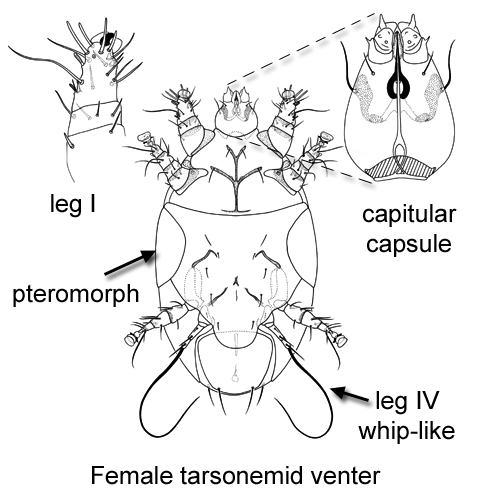 (broad mitebroad mite:
(also tea mite) Polyphagotarsonemus latus (Banks) a plant-parasitic tarsonemid mite.
, cyclamen mite, fern mites); some tarsonemids and members of the Pygmephoroidea are pests in mushroom culture.
The order Sarcoptiformes, suborder Endeostigmata contains major crop pests and pathogen vectors in the Eriophyoidea (gall, erinose, big-bud and rust mitesrust mite:
leaf vagrant forms of the Eriophyoidea whose feeding causes a russet coloration on leaves.
). Other sarcoptiform lineages contain a few minor pests of crops. Some oribatid mites in the infraorders Mixonomata and Desmonomata occasionally damage roots (including those of hydroponic vegetables) or leaves (mostly in association with damage by leaf fungi), as is also true of some members of the hyporder Astigmata (e.g., Tyrophagus spp.). Rhizoglyphus spp. (hyporder Astigmata) are pests of roots and underground storage organs of plants, including bulbs, corms, and rhizomes.
Biological control agents are broadly distributed across the Acari
Factsheet for:Acari
Glossary:Opilioacariformes:
an obsolescent supraordinal term used for the Opilioacarida.
. Important biocontrol agents in the Order Mesostigmata all belong to the Suborder Monogynaspida and include useful predators in the families Phytoseiidae, Laelapidae, Parasitidae, Uropodidae and Ascidae. Despite their benefits, the import of these mites is regulated in many countries to prevent the introduction of foreign species that could outcompete local wild species, potentially disrupting natural ecosystems. Sometimes these and related mites are also a concern as phoretics on insects imported for biological control or in laboratory cultures.
In the order Trombidiformes, suborder Prostigmata, plant-inhabiting predators in the infraorder Eupodina include the Bdelloidea (snout mites), Tydeidae (tydeid mites are also important biocontrol agents of leaf fungi and mildews), and Iollinidae. The infraorder Anystina includes the predatory Anystidae (whirligig mites) and predatory and insect-parasitic members of the hyporder Parasitengona (red velvet mites, water mites), which can be used to control mosquitos. The infraorder EleutherengonaEleutherengona:
(also Eleutherengonida, Eleutherengonina, Eleutherengonides) an infraorderwithin the Prostigmata consisting of the two hyporders Raphignathina and Heterostigmata. Eleutherengona includes many of the most important plant-parasitic mites, e.g., spider mites, broad mite, cyclamen mite.
includes numerous predators in the hyporder Raphignathina (e.g., Stigmaeidae, Eupalopsellidae, Camerobiidae, Caligonellidae, and Cheyleitidae) and some potentially useful insect parasites (or parasitoids) in the hyporder Heterostigmata (e.g., Podapolipidae, Pyemotidae, Acarophenacidae, Tarsonemidae).
In the order Sarcoptiformes, some oribatid mites (Hyporder Brachypylina) are associated with biocontrol of aquatic weeds (e.g., Orthogalumna spp.) or disruption of adelgid colonies. Some important predators of scale insects that are in the hyporder Astigmata (e.g., Hemisarcoptes) can occur on insects, but they are not biological control agents. Astigmatid mites (Thyreophagus, Tyrophagus, Carpoglyphus, and others) are important as factitious prey for mass-produced predatory mites and can be inadvertently released into the environment when these predatory mites are deployed for biocontrol purposes.
Vertebrate parasitism has arisen in many groups of mites. All ticks (order Ixodida) are obligate blood-feeding parasites of vertebrates and include the most important arthropod vectors of disease, second only to mosquitos. Any ticktick:
any member of the parasitiform suborder Ixodida.
intercepted in quarantine is of concern, irrespective of its distribution, because of the chance of it containing new kinds or strains of pathogenic organisms.
In the order Mesostigmata, most parasites are found in the suborder Monogynaspida, but a few reptile mites occur in the suborder Trigynaspida. Two families of Monogynaspida (Ascidae, Ameroseiidae) also have flower mites that use vertebrates to move from plant to plant, and may compete with their hosts for nectar and pollen, but are otherwise non-pathogenic.
Parasitic members of the order Sarcoptiformes are almost entirely restricted to the hyporder Astigmata (scab and mange mites, fur and feather mites, and pyroglyphid dust mites). Most pyroglyphid dust mites are secondary free-living, having evolved from parasitic ancestors and are medically important because they cause allergies in humans. However, some oribatid mites in the hyporder Brachypylina are of medical-veterinary concern as vectors of acanthocephalan cestodes; aquatic oribatid mites are sometimes found embedded in fish, probably in association with fungal infections.
Parasitic mites in the order Trombidiformes are restricted to the suborder Prostigmata, and primarily to the infraorder EleutherengonaEleutherengona:
(also Eleutherengonida, Eleutherengonina, Eleutherengonides) an infraorderwithin the Prostigmata consisting of the two hyporders Raphignathina and Heterostigmata. Eleutherengona includes many of the most important plant-parasitic mites, e.g., spider mites, broad mite, cyclamen mite.
(Cheyletoidea, Pterygosomatidae). However, chiggers (infraorder Anystina) are important vectors of rickettsial diseases (e.g., scrub typhus) and some members of the infraorder Eupodina are nasal parasites of some vertebrates (Ereynetidae).
Parasites, inquilinesinquiline:
an animal that lives habitually in the living space of another species; e.g., an insect that lays its eggs in a gall produced by another insect.
, and phoretic associates of bees have arisen in several groups of mites. The most important acarine parasites of bees are members of the order Mesostigmata, suborder Monogynaspida (e.g., Varroa). Many apparently neutral or mutualistic phoretic associations also occur in the Monogynaspides.
In the order Sarcoptiformes, the hyporder Astigmata contains a great variety of bee associates, including Chaetodactylus spp, which are kleptoparasites of many solitary bees that are becoming more important in pollination. While adult mites inhabit the bee nest, often competing with or killing the developing bee larvae, their phoretic stages (hypopi) typically disperse by attaching to adult bees.
In the order Trombidiformes, suborder Prostigmata important bee parasites occur in the infraorder EleutherengonaEleutherengona:
(also Eleutherengonida, Eleutherengonina, Eleutherengonides) an infraorderwithin the Prostigmata consisting of the two hyporders Raphignathina and Heterostigmata. Eleutherengona includes many of the most important plant-parasitic mites, e.g., spider mites, broad mite, cyclamen mite.
(hyporder Heterostigmata), including the tracheal mites associated with Isle of Wight Disease. Some predatory Cheyletidae associated with carpenter bees provide bodyguard services, protecting the bees against other parasitic and kleptoparasitic mites in the nest. A variety of other prostigmatans are sometimes found on bees (e.g., chiggers, tydeid mites), but these appear to be primarily phoretic or accidental associations.
For a comprehensive review of bee mites, be sure to visit ITP's Bee Mite ID tool!
Stored products contain a great diversity of mites, many of which are pests. This is especially true of the hyporder Astigmata, many species of which are associated with direct damage to stored products, spread of fungal contamination, and allergic reactions in people.
Among the numerous other groups of mites associated with stored products, only the infraorder EleutherengonaEleutherengona:
(also Eleutherengonida, Eleutherengonina, Eleutherengonides) an infraorderwithin the Prostigmata consisting of the two hyporders Raphignathina and Heterostigmata. Eleutherengona includes many of the most important plant-parasitic mites, e.g., spider mites, broad mite, cyclamen mite.
(mostly fungivores or insect parasites in the hyporder Heterostigmata) approaches the importance of the Astigmata. Other stored product mites are mostly predators (order Mesostigmata, suborder Monogynaspida), rarely biting people, (DermanyssinaDermanyssina:
an alternative name for the hyporder Dermanyssiae, a lineage of Mesostigmata.
, Raphignathina, and Heterostigmata), or minor fungivores (some Mesostigmata, e.g., Ameroseiidae and many members of the suborder Oribatida).
Author: David E. Walter
Content last updated Sept. 2006, unless indicated otherwise
Lucid key player updated Sept. 2025
idtools.org