Nine Lucid keys are provided for identification of your unknown mite or mite look-a-like. These keys cover eight groups of mites, as well as a key to discriminate between mites and tiny hexapods and arachnids that overlap mites in size (Is it a mite). Taxa in the keys are loosely ordered by classification.
Lucid identification keys are flexible and multi-tiered. They simplify and expedite identification, allowing you to select diagnostic characters (or “features”) and generate a list of taxa (or “entities”) that possess those features. Consult 'Help' from the Lucid interactive key menu at any time by clicking on the question mark button on the key’s menu bar. For more about using Lucid keys, see ITP’s Lucid Best Practices page.
Select the characters (or "features") that are most obvious or the easiest for you to interpret. Although characters are listed in a certain manner, you may choose characters in the order you wish. It’s OK to skip the character if your specimen does not show a character or you do not understand a character or its states. The glossary may help you interpret characters. Lucid allows you to choose multiple states of a character.
After you have selected several character states and you have a shorter list of taxa; you can use the Lucid’s “Best” tool to assess which of the remaining characters and states will assist you in identification. This will help you determine the most efficient next step. You will need to have the Features Available window selected and all features expanded in order to use the "Best" tool.
After choosing characters, some taxa will remain in the “Entities Remaining” section. Open their fact sheets and confirm that your specimen matches or is very similar to the description.
Under the navigation menu “Mites” are introductory pages to mite groups, morphology, and classification. Reviewing these pages as well as browsing the glossary, gallery, and fact sheets are a good start to learning more about mites.
The goals of these keys are (1) to allow a USDA quarantine officer to quickly sort a plant-parasitic mite intercept into its proper family for further identification and (2) to teach acarine morphology and taxonomy through use of the key. Additionally, a separate Glossary with about 150 morphological terms may be accessed from the navigation menu.
This key allows identification of the acarine orders Opilioacarida, Holothyrida, and Ixodida. Additionally keyed are: all 3 suborders of Mesostigmata (Sejida, Trigynaspida, Monogynaspida); the sarcoptiform suborder Endeostigmata; 4 supercohorts, 3 cohorts, and one specialized dispersal stagestage:
a distinct developmental form, e.g., the egg, larval, nymphal and adult stages. Since mite instars are usually morphologically distinct, they are also stages (and see stase). Some authors, however, insist that instar should be apolysis to apolysis and stage ecdysis to ecdysis. Since apolysis can be a discontinuous process and, in any case, is difficult to determine, in practice the difference between a stage and an instar is abstract and of importance only if you have a contentious referee.
(the astigmatanastigmatan:
a member of the Astigmata; characteristic of or belonging to the Astigmata.
hypopus) of Oribatida (including the brachypylinebrachypyline:
having separate genital and anal plates surrounded by a large ventral plate (composed of aggenital and adanal elements); usage usually restricted to traditional oribatid mites (see macropyline).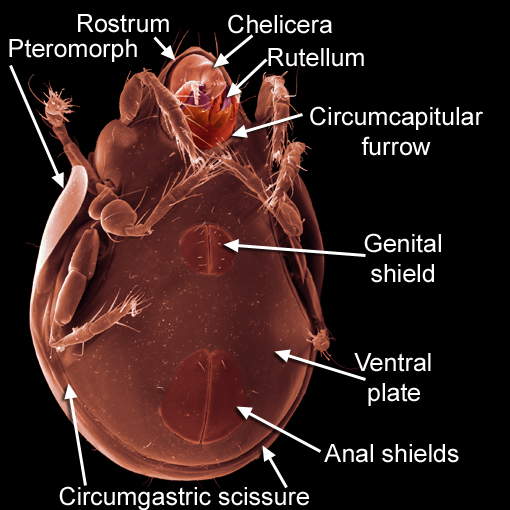 oribatid mites and the former suborder Astigmata); the trombidiform suborder Sphaerolichida; and 3 supercohorts and 2 cohorts of Prostigmata.
One of the unfortunate truths about mite taxonomy is that there is a plethora of synonyms, alternative definitions, and ranks for many higher-level taxa, not to mention unusual ranks, such as 'supercohort' and 'cohort.' This key will use those names and ranks recognized in the revision of the Manual of Acarology (GW Krantz & DE Walter, eds.), in preparation at the time of the writing of version 1 of this tool.
This key allows separation of the plant-parasitic mite families of most interest to quarantine.
This is a key to the genera of primitive acariform mite groups Endeostigmata and Sphaerolichida written and compiled by Dr. David Evans Walter of Colorado State University and the University of Alberta (dew@ualberta.ca) with the assistance of Dr. Heather Proctor of the University of Alberta.
Endeostigmatans are common in many habitats, but seem to reach their highest abundances in extreme habitats such as deserts, beaches, and polar regions. As far as is known, these mites are fungivores, algivores and predators on small invertebrates such as nematodes, tardigrades, and mites. None are considered economically important pests. They are most likely to be intercepted in goods containing soil, especially dry soils including sand, lichens, mosses or other materials associated with dry or otherwise extreme habitats, including anthropogenic accumulations of dust.
This is a key to mesostigmatic mites likely to be found in quarantine intercepts compiled by Dr. David Evans Walter of Colorado State University and the University of Alberta (dew@ualberta.ca).
About one-quarter of all mite species belong to the Mesostigmata, including many economically important pests (e.g., varroa mite of bees, fowl mites, rat mites) and even more economically useful biocontrol agents (especially in the families Phytoseiidae, Laelapidae and Macrochelidae). Because of their pervasiveness, mesostigmatans are commonly found in quarantine inspections, but primarily because few are plant parasites, there are few taxonomic specialists to help in their identification. This key is designed to support the identification of members of the largest suborder of Mesostigmata, the Monogynaspida (See the key Major Mite Taxa to identify Mesostigmata to suborder). Monogynaspids are the mesostigmatans most likely to be found in a quarantine intercept and the Monogynaspida contains all of the economically important species.
This is a key to adult females of described species of Phytoseiulus compiled by Dr. David Evans Walter of Colorado State University and the University of Alberta (dew@ualberta.ca).
This is a key to adult females of described species of Stratiolaelaps compiled by Dr. David Evans Walter of Colorado State University and the University of Alberta (dew@ualberta.ca).
This key allows identification of the genera of Bryobiinae of most interest to quarantine.
This key allows identification of the genera of Tetranychinae of most interest to quarantine.
Author: David E. Walter
Content last updated Sept. 2006, unless indicated otherwise
Lucid key player updated Sept. 2025
idtools.org