Primitively, the apoteleapotele:
(Greek apotelein = to complete)—the terminus of an appendage; the most distal leg segment, often consisting of an empodium and a pair of claws. The apotele of a leg is usually treated as equivalent to the pretarsus or some part thereof (e.g., the claws and empodium), but the palptarsal apotele in Mesostigmata is a tined structure originating at the base of the palptarsus and thought to be a remnant of the claws. The chelicerae are also an appendage and terminate in the movable digit.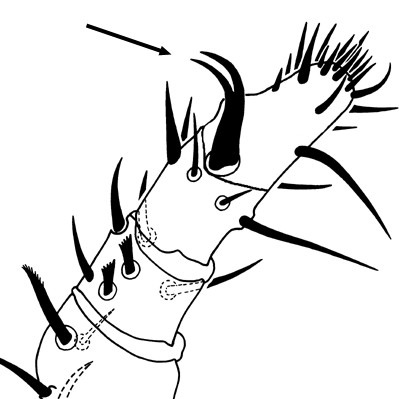 is present as 3 clawclaw:
like - having a distal hook; resembling a claw.
-like structures, but is more commonly a pair of claws and a pad-likepad-like:
in Prostigmata, used to refer to empodia that do not have a distal hook (claw-like); when tenent hairs are present a 'pad-like' empodium may look more like a pincushion; in other Acari, usually a simple, pad-like empodium.
to highly modified empodiumempodium:
(pl. empodia) an unpaired structure arising between the tarsal claws, ranging from pad-like to claw-like and often bearing structures such as tenent hairs, dense setulae, or taking the form of a featherclaw (Eriophyoidea)..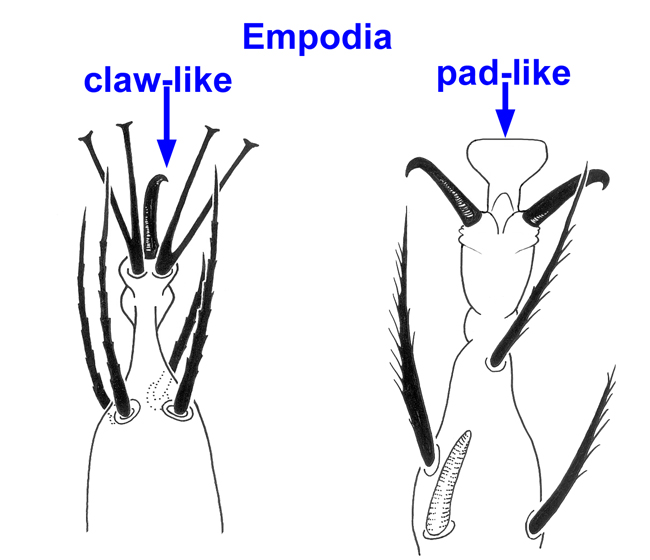 or a single median clawclaw:
like - having a distal hook; resembling a claw.
.me Mesostigmata, Endeostigmata, and Prostigmata the apoteleapotele:
(Greek apotelein = to complete)—the terminus of an appendage; the most distal leg segment, often consisting of an empodium and a pair of claws. The apotele of a leg is usually treated as equivalent to the pretarsus or some part thereof (e.g., the claws and empodium), but the palptarsal apotele in Mesostigmata is a tined structure originating at the base of the palptarsus and thought to be a remnant of the claws. The chelicerae are also an appendage and terminate in the movable digit. on tarsustarsus:
(pl. tarsi) the subdistal leg segment between the tibia and the pretarsus (apotele).
I has been lost.
Most parasitiform mites have a pair of lateral claws and a pad-likepad-like:
in Prostigmata, used to refer to empodia that do not have a distal hook (claw-like); when tenent hairs are present a 'pad-like' empodium may look more like a pincushion; in other Acari, usually a simple, pad-like empodium.
empodium, at least on legs II–IV few Monogynaspida associated with bees the claws are so small and fine as to be effectively absent. In some acariform mites, the lateral claws actually are absent and the empodiumempodium:
(pl. empodia) an unpaired structure arising between the tarsal claws, ranging from pad-like to claw-like and often bearing structures such as tenent hairs, dense setulae, or taking the form of a featherclaw (Eriophyoidea).. is pad-likepad-like:
in Prostigmata, used to refer to empodia that do not have a distal hook (claw-like); when tenent hairs are present a 'pad-like' empodium may look more like a pincushion; in other Acari, usually a simple, pad-like empodium.
.
In Acariformes there is a bewildering, but often taxonomically useful, array of forms of the pretarsustarsal apotele:
(also pretarsus) the most distal segments of legs and palps bearing the claws and empodium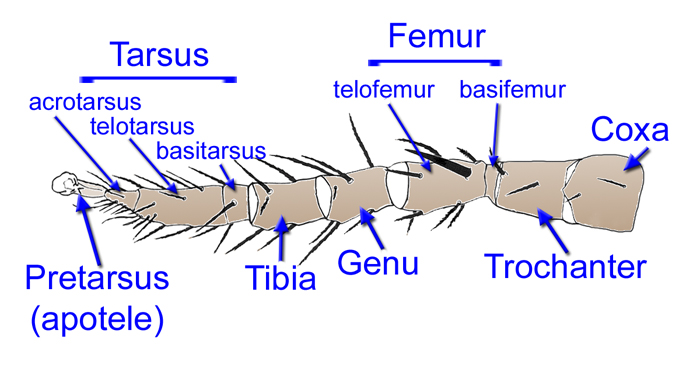 .xample, the tarsal claws of some acariform mites are broadly bipectinatebipectinate:
a seta or other process having comb-like teeth on two sides (see pectinate).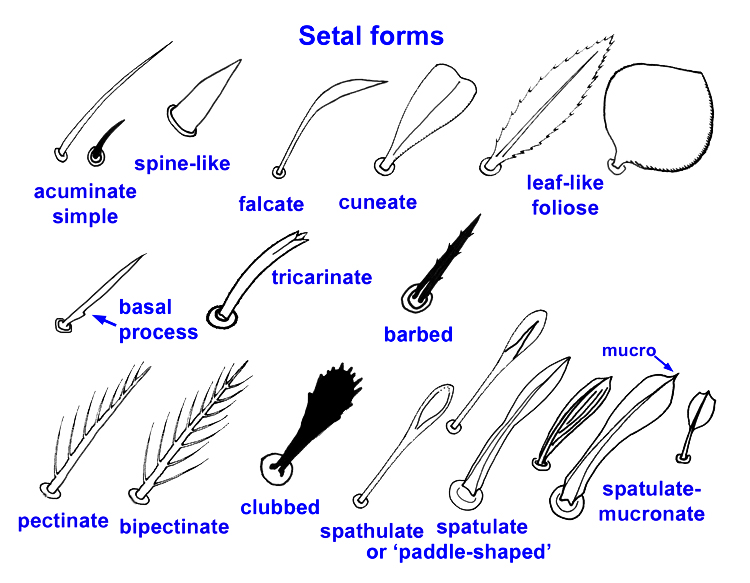 , that is with ,comb-like rows of teeth on either side of the clawclaw:
like - having a distal hook; resembling a claw.
. In soes with tridactyloustridactylous:
having three claws. 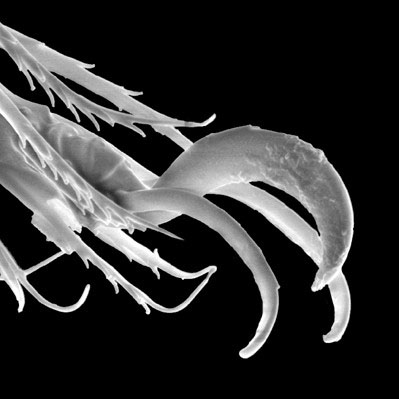 claws, the median clawclaw:
like - having a distal hook; resembling a claw.
(empodial clawclaw:
like - having a distal hook; resembling a claw.
) is much shorter than the lateral claws, a condition herein called heterotridactyl.
In some acariform mites, the tarsal apoteles are produced at the end of a cylindrical stalk.hers, the empodiumempodium:
(pl. empodia) an unpaired structure arising between the tarsal claws, ranging from pad-like to claw-like and often bearing structures such as tenent hairs, dense setulae, or taking the form of a featherclaw (Eriophyoidea).. or and / or h claws may bear tenent hairs, i.e., seta-like processes that have flattened tips and resemble small nails.can be present in place of lateral claws, arising from lateral claws, or on the empodiumempodium:
(pl. empodia) an unpaired structure arising between the tarsal claws, ranging from pad-like to claw-like and often bearing structures such as tenent hairs, dense setulae, or taking the form of a featherclaw (Eriophyoidea)... arboreal oribatid mites have tenent hairs on the distal tarsustarsus:
(pl. tarsi) the subdistal leg segment between the tibia and the pretarsus (apotele).
, rather than on the tarsal apoteletarsal apotele:
(also pretarsus) the most distal segments of legs and palps bearing the claws and empodium.
Author: David E. Walter
Content last updated Sept. 2006, unless indicated otherwise
Lucid key player updated Sept. 2025
idtools.org