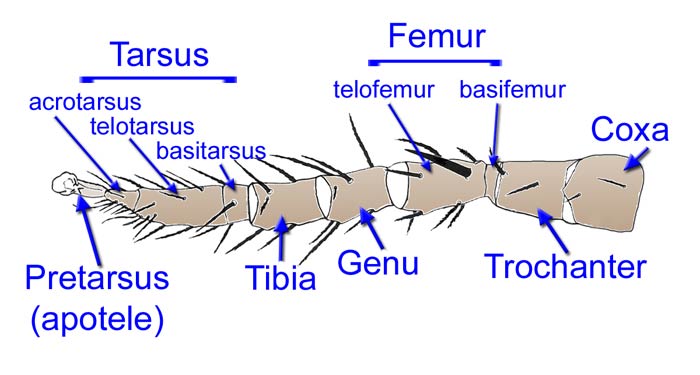
In mites there are 7 basic leg segments, from the tip to the
base: apoteleapotele:
(Greek apotelein = to complete)—the terminus of an appendage; the most distal leg segment, often consisting of an empodium and a pair of claws. The apotele of a leg is usually treated as equivalent to the pretarsus or some part thereof (e.g., the claws and empodium), but the palptarsal apotele in Mesostigmata is a tined structure originating at the base of the palptarsus and thought to be a remnant of the claws. The chelicerae are also an appendage and terminate in the movable digit.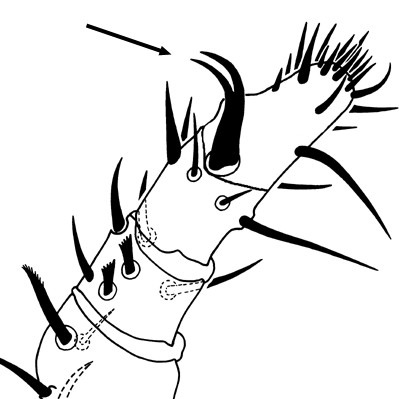 , tarsustarsus:
(pl. tarsi) the subdistal leg segment between the tibia and the pretarsus (apotele).
, tibiatibia:
(pl. tibiae) the leg segment between the genu and the tarsus.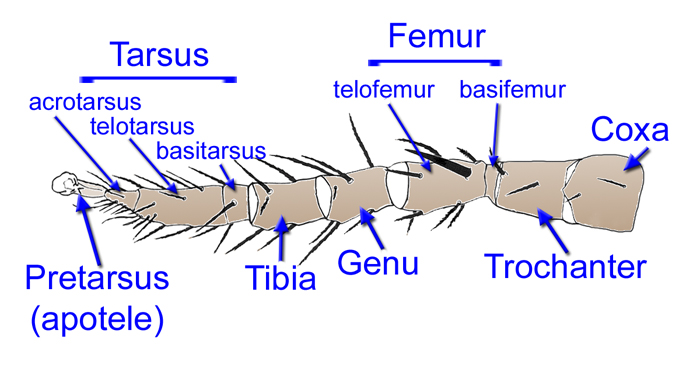 , genugenu:
(pl. genua) (= patella) the 4th leg segment, between the femur and tibia.
, femurfemur:
(pl. femora) major leg segment between trochanter and genu; often subdivided into a basifemur and a telofemur., trochantertrochanter:
the leg segment between the coxa and the femur., and coxacoxa:
the basal segment of the leg, articulating with (Parasitiformes) or fused to (Acariformes) the body wall.. Some of
these basic segments, however, may be subdivided. For example, the femorafemur:
(pl. femora) major leg segment between trochanter and genu; often subdivided into a basifemur and a telofemur.
of legs IV are often divided into two subsegments, the basifemurbasifemur:
a basal subdivision of the femur of the leg or palp.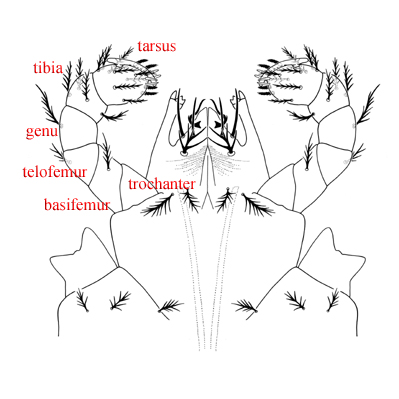 and the
telofemur.
and the
telofemur.
Author: David E. Walter
Content last updated Sept. 2006, unless indicated otherwise
Lucid key player updated Sept. 2025
idtools.org