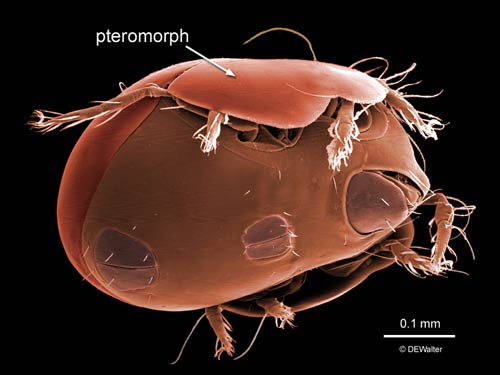
Many Brachypylina have well developed pteromorphs; ventrally curving projections of the lateral bodybody:
the idiosoma of mites.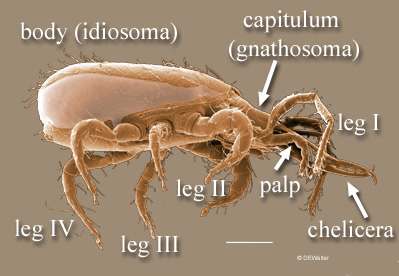 wall that protect the legs. These may be fixed or jointed and flexible. Some tarsonemidtarsonemid:
a mite belonging to the family Tarsonemidae including many economically important species (e.g., species of Acarapis, Tarsonemus, Polyphagotarsonemus, Phytonemus).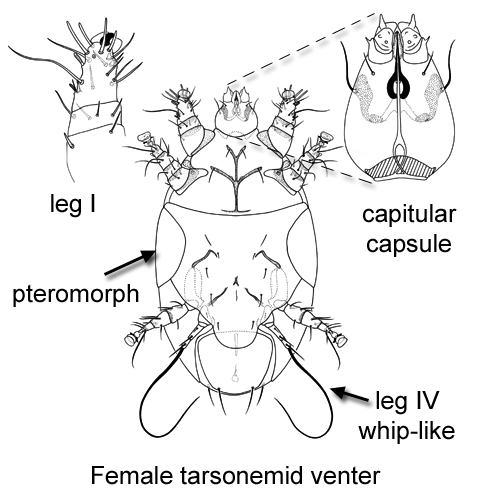 mites (Prostigmata: EleutherengonaEleutherengona:
(also Eleutherengonida, Eleutherengonina, Eleutherengonides) an infraorderwithin the Prostigmata consisting of the two hyporders Raphignathina and Heterostigmata. Eleutherengona includes many of the most important plant-parasitic mites, e.g., spider mites, broad mite, cyclamen mite.
) also have fixed pteromorphpteromorph:
wing-like to shelf-like lateral extensions of the body in oribatid and tarsonemid mites.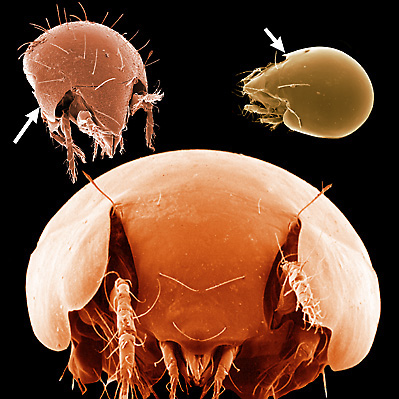 -like extensions, although these may be primarily for storing fungal spores. A few oribatid mites have projections at the humeral angle that are fixed and horn-like. Some Mesostigmata and oribatid mites (Desmonomata) have 1–2 pairs of projecting posteriorposterior:
the back part of the body or towards that region in comparison, e.g., 'posterior to'.
horns, and some symbiotic Astigmata (e.g., male feather mites) may have a deeply bifurcate posteriorposterior:
the back part of the body or towards that region in comparison, e.g., 'posterior to'.
.
Author: David E. Walter
Content last updated Sept. 2006, unless indicated otherwise
Lucid key player updated Sept. 2025
idtools.org