The venterventer:
the lower or under side; opposed to dorsum.
refers to the underside of the animal. The ventral regionventral region:
in Mesostigmata, the area between the genital and anal regions.
is the area between the genital opening (and its pair of setae) and the anal opening and its 3 circumanal setaecircumanal setae:
in Mesostigmata, the three setae (postanal and pair of peranal) setae surrounding the anal opening.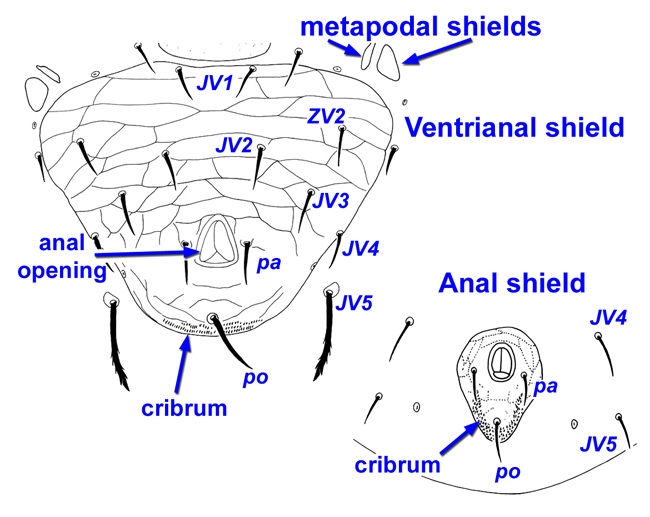 . True ventralventral:
relating to the lower or under side; opposed to dorsal.
shields or their component plates are absent in some Monogynaspida, e.g., in the families Arctacaridae, Ascidae (e.g., Proctolaelaps, Arctoseius, Iphidozercon), Eviphididae, and Laelapidae. When the anal shield is expanded and captures some of the ventral setaeventral setae:
in the Lindquist-Evans system used in the Mesostigmata, the ventral region has up to three longitudinal rows (Jv, Zv, Lv) with 1-5 transverse row designations.
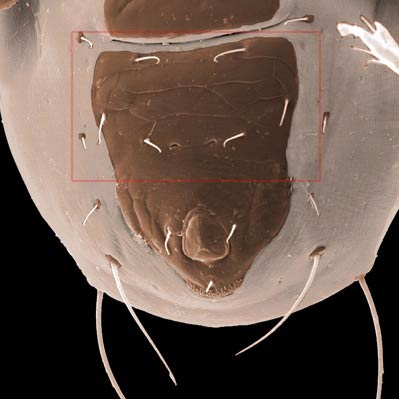
it is called a ventrianal shieldventrianal shield:
in Mesostigmata, a ventral shield bearing the anal opening, circum anal setae, and one or more pairs of ventral setae or pores (lyrifissures) [see anal shield]; maybe rather narrow or very broad and covering most of the gaster., and depending on its extent and the ventral setaeventral setae:
in the Lindquist-Evans system used in the Mesostigmata, the ventral region has up to three longitudinal rows (Jv, Zv, Lv) with 1-5 transverse row designations.
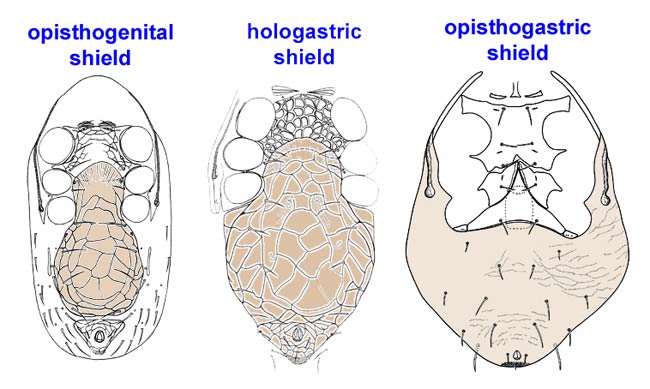
captured, shields that cover most or all of the venterventer:
the lower or under side; opposed to dorsum.
derive their names from whether or not the genital shieldgenital shield:
a shield or shields covering the genital opening; in female mongynaspine Mesostigmata this shield is usually called the epigynal (epigynial) shield.
is also captured and how extensively the combined shield covers the venterventer:
the lower or under side; opposed to dorsum.
.
Author: David E. Walter
Content last updated Sept. 2006, unless indicated otherwise
Lucid key player updated Sept. 2025
idtools.org