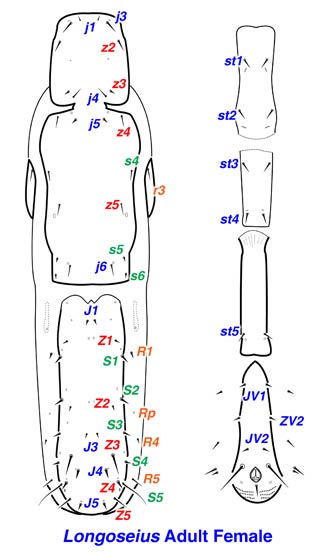
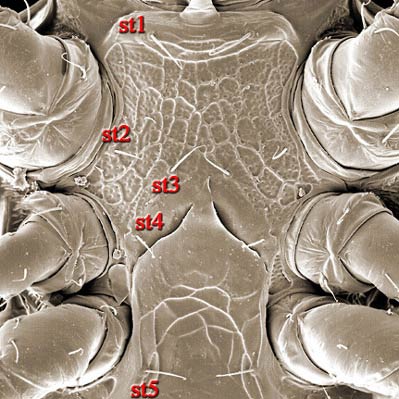
he area between the coxae of the legs is called the sternal region and normally bears 5 pairs of setae and some form of sclerotized sternal or intercoxal shield (see the 24b feature) in adult Monogynaspida.
The anteriormost three pairs of sternal setaesternal setae:
in Mesostigmata, the five pairs of setae in the intercoxal region designated st1-5; st1-3 are present in the larva and usually are borne on a sternal shield in the adult female; st4, the metasternal setae, are added in the deutonymph, often are borne on metasternal platelets, and sometimes on the sternal shield; st5, the genital setae, are added in the protonymph and usually borne on or are inserted laterad the epigynal shield in the adult female.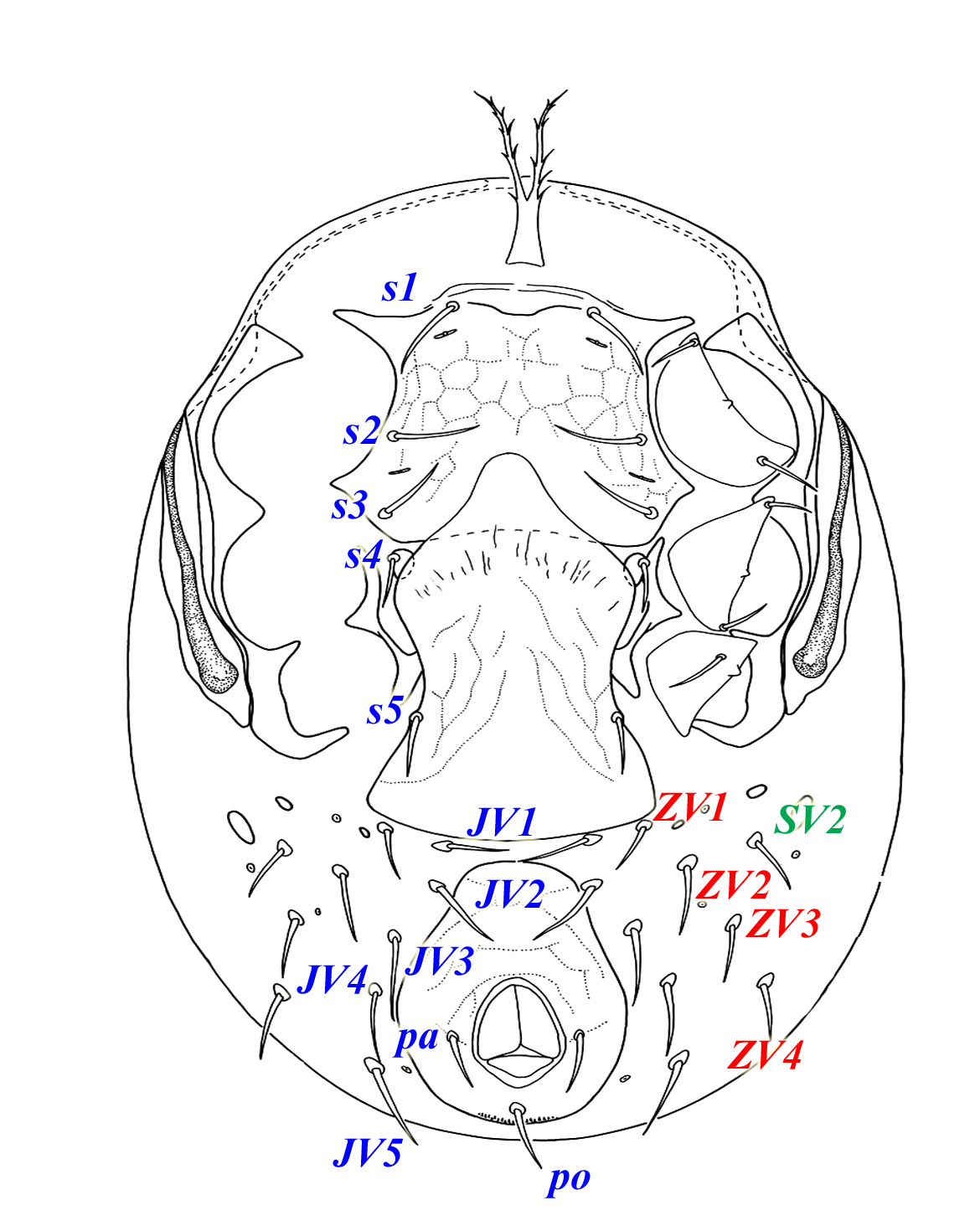 (st1–3) are present in the larva (on a weakly sclerotized sternal shieldsternal shield:
a shield in the anterior intercoxal region of parasitiform mites that bears one or more pairs of sternal setae.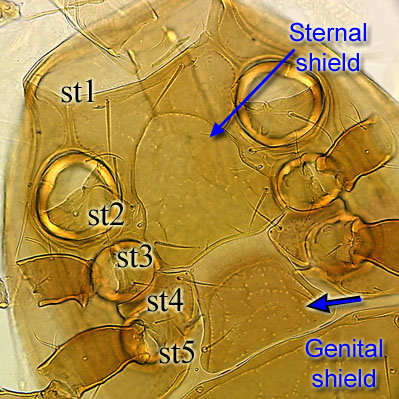 ) and often present on a sclerotized sternal shieldsternal shield:
a shield in the anterior intercoxal region of parasitiform mites that bears one or more pairs of sternal setae. in the adult.
The posteriormost pair (st5 = genital or epigynialepigynal:
(also epigynial) of or relating to the female genital opening or a shield protecting it.
setae) are added in the protonymphprotonymph:
the first nymphal stage or instar, usually octopod.
.
The remaining pair (st4 = metasternal setae) are added in the deutonymphdeutonymph:
(also deuteronymph) the second nymphal stage or instar.
, typically to a lightly sclerotized sternal shieldsternal shield:
a shield in the anterior intercoxal region of parasitiform mites that bears one or more pairs of sternal setae..
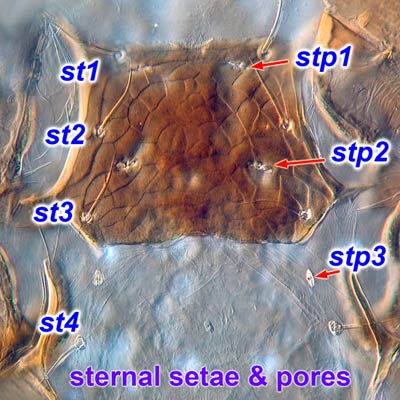
In most Rhodacaroidea (Rhodacaridae, Digamasellidae, and Ologamasidae - but not Halolaelapidae) the sternal shieldsternal shield:
a shield in the anterior intercoxal region of parasitiform mites that bears one or more pairs of sternal setae. bears 4 pairs of sternal setaesternal setae:
in Mesostigmata, the five pairs of setae in the intercoxal region designated st1-5; st1-3 are present in the larva and usually are borne on a sternal shield in the adult female; st4, the metasternal setae, are added in the deutonymph, often are borne on metasternal platelets, and sometimes on the sternal shield; st5, the genital setae, are added in the protonymph and usually borne on or are inserted laterad the epigynal shield in the adult female. (st1–4) and 3 pairs of lyrifissures or 'pores' (stp1–3). This 'capture' of the metasternal seta is a useful character with some exceptions:
Some Pachylaelapidae, Parholaspididae, and Veigaiidae also have sternal shields that partially or completely capture sternal setaesternal setae:
in Mesostigmata, the five pairs of setae in the intercoxal region designated st1-5; st1-3 are present in the larva and usually are borne on a sternal shield in the adult female; st4, the metasternal setae, are added in the deutonymph, often are borne on metasternal platelets, and sometimes on the sternal shield; st5, the genital setae, are added in the protonymph and usually borne on or are inserted laterad the epigynal shield in the adult female. st4 and associated sclerotization (i.e., the metasternal platelets). However, the most common condition in Monogynaspida is a shield bearing 3 pairs of sternal setaesternal setae:
in Mesostigmata, the five pairs of setae in the intercoxal region designated st1-5; st1-3 are present in the larva and usually are borne on a sternal shield in the adult female; st4, the metasternal setae, are added in the deutonymph, often are borne on metasternal platelets, and sometimes on the sternal shield; st5, the genital setae, are added in the protonymph and usually borne on or are inserted laterad the epigynal shield in the adult female. (st1–3), with st4 on its own shield (the metasternal plateletmetasternal shield:
(also metasternal platelet) small, usually teardrop to subtriangular shields bearing the metasternal setae (st4); sometimes fused to the sternal shield or the endopodal shields.
) or in the soft cuticle.
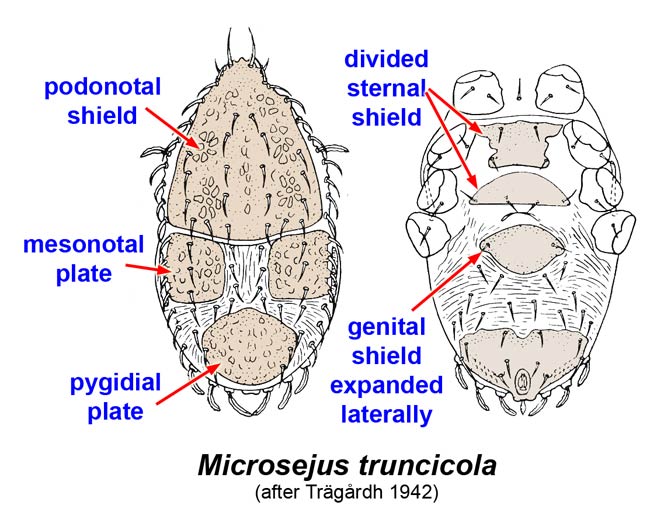
Rarely, the sternal shieldsternal shield:
a shield in the anterior intercoxal region of parasitiform mites that bears one or more pairs of sternal setae. is divided between st2–3 and consists of subequal plates each of which bear 2 pairs of setae (e.g., Longoseius (Longoseius), Microsejus).
In contrast, the sternal shieldsternal shield:
a shield in the anterior intercoxal region of parasitiform mites that bears one or more pairs of sternal setae. may be reduced and bear only 1 or 2 pairs of setae. This condition is most common in the Ameroseiidae, Phytoseiidae, and in some vertebrate-parasitic Dermanyssoidea (e.g., Ornithonyssus, Ophionyssus, and Dermanyssus), but may occur in other groups (e.g., phoretic morphs of Antennoseius (Vitzthumia).
Very rarely, sternal shieldsternal shield:
a shield in the anterior intercoxal region of parasitiform mites that bears one or more pairs of sternal setae. hypertrichy can be found among parasitic Dermanyssoidea, e.g., in the bee parasites of the genus Varroa.
Author: David E. Walter
Content last updated Sept. 2006, unless indicated otherwise
Lucid key player updated Sept. 2025
idtools.org