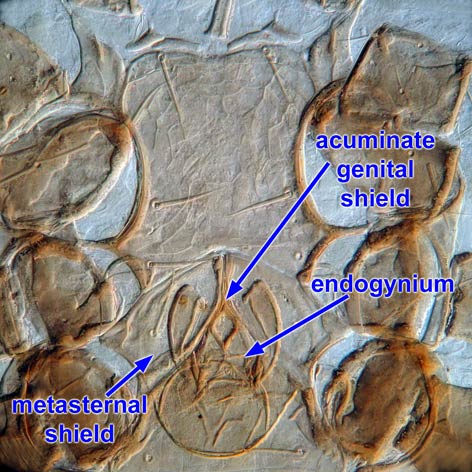
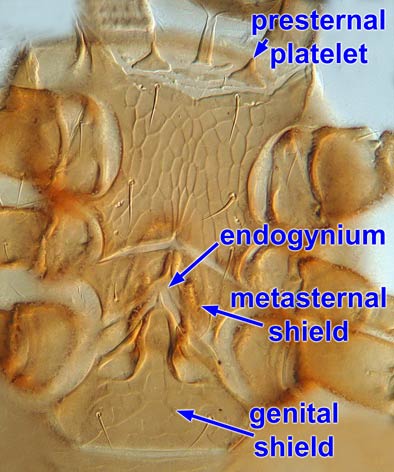
Early derivative lineages of Monogynaspida have a tocospermal system where males used their chelicerae to directly transfer sperm into the female genital opening. Usually there is a sack-like spermathecaspermatheca:
a structure in the female for storing sperm, typically sac-like.
under the genital opening that receives the spermatophorespermatophore:
any structure that carries a packet of sperm, including complex stalks deposited on substrate by male acariform mites and flask-like structures carried on the chelicerae of male mesostigmatans.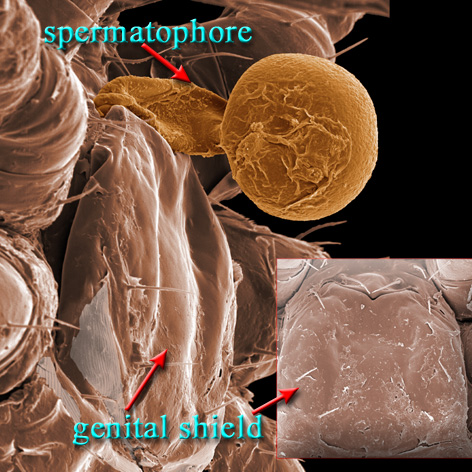 , but this is usually lightly sclerotized. In some Parasitidae, however, a strongly sclerotized endogynium, often with tooth-like structures, can be seen.
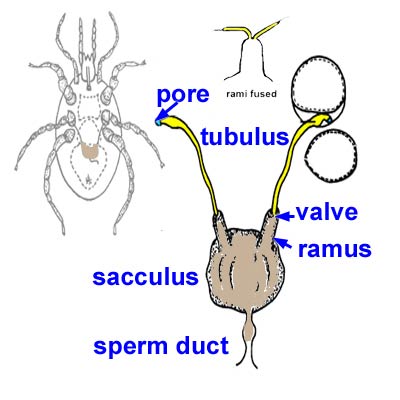
In the Dermanyssiae, males transfer sperm with a spermatodactylspermatodactyl:
(also spermadactyl) the 'sperm finger' on the chelicerae of male dermanyssine Mesostigmata used to transfer sperm to the secondary sperm system in the female; spermatodactyls take various forms, from simple finger-like processes to very long, contorted structures. 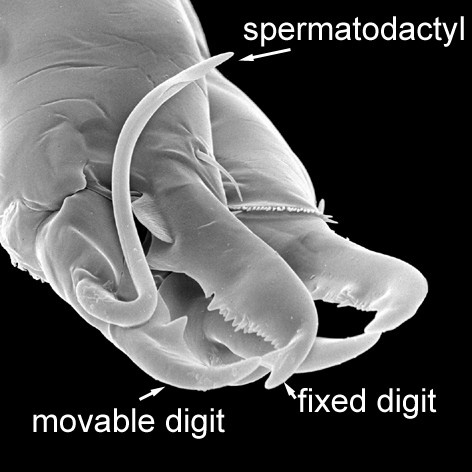 into a porepore:
a pore-like opening or structure in the cuticle. In Mesostigmata, lyrifissures and true pore openings are often difficult to separate and both tend to be called 'pores', e.g., the sternal pores stp1-3.
in the female (often in the acetabulum of coxacoxa:
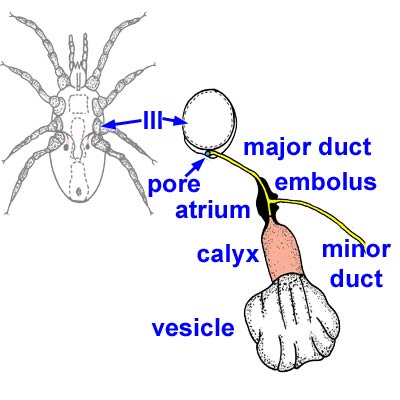
the basal segment of the leg, articulating with (Parasitiformes) or fused to (Acariformes) the body wall.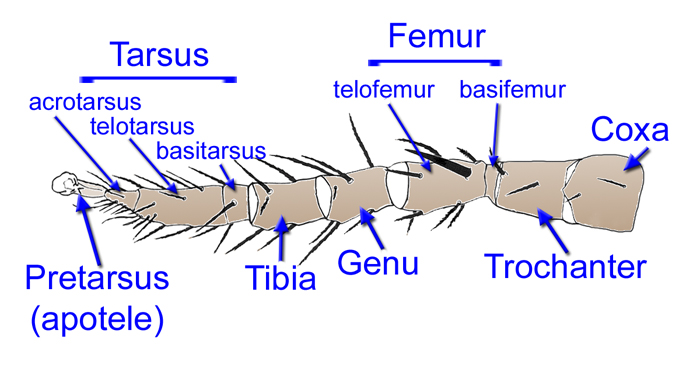 IV, but sometimes in another part of the intercoxal area or on the legs). In the laelapid-type system, the ducts lead to a central sack-like spermathecaspermatheca:
a structure in the female for storing sperm, typically sac-like.
. However, in the Phytoseioidea, apparent spermathecae are paired, have a complex structure, and are often diagnostic at the species-level.
Author: David E. Walter
Content last updated Sept. 2006, unless indicated otherwise
Lucid key player updated Sept. 2025
idtools.org