Primitively, the pilus dentilispilus dentilis:
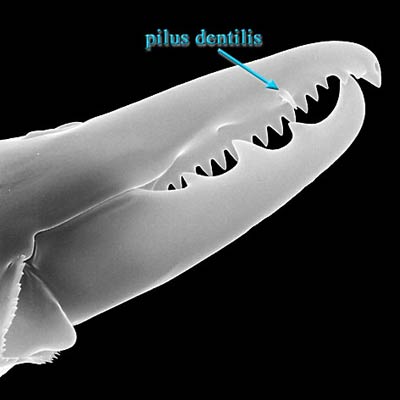
(pl. pili dentilis) a seta-like or membranous sensory organ inserted ventrolaterally on the fixed digit of the chelicera of many Mesostigmata.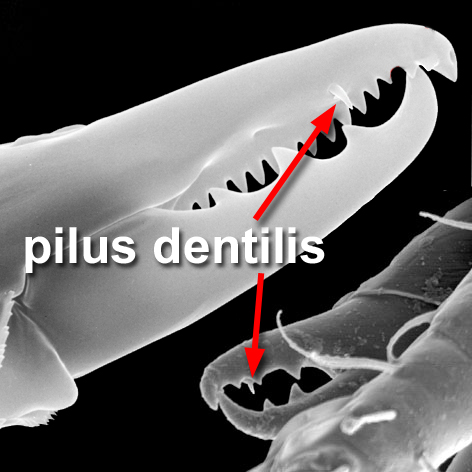 appears to be a seta-like mechanoreceptor that probably functions to inform the mite that it is gripping something in its chelicerachelicera:
a limb on the presumed first body segment in chelicerate arthropods, the primary mouthparts. In mites the chelicerae are primitively chelate-dentate, but may be modified into almost unrecognizable forms. In Acariformes, the chelicerae are usually 2-segmented, but in other mites and some basal acariforms they have three segments. Rarely, in some Uropodoidea (Mesostigmata), a subdivision makes them appear 4-segmented.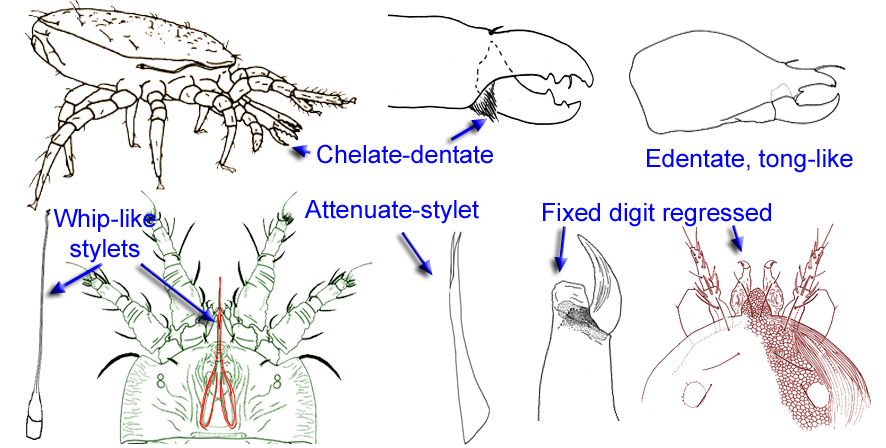 . In a few groups (e.g., Arctacaridae, Polyaspididae, Trachyuropodidae), however, the pilus dentilispilus dentilis:
(pl. pili dentilis) a seta-like or membranous sensory organ inserted ventrolaterally on the fixed digit of the chelicera of many Mesostigmata. resembles a bifurcatebifurcate:
split into two distally or with two projections. 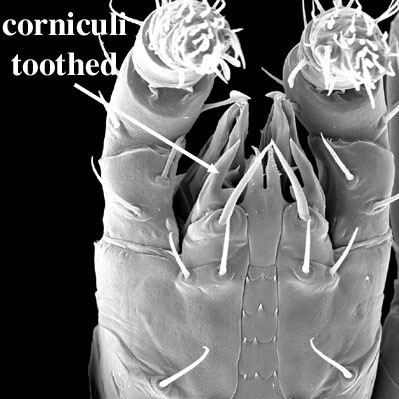 tooth. In several other groups the pilus dentilispilus dentilis:
(pl. pili dentilis) a seta-like or membranous sensory organ inserted ventrolaterally on the fixed digit of the chelicera of many Mesostigmata. becomes membranous and unrecognizable or lost. In a few groups, e.g., the pilus dentilispilus dentilis:
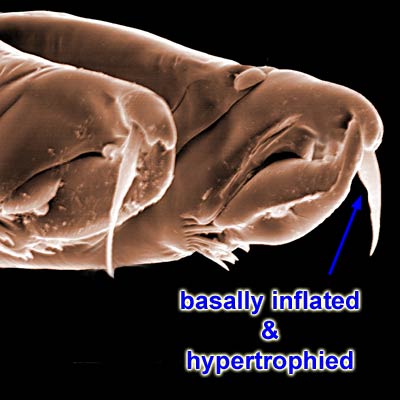
(pl. pili dentilis) a seta-like or membranous sensory organ inserted ventrolaterally on the fixed digit of the chelicera of many Mesostigmata. is very large and in Androlaelaps (Laelapidae) it is swollen basally.
Author: David E. Walter
Content last updated Sept. 2006, unless indicated otherwise
Lucid key player updated Sept. 2025
idtools.org