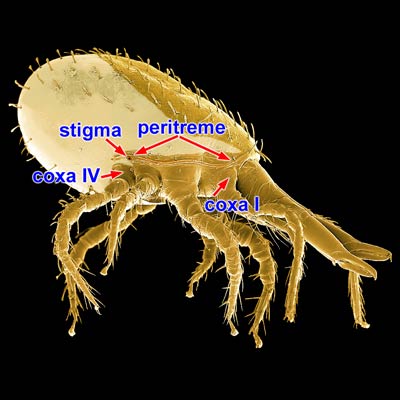
The typical peritremeperitreme:
a groove or gutter on the surface connecting to a stigmatal opening. In Mesostigmata the peritremes are lateral and run above the coxae of the legs and usually run to near the anterior margin of the idiosoma, but they may be very short or vestigial. In Prostigmata peritremes are usually found on the anterior margin of the idiosoma, as short processes to either side of the capitulum (emergent peritremes), or as simple to complex lines or reticulations of short, connected chambers on the dorsal surface of the chelicerae or stylophore.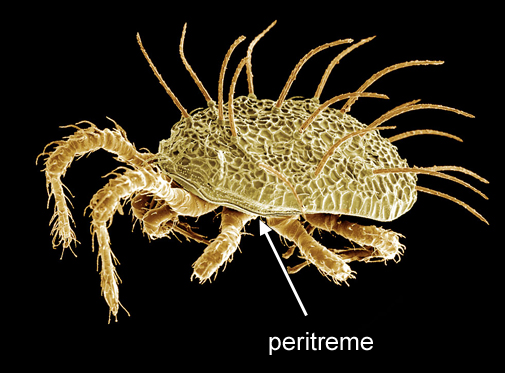 is relatively long and more or less linear, running from the stigmatal opening (usually above coxae III–IV) along the peritrematalperitrematal:
(peritrematic) of or referring to the peritreme; adjectival form of peritreme.
shield as far as coxae I and sometimes farther—onto the fused peritrematalperitrematal:
(peritrematic) of or referring to the peritreme; adjectival form of peritreme.
-dorsal shield. The length of the peritremes (i.e., how far they extend anteriorly) is often a useful species-level character, but because of numerous exceptions is difficult to apply at high taxonomic levels. However, several genera and families have distinctive peritrematalperitrematal:
(peritrematic) of or referring to the peritreme; adjectival form of peritreme.
forms. For example, mites that live in wet habitats often have extended peritrematalperitrematal:
(peritrematic) of or referring to the peritreme; adjectival form of peritreme.
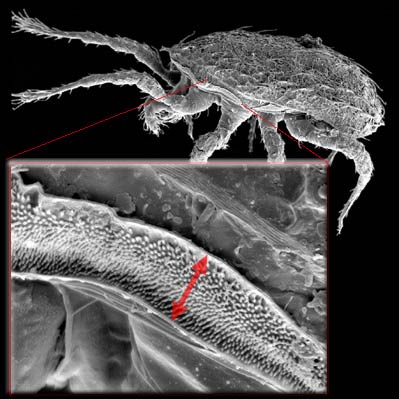
surfaces either as outpockets or as the flattening of the entire peritremeperitreme:
a groove or gutter on the surface connecting to a stigmatal opening. In Mesostigmata the peritremes are lateral and run above the coxae of the legs and usually run to near the anterior margin of the idiosoma, but they may be very short or vestigial. In Prostigmata peritremes are usually found on the anterior margin of the idiosoma, as short processes to either side of the capitulum (emergent peritremes), or as simple to complex lines or reticulations of short, connected chambers on the dorsal surface of the chelicerae or stylophore. into a plastron.
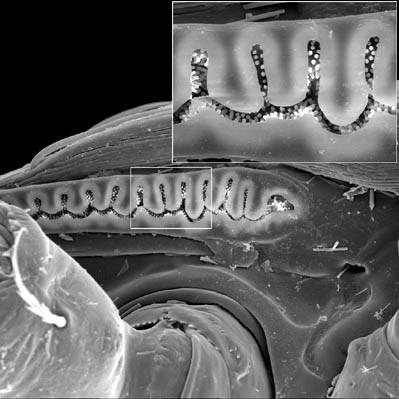
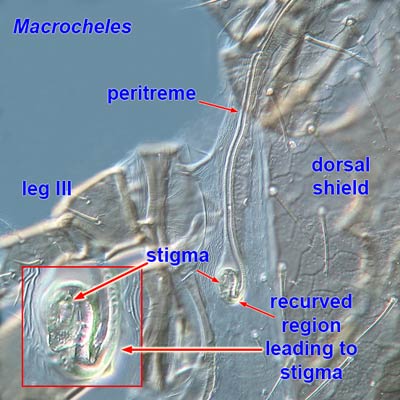
Macrochelidae and Thinozerconidae typically have the peritremeperitreme:
a groove or gutter on the surface connecting to a stigmatal opening. In Mesostigmata the peritremes are lateral and run above the coxae of the legs and usually run to near the anterior margin of the idiosoma, but they may be very short or vestigial. In Prostigmata peritremes are usually found on the anterior margin of the idiosoma, as short processes to either side of the capitulum (emergent peritremes), or as simple to complex lines or reticulations of short, connected chambers on the dorsal surface of the chelicerae or stylophore. looped basally near the stigmastigma:
the opening to the tracheal system.
, while species of Iphidozercon (Ascidae, Arctoseiinae) have hookhook:
(as in cheliceral hook) the distal hook-like tips of chelicerae in the Mesostigmata, as opposed to cheliceral teeth.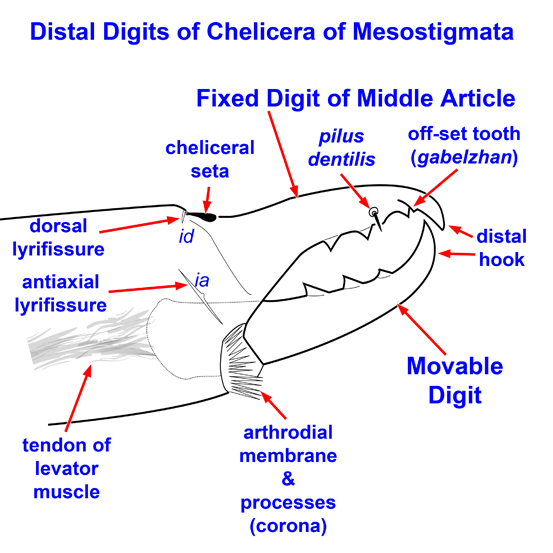 -like distaldistal:
towards the free end of an appendage.
extremities. Some Uropodioidea have complex, sinuatesinuate:
with a winding, snake-like, or wave-like form, as in the peritremes of some Uropodidae (Mesostigmata) or the setae of various mites.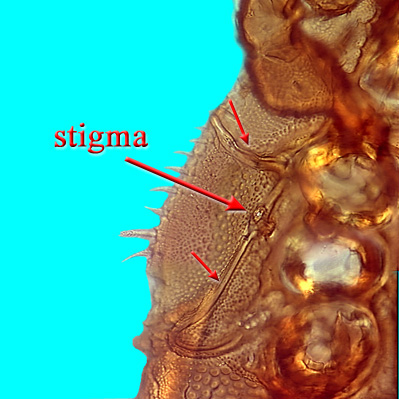 peritremes.
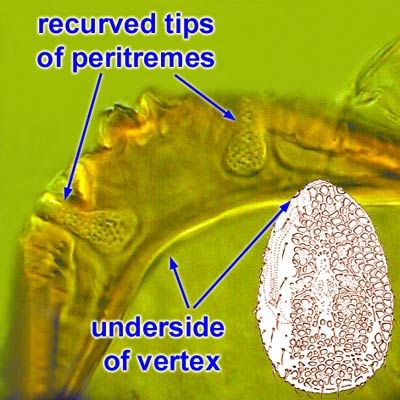
Reduction of the anterior portion of the peritremeperitreme:
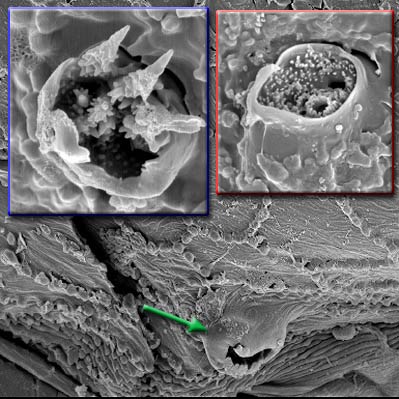
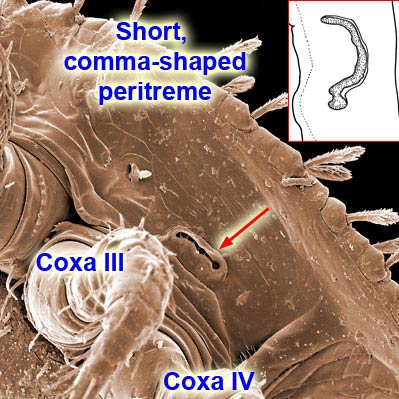
a groove or gutter on the surface connecting to a stigmatal opening. In Mesostigmata the peritremes are lateral and run above the coxae of the legs and usually run to near the anterior margin of the idiosoma, but they may be very short or vestigial. In Prostigmata peritremes are usually found on the anterior margin of the idiosoma, as short processes to either side of the capitulum (emergent peritremes), or as simple to complex lines or reticulations of short, connected chambers on the dorsal surface of the chelicerae or stylophore. occurs commonly in many families. Very short peritremes that end before coxae II are found in a variety of groups, but short, curved peritremes that more or less resemble commas are found only in Zerconidae and in the bee parasitic Varroidae. Peritremes may be suppressed to only a small area around the stigmatal opening or developed as a raised area around the stigmatal opening.
Author: David E. Walter
Content last updated Sept. 2006, unless indicated otherwise
Lucid key player updated Sept. 2025
idtools.org