Several different kinds of arachnids (e.g., pseudoscorpions, whipscorpions) brood their developing eggs in a sack-like structure on their venterventer:
the lower or under side; opposed to dorsum.
. Mites never do this, although some oribatid mites are known to carry eggs on their backs. Spiders typically carry or guard a silken egg case. Some centipedes wrap their bodies around their developing eggs or young hatchlings.
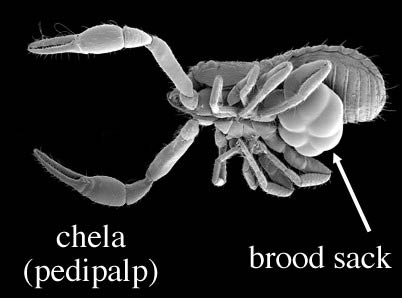
Isopoda and Amphipoda carry their eggs in a pouch along their leg bases—the marsupium or vivarium. The pouch is formed ventrally by plate-like processes on the coxae. In cladocerans, the embryo pouch occurs under the carapacecarapace:
the shield covering the dorsal prosoma of arachnids; in some European literature, the mesostigmatan podonotal shield.
.
Spiders (Araneae) produce silksilk:
fine threads spun by acariform mites to form a molting chamber (cocoon), protect or attach eggs, or a loosely defined to finely woven web.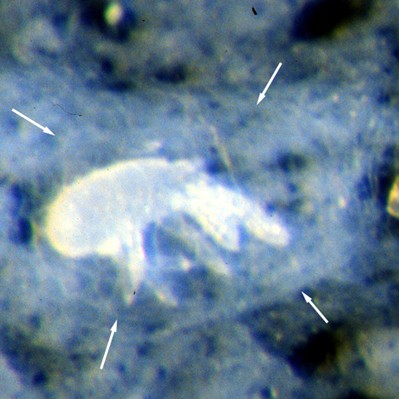 from abdominal spinnerets and often use this silksilk:
fine threads spun by acariform mites to form a molting chamber (cocoon), protect or attach eggs, or a loosely defined to finely woven web. to protect their eggs. Some species carry spherical egg sacs, while others suspend them in webs or attach them to bark or leaves (as in this lynx spider).
Scorpions, some whipscorpions, and some insects carry around first stagestage:
a distinct developmental form, e.g., the egg, larval, nymphal and adult stages. Since mite instars are usually morphologically distinct, they are also stages (and see stase). Some authors, however, insist that instar should be apolysis to apolysis and stage ecdysis to ecdysis. Since apolysis can be a discontinuous process and, in any case, is difficult to determine, in practice the difference between a stage and an instar is abstract and of importance only if you have a contentious referee.
immatures on their backs. No mites do this, although some do carry eggs, as do insects such as Belostommatidae.
Author: David E. Walter
Content last updated Sept. 2006, unless indicated otherwise
Lucid key player updated Sept. 2025
idtools.org