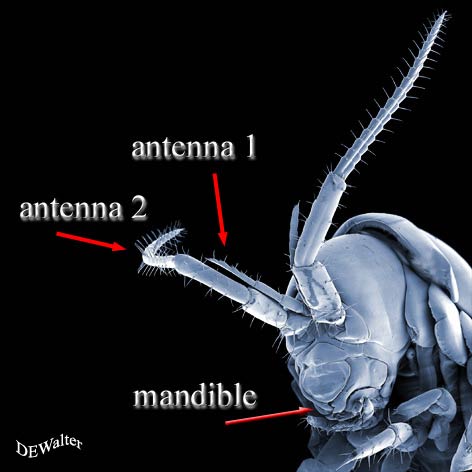
Crustaceans have two pairs of sensory limbs on their heads: the antennules and the antennae. Both may have two branches. In Ostracoda both structures are used in feeding. In Isopoda the antennules are minute and difficult to see, but they are readily apparent in Amphipoda.
Pauropods have bifurcatebifurcate:
split into two distally or with two projections. 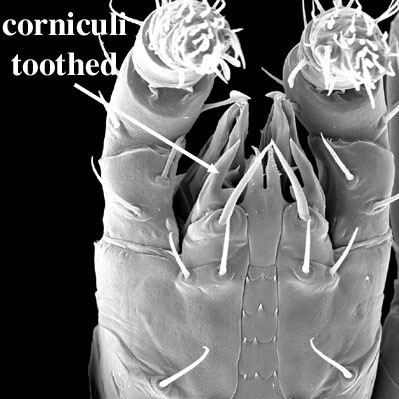 (sometimes seeming trifurcatetrifurcate:
split into three distally.
because of a sensory process) antennae with bead-like flagella and no eyes.
Antennae are preoral sensory limbs that originate on the head in front of the eyes (when present) and above the mouth. Some insects and hexapods have reduced or seemingly absent antennae (or they may be broken off), and may have well developed labial or maxillary palps that can be confused with antennae (but antennae will also be present). Some snout mites have elbowedelbowed:
bent as in the arm at the elbow; geniculate.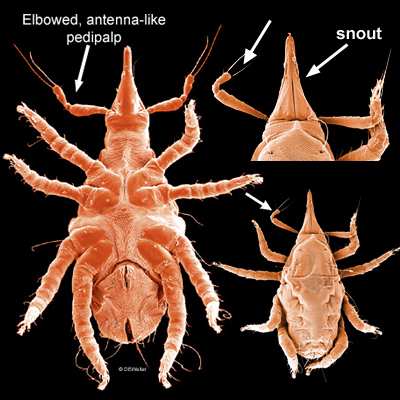 palps that are rather antenna-like.
Ants, other hymenopterans, and some other Insecta have elbowedelbowed:
bent as in the arm at the elbow; geniculate. (i.e., geniculategeniculate:
with an elbow- or knee-like bend.) antennae with a long basalbasal:
towards the base of a structure; on a limb, towards the insertion on the body.
scape and a distaldistal:
towards the free end of an appendage.
flagellum that is made up of a few to many segments.
Misinterpretations allowed: Some mites have geniculategeniculate:
with an elbow- or knee-like bend. palps that may look like antennae. (You can choose to disable "Allow misinterpretations" in the Preferences (gear icon) options.)
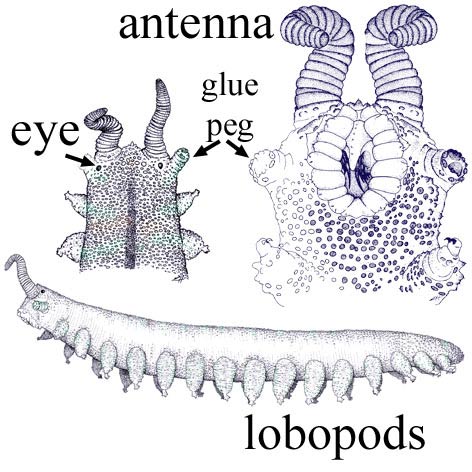
Velvet worms have a series of constrictions in their bodybody:
the idiosoma of mites.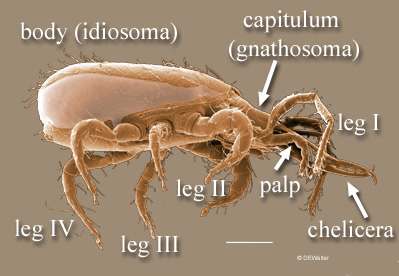 , antennae, and legs (lobopods), that give them the appearance of being constructed of a series of rings.
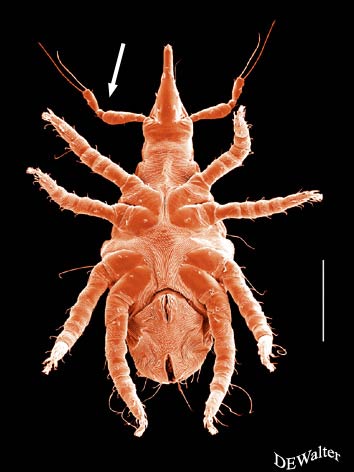
Snout mites (Prostigmata, Bdelloidea) have elbowedelbowed:
bent as in the arm at the elbow; geniculate. palps that look rather antenna-like, and their six-legged larvae could be confused with a scale crawler or similar minute insect. However, the forward projecting mouthparts and the lack of segmentationsegmentation:
in mites distinct external segments have been lost but remnants of segmentation may be represented by hysterosomal folds or transverse arrays of setae and other cuticular sense organs. In theory, all chelicerates have a prosoma composed of 6 segments (cheliceral, pedipalpal, and four leg-bearing segments = body segments I-VI). Ventrally the positions of the prosomal segments can be identified by the insertions of their appendages, but dorsally they are obscured. The opisthosoma is thought to comprise an additional 12-13 segments (body segments VII-XVIII or XIX), but appears to be somewhat to much reduced in most mites, except possibly Opilioacarida. In early derivative Acariformes (e.g., many Endeostigmata), hysterosomal folds are thought to represent segmentation and in the Grandjean system are designated (from the sejugal furrow to the anus): C, D, E, F, H, PS AD, AN, PA. There is disagreement in the literature over the origin of 'segments' C and D. Adherents of Grandjean consider them to be opisthosomatic (with C probably representing a fusion of the pregenital [body segment VII] and genital [VIII] segments). Others believe that C and D are the dorsal regions of the last two prosomal segments that bear leggs III and IV (i.e., body segments V & VI).
should help to distinguish these mites from other small arthropods.
Amblypygids and uropygids (Thelyponida) have attenuate and whip-likewhip-like:
long, slender and sinuous as in the posterior setae of some phytoseiid mites (Mesostigmata) or the stylets of spider mites and their relatives (Prostigmata: Tetranychoidea).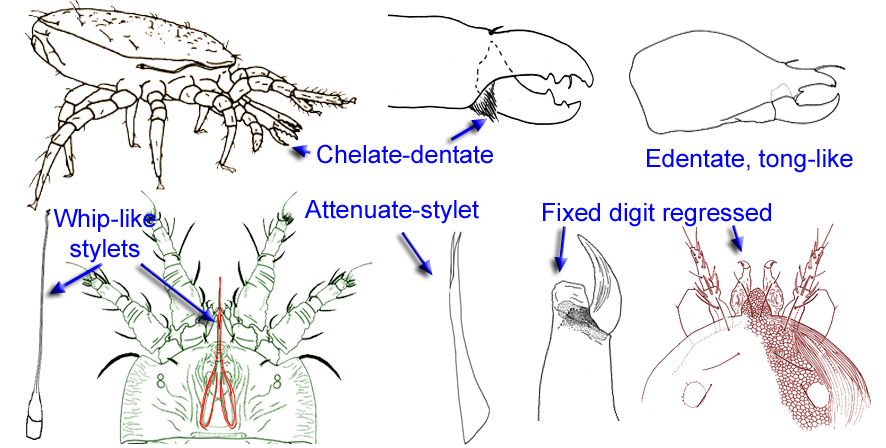 legs I with the tarsitarsus:
(pl. tarsi) the subdistal leg segment between the tibia and the pretarsus (apotele).
subdivided into numerous pseudosegments.
Crustaceans often have two branches or flagellae on each antenna (as well as having two pairs of antennae).
Amblypygids and uropygids (Thelyponida) have attenuate and whip-likewhip-like:
long, slender and sinuous as in the posterior setae of some phytoseiid mites (Mesostigmata) or the stylets of spider mites and their relatives (Prostigmata: Tetranychoidea). legs I with the tarsitarsus:
(pl. tarsi) the subdistal leg segment between the tibia and the pretarsus (apotele).
subdivided into numerous pseudosegments.
Author: David E. Walter
Content last updated Sept. 2006, unless indicated otherwise
Lucid key player updated Sept. 2025
idtools.org