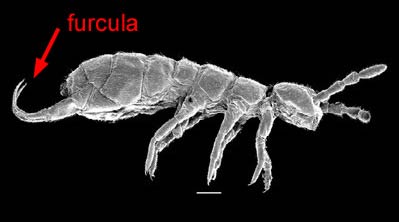
Most springtails have a bifurcatebifurcate:
split into two distally or with two projections. 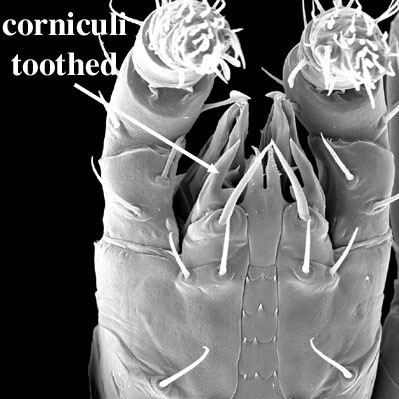 process near the end of their abdomens, the furcula, that gives them their spring. The furcula can be very long or short, and rarely is absent.
Japygids (Diplura) and earwigs (Insecta) have pincers at the rear of their abdomens. Japygids use these pincers to capture and hold prey, and then curl the abdomen to bring the prey in range of the mouthparts. Some mites have distal opisthosomalopisthosomal:
(opisthosomatic) adjectival form of opisthosoma.
lobes and/or hypertrophied posteriorposterior:
the back part of the body or towards that region in comparison, e.g., 'posterior to'.
setae, but not pincers.
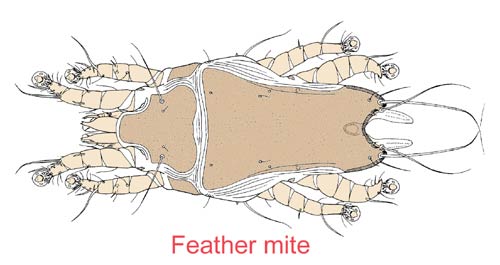
Cerci (singilar, cercus) are sensory appendages at the rear of many Insecta, Diplura, and Symphyla. Cerci are usually composed of several to many segments, but may be pincer-like or setiform. The uropods and caudal rami of Isopoda and Copepoda look rather like cerci. Aphids have subterminal tubes that could be confused with cerci.
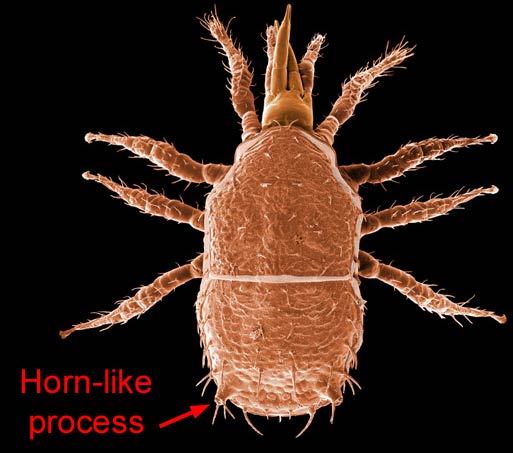
Misinterpretations allowed: Mites never have rami, uropods, or caudal filaments, but sometimes have whip-likewhip-like:
long, slender and sinuous as in the posterior setae of some phytoseiid mites (Mesostigmata) or the stylets of spider mites and their relatives (Prostigmata: Tetranychoidea).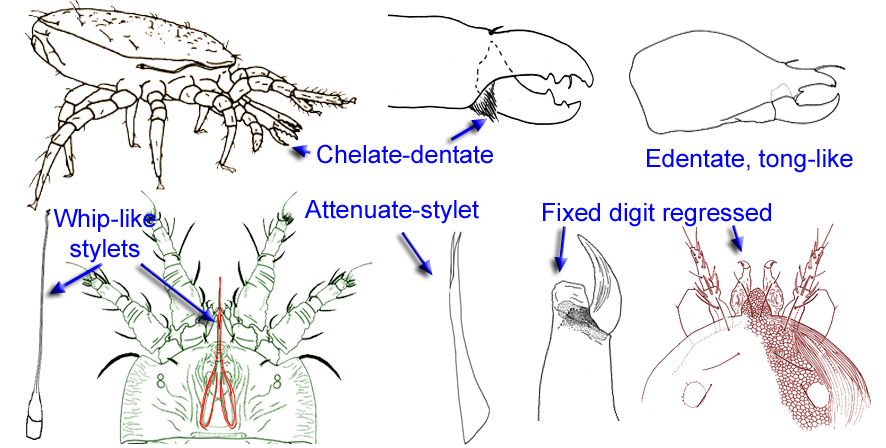 posterior setae or setae born on short horn-like projections and are allowed here as misinterpretations. Similarly, the posteriormost legs of some Chilopoda and the furcula of some springtails are somewhat cercus-like. (You can choose to disable "Allow misinterpretations" in the Preferences (gear icon) options.)
Polyxenida millipedes have a pair of distinctive columns of tightly bunched hairs (pencil tufts) at the ends of their bodies. Similar structures are found in a few cyphothalmid opilionids.
Most spiders (Araneae) produce silksilk:
fine threads spun by acariform mites to form a molting chamber (cocoon), protect or attach eggs, or a loosely defined to finely woven web.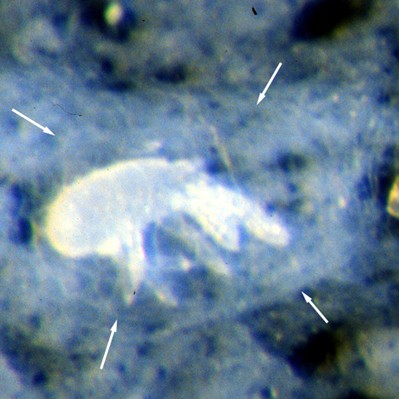 , even those that don't spin webs, and the silksilk:
fine threads spun by acariform mites to form a molting chamber (cocoon), protect or attach eggs, or a loosely defined to finely woven web. is produced from palppalp:
(= pedipalp) the second pair of limbs in arachnids, used in feeding and originating on either side of the chelicerae. In mites, the palps may be vestigial, with only a few segments, or have a maximum of 5 freely articulating segments (rarely the femur is subdivided) and a distal or subdistal apotele.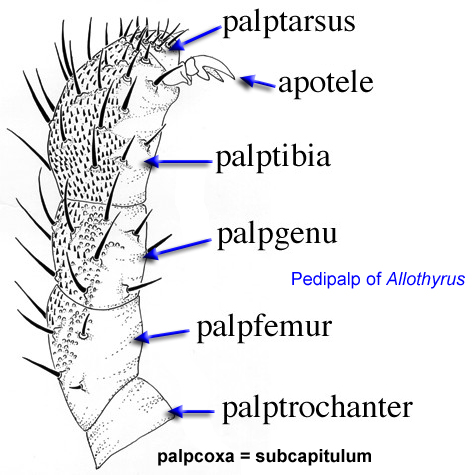 -like (primitive spiders) to peg-like abdominal structures, usually at the distaldistal:
towards the free end of an appendage.
end of the abdomen.
Misinterpreations allowed: Microwhipscorpions (Palpigradi) have a distinctive, multisegmented, whip-likewhip-like:
long, slender and sinuous as in the posterior setae of some phytoseiid mites (Mesostigmata) or the stylets of spider mites and their relatives (Prostigmata: Tetranychoidea). flagellum at the rear of the bodybody:
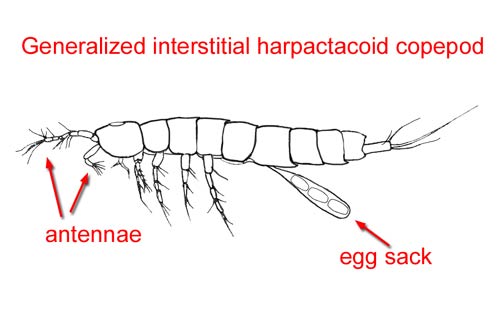
the idiosoma of mites.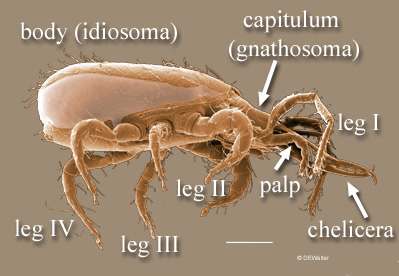 . Unfortunately, the flagellum often snaps off in preserved specimens. The long terminal filaments of some harpactacoid copepods could be confused with a flagellum and is allowed here. (You can choose to disable "Allow misinterpretations" in the Preferences (gear icon) options.)
The flagellum of schizomids (Schizomida) is short and finger-like (nymphs, females) or knobbed (males).
The abdomen of some insects (e.g., thrips) terminates in a tube-like narrowing of the bodybody:
the idiosoma of mites., or sometimes a tube-like ovipositorovipositor:
an extrusible organ for laying eggs. Female oribatids have a well developed ovipositor that ends in three finger-like projections. Ovipositors are less well developed or absent in other mites.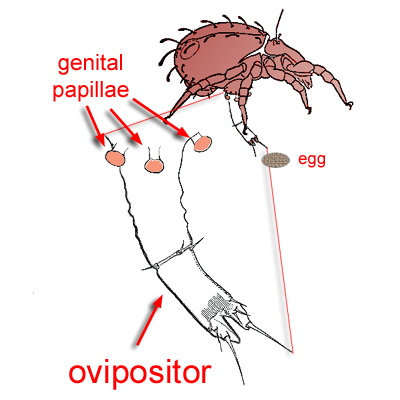 . Ricinuleids and amblypygids have a more or less well defined ring-like postabdomen. A few mites have an elongate, tube-like posteriorposterior:
the back part of the body or towards that region in comparison, e.g., 'posterior to'.
or appendage.
The genitalia of insects are distaldistal:
towards the free end of an appendage.
on the abdomen (modified limbs of abdominal segments 8–9) and often modified into an ovipositorovipositor:
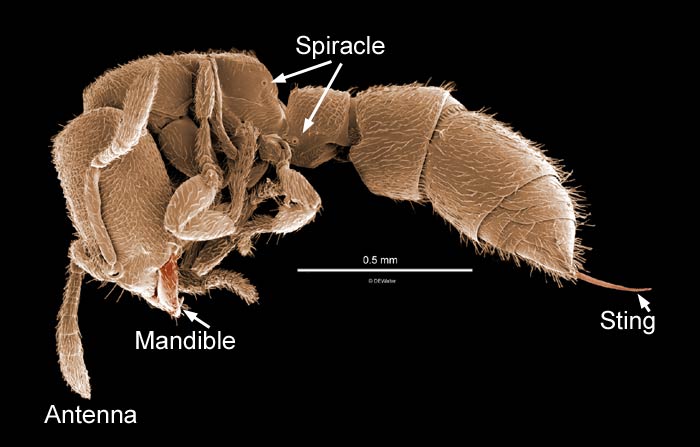
an extrusible organ for laying eggs. Female oribatids have a well developed ovipositor that ends in three finger-like projections. Ovipositors are less well developed or absent in other mites. in adult females, sometimes used defensively as a sting.
The genitalia of all arachnids, including mites, are produced basally on the opisthosomaopisthosoma:
(= abdomen) the posterior body division in arachnids; usually not distinct in mites because of the fusion of the opisthosoma with part of the prosoma to form the idiosoma.
(bodybody:
the idiosoma of mites. segment VIII). When mites have an ovipositorovipositor:
an extrusible organ for laying eggs. Female oribatids have a well developed ovipositor that ends in three finger-like projections. Ovipositors are less well developed or absent in other mites., it occurs in mid-body. However, some mites (e.g., spider mites and their relatives) have a posteriorposterior:
the back part of the body or towards that region in comparison, e.g., 'posterior to'.
aedeagus, typically a minute sclerotized internal structure.
Misinterpretations allowed: A few mites have tail-like processes that could be confused with an ovipositorovipositor:
an extrusible organ for laying eggs. Female oribatids have a well developed ovipositor that ends in three finger-like projections. Ovipositors are less well developed or absent in other mites., e.g., the strange Australian Xanthodasythyreus and some feather mites. (You can choose to disable "Allow misinterpretations" in the Preferences (gear icon) options.)
Author: David E. Walter
Content last updated Sept. 2006, unless indicated otherwise
Lucid key player updated Sept. 2025
idtools.org