Scorpions and pseudoscorpions have independently derived chelatechelate:
pincer-like, as in a crab's claws, a scorpion's pedipalps or many chelicerae; in water mites (Hydrachnida), chelate palps have a dorsal palptibial process opposed to a ventral movable palptarsus (opposed to uncate).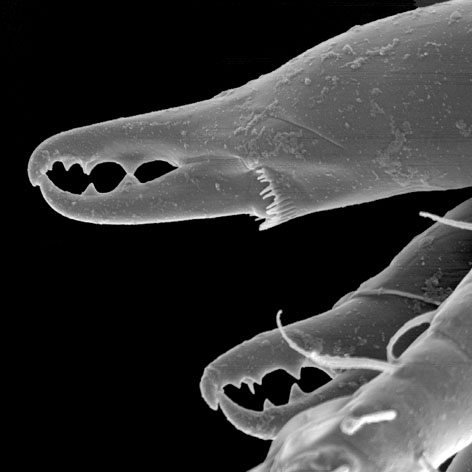 pedipalps that resemble the chelae of crabs. These are used to grasp and manipulate prey, and in many pseudoscorpions pedipalps are also used to deliver a venom to the prey.
Misinterpretations allowed: Amphipods often have chelatechelate:
pincer-like, as in a crab's claws, a scorpion's pedipalps or many chelicerae; in water mites (Hydrachnida), chelate palps have a dorsal palptibial process opposed to a ventral movable palptarsus (opposed to uncate). thoracic appendages that could be confused with chelatechelate:
pincer-like, as in a crab's claws, a scorpion's pedipalps or many chelicerae; in water mites (Hydrachnida), chelate palps have a dorsal palptibial process opposed to a ventral movable palptarsus (opposed to uncate). pedipalps. (You can choose to disable "Allow misinterpretations" in the Preferences (gear icon) options.)
Many arachnids use their pedipalps to capture prey. In most whipscorpions (Amblybygida, Thelyponida, Schizomida) the pedipalps are massive, spine-covered structures that are used to capture and mash prey during external digestion. Some mites and opilionids have similarly modified pedipalps.
Some acariform mites have secondarily pincer-like palps formed by a hypertrophied distaldistal:
towards the free end of an appendage.
palptibial seta (the clawclaw:
like - having a distal hook; resembling a claw.
) and an often swollen palptarsus (the thumb). The arrangement is called a thumb-clawthumb-claw:
a hypertrophied, usually claw-like seta on the dorso-distal margin of the palptibia that forms a pincer with the palptarsus of some Prostigmata; the palp thumb-claw complex.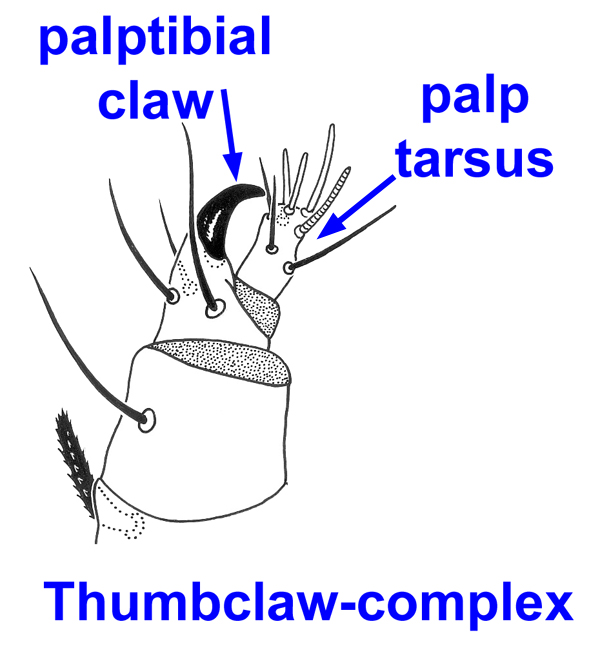 process and is useful in separating groups of Prostigmata.
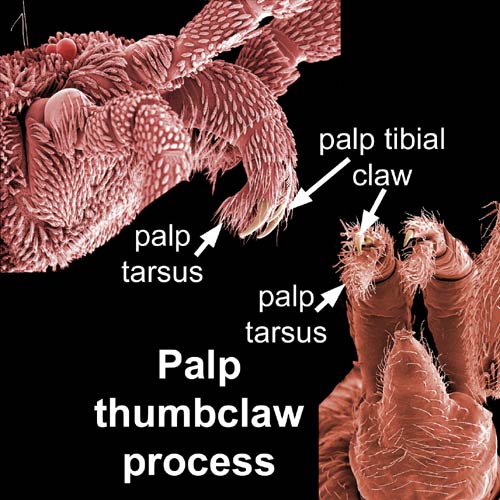
A leg-like pedipalppedipalp:
(= palp) the second pair of limbs in arachnids.
was probably the primitive condition in arachnids and is retained or newly derived in a number of taxa. For example, many mygalomorph spiders often have long, leg-like palps; solfugids have leg-like palps ending in an adhesive pad; many mites and opilionids have rather long palps.
Misinterpretations allowed: Pedipalps are found only in arachnids, but some insects have very long palps that are rather leg-like. This is especially true in the primitive jumping bristletails. Also, palps are typically long in crustaceans. (You can choose to disable "Allow misinterpretations" in the Preferences (gear icon) options.)
The pedipalps of mites have a maximum of 5 free segments (trochantertrochanter:
the leg segment between the coxa and the femur.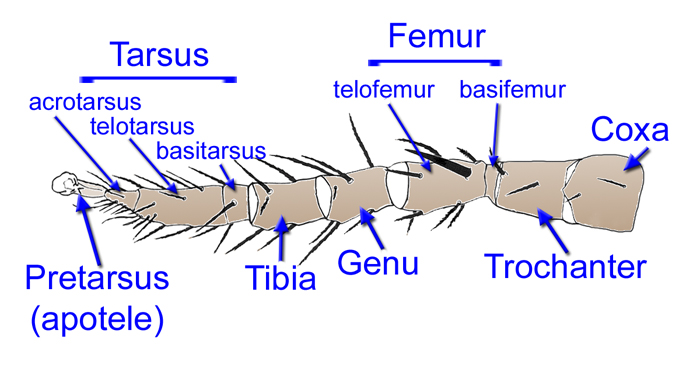 , femurfemur:
(pl. femora) major leg segment between trochanter and genu; often subdivided into a basifemur and a telofemur., genugenu:
(pl. genua) (= patella) the 4th leg segment, between the femur and tibia.
, tibiatibia:
(pl. tibiae) the leg segment between the genu and the tarsus., tarsustarsus:
(pl. tarsi) the subdistal leg segment between the tibia and the pretarsus (apotele).
). In all mites the palppalp:
(= pedipalp) the second pair of limbs in arachnids, used in feeding and originating on either side of the chelicerae. In mites, the palps may be vestigial, with only a few segments, or have a maximum of 5 freely articulating segments (rarely the femur is subdivided) and a distal or subdistal apotele.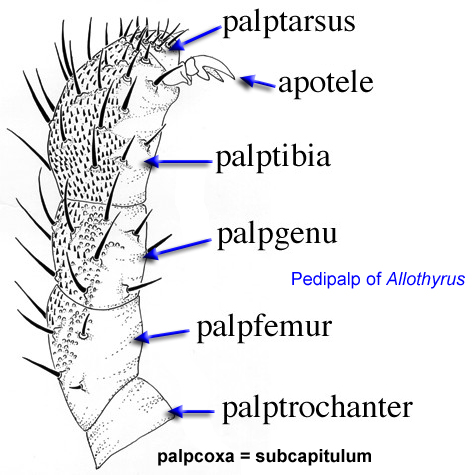 coxae are fused to form the subcapitulumsubcapitulum:
(also infracapitulum) the venter of the capitulum; the ventral faces of the fused palpcoxae; apparently formed independently in the two superorders of mites.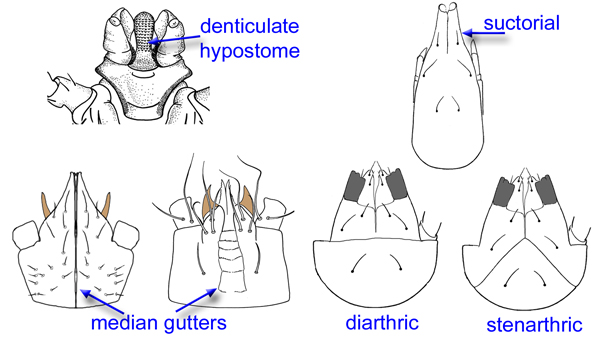 . In most mites the palppalp:
(= pedipalp) the second pair of limbs in arachnids, used in feeding and originating on either side of the chelicerae. In mites, the palps may be vestigial, with only a few segments, or have a maximum of 5 freely articulating segments (rarely the femur is subdivided) and a distal or subdistal apotele. tarsal claws (apoteleapotele:
(Greek apotelein = to complete)—the terminus of an appendage; the most distal leg segment, often consisting of an empodium and a pair of claws. The apotele of a leg is usually treated as equivalent to the pretarsus or some part thereof (e.g., the claws and empodium), but the palptarsal apotele in Mesostigmata is a tined structure originating at the base of the palptarsus and thought to be a remnant of the claws. The chelicerae are also an appendage and terminate in the movable digit.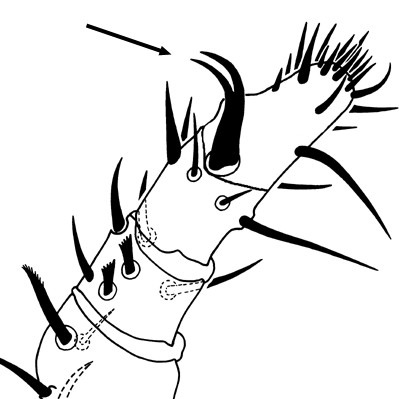 ) have been lost or reduced to a subdistal, 2-4 toothed structure.
Ricinuleids and some mites (e.g., snout mites, Bdelloidea) have distinctly elbowedelbowed:
bent as in the arm at the elbow; geniculate.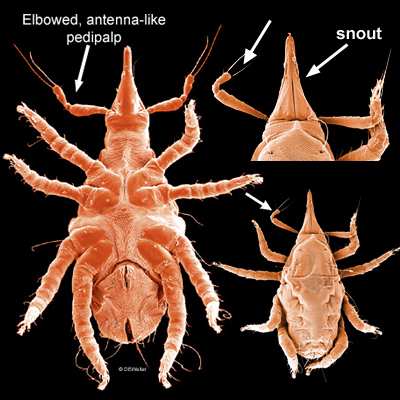 palps, with a large basalbasal:
towards the base of a structure; on a limb, towards the insertion on the body.
segment and distaldistal:
towards the free end of an appendage.
segment(s) that diverge at a sharp angle.
Pedipalps are prominent in most arachinids, but are reduced or absent in some mites (e.g., hypopal astigmatans).
Author: David E. Walter
Content last updated Sept. 2006, unless indicated otherwise
Lucid key player updated Sept. 2025
idtools.org