Astigmaticastigmatic:
adjectival form of Astigmata.
mites and many oribatidsoribatidmites:
are a member of the sarcoptiform suborder Oribatida (=Cryptostigmata, Oribatei); some academics consider the use of 'oribatid' as a noun to be low class, but others consider that attitude pedantic.
have a pair of lateral opisthonotal glandsopisthonotal glands:
see oil glands
often visible as large black, brown, yellow, or red spots. The glandgland:
usually referring to a glandular opening in the cuticle such as the lateral opisthonotal glands in the Sarcoptiformes or the idionotal glands in the Mesostigmata (see gdj etc. above), including hypertrophied openings that produce defensive secretions.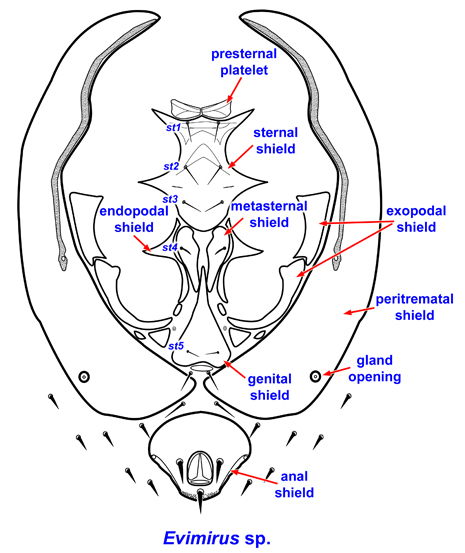 duct orifices are protected by a cuticular flap and the secretions contain a variety of volatile compounds that may serve as alarm pheromones, aggregation and/or sex pheromones, or as defense substances against fungal or predatory attacks. Rarely, as in the oribatid mites of the genus Hermanniella, the glandgland:
usually referring to a glandular opening in the cuticle such as the lateral opisthonotal glands in the Sarcoptiformes or the idionotal glands in the Mesostigmata (see gdj etc. above), including hypertrophied openings that produce defensive secretions. has a spout-like opening.
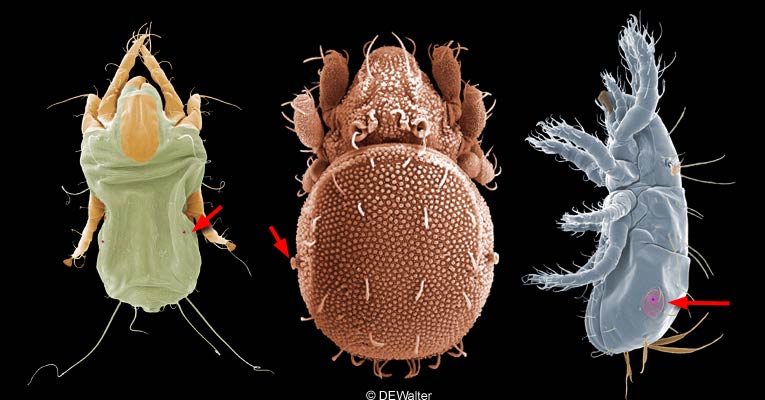
Similar glands are found on holothyrans, ticks (the sensillasensillum:
(pl. sensilla) (also sensillae; 'sensillus' is incorrect) a sensory structure; sensilla is often used for the bothridial seta in Acariformes.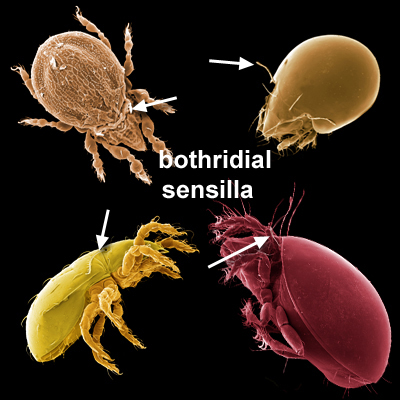 sagittiformia), and some Opiliones (Sironoidea). Harvestmen also have repugnatorial glands on the prosomaprosoma:
(= cephalothorax) the anterior body region in arachnids; usually not distinct in mites.
, and many other kinds of arthropods have glands or glandgland:
usually referring to a glandular opening in the cuticle such as the lateral opisthonotal glands in the Sarcoptiformes or the idionotal glands in the Mesostigmata (see gdj etc. above), including hypertrophied openings that produce defensive secretions.-like structures.
Many arthropods have glandgland:
usually referring to a glandular opening in the cuticle such as the lateral opisthonotal glands in the Sarcoptiformes or the idionotal glands in the Mesostigmata (see gdj etc. above), including hypertrophied openings that produce defensive secretions. like structures on their abdomens or thoraces (e.g., stink glands), but only some mites (Acariformes, Oribatida, Astigmata) have a pair of opisthosomal glandsopisthosomal glands:
see oil glands.
.
Many arthropods have glandgland:
usually referring to a glandular opening in the cuticle such as the lateral opisthonotal glands in the Sarcoptiformes or the idionotal glands in the Mesostigmata (see gdj etc. above), including hypertrophied openings that produce defensive secretions.-like structures on their abdomens or thoraces (e.g., stink glands), but only some mites (Acariformes, Oribatida, Astigmata) have a pair of opisthosomal glandsopisthosomal glands:
see oil glands.
.
Author: David E. Walter
Content last updated Sept. 2006, unless indicated otherwise
Lucid key player updated Sept. 2025
idtools.org