Some beetles and beetle mites (Oribatida) have leg segments that are swollen in the middle or distally, giving the legs a bead-like appearance. Individual segments may be fusiform, bowling pin-shaped, oval, or subspherical.
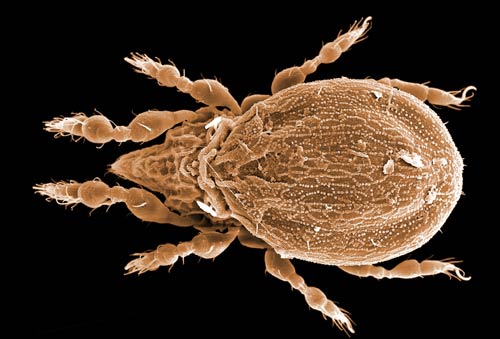
A rare form of modification of the leg segments found in some beetles, mites, and ricinuleids has the appearance of mechanical ball and socket joints.
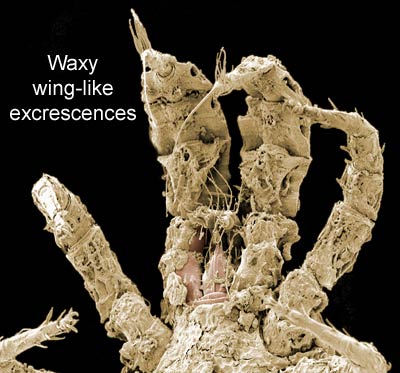
Some mites and insects have leg segments expanded into keel-like flanges or wing-likewing-like:
projecting from the body or other structures like the wings of insects.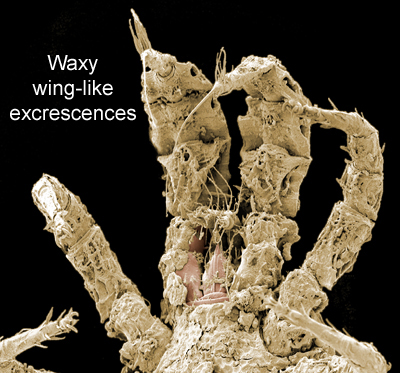 lateral extensions, either cuticular or composed of waxy cerotegumentcerotegument:
the outer layers of the epicuticle, including the wax and cement layers; often thin and inconspicuous, but sometimes very thick, ornamented, and obscuring the underlying cuticle; thick ceroteguments often can be peeled off to expose a very different-looking mite.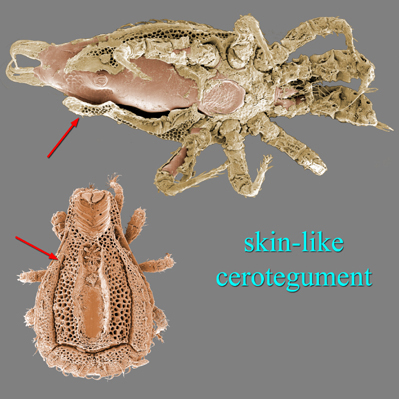 .
.
Jumping has evolved in many different lineages of arthropods. Perhaps the simplest kind of adaptation for jumping is greatly enlarged muscles on some basalbasal:
towards the base of a structure; on a limb, towards the insertion on the body.
segments of the hind legs. This type of adaptation for jumping is present in some mites (e.g., species of Eupodes) in the form of swollen femorafemur:
(pl. femora) major leg segment between trochanter and genu; often subdivided into a basifemur and a telofemur.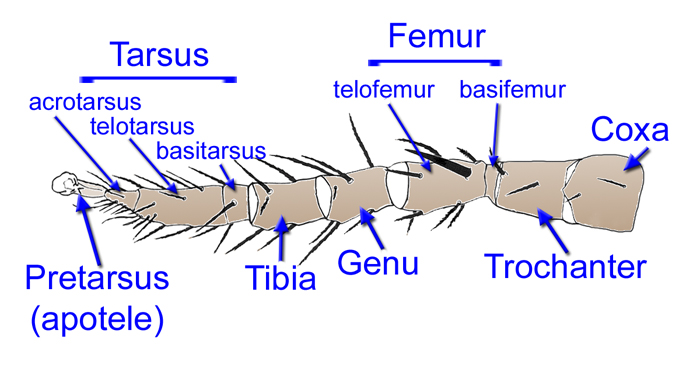 of legs IV.
Author: David E. Walter
Content last updated Sept. 2006, unless indicated otherwise
Lucid key player updated Sept. 2025
idtools.org