In some taxa, the lateral claws have been lost and the empodiumempodium:
(pl. empodia) an unpaired structure arising between the tarsal claws, ranging from pad-like to claw-like and often bearing structures such as tenent hairs, dense setulae, or taking the form of a featherclaw (Eriophyoidea)..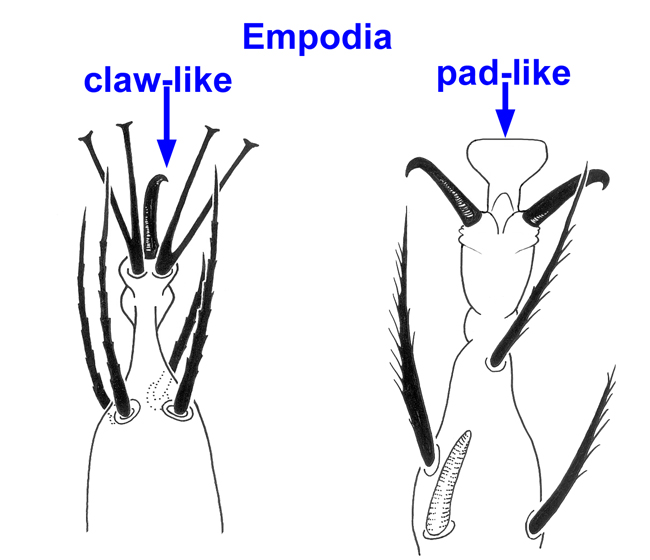 is clawclaw:
like - having a distal hook; resembling a claw.
-like.
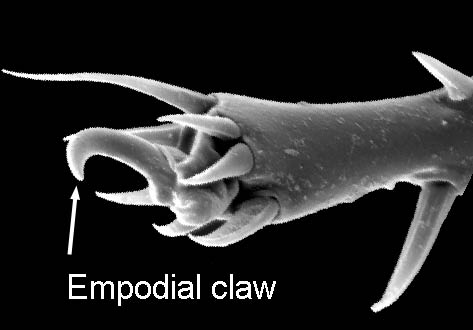
The distaldistal:
towards the free end of an appendage.
tarsal segment in an arthropod usually ends in a tripartite structure, generally consisting of a pair of lateral claws and a median empodiumempodium:
(pl. empodia) an unpaired structure arising between the tarsal claws, ranging from pad-like to claw-like and often bearing structures such as tenent hairs, dense setulae, or taking the form of a featherclaw (Eriophyoidea).., which may be clawclaw:
like - having a distal hook; resembling a claw.
-like or pad-likepad-like:
in Prostigmata, used to refer to empodia that do not have a distal hook (claw-like); when tenent hairs are present a 'pad-like' empodium may look more like a pincushion; in other Acari, usually a simple, pad-like empodium.
(=pulvillus).
The distaldistal:
towards the free end of an appendage.
tarsal segment in primitive arachnids appears to have consisted of three claws, a condition retained, or re-evolved, in some modern forms.
Tardigrades have four or more curved claws at the end of each leg.
Springtails (Collembola) have a single clawclaw:
like - having a distal hook; resembling a claw.
(unguis) that is usually opposed to an empodial appendage (unguiculus) with a lamellalamella:
(pl. lamellae) a longitudinal projection on the prodorsum of many oribatid mites that protects legs I when they are retracted; lamellae usually arise near the base of the bothridia and terminate with a projecting lamellar seta (often on a free cusp). Lamellae may be connected by a translamella.
, resulting in a snipper-like structure.
Pretarsi have three major components: a median element, the empodiumempodium:
(pl. empodia) an unpaired structure arising between the tarsal claws, ranging from pad-like to claw-like and often bearing structures such as tenent hairs, dense setulae, or taking the form of a featherclaw (Eriophyoidea).., which may be pad-likepad-like:
in Prostigmata, used to refer to empodia that do not have a distal hook (claw-like); when tenent hairs are present a 'pad-like' empodium may look more like a pincushion; in other Acari, usually a simple, pad-like empodium.
or clawclaw:
like - having a distal hook; resembling a claw.
-like, and a pair of lateral claws. However, the lateral claws may be absent, leaving only a pad-like pulvilluspulvillus:
a membranous, pad-like structure associated with the claws in Mesostigmata.
, or they may be highly modified and seeming to be absent.
Tenent hairs rather resemble flat-headed nails and are probably important in balance or traction. They are found on the bodybody:
the idiosoma of mites.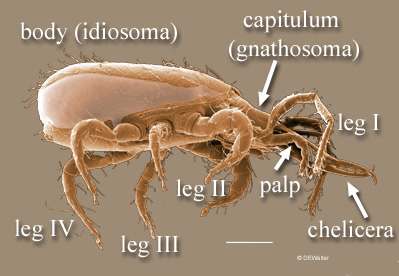 , legs, and tarsitarsus:
(pl. tarsi) the subdistal leg segment between the tibia and the pretarsus (apotele).
of insects, springtails and mites. Among soil microarthropods, some Sarcoptiformes have leg tenent hairs and many Trombidiformes have tenent hairs on the empodiumempodium:
(pl. empodia) an unpaired structure arising between the tarsal claws, ranging from pad-like to claw-like and often bearing structures such as tenent hairs, dense setulae, or taking the form of a featherclaw (Eriophyoidea).. or lateral claws (sometimes lateral claws are replaced by a pair of tenent hairs).
Author: David E. Walter
Content last updated Sept. 2006, unless indicated otherwise
Lucid key player updated Sept. 2025
idtools.org