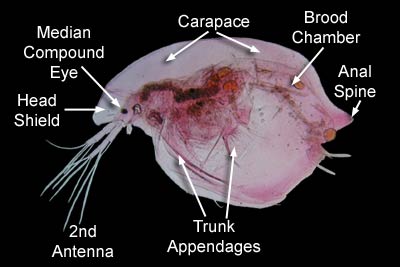
In arthropods, bodybody:
the idiosoma of mites.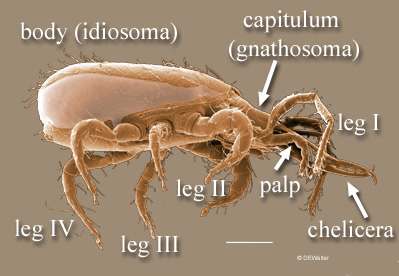 regions (tagmata) are functional units composed of several segments variously modified and fused. Myriapods have two regions: head and trunk (abdomen) with numerous pairs of legs. Terrestrial crustaceans have three regions, but the thorax has numerous legs and the abdomen is not strongly set off, so they appear to have a head and trunk.
Velvet worms, tardigrades, and some insect larvae have a more or less well defined head and a trunk with lobopods or prolegs.
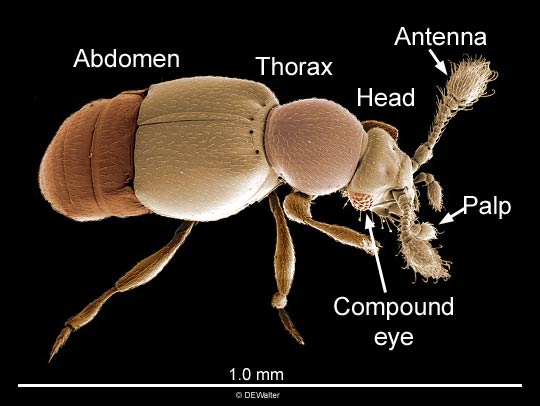
Insects, springtails and other hexapods (as well as first instarinstar:
(Latin = form) an immature mite or other arthropod between molts (or from apolysis to apolysis for some authors), or between egg hatching and the first molt. Mites mostly have determinate growth and do not molt after reaching the adult stage; therefore, the adult is not considered an instar.
millipedes) have three bodybody:
the idiosoma of mites. regions: a head with antennae and often eyes, a thorax with three pairs of legs and up to two pairs of wings, and an abdomen that has no true legs (styli or prolegs may be present—see Character 6d) and is usually clearly segmented.
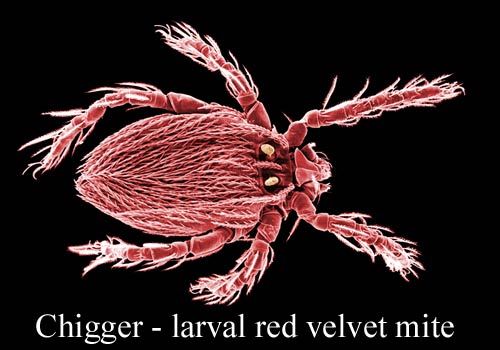
Misinterpretations allowed: Mite larvae are hexapodhexapod:
with three pairs of legs (i.e. 6 legs), as in the larvae of mites or the larviform stages of others.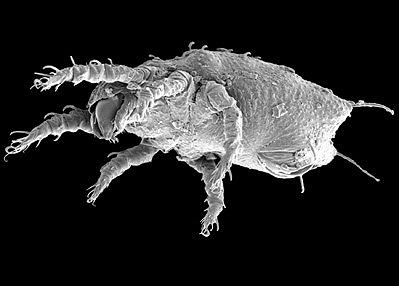 and could be misinterpreted as having a thorax. (You can choose to disable "Allow misinterpretations" in the Preferences (gear icon) options.)
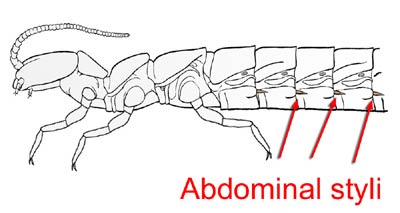
Diplurans, proturans, and thysanurans often retain remnants of the abdominal legs of their crustacean ancestors in the form of 1–2 segmented styli.
Scorpions (Scorpionida) have a unique set of bodybody:
the idiosoma of mites. tagmata: prosomaprosoma:
(= cephalothorax) the anterior body region in arachnids; usually not distinct in mites.
, mesosoma, and metasoma.
Most arachnids have only two major bodybody:
the idiosoma of mites. regions. The anterior region (prosomaprosoma:
(= cephalothorax) the anterior body region in arachnids; usually not distinct in mites.
or cephalothoraxprosoma:
(= cephalothorax) the anterior body region in arachnids; usually not distinct in mites.
) has the mouth parts, legs, and eyes and is used for feeding, sensing and locomotion. The posteriorposterior:
the back part of the body or towards that region in comparison, e.g., 'posterior to'.
region (opisthosomaopisthosoma:
(= abdomen) the posterior body division in arachnids; usually not distinct in mites because of the fusion of the opisthosoma with part of the prosoma to form the idiosoma.
or abdomen) carries out the rest of the bodybody:
the idiosoma of mites. functions. In spiders and some whipscorpions a narrow waist or pedicel separates the two regions. In pseudoscorpions, opilionids, and other arachnids the juncture is broad, but unlike in mites, opisthosomal segmentationsegmentation:
in mites distinct external segments have been lost but remnants of segmentation may be represented by hysterosomal folds or transverse arrays of setae and other cuticular sense organs. In theory, all chelicerates have a prosoma composed of 6 segments (cheliceral, pedipalpal, and four leg-bearing segments = body segments I-VI). Ventrally the positions of the prosomal segments can be identified by the insertions of their appendages, but dorsally they are obscured. The opisthosoma is thought to comprise an additional 12-13 segments (body segments VII-XVIII or XIX), but appears to be somewhat to much reduced in most mites, except possibly Opilioacarida. In early derivative Acariformes (e.g., many Endeostigmata), hysterosomal folds are thought to represent segmentation and in the Grandjean system are designated (from the sejugal furrow to the anus): C, D, E, F, H, PS AD, AN, PA. There is disagreement in the literature over the origin of 'segments' C and D. Adherents of Grandjean consider them to be opisthosomatic (with C probably representing a fusion of the pregenital [body segment VII] and genital [VIII] segments). Others believe that C and D are the dorsal regions of the last two prosomal segments that bear leggs III and IV (i.e., body segments V & VI).
is clearly present.
Misinterpretations allowed: Mites have lost a clear distinction between prosomaprosoma:
(= cephalothorax) the anterior body region in arachnids; usually not distinct in mites.
and opisthosomaopisthosoma:
(= abdomen) the posterior body division in arachnids; usually not distinct in mites because of the fusion of the opisthosoma with part of the prosoma to form the idiosoma.
, and have two unique bodybody:
the idiosoma of mites. tagmata: gnathosomagnathosoma:
(= capitulum) the anteriormost part of a mite or ricinuleid, composed of the cheliceral and pedipalpal segments and separated from the body (idiosoma) by a ring of soft cuticle.
(capitulumgnathosoma:
(= capitulum) the anteriormost part of a mite or ricinuleid, composed of the cheliceral and pedipalpal segments and separated from the body (idiosoma) by a ring of soft cuticle.
) and idiosoma (bodybody:
the idiosoma of mites.). Mites are retained when you use this feature if 'Allow Misinterpretations' is enabled. (You can choose to disable "Allow misinterpretations" in the Preferences (gear icon) options.)
Spiders (Araneae) have a 'wasp waist,' the pedicel, joining the prosomaprosoma:
(= cephalothorax) the anterior body region in arachnids; usually not distinct in mites.
to the opisthosomaopisthosoma:
(= abdomen) the posterior body division in arachnids; usually not distinct in mites because of the fusion of the opisthosoma with part of the prosoma to form the idiosoma.
.
Misinterpretations allowed: Narrow waists also occur in some wingless insects, but these arthropods have a head with antennae and often with compound eyes. (You can choose to disable "Allow misinterpretations" in the Preferences (gear icon) options.)
Some mites have a tripartite appearance, with a well-developed capitulumgnathosoma:
(= capitulum) the anteriormost part of a mite or ricinuleid, composed of the cheliceral and pedipalpal segments and separated from the body (idiosoma) by a ring of soft cuticle.
and 1–2 constrictions behind the legs.
Mites have no head, but some have a small head-like anterior region (the capitulumgnathosoma:
(= capitulum) the anteriormost part of a mite or ricinuleid, composed of the cheliceral and pedipalpal segments and separated from the body (idiosoma) by a ring of soft cuticle.
or gnathosomagnathosoma:
(= capitulum) the anteriormost part of a mite or ricinuleid, composed of the cheliceral and pedipalpal segments and separated from the body (idiosoma) by a ring of soft cuticle.
) that bears the chelicerae and palps.
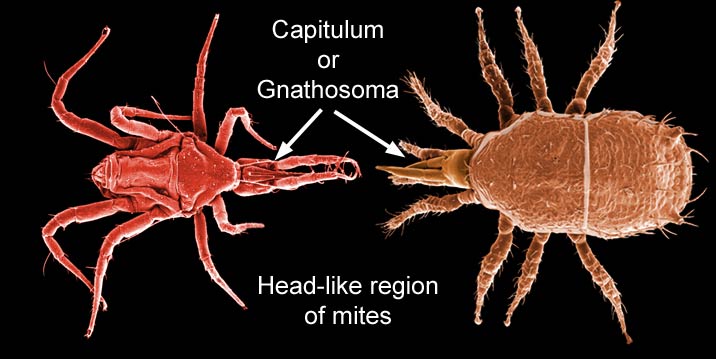
Misinterpretations allowed: Although the overall appearance of these mites can be somewhat insect-like (especially if they are larvae with only three pairs of legs), the capitulumgnathosoma:
(= capitulum) the anteriormost part of a mite or ricinuleid, composed of the cheliceral and pedipalpal segments and separated from the body (idiosoma) by a ring of soft cuticle.
does not bear eyes or antennae, and the bodybody:
the idiosoma of mites. is not segmented. (You can choose to disable "Allow misinterpretations" in the Preferences (gear icon) options.)
In many mites only one bodybody:
the idiosoma of mites. region—the idiosoma—is easily distinguished.
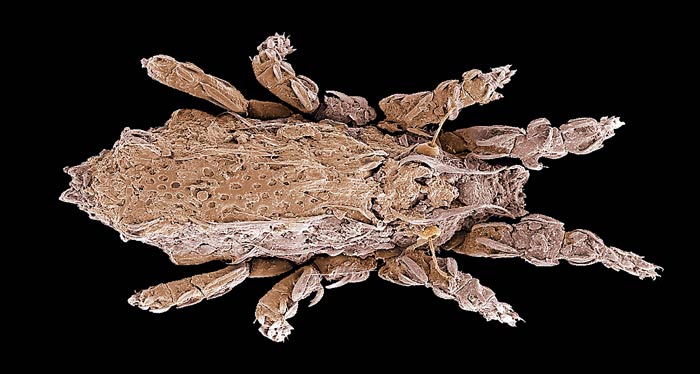
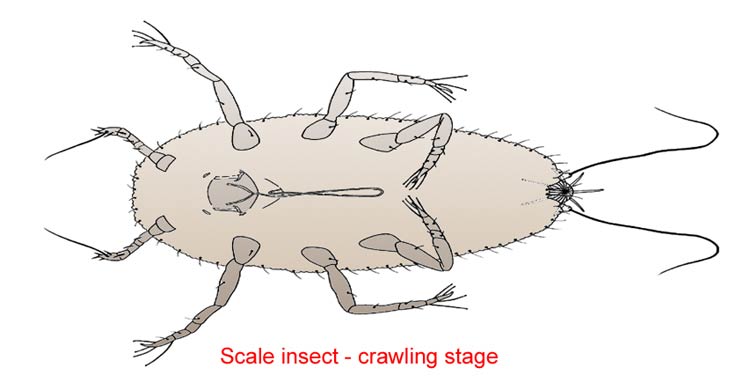
Scale insects, the immature stages of white flies, and some parasitic mites are often blob-like and even the remnants of legs can be difficult to distinguish. Tardigrades have a cephalic segment, but no distinct head and lobopods, rather than segmented legs.
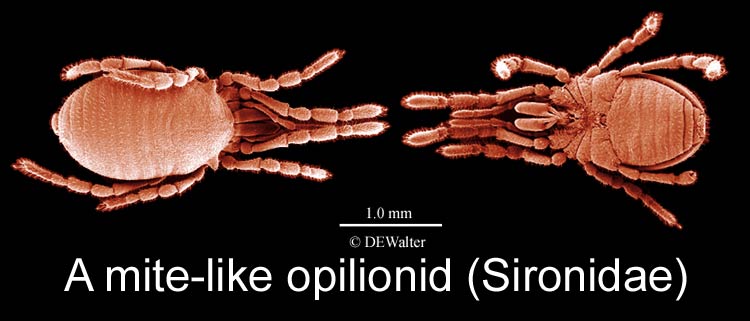
Misinterpretations allowed: Pseudoscorpions and opilionids have broad prosomal-opisthosomalopisthosomal:
(opisthosomatic) adjectival form of opisthosoma.
junctures and could be confused with mites. (You can choose to disable "Allow misinterpretations" in the Preferences (gear icon) options.)
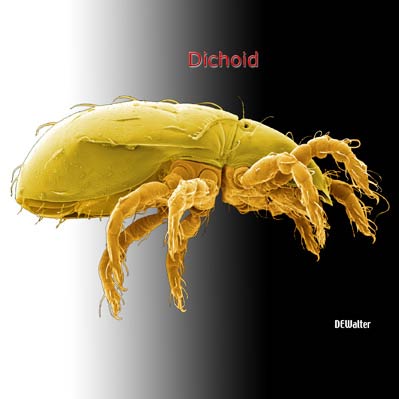
Some early derivative groups of oribatid mites have the idiosoma completely divided between legs II and III, a condition known as dichoidydichoidy:
having the body articulated between legs II-III by a flexible sejugal (protero-hystersomatic) furrow (Acariformes). (See also trichoidy, ptychoidy, holoidy).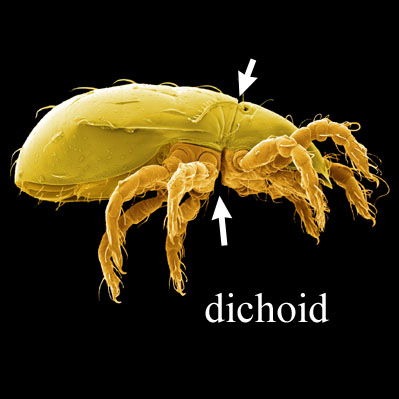 . This type of bodybody:
the idiosoma of mites. division is unique to the Acariformes.
Tardigrades have a cephalic segment, but no distinct head and lobopods, rather than segmented legs.
Misinterpretations allowed: Pseudoscorpions, opilionids, and mites do not have a head, and often lack clear separation between the bodybody:
the idiosoma of mites. regions that they have and could be misinterpreted as belonging to this couplet. (You can choose to disable "Allow misinterpretations" in the Preferences (gear icon) options.)
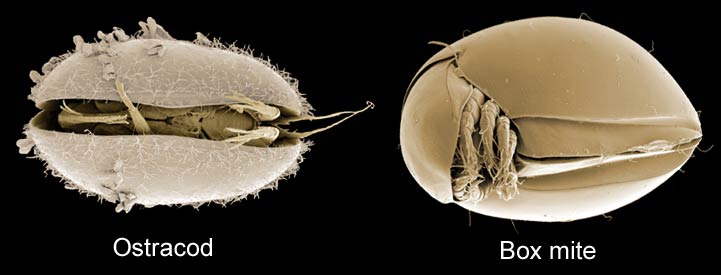
Seed shrimp (Ostracoda) have clam-like bivalvedbivalved:
with two longitudinal plates or valve-like coverings.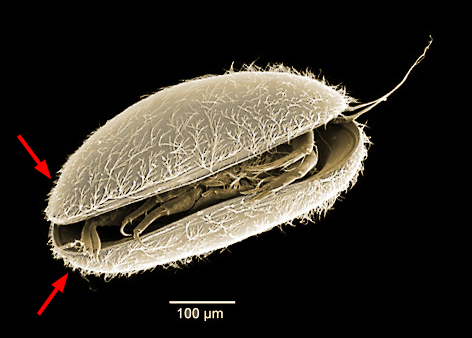 carapaces. Water fleas are enclosed in a carapacecarapace:
the shield covering the dorsal prosoma of arachnids; in some European literature, the mesostigmatan podonotal shield.
and head shield, although usually transparent and less likely to be confused with box mitesbox mites:
oribatid mites that exhibit ptychoidy, the ability to withdraw their limbs and close-up like a box.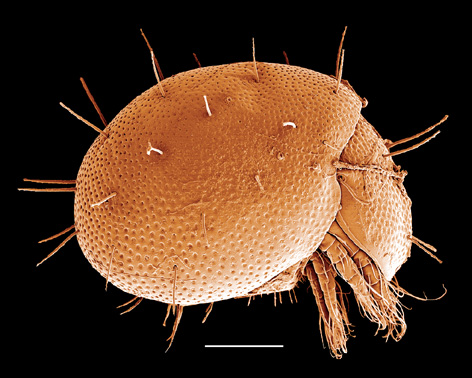 .
.
Misinterpretations allowed: Some oribatid mites or beetles could be confused with ostracods. (You can choose to disable "Allow misinterpretations" in the Preferences (gear icon) options.)
Author: David E. Walter
Content last updated Sept. 2006, unless indicated otherwise
Lucid key player updated Sept. 2025
idtools.org