Most arthropods have segmentally arranged sclerotized plates separated by soft, flexible cuticle. Clearly defined segmental plates visible on the underside of the abdomen are a clear indication that an arthropod is not a mite.
Misinterpretations allowed (you can choose to disable "Allow misinterpretations" in the Preferences (gear icon) options): Ricinuleids, some primitive oribatid mites, and some prostigmatans have series of plates that could be mistaken for segments (see Feature 4c).
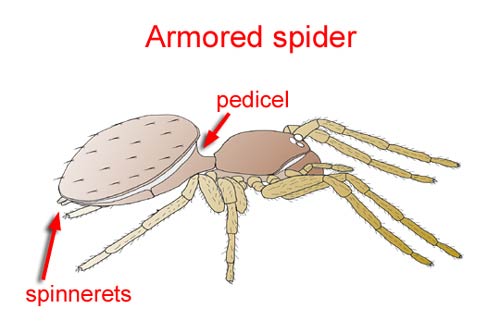
Many insects (e.g., beetles), a variety of armored mites (especially Oribatida, Uropodidae, and Labidostommatidae), and some opilionids and spiders are well protected against predation by thick sclerotization that obscures any segmentationsegmentation:
in mites distinct external segments have been lost but remnants of segmentation may be represented by hysterosomal folds or transverse arrays of setae and other cuticular sense organs. In theory, all chelicerates have a prosoma composed of 6 segments (cheliceral, pedipalpal, and four leg-bearing segments = body segments I-VI). Ventrally the positions of the prosomal segments can be identified by the insertions of their appendages, but dorsally they are obscured. The opisthosoma is thought to comprise an additional 12-13 segments (body segments VII-XVIII or XIX), but appears to be somewhat to much reduced in most mites, except possibly Opilioacarida. In early derivative Acariformes (e.g., many Endeostigmata), hysterosomal folds are thought to represent segmentation and in the Grandjean system are designated (from the sejugal furrow to the anus): C, D, E, F, H, PS AD, AN, PA. There is disagreement in the literature over the origin of 'segments' C and D. Adherents of Grandjean consider them to be opisthosomatic (with C probably representing a fusion of the pregenital [body segment VII] and genital [VIII] segments). Others believe that C and D are the dorsal regions of the last two prosomal segments that bear leggs III and IV (i.e., body segments V & VI).
that may be present dorsally.
Misinterpretations allowed: Ball-rolling millipedes and isopods have well-defined segments, and so do not meet this feature state, but are allowed as misinterpretations. (You can choose to disable "Allow misinterpretations" in the Preferences (gear icon) options.)
The bivalvedbivalved:
with two longitudinal plates or valve-like coverings.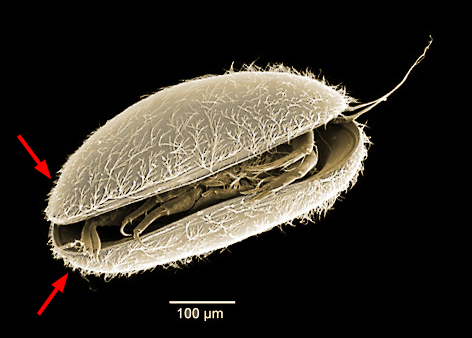 carpace of terrestrial seed shrimp (Ostracoda) is distinctive.
Misinterpretations allowed: Though distinctive, the ptychoid bodybody:
the idiosoma of mites.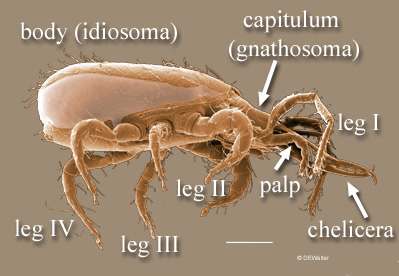 shape of box mitesbox mites:
oribatid mites that exhibit ptychoidy, the ability to withdraw their limbs and close-up like a box.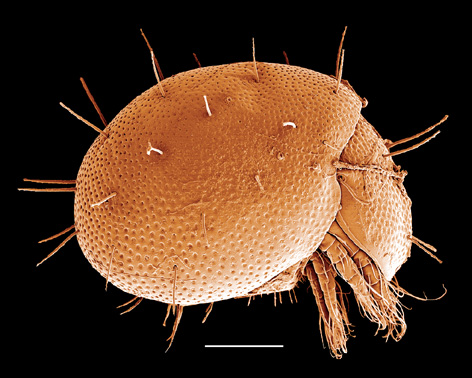 (see Feature 5d) or some ball-rolling beetles may seem similar and are allowed here as misinterpretations. (You can choose to disable "Allow misinterpretations" in the Preferences (gear icon) options.)
Ptychoidyptychoidy:
the ability of some oribatid mites to withdraw the legs between two body regions like a penknife being closed or a box being closed (hence box mites), and resulting in a seed-like appearance. A derived form of dichoidy.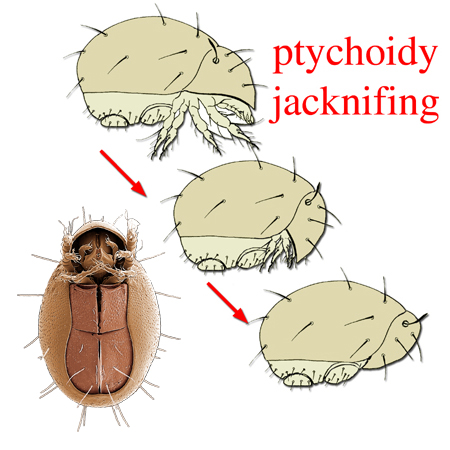 or jacknifing has evolved in several groups of oribatid mites, most notably in the box mitesbox mites:
oribatid mites that exhibit ptychoidy, the ability to withdraw their limbs and close-up like a box.. When attacked or otherwise disturbed, these mites are able to retract their legs (as a penknife is folded away) and close down the front end of the bodybody:
the idiosoma of mites. against the rear portion and present a smooth, featureless surface to the attacker. Some insects and mites are similarly able to retract their legs.
Misinterpretations allowed: Seed shrimp (Ostracoda) and water fleas (Cladocera) have a carapacecarapace:
the shield covering the dorsal prosoma of arachnids; in some European literature, the mesostigmatan podonotal shield.
(hinged in ostracods) into which the bodybody:
the idiosoma of mites. is withdrawn that could be confused with ptychoidyptychoidy:
the ability of some oribatid mites to withdraw the legs between two body regions like a penknife being closed or a box being closed (hence box mites), and resulting in a seed-like appearance. A derived form of dichoidy., and are so included here as a misinterpretation. (You can choose to disable "Allow misinterpretations" in the Preferences (gear icon) options.)
Ball rollers are strongly segmented and capable of rolling into a ball that presents the dorsaldorsal:
relating to the upper or back side; opposed to ventral.
surfaces of the sclerotized segments to an attacker. This is a common ability in isopods (pill bugs) and occurs in some millipedes (pill millipedes) and insects.
Misinterpretations allowed. Seed shrimp (Ostracoda) have a bivalved carapacecarapace:
the shield covering the dorsal prosoma of arachnids; in some European literature, the mesostigmatan podonotal shield.
into which the bodybody:
the idiosoma of mites. is withdrawn that could be confused with ball rolling and some mites are able to protect their bodies with ptychoidyptychoidy:
the ability of some oribatid mites to withdraw the legs between two body regions like a penknife being closed or a box being closed (hence box mites), and resulting in a seed-like appearance. A derived form of dichoidy. or movable pteromorphs, and so they are included here as misinterpretations. (You can choose to disable "Allow misinterpretations" in the Preferences (gear icon) options.)
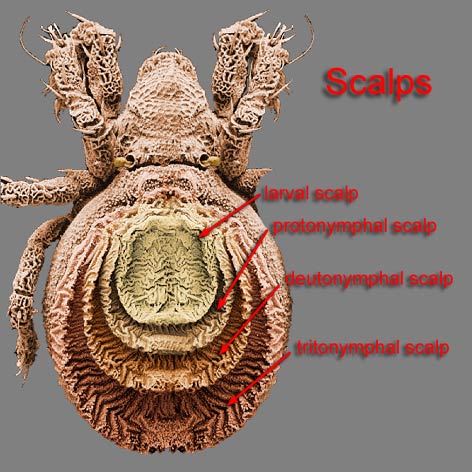
Some groups of oribatid mites retain the notogasteral portion of each molt and carry them stacked on their backs.
A few groups of oribatid mites carry the notogasteral portion of one or more immature molts on their backs. These can be raised in a pagoda-like series or only the final (tritonymphal) molt may be carried.
Some insects and mites produce waxy growths from their cuticles.
Some oribatid, uropodine and microgyniine mites produce a thick, skin-like cerotegumentcerotegument:
the outer layers of the epicuticle, including the wax and cement layers; often thin and inconspicuous, but sometimes very thick, ornamented, and obscuring the underlying cuticle; thick ceroteguments often can be peeled off to expose a very different-looking mite.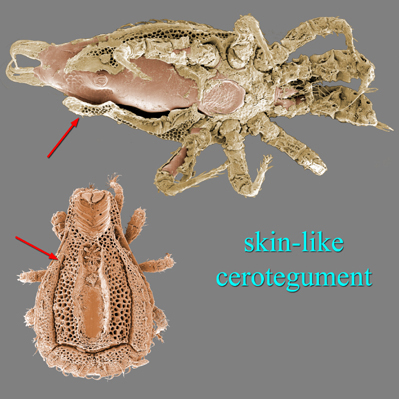 that encloses their entireentire:
a shield or sclerite with a continuous margin without incisions.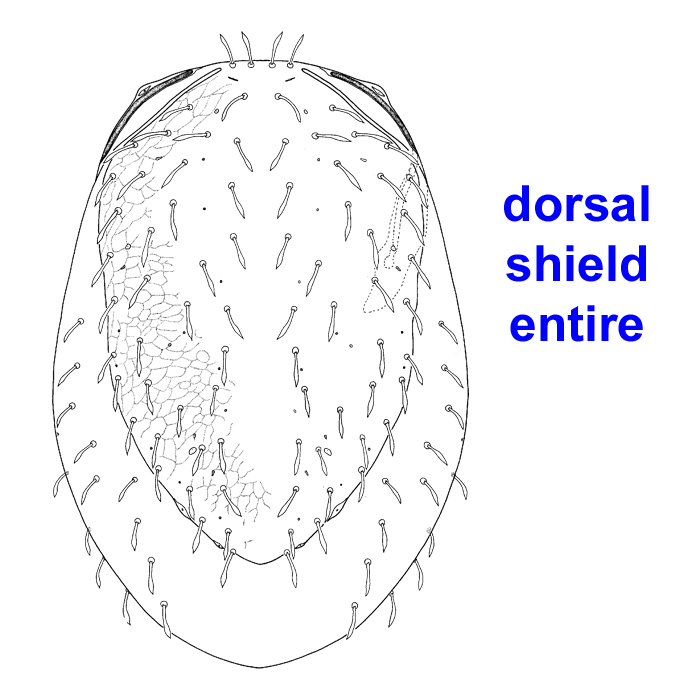 body and often bears reticulatereticulate:
foveate - having a net-like ornamentation composed of irregular, rounded cells. Also having a net-like structure; usually referring to ornamentation on shields composed of irregular, angular cells.
or papillate ornamentation.
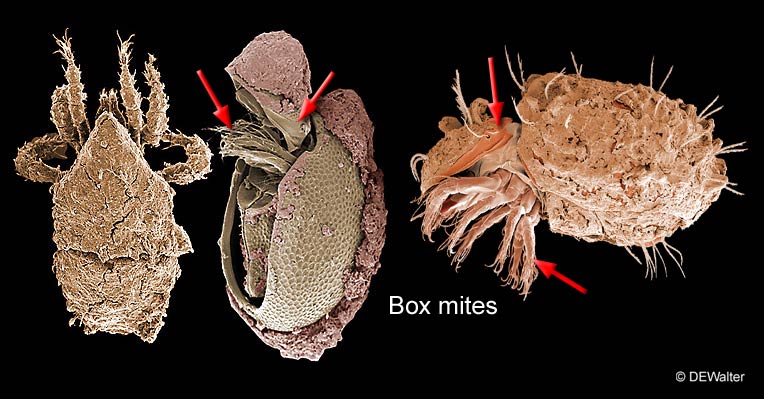
Any arthropod may have adhering soil or debris, but some oribatid and mesostigmatic mites and a few opilionids coat their bodies in a layer of soil, presumably as tactile and/or visual camouflage. Setae may project through this layer, but often the only parts of the bodybody:
the idiosoma of mites. surface visible are the joints of the legs, junctures between sclerotized plates, and areas capable of retraction, such as the legs and margins of the aspidosomaaspidosoma:
the anterior dorsal region of the prosoma in acariform mites.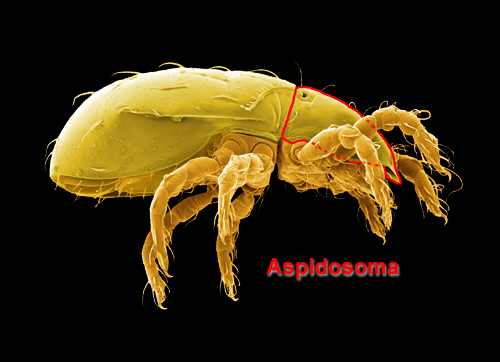 in the box mitesbox mites:
oribatid mites that exhibit ptychoidy, the ability to withdraw their limbs and close-up like a box. below. The bodybody:
the idiosoma of mites. surface can be seen by peeling away the soil layer, as in the box mite in the center below.
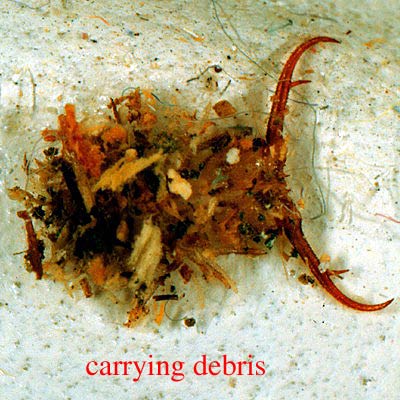
Other mites (e.g., some Tarsonemidae (Fungitarsonemus), some Uropodina), and some insects collect pieces of debris, often including balls of algae, lichens, or pollen, and pile them up in mounds or layers on their backs (presumably using a glue or wax to attach the debris).
Many mites are protected by a pincushion of long, spine-likespine-like:
a seta or other structure that resembles a thorn or spine; spiniform.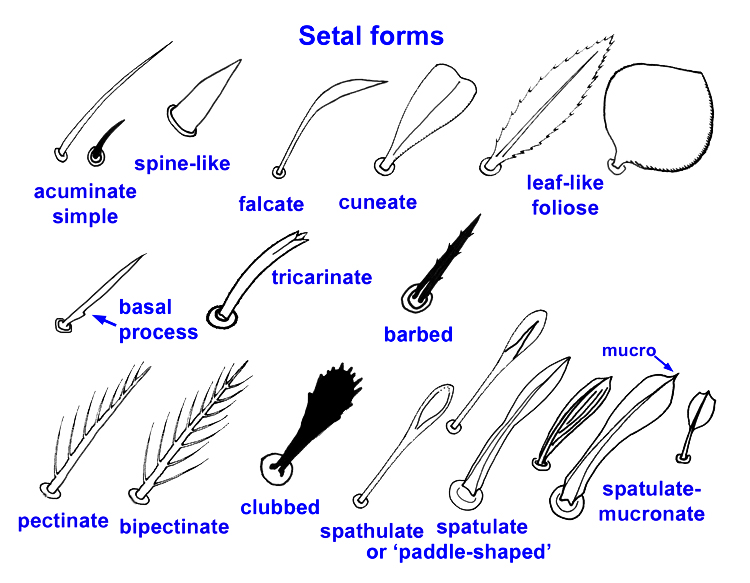 setae. Tufts of similar setae also protect polyxenid millipedes and some insects.
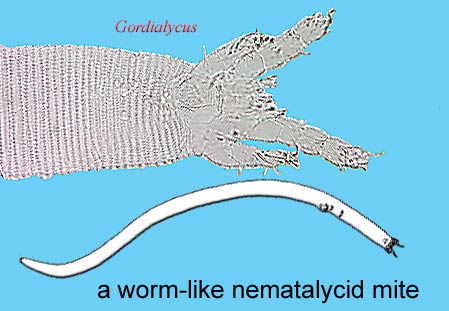
A few very strange deep-soil mites (Nematalycidae), gall and rust mitesrust mite:
leaf vagrant forms of the Eriophyoidea whose feeding causes a russet coloration on leaves.
(Eriophyoidea), and Onychophora have annulate bodies that appear worm-likeworm-like:
elongate, with reduced legs as in some Nematalycidae (Endeostigmata).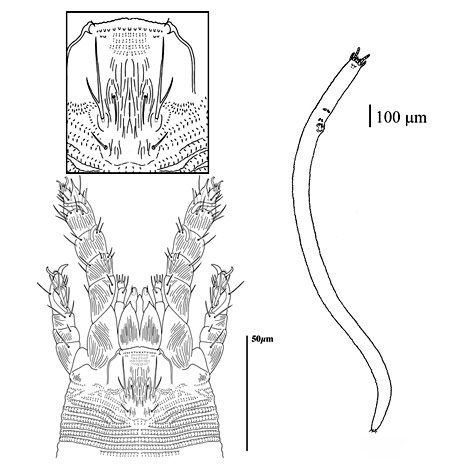 . Some immature insects are also worm-likeworm-like:
elongate, with reduced legs as in some Nematalycidae (Endeostigmata)..
Author: David E. Walter
Content last updated Sept. 2006, unless indicated otherwise
Lucid key player updated Sept. 2025
idtools.org