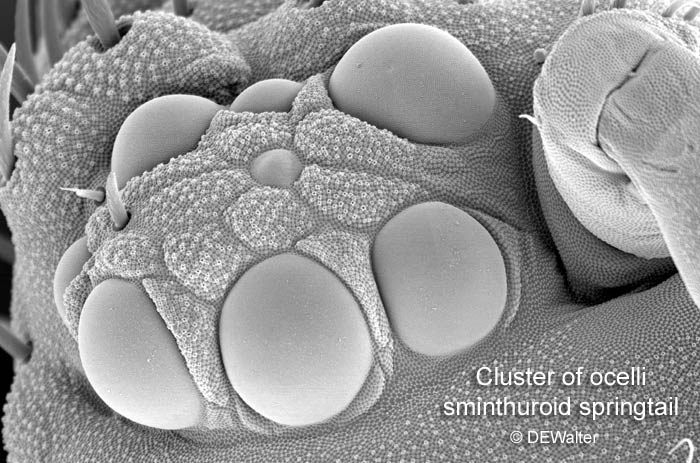
Compound eyes are found in most adult insects, and in some myriapods and crustaceans. Most arthropod intercepts with compound eyes will be insects (which may in addition have one or more dorsal ocelliocellus:
(pl. ocelli) a simple eye. Mites with eyes usually have one or two pairs of lateral ocelli, but some Opilioacarida have three pairs. Additionally, some acariform mites have one or two median ocelli on the underside of the naso.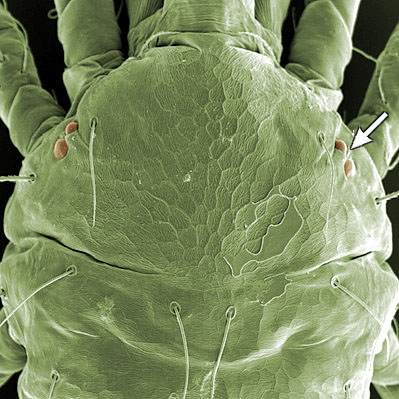 , i.e., single-lens eyes). Some collembolans and myriapods may have eye-like clusters of ocelliocellus:
(pl. ocelli) a simple eye. Mites with eyes usually have one or two pairs of lateral ocelli, but some Opilioacarida have three pairs. Additionally, some acariform mites have one or two median ocelli on the underside of the naso..
A few spiders are blind, but most will have 6–8 ocelliocellus:
(pl. ocelli) a simple eye. Mites with eyes usually have one or two pairs of lateral ocelli, but some Opilioacarida have three pairs. Additionally, some acariform mites have one or two median ocelli on the underside of the naso. (simplesimple:
unadorned; simple setae are needle-like and without hairs or pectins.
single-lensed eyes) along the frontal margin of the prosomaprosoma:
(= cephalothorax) the anterior body region in arachnids; usually not distinct in mites.
.
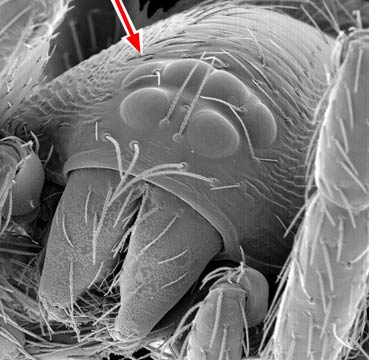
A few spiders have their ocelliocellus:
(pl. ocelli) a simple eye. Mites with eyes usually have one or two pairs of lateral ocelli, but some Opilioacarida have three pairs. Additionally, some acariform mites have one or two median ocelli on the underside of the naso. in discrete clusters, but this is more common in hexapods and myriapods.
Many mites are blind, but when present, eyes are found on the 'shoulders' region of the bodybody:
the idiosoma of mites.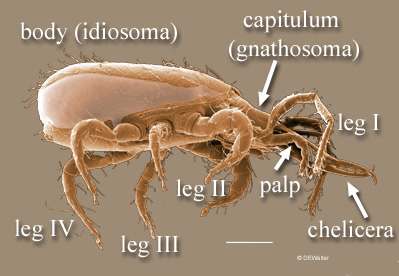 , above the legs. The eyes are simple ocelliocellus:
(pl. ocelli) a simple eye. Mites with eyes usually have one or two pairs of lateral ocelli, but some Opilioacarida have three pairs. Additionally, some acariform mites have one or two median ocelli on the underside of the naso. and typically grouped as two pairs of circular to oval lenses (often red in color). Usually they are sessile, but in some Prostigmata the posteriorposterior:
the back part of the body or towards that region in comparison, e.g., 'posterior to'.
pair are raised or on short stalks.
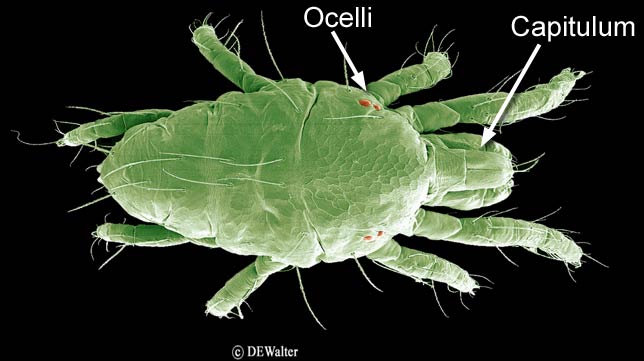
Some opilioacarans have 2 sets of 3 ocelliocellus:
(pl. ocelli) a simple eye. Mites with eyes usually have one or two pairs of lateral ocelli, but some Opilioacarida have three pairs. Additionally, some acariform mites have one or two median ocelli on the underside of the naso., but most mites have one or two pairs of eyes. In many Prostigmata, the anterior and posteriorposterior:
the back part of the body or towards that region in comparison, e.g., 'posterior to'.
members of the pair are different in form and the posteriorposterior:
the back part of the body or towards that region in comparison, e.g., 'posterior to'.
member is sometimes called the ocular bodybody:
the idiosoma of mites..
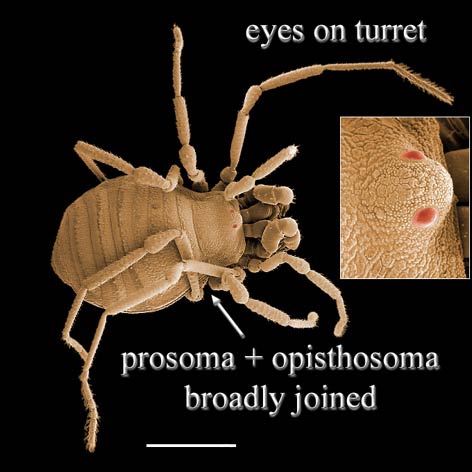
Opiliones are either blind or have a pair of ocelliocellus:
(pl. ocelli) a simple eye. Mites with eyes usually have one or two pairs of lateral ocelli, but some Opilioacarida have three pairs. Additionally, some acariform mites have one or two median ocelli on the underside of the naso. on a median turret-like projection of the prosomaprosoma:
(= cephalothorax) the anterior body region in arachnids; usually not distinct in mites.
. When such eyes are present, they are a useful character for distinguishing opilionids from mites. Unfortunately, the most mite-like opilionids are blind. Solfugids and some water mites have their ocelliocellus:
(pl. ocelli) a simple eye. Mites with eyes usually have one or two pairs of lateral ocelli, but some Opilioacarida have three pairs. Additionally, some acariform mites have one or two median ocelli on the underside of the naso. on a median ocular plate (although usually 2 pairs of ocelliocellus:
(pl. ocelli) a simple eye. Mites with eyes usually have one or two pairs of lateral ocelli, but some Opilioacarida have three pairs. Additionally, some acariform mites have one or two median ocelli on the underside of the naso.) and a few spiders have ocelliocellus:
(pl. ocelli) a simple eye. Mites with eyes usually have one or two pairs of lateral ocelli, but some Opilioacarida have three pairs. Additionally, some acariform mites have one or two median ocelli on the underside of the naso. on raised processes.
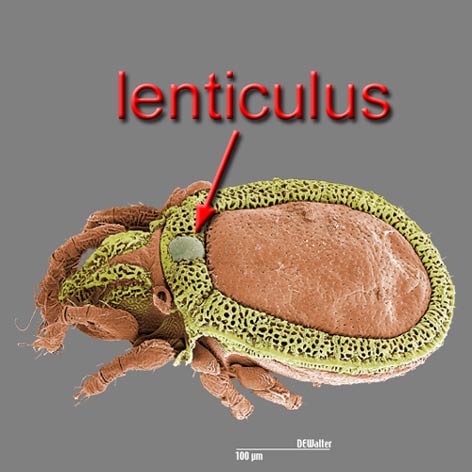
Several groups of oribatid mites appear to have independently evolved a new type of light-sensitive organ called the lenticulus. This structure is median, unpaired, and often a simplesimple:
unadorned; simple setae are needle-like and without hairs or pectins.
oval of lightly colored cuticle, but may have a distinct convex lens. It is usually situated at the anterior edge of the notogasternotogaster:
the dorsal hysterosoma, or in a more specific sense, the shield covering the dorso-lateral aspects of the hysterosoma in many oribatid mites.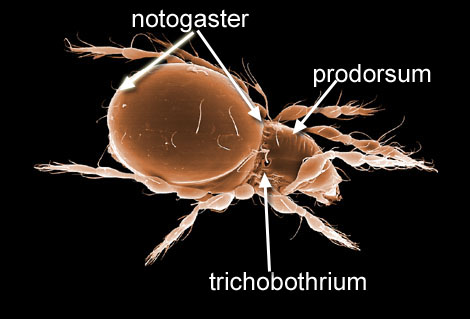 . Some early derivative acariform mites also have a single median eye, often hidden under a nose-like process above the chelicerae called the naso.
A few prostigmatans (e.g., some velvet mites) have their eyes produced on stalks. Stalkedstalked:
raised up or otherwise produced on a stalk.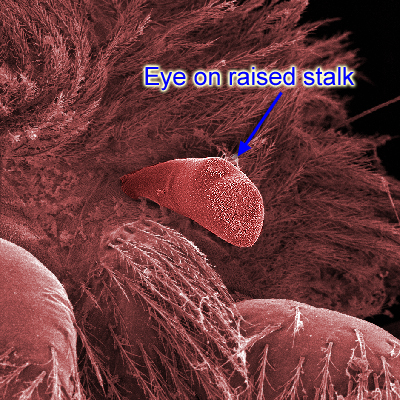 and movable compound eyes are present in many crustaceans (e.g., crabs, lobsters) and some insects have their eyes produced on fixed lateral stalks. However, these are always compound eyes; mite eyes are always simple ocelliocellus:
(pl. ocelli) a simple eye. Mites with eyes usually have one or two pairs of lateral ocelli, but some Opilioacarida have three pairs. Additionally, some acariform mites have one or two median ocelli on the underside of the naso..
Eyes are sometimes absent in most groups of small arthropods, and always absent from Palpigradi, Schizomida, Pauropoda, Symphyla, Diplura, and Protura (although the eye-like pseudoculus is present). Copopoda and Ostracoda have a naupliar eye (under the carapacecarapace:
the shield covering the dorsal prosoma of arachnids; in some European literature, the mesostigmatan podonotal shield.
in the latter) that is visible in live specimens as a black dot, but it loses its color on preservation.
Misinterpretations allowed: The ocelliocellus:
(pl. ocelli) a simple eye. Mites with eyes usually have one or two pairs of lateral ocelli, but some Opilioacarida have three pairs. Additionally, some acariform mites have one or two median ocelli on the underside of the naso. of Onychophora are small and may be difficult to see in the papillate cuticle. (You can choose to disable "Allow misinterpretations" in the Preferences (gear icon) options.)
Author: David E. Walter
Content last updated Sept. 2006, unless indicated otherwise
Lucid key player updated Sept. 2025
idtools.org