Also known as corniclescornicle:
Paired cylindrical chambers on the dorsal surface of sixth abdominal segment from which alarm pheromones are expelled. See siphunculus.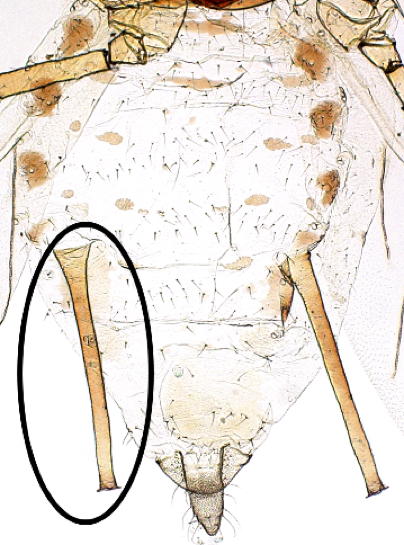 , one of the defining features of aphids
Siphunculisiphunculus:
Paired cylindrical chamber on the dorsal lateral surface of sixth abdominal segment from which alarm pheromones are expelled. See cornicle.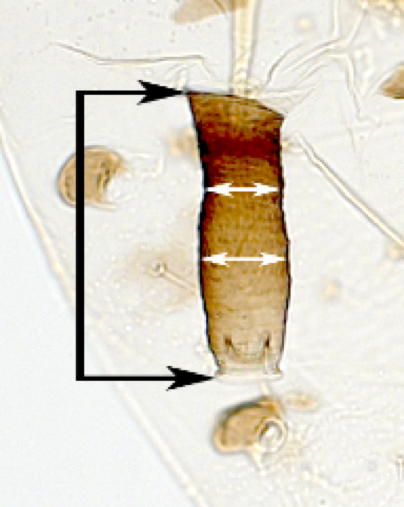 are structures located on the dorsumdorsum:
The back of the insect. See also tergum.
of the sixth abdominalabdominal:
Pertaining or belonging to the abdomen.
segment of aphids. They all have an opening or pore from which pheromones are emitted, often as liquid globules. Siphunculisiphunculus:
Paired cylindrical chamber on the dorsal lateral surface of sixth abdominal segment from which alarm pheromones are expelled. See cornicle. come in a great diversity of forms, from long cylinders to short cones to mere pores, and are absent in some species.
Some siphunculisiphunculus:
Paired cylindrical chamber on the dorsal lateral surface of sixth abdominal segment from which alarm pheromones are expelled. See cornicle. are extremely long and conspicuous, especially in many species of the tribe Macrosiphini. Note that siphunculisiphunculus:
Paired cylindrical chamber on the dorsal lateral surface of sixth abdominal segment from which alarm pheromones are expelled. See cornicle. are never perfectly cylindrical, but if they are not swollen (with a distaldistal:
Of or pertaining to a position further away, as in towards the apex of an appendage. Opposite of proximal. See also terminal and ultimate.
section thicker than a basalbasal:
Of or pertaining to the base, as in the first, or basal segment of an appendage. Opposite of terminal and apical. See also proximal.
section), or not broadly conical, they are considered cylindrical.
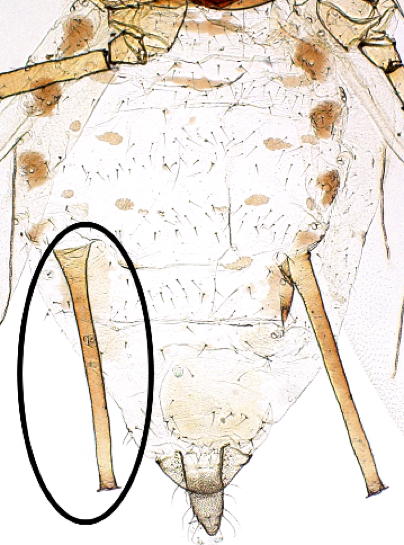
The aphid's left siphunculussiphunculus:
Paired cylindrical chamber on the dorsal lateral surface of sixth abdominal segment from which alarm pheromones are expelled. See cornicle. is circled. Note also the postsiphuncular scleritepostsiphuncular sclerite:
A sclerite on the abdominal dorsum immediately behind the base of the siphunculus.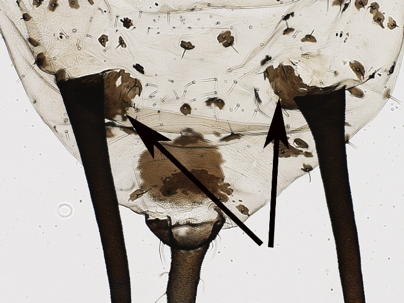 and the flange at the tip.
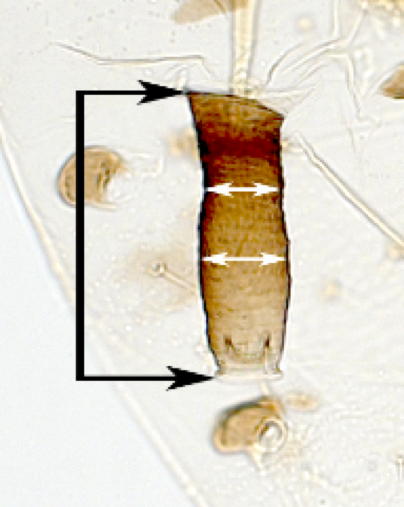
A siphunculussiphunculus:
Paired cylindrical chamber on the dorsal lateral surface of sixth abdominal segment from which alarm pheromones are expelled. See cornicle. can be long or short. Note that siphunculisiphunculus:
Paired cylindrical chamber on the dorsal lateral surface of sixth abdominal segment from which alarm pheromones are expelled. See cornicle. are never perfectly cylindrical, but if they are not swollen (with a distaldistal:
Of or pertaining to a position further away, as in towards the apex of an appendage. Opposite of proximal. See also terminal and ultimate.
section thicker than a basalbasal:
Of or pertaining to the base, as in the first, or basal segment of an appendage. Opposite of terminal and apical. See also proximal.
section), or not broadly conical, they are considered cylindrical.
Its length is measured as the shortest straight distance between its basebase:
The bottom end of a structure or appendage. The term is often used to describe that portion of the terminal antennal segment that is not the processus terminalis.
where it is attached to the aphid abomen, and the extreme distaldistal:
Of or pertaining to a position further away, as in towards the apex of an appendage. Opposite of proximal. See also terminal and ultimate.
end (black arrows). The white arrows show the measurement of the basalbasal:
Of or pertaining to the base, as in the first, or basal segment of an appendage. Opposite of terminal and apical. See also proximal.
diameter and the diameter at the approximate mid-point of the siphunculussiphunculus:
Paired cylindrical chamber on the dorsal lateral surface of sixth abdominal segment from which alarm pheromones are expelled. See cornicle..
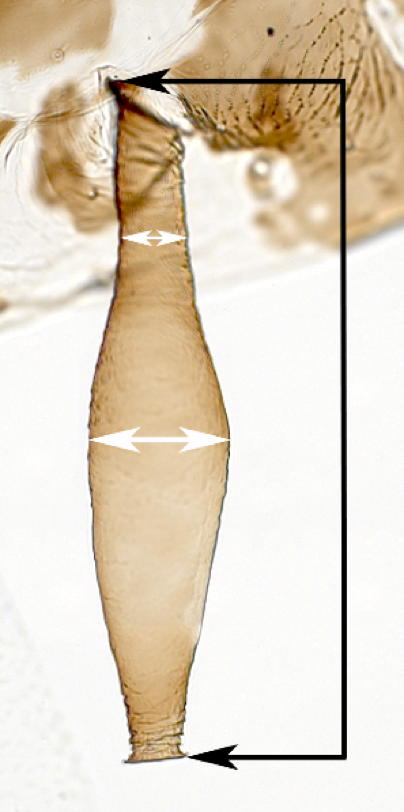
Some siphunculisiphunculus:
Paired cylindrical chamber on the dorsal lateral surface of sixth abdominal segment from which alarm pheromones are expelled. See cornicle. are visibly swollen.
Length measurement is from basebase:
The bottom end of a structure or appendage. The term is often used to describe that portion of the terminal antennal segment that is not the processus terminalis.
to tip (black arrows). The white arrows highlight measuring the diameter of the siphunculussiphunculus:
Paired cylindrical chamber on the dorsal lateral surface of sixth abdominal segment from which alarm pheromones are expelled. See cornicle. at its sub-swelling constriction and the point of maximum swelling.
Some siphunculisiphunculus:
Paired cylindrical chamber on the dorsal lateral surface of sixth abdominal segment from which alarm pheromones are expelled. See cornicle. can be extremely swollen.
Length measurement is from basebase:
The bottom end of a structure or appendage. The term is often used to describe that portion of the terminal antennal segment that is not the processus terminalis.
to tip (black arrows). The white arrows highlight measuring the diameter of the siphunculussiphunculus:
Paired cylindrical chamber on the dorsal lateral surface of sixth abdominal segment from which alarm pheromones are expelled. See cornicle. at its sub-swelling constriction and the point of maximum swelling.
Some siphunculisiphunculus:
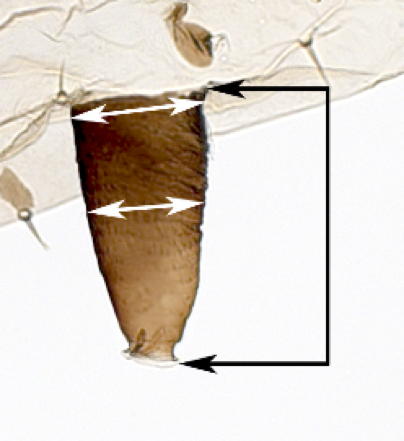
Paired cylindrical chamber on the dorsal lateral surface of sixth abdominal segment from which alarm pheromones are expelled. See cornicle. are broad cones.
These siphunculisiphunculus:
Paired cylindrical chamber on the dorsal lateral surface of sixth abdominal segment from which alarm pheromones are expelled. See cornicle. are sclerotizedsclerotized:
Descriptive of the state of being hardened. Usually refers to a structure with thickened and darkened cuticle.
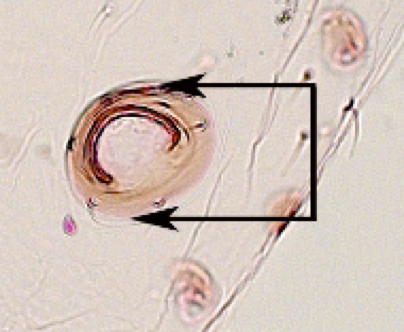
cones (black arrows). The white arrows indicate that the basalbasal:
Of or pertaining to the base, as in the first, or basal segment of an appendage. Opposite of terminal and apical. See also proximal.
diameter should be measured from the greatest opposite points, where the cone is at its broadest.
Some siphunculisiphunculus:
Paired cylindrical chamber on the dorsal lateral surface of sixth abdominal segment from which alarm pheromones are expelled. See cornicle. are short cones, often with setaeseta:
A socketed, hairlike extension of the body wall. Setae are sometimes called hairs.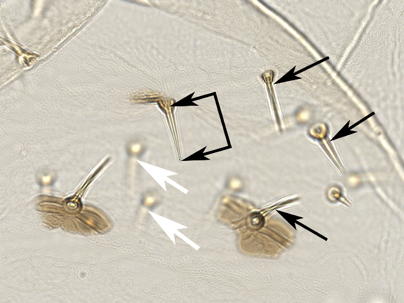 .
.
The diameter of this siphunculussiphunculus:
Paired cylindrical chamber on the dorsal lateral surface of sixth abdominal segment from which alarm pheromones are expelled. See cornicle. is little larger than its pore.
Some siphunculisiphunculus:
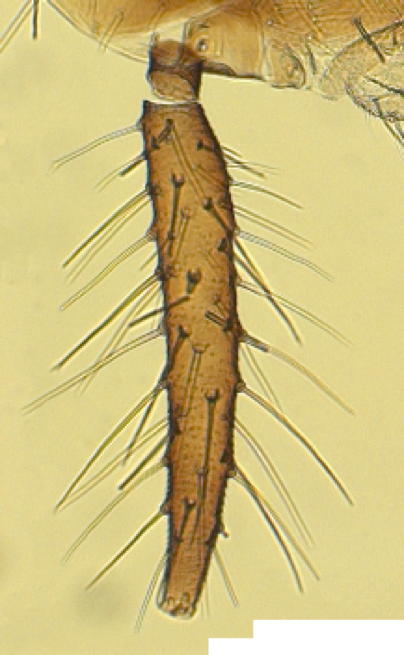
Paired cylindrical chamber on the dorsal lateral surface of sixth abdominal segment from which alarm pheromones are expelled. See cornicle. bear setaeseta:
A socketed, hairlike extension of the body wall. Setae are sometimes called hairs..
The siphunculisiphunculus:
Paired cylindrical chamber on the dorsal lateral surface of sixth abdominal segment from which alarm pheromones are expelled. See cornicle. of most aphids do not bear setaeseta:
A socketed, hairlike extension of the body wall. Setae are sometimes called hairs.. Those that do are usually conical, although there are other exceptions such as the siphunculussiphunculus:
Paired cylindrical chamber on the dorsal lateral surface of sixth abdominal segment from which alarm pheromones are expelled. See cornicle. of Greenidea psidii.
The siphunculisiphunculus:
Paired cylindrical chamber on the dorsal lateral surface of sixth abdominal segment from which alarm pheromones are expelled. See cornicle. of some species bear distinct reticulationsreticulation:
Pattern of connected polygons. In aphids usually associated with the siphunculus or abdominal cuticle.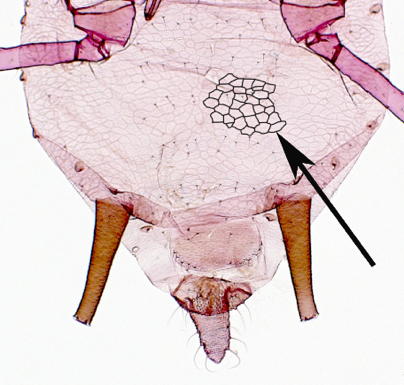 towards the distaldistal:
Of or pertaining to a position further away, as in towards the apex of an appendage. Opposite of proximal. See also terminal and ultimate.
end. The proportion of the siphunculussiphunculus:
Paired cylindrical chamber on the dorsal lateral surface of sixth abdominal segment from which alarm pheromones are expelled. See cornicle. covered in reticulationsreticulation:
Pattern of connected polygons. In aphids usually associated with the siphunculus or abdominal cuticle. can be used for species identification.
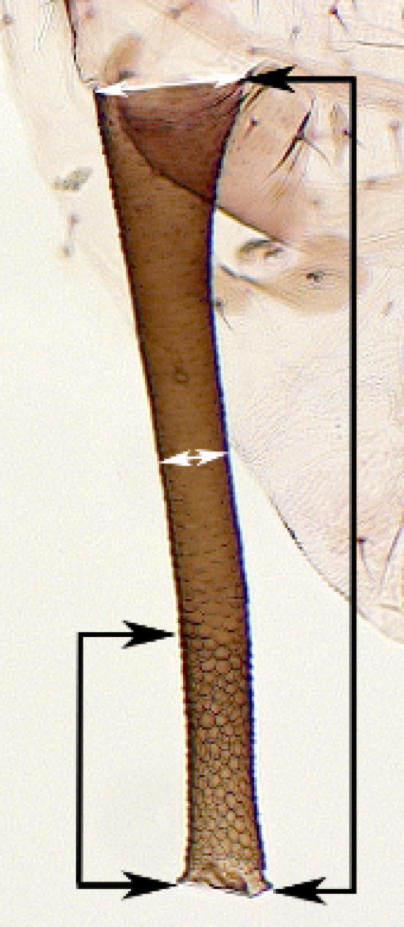
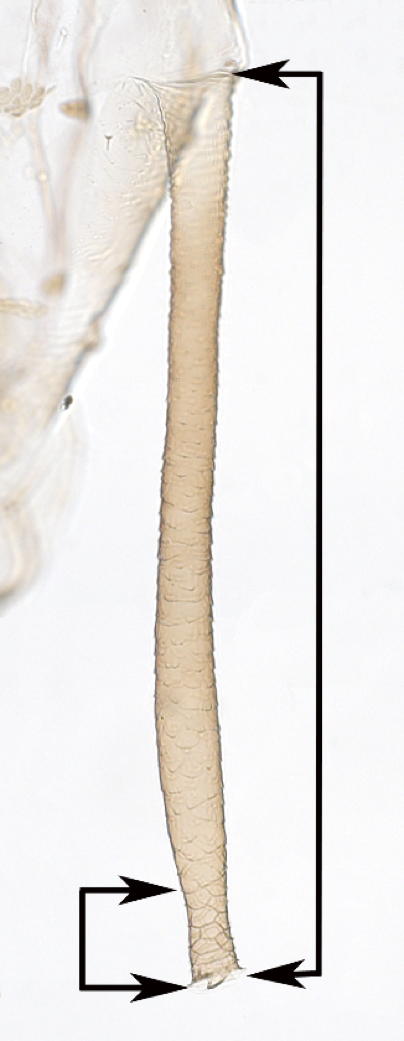
The image of this siphunculussiphunculus:
Paired cylindrical chamber on the dorsal lateral surface of sixth abdominal segment from which alarm pheromones are expelled. See cornicle. includes the measure of the length and the length of the reticulated regions (black arrows), and the basalbasal:
Of or pertaining to the base, as in the first, or basal segment of an appendage. Opposite of terminal and apical. See also proximal.
and mid-siphunculussiphunculus:
Paired cylindrical chamber on the dorsal lateral surface of sixth abdominal segment from which alarm pheromones are expelled. See cornicle. diameters (white arrows).
The image of this siphunculussiphunculus:
Paired cylindrical chamber on the dorsal lateral surface of sixth abdominal segment from which alarm pheromones are expelled. See cornicle. includes the measure of the length and the length of the reticulated regions (black arrows). Note that this siphunculussiphunculus:
Paired cylindrical chamber on the dorsal lateral surface of sixth abdominal segment from which alarm pheromones are expelled. See cornicle. is also swollen.
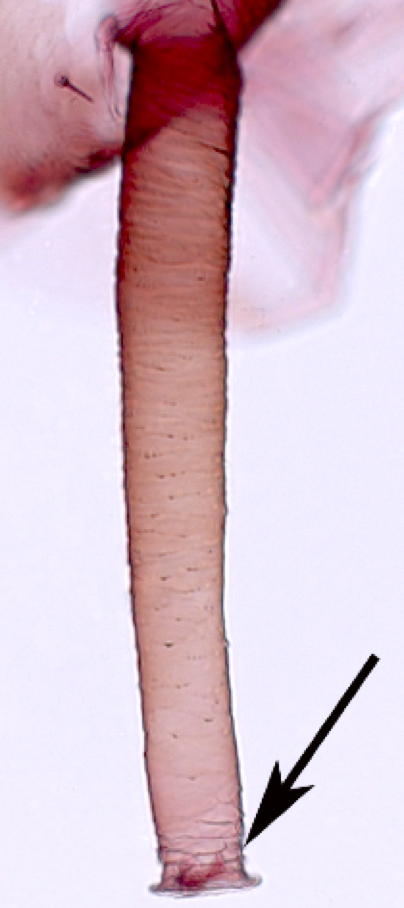
In some cases, siphunculisiphunculus:
Paired cylindrical chamber on the dorsal lateral surface of sixth abdominal segment from which alarm pheromones are expelled. See cornicle. will have a few rows of flattened polygons just under the distaldistal:
Of or pertaining to a position further away, as in towards the apex of an appendage. Opposite of proximal. See also terminal and ultimate.
flange. They are highly variable are NOT considered reticulationsreticulation:
Pattern of connected polygons. In aphids usually associated with the siphunculus or abdominal cuticle..
The arrow points to the distaldistal:
Of or pertaining to a position further away, as in towards the apex of an appendage. Opposite of proximal. See also terminal and ultimate.
polygons that are not to be considered reticulationsreticulation:
Pattern of connected polygons. In aphids usually associated with the siphunculus or abdominal cuticle..
In some species, the siphunculisiphunculus:
Paired cylindrical chamber on the dorsal lateral surface of sixth abdominal segment from which alarm pheromones are expelled. See cornicle. are completely absent. It is believed that this is a derived trait. That is, these species are evolved from species that did have siphunculisiphunculus:
Paired cylindrical chamber on the dorsal lateral surface of sixth abdominal segment from which alarm pheromones are expelled. See cornicle., but lost them over the course of time, presumably because they no longer served a purpose.
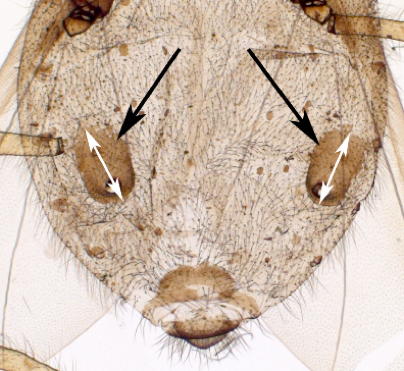
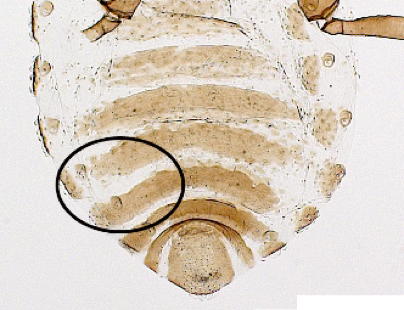
The oval shows where the left siphunculussiphunculus:
Paired cylindrical chamber on the dorsal lateral surface of sixth abdominal segment from which alarm pheromones are expelled. See cornicle. would be were there one present. Note that there are spiraclesspiracle:
An external opening of the body wall opening into a trachea. Used for breathing.
present on each abdominalabdominal:
Pertaining or belonging to the abdomen.
segment, so be sure you do not mistake a spiraclespiracle:
An external opening of the body wall opening into a trachea. Used for breathing.
for a siphunculussiphunculus:
Paired cylindrical chamber on the dorsal lateral surface of sixth abdominal segment from which alarm pheromones are expelled. See cornicle. pore, or vice versa, as some siphunculisiphunculus:
Paired cylindrical chamber on the dorsal lateral surface of sixth abdominal segment from which alarm pheromones are expelled. See cornicle. can be quite indistinct.
Authors: Favret and Miller
Content updated March 2014; nomenclature updated February 2026
idtools.org