Compound eyecompound eye:
An aggregation of individual ommatidia located on the head.
, triommatidiumtriommatidium:
A section of the compound eye, consisting of a cluster of three ommatidia, on each side of the head. In most adults, it is located on an ocular tubercle. Occasionally in apterae and immatures, the main part of the compound eye is absent and only the triommatidium is present.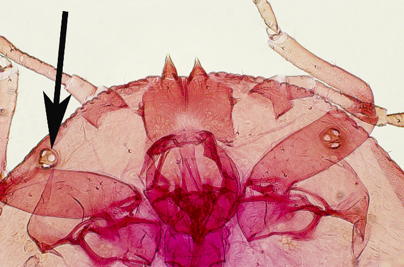 , and ocellusocellus:
A simple ocular lens on the head. Normally there are three ocelli in alatae, none in apterae.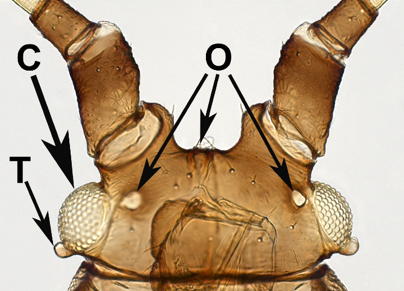
The presence or absence of compound eyescompound eye:
An aggregation of individual ommatidia located on the head.
in adult aphids can help identify species.
Most adult aphids have a pair of conspicuous compound eyescompound eye:
An aggregation of individual ommatidia located on the head.
. Most alatae also have three ocelliocellus:
A simple ocular lens on the head. Normally there are three ocelli in alatae, none in apterae. arrayed in a broad triangle on the dorsaldorsal:
Pertaining to the upper surface of the body or structure.
aspect of the headhead:
The first or most anterior region of the body, bearing primary sense organs.
. A triommatidiumtriommatidium:
A section of the compound eye, consisting of a cluster of three ommatidia, on each side of the head. In most adults, it is located on an ocular tubercle. Occasionally in apterae and immatures, the main part of the compound eye is absent and only the triommatidium is present. is often associated with the compound eyecompound eye:
An aggregation of individual ommatidia located on the head.
, located on an ocular tubercleocular tubercle:
Tubercle at the base of the compound eye bearing the triommatidium. on the posterior marginmargin:
The side of the body or a structure.
of the compound eyecompound eye:
An aggregation of individual ommatidia located on the head.
.
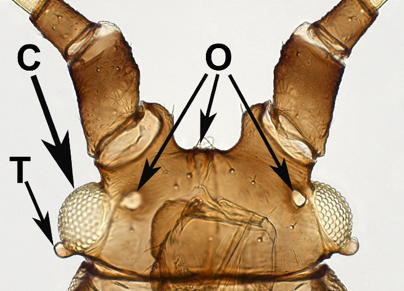
The left compound eyecompound eye:
An aggregation of individual ommatidia located on the head.
is labeled C, the left triommatidiumtriommatidium:
A section of the compound eye, consisting of a cluster of three ommatidia, on each side of the head. In most adults, it is located on an ocular tubercle. Occasionally in apterae and immatures, the main part of the compound eye is absent and only the triommatidium is present. on an ocular tubercleocular tubercle:
Tubercle at the base of the compound eye bearing the triommatidium. is labled T, and all three ocelliocellus:
A simple ocular lens on the head. Normally there are three ocelli in alatae, none in apterae. are labeled O.
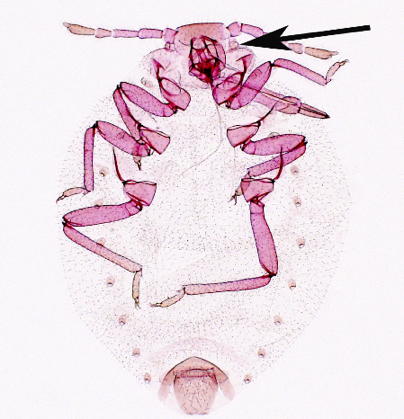
The normal compound eyescompound eye:
An aggregation of individual ommatidia located on the head.
are absent on this adult.
Only the triommatidiatriommatidium:
A section of the compound eye, consisting of a cluster of three ommatidia, on each side of the head. In most adults, it is located on an ocular tubercle. Occasionally in apterae and immatures, the main part of the compound eye is absent and only the triommatidium is present. remain (arrow). The ocelliocellus:
A simple ocular lens on the head. Normally there are three ocelli in alatae, none in apterae. are also absent.
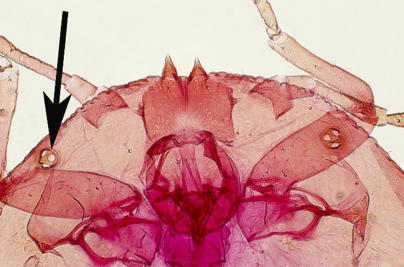
Compound eyescompound eye:
An aggregation of individual ommatidia located on the head.
reduced to just the triommatidiumtriommatidium:
A section of the compound eye, consisting of a cluster of three ommatidia, on each side of the head. In most adults, it is located on an ocular tubercle. Occasionally in apterae and immatures, the main part of the compound eye is absent and only the triommatidium is present., here still present on an ocular tubercleocular tubercle:
Tubercle at the base of the compound eye bearing the triommatidium..
Authors: Favret and Miller
Content updated March 2014; nomenclature updated February 2026
idtools.org