|
The flagellumflagellum:
The entire portion of the antenna distal to the pedicel or second segment.
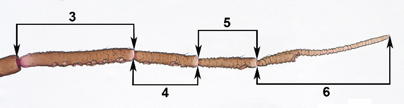
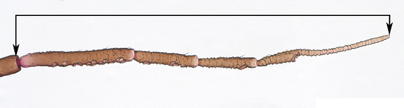 is composed of the four (or three) terminalterminal: is composed of the four (or three) terminalterminal:
Of or pertaining to the last position (e.g., terminal antennal segment). See also ultimate and distal.
segments of the antennaantenna:
The first appendage of the head of the insect.
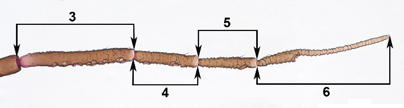 . .
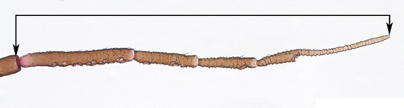
It is measured as a straight line from the basebase:
The bottom end of a structure or appendage. The term is often used to describe that portion of the terminal antennal segment that is not the processus terminalis.
of third antennalAntennal:
Of or pertaining to the antenna.
segment to the tip of the sixth (or fifth, when there are only five). In cases where the antennaantenna:
The first appendage of the head of the insect.
is strongly curved on the slide, it may be best to measure the length of the flagellumflagellum:
The entire portion of the antenna distal to the pedicel or second segment.
as the sum of its individual segments.
|
|
The length of each of the four (or three) segments of the flagellumflagellum:
The entire portion of the antenna distal to the pedicel or second segment.
are easily measured.
|
|
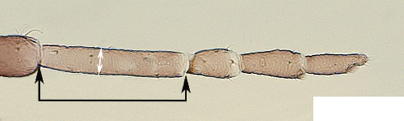
Both the length (black arrows) and diameter (white arrows) of the third antennalAntennal:
Of or pertaining to the antenna.
segment are important measurements. The number of sensoriasensorium:
Plate-like sensory organ of varying shape on any of the segments of the flagellum.
and the length of the longest setaseta:
A socketed, hairlike extension of the body wall. Setae are sometimes called hairs.
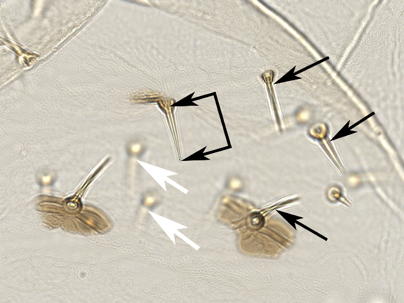 on the segment are also used. on the segment are also used.
|
|
The terminalterminal:
Of or pertaining to the last position (e.g., terminal antennal segment). See also ultimate and distal.
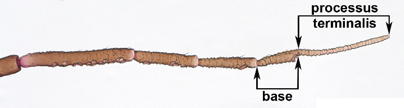
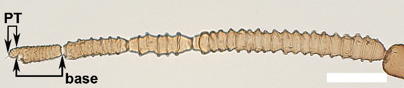
antennal segment, usually the sixth but sometimes the fifth, is divided into the basebase:
The bottom end of a structure or appendage. The term is often used to describe that portion of the terminal antennal segment that is not the processus terminalis.
and the processus terminalisprocessus terminalis:
The slender apical part of the sixth antennal segment distal to the primary sensorium on the thickened base.
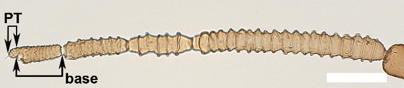 (PTPT: (PTPT:
Abbreviation for processus terminalis.
). The PTPT:
Abbreviation for processus terminalis.
is sometimes called the unguisunguis:
In aphids, the processus terminalis. In most other insects, the unguis is the tarsal claw.
, which is not to be confused with tarsal clawtarsal claw:
Curved, distally pointed, paired processes on the distal end of the last tarsal segment.
of other insects.
The basebase:
The bottom end of a structure or appendage. The term is often used to describe that portion of the terminal antennal segment that is not the processus terminalis.
of the terminalterminal:
Of or pertaining to the last position (e.g., terminal antennal segment). See also ultimate and distal.
antennal segment is measured from its basebase:
The bottom end of a structure or appendage. The term is often used to describe that portion of the terminal antennal segment that is not the processus terminalis.
to the distal marginmargin:
The side of the body or a structure.
of the primary sensoriumprimary sensorium:
A circular sensorium occurring often on the subapical part of the fifth antennal segment and always on sixth antennal segment.
. The PTPT:
Abbreviation for processus terminalis.
is measured from the distal marginmargin:
The side of the body or a structure.
of the primary sensoriumprimary sensorium:
A circular sensorium occurring often on the subapical part of the fifth antennal segment and always on sixth antennal segment.
to the tip of the antennaantenna:
The first appendage of the head of the insect.
.
|
|
The PTPT:
Abbreviation for processus terminalis.
can be longer or shorter than the basebase:
The bottom end of a structure or appendage. The term is often used to describe that portion of the terminal antennal segment that is not the processus terminalis.
of the terminalterminal:
Of or pertaining to the last position (e.g., terminal antennal segment). See also ultimate and distal.
antennal segment.
|
|
The terminalterminal:
Of or pertaining to the last position (e.g., terminal antennal segment). See also ultimate and distal.
antennal segment always bears a primary sensoriumprimary sensorium:
A circular sensorium occurring often on the subapical part of the fifth antennal segment and always on sixth antennal segment.
, sometimes with a cluster of accessory sensoriaaccessory sensorium:
A small cluster of primary sensoria adjacent to a larger primary sensorium, both occurring on the distal end of the base of the terminal antennal segment.
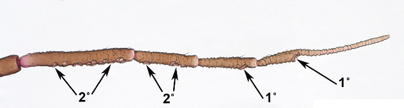
assoicated with it. The fifth antennalAntennal:
Of or pertaining to the antenna.
segment also usually bears a primary sensoriumprimary sensorium:
A circular sensorium occurring often on the subapical part of the fifth antennal segment and always on sixth antennal segment.
, and sometimes the fourth antennalAntennal:
Of or pertaining to the antenna.
segment does as well. Primary sensoriaprimary sensorium:
A circular sensorium occurring often on the subapical part of the fifth antennal segment and always on sixth antennal segment.
on the fourth and fifth segments are located towards the distaldistal:
Of or pertaining to a position further away, as in towards the apex of an appendage. Opposite of proximal. See also terminal and ultimate.
end of the segment and usually at a slight angle to the main axis of the segment (like the primary sensoriumprimary sensorium:
A circular sensorium occurring often on the subapical part of the fifth antennal segment and always on sixth antennal segment.
of the terminalterminal:
Of or pertaining to the last position (e.g., terminal antennal segment). See also ultimate and distal.
antennal segment). When present, seondary sensoriasensorium:
Plate-like sensory organ of varying shape on any of the segments of the flagellum.
, also known as rhinaria, may be found on the third, fourth, or fifth antennalAntennal:
Of or pertaining to the antenna.
segments. They are usually smaller than the primary sensoriaprimary sensorium:
A circular sensorium occurring often on the subapical part of the fifth antennal segment and always on sixth antennal segment.
and generally in the same plane as the main axis of the segment.
When counting sensoriasensorium:
Plate-like sensory organ of varying shape on any of the segments of the flagellum.
, AphID does not consider primary sensoriaprimary sensorium:
A circular sensorium occurring often on the subapical part of the fifth antennal segment and always on sixth antennal segment.
. Count only rhinaria (=secondary sensoriasensorium:
Plate-like sensory organ of varying shape on any of the segments of the flagellum.
).
|
|
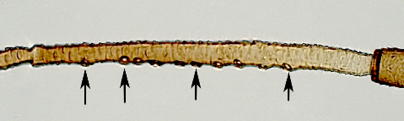
These are standard circular secondary sensoriasecondary sensorium:
Sensorium occurring on any of the third, fourth, and fifth segments of the antenna. See also rhinarium.
arrayed as a line along the full length of the third antennalAntennal:
Of or pertaining to the antenna.
segment.
|
|
These are standard circular secondary sensoriasecondary sensorium:
Sensorium occurring on any of the third, fourth, and fifth segments of the antenna. See also rhinarium.
clustered at the basebase:
The bottom end of a structure or appendage. The term is often used to describe that portion of the terminal antennal segment that is not the processus terminalis.
of the third antennalAntennal:
Of or pertaining to the antenna.
segment.
|
|
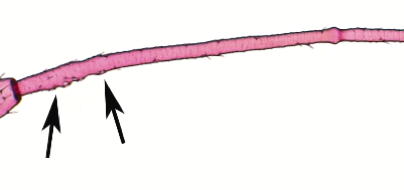
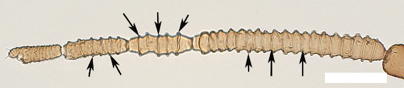
These are annular secondary sensoriasecondary sensorium:
Sensorium occurring on any of the third, fourth, and fifth segments of the antenna. See also rhinarium.
arrayed along the full length of the third, fourth, and fifth antennalAntennal:
Of or pertaining to the antenna.
segments. Each one almost completely encircles the antennaantenna:
The first appendage of the head of the insect.
.
|