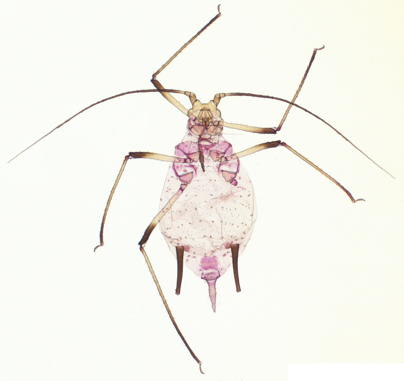
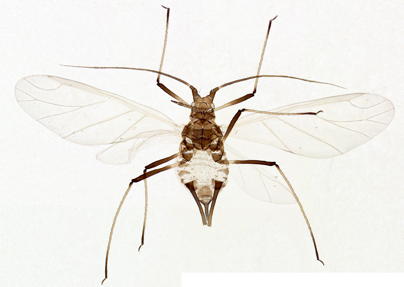
Aphid species each exhibit several biologically and morphologically different forms
Aphid species can exhibit as many as 12 different forms, or morphs, during the course of their seasonal life-cycle. AphID only considers adult female viviparaevivipara:
A female adult capable of giving birth to nymphs through live birth. Contrasts with ovipara.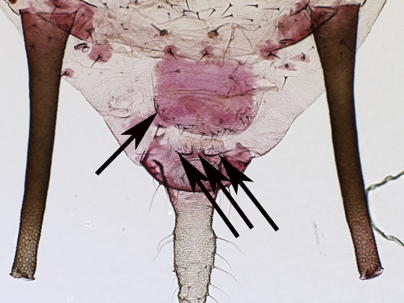 , apterous and alatealata:
An aphid with wings, except in aberrant cases always an adult.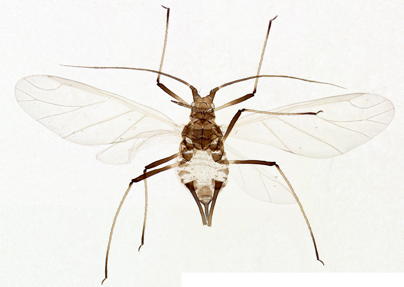 . It does not treat males, oviparaeovipara:
A female adult capable of producing eggs. Contrasts with vivipara.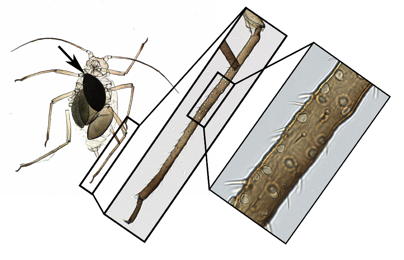 , immaturesimmature:
An individual younger than adult. An embryo or nymph.
, or any number of other specialized morphs. Before using AphID, it is important to confirm that the unidentified specimen is an adult female viviparavivipara:
A female adult capable of giving birth to nymphs through live birth. Contrasts with ovipara., and NOT an immatureimmature:
An individual younger than adult. An embryo or nymph.
, an oviparaovipara:
A female adult capable of producing eggs. Contrasts with vivipara., or a male.
The adult apterous viviparavivipara:
A female adult capable of giving birth to nymphs through live birth. Contrasts with ovipara. is specialized for asexual (parthenogenetic) reproduction. She gives live birth to genetic clonesclone:
The genetically identical offpsring, through any number of generations, of a single vivipara. Many (but not all) aphid colonies are composed of clones. Clonal lineages can extend, through parthenogenesis, for many generations and even across many years. The term usually refers to an individual aphid, but can also refer to the entire genetically homogeneous lineage.
of herself.
The alataalata:
An aphid with wings, except in aberrant cases always an adult. is equipped with wingswing:
One of four thoracic appendages used in aphid flight. Possessed by alatae (by definition). See also forewing and hindwing.
for migration or movement from one host to another. She is also very fecund, although does not typically produce quite as many offspring as her apterous sister.
The adult viviparavivipara:
A female adult capable of giving birth to nymphs through live birth. Contrasts with ovipara. can be recognized by the presence of a genital plategenital plate:
A ventral sclerite (sternite), variable in size and shape, in front of the genital opening. It is present only in adults.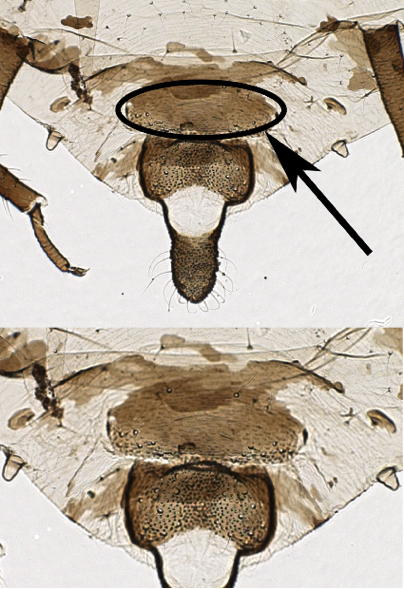 and rudimentary gonapophysesrudimentary gonapophysis:
Reduced genitalia consisting of several seta-covered bumps in the hind region of an adult female.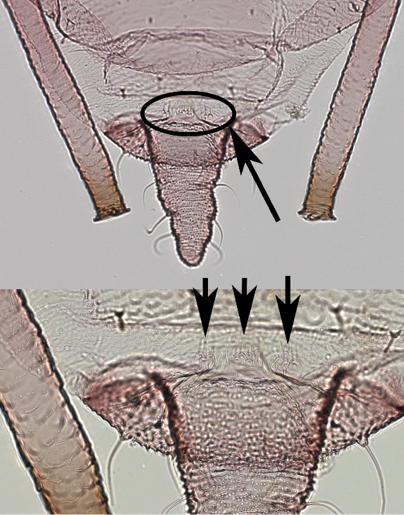 . It also frequently has embryos visible within its abdomenabdomen:
Third main body region of the aphid, consisting of eight segments.
.
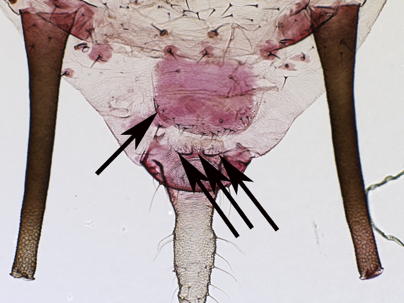
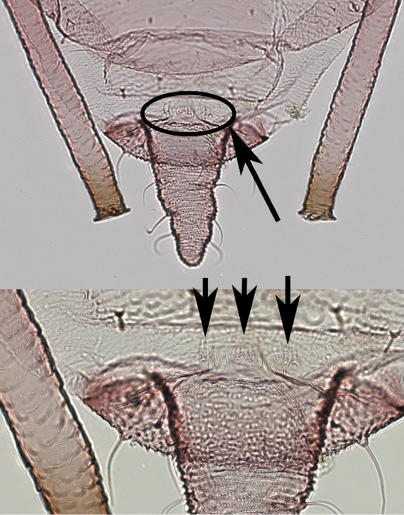
The genital plategenital plate:
A ventral sclerite (sternite), variable in size and shape, in front of the genital opening. It is present only in adults. is pointed to above and three rudimentary gonapophysesrudimentary gonapophysis:
Reduced genitalia consisting of several seta-covered bumps in the hind region of an adult female. are below. These structures can be hard to distinguish if the specimen is poorly mounted.
The genital plategenital plate:
A ventral sclerite (sternite), variable in size and shape, in front of the genital opening. It is present only in adults. is characteristic of adult aphids.
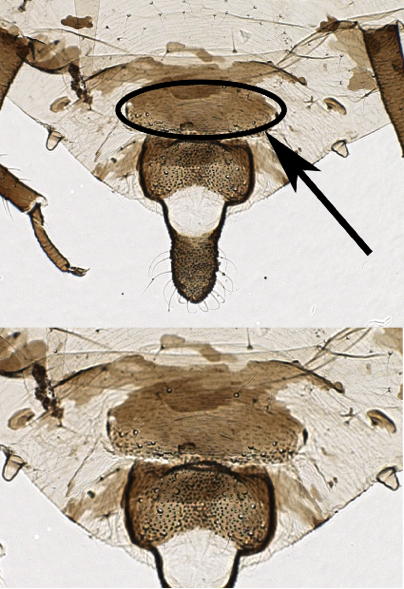
The genital plategenital plate:
A ventral sclerite (sternite), variable in size and shape, in front of the genital opening. It is present only in adults. is circled and pointed to in this image. Note the clustering of setaeseta:
A socketed, hairlike extension of the body wall. Setae are sometimes called hairs.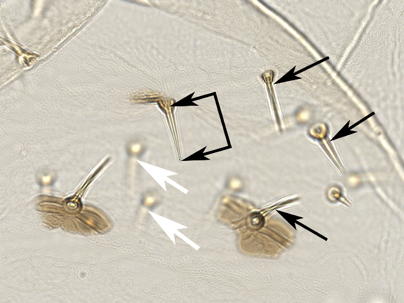 on the bottom end of the scleritesclerite:
A thickened and darkened region of the cuticle resembling a plate.
, with only a few setaeseta:
A socketed, hairlike extension of the body wall. Setae are sometimes called hairs. towards the front, and none in the middle. This is a common (but not universal) pattern of genital plate setaeseta:
A socketed, hairlike extension of the body wall. Setae are sometimes called hairs..
Viviparaevivipara:
A female adult capable of giving birth to nymphs through live birth. Contrasts with ovipara. also exhibit these structures, which are reduced and modified genitalia used in live birth. The number of gonapophysesgonapophysis:
Reduced genitalia consisting of several seta-covered bumps in the hind region of an adult female. Usually referred to as rudimentary gonapophysis. is standard among aphid groups, there usually being three or four.
Three rudimentary gonapophysesrudimentary gonapophysis:
Reduced genitalia consisting of several seta-covered bumps in the hind region of an adult female. are covered in small setaeseta:
A socketed, hairlike extension of the body wall. Setae are sometimes called hairs..
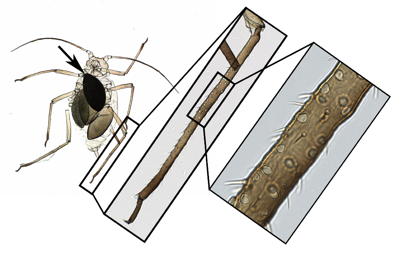
The oviparaovipara:
A female adult capable of producing eggs. Contrasts with vivipara. is usually easily recognized by having a large number of pseudosensoriapseudosensorium:
Scent glands on the metatibiae of oviparae (also rarely on viviparae), similar in appearance to rhinaria. on her metatibiametatibia:
The tibia of the metathorax, or the tibia of the hindleg.
. In some instances, if she has mated, she may also be carying eggs.
Pseudosensoriapseudosensorium:
Scent glands on the metatibiae of oviparae (also rarely on viviparae), similar in appearance to rhinaria. on the tibiatibia:
The fourth and longest segment of the leg basally attached to the femur and distally attached to the tarsus.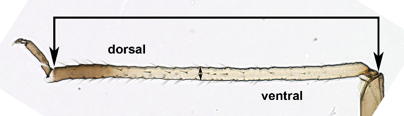 are clearly visible here. Note also the large and conspicuous eggs.
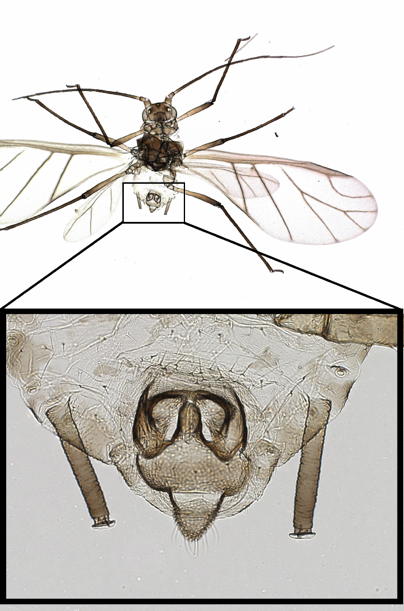
The adult male has obvious genitalia. In poor specimen preparations, however, the genitalia may be hard to distinguish from the rest of the generally heavily sclerotizedsclerotized:
Descriptive of the state of being hardened. Usually refers to a structure with thickened and darkened cuticle.
rear end of the aphid.
The genitalia on this male are clearly visible.
Authors: Favret and Miller
Content updated March 2014; nomenclature updated February 2026
idtools.org