Tuberclestubercle:
Projecting structure occurring on the surface of the cuticle. The functions of tubercles are varied, ranging from muscle attachment points to grasping points for ant mandibles. Marginal abdominal tubercles are important to aphid identification. The term tubercle can also refer to a protuberance of the head near the margin of the antennal socket: see antennal tubercle.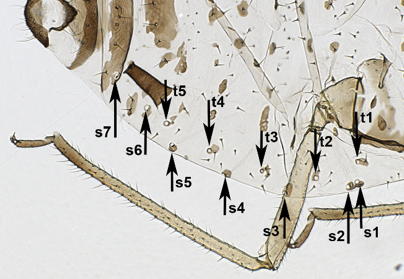 arranged singly on the laterallateral:
Pertaining to the side of the body or structure. See also marginal.
sides of abdominalabdominal:
Pertaining or belonging to the abdomen.
segments
The function of marginalmarginal:
Of or pertaining to the margin. See also lateral.
abdominal tuberclestubercle:
Projecting structure occurring on the surface of the cuticle. The functions of tubercles are varied, ranging from muscle attachment points to grasping points for ant mandibles. Marginal abdominal tubercles are important to aphid identification. The term tubercle can also refer to a protuberance of the head near the margin of the antennal socket: see antennal tubercle. is not fully understood, although ant-attended species often have large tuberclestubercle:
Projecting structure occurring on the surface of the cuticle. The functions of tubercles are varied, ranging from muscle attachment points to grasping points for ant mandibles. Marginal abdominal tubercles are important to aphid identification. The term tubercle can also refer to a protuberance of the head near the margin of the antennal socket: see antennal tubercle., suggesting they may be points of purchase as ants grasp the aphids in their mandibles. The distribution of marginal tuberclestubercle:
Projecting structure occurring on the surface of the cuticle. The functions of tubercles are varied, ranging from muscle attachment points to grasping points for ant mandibles. Marginal abdominal tubercles are important to aphid identification. The term tubercle can also refer to a protuberance of the head near the margin of the antennal socket: see antennal tubercle. on the aphid's abdomenabdomen:
Third main body region of the aphid, consisting of eight segments.
can help identify aphids. For example, species in the tribe Aphidini, including Aphis and Rhopalosiphum have tuberclestubercle:
Projecting structure occurring on the surface of the cuticle. The functions of tubercles are varied, ranging from muscle attachment points to grasping points for ant mandibles. Marginal abdominal tubercles are important to aphid identification. The term tubercle can also refer to a protuberance of the head near the margin of the antennal socket: see antennal tubercle. on abdominalabdominal:
Pertaining or belonging to the abdomen.
segments 1 and 7. Although other aphids may have marginalmarginal:
Of or pertaining to the margin. See also lateral.
abdominal tuberclestubercle:
Projecting structure occurring on the surface of the cuticle. The functions of tubercles are varied, ranging from muscle attachment points to grasping points for ant mandibles. Marginal abdominal tubercles are important to aphid identification. The term tubercle can also refer to a protuberance of the head near the margin of the antennal socket: see antennal tubercle., they do not have them on both segments 1 and 7.
Marginal tuberclestubercle:
Projecting structure occurring on the surface of the cuticle. The functions of tubercles are varied, ranging from muscle attachment points to grasping points for ant mandibles. Marginal abdominal tubercles are important to aphid identification. The term tubercle can also refer to a protuberance of the head near the margin of the antennal socket: see antennal tubercle. are sometimes difficult to distinguish from spiraclesspiracle:
An external opening of the body wall opening into a trachea. Used for breathing.
.
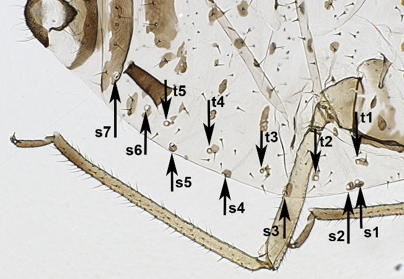
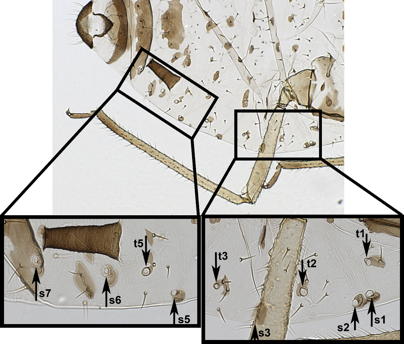
Tuberclestubercle:
Projecting structure occurring on the surface of the cuticle. The functions of tubercles are varied, ranging from muscle attachment points to grasping points for ant mandibles. Marginal abdominal tubercles are important to aphid identification. The term tubercle can also refer to a protuberance of the head near the margin of the antennal socket: see antennal tubercle. are located on this aphid on abdominalabdominal:
Pertaining or belonging to the abdomen.
segments 1 through 5 (labeled t1-t5). Spiraclesspiracle:
An external opening of the body wall opening into a trachea. Used for breathing.
are located on segments 1-7 (labeled s1-s7).
The lack of tuberclestubercle:
Projecting structure occurring on the surface of the cuticle. The functions of tubercles are varied, ranging from muscle attachment points to grasping points for ant mandibles. Marginal abdominal tubercles are important to aphid identification. The term tubercle can also refer to a protuberance of the head near the margin of the antennal socket: see antennal tubercle. on both abdominalabdominal:
Pertaining or belonging to the abdomen.
segments 1 and 7 is a key feature in AphID.
Here, although there is a tubercletubercle:
Projecting structure occurring on the surface of the cuticle. The functions of tubercles are varied, ranging from muscle attachment points to grasping points for ant mandibles. Marginal abdominal tubercles are important to aphid identification. The term tubercle can also refer to a protuberance of the head near the margin of the antennal socket: see antennal tubercle. located on abdominalabdominal:
Pertaining or belonging to the abdomen.
segment 1 (labeled t1), there is no tubercletubercle:
Projecting structure occurring on the surface of the cuticle. The functions of tubercles are varied, ranging from muscle attachment points to grasping points for ant mandibles. Marginal abdominal tubercles are important to aphid identification. The term tubercle can also refer to a protuberance of the head near the margin of the antennal socket: see antennal tubercle. on segment 7. Note that tuberclestubercle:
Projecting structure occurring on the surface of the cuticle. The functions of tubercles are varied, ranging from muscle attachment points to grasping points for ant mandibles. Marginal abdominal tubercles are important to aphid identification. The term tubercle can also refer to a protuberance of the head near the margin of the antennal socket: see antennal tubercle. are labeled t1, t2, t3, and t5, whereas spiraclesspiracle:
An external opening of the body wall opening into a trachea. Used for breathing.
are labeled s1-s3 and s5-s7.
The presence of marginal tuberclestubercle:
Projecting structure occurring on the surface of the cuticle. The functions of tubercles are varied, ranging from muscle attachment points to grasping points for ant mandibles. Marginal abdominal tubercles are important to aphid identification. The term tubercle can also refer to a protuberance of the head near the margin of the antennal socket: see antennal tubercle. on both abdominalabdominal:
Pertaining or belonging to the abdomen.
segments 1 and 7 is important to identifying some aphid species. The possible presence of tuberclestubercle:
Projecting structure occurring on the surface of the cuticle. The functions of tubercles are varied, ranging from muscle attachment points to grasping points for ant mandibles. Marginal abdominal tubercles are important to aphid identification. The term tubercle can also refer to a protuberance of the head near the margin of the antennal socket: see antennal tubercle. on other segments does not effect the importance of these particular tuberclestubercle:
Projecting structure occurring on the surface of the cuticle. The functions of tubercles are varied, ranging from muscle attachment points to grasping points for ant mandibles. Marginal abdominal tubercles are important to aphid identification. The term tubercle can also refer to a protuberance of the head near the margin of the antennal socket: see antennal tubercle..
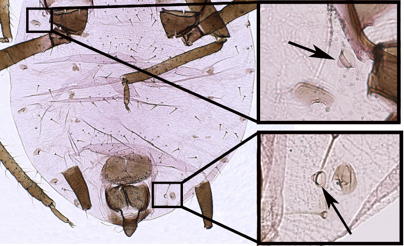
Close-up images of a tubercletubercle:
Projecting structure occurring on the surface of the cuticle. The functions of tubercles are varied, ranging from muscle attachment points to grasping points for ant mandibles. Marginal abdominal tubercles are important to aphid identification. The term tubercle can also refer to a protuberance of the head near the margin of the antennal socket: see antennal tubercle. on the left side of abdominalabdominal:
Pertaining or belonging to the abdomen.
segment 1 and a tubercletubercle:
Projecting structure occurring on the surface of the cuticle. The functions of tubercles are varied, ranging from muscle attachment points to grasping points for ant mandibles. Marginal abdominal tubercles are important to aphid identification. The term tubercle can also refer to a protuberance of the head near the margin of the antennal socket: see antennal tubercle. on the right side of abdominalabdominal:
Pertaining or belonging to the abdomen.
segment 7 (black arrows). Note also the nearby spiraclespiracle:
An external opening of the body wall opening into a trachea. Used for breathing.
in both cases.
Authors: Favret and Miller
Content updated March 2014; nomenclature updated February 2026
idtools.org