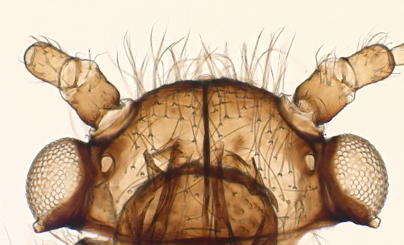
Outgrowths of the headhead:
The first or most anterior region of the body, bearing primary sense organs.
associated with the antennal socketantennal socket:
The opening in the head where the antenna is connected.
Antennal tuberclesantennal tubercle:
An extension of the head near the medial margin of the antennal socket.
are misnamed as they are not actually tuberclestubercle:
Projecting structure occurring on the surface of the cuticle. The functions of tubercles are varied, ranging from muscle attachment points to grasping points for ant mandibles. Marginal abdominal tubercles are important to aphid identification. The term tubercle can also refer to a protuberance of the head near the margin of the antennal socket: see antennal tubercle.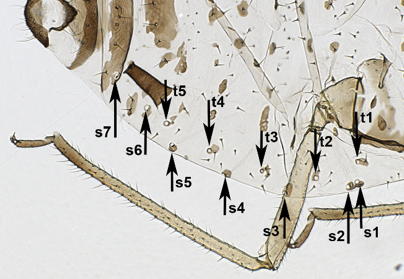 , but an integral part of the headhead:
The first or most anterior region of the body, bearing primary sense organs.
. They are associated with the antennal socketantennal socket:
The opening in the head where the antenna is connected.
and are not actually part of the antennaantenna:
The first appendage of the head of the insect.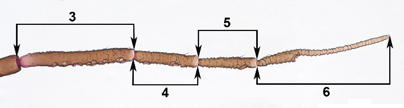 . In some aphids, there are projections on the first antennalAntennal:
Of or pertaining to the antenna.
segment, but these are not antennal tuberclesantennal tubercle:
An extension of the head near the medial margin of the antennal socket.
in the sense used in aphid morphology.
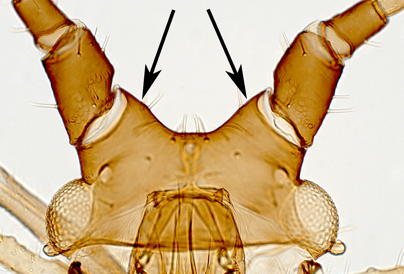
These antennal tuberclesantennal tubercle:
An extension of the head near the medial margin of the antennal socket.
diverge from one another and are smooth.
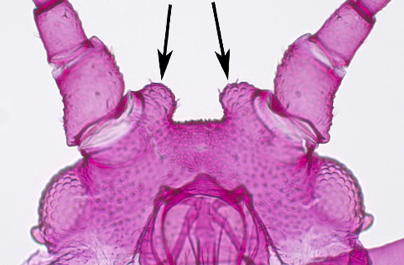
These antennal tuberclesantennal tubercle:
An extension of the head near the medial margin of the antennal socket.
are parallel and scabrous.
In AphID, all tuberclestubercle:
Projecting structure occurring on the surface of the cuticle. The functions of tubercles are varied, ranging from muscle attachment points to grasping points for ant mandibles. Marginal abdominal tubercles are important to aphid identification. The term tubercle can also refer to a protuberance of the head near the margin of the antennal socket: see antennal tubercle., when well developed, are considered either 1) parallel to converging or 2) parallel to diverging. In no case in AphID are the antennal tuberclesantennal tubercle:
An extension of the head near the medial margin of the antennal socket.
of an aphid species exclusively parallel. Thus, coding a specimen as having parallel antennal tuberclesantennal tubercle:
An extension of the head near the medial margin of the antennal socket.
will actually permit it to have any of the three.
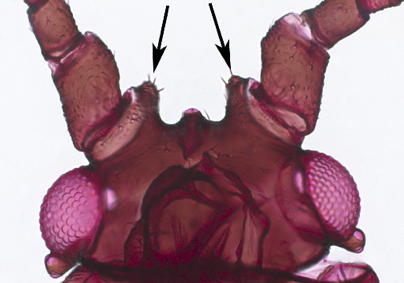
These antennal tuberclesantennal tubercle:
An extension of the head near the medial margin of the antennal socket.
are converging on one another and are scabrous.
Many aphid species have reduced antennal tuberclesantennal tubercle:
An extension of the head near the medial margin of the antennal socket.
. These are obviously undeveloped and in AphID fall into the same category as those species that have no antennal tuberclesantennal tubercle:
An extension of the head near the medial margin of the antennal socket.
at all.
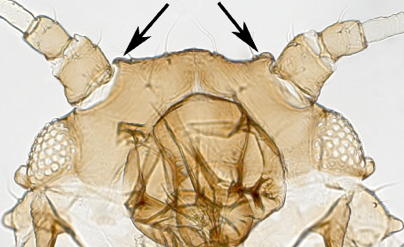
Some aphid species clearly have no antennal tuberclesantennal tubercle:
An extension of the head near the medial margin of the antennal socket.
at all.
Authors: Favret and Miller
Content updated March 2014; nomenclature updated February 2026
idtools.org