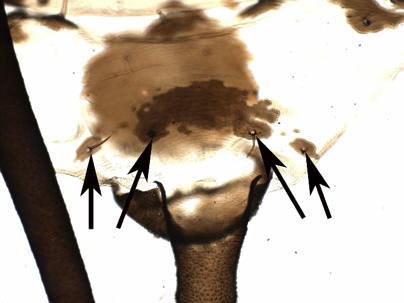
Sometimes simply referred to as hairshair:
Incorrect term sometimes used in place of seta.
, setaeseta:
A socketed, hairlike extension of the body wall. Setae are sometimes called hairs.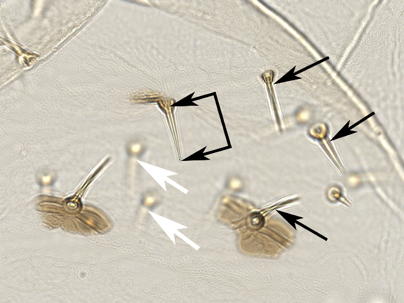 often cover much of an aphid's body
Setaeseta:
A socketed, hairlike extension of the body wall. Setae are sometimes called hairs. can come in a wide variety of shapes and sizes. They are most often defined by their length and by the shape of their points: sharp, fine, incrassate, spatulate, etc. AphID only uses their lengths.
Setaeseta:
A socketed, hairlike extension of the body wall. Setae are sometimes called hairs. should be measured from basebase:
The bottom end of a structure or appendage. The term is often used to describe that portion of the terminal antennal segment that is not the processus terminalis.
to apexapex:
The far distal end of a structure. Opposite of base.
.
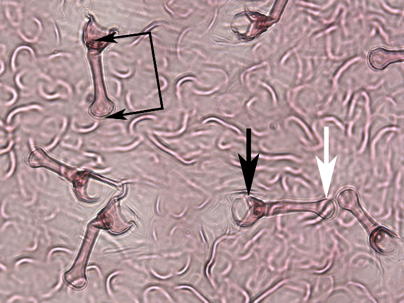
Bracketed arrows show the points at which to measure the setaseta:
A socketed, hairlike extension of the body wall. Setae are sometimes called hairs. length. Note that these setaeseta:
A socketed, hairlike extension of the body wall. Setae are sometimes called hairs. are located on small tuberclestubercle:
Projecting structure occurring on the surface of the cuticle. The functions of tubercles are varied, ranging from muscle attachment points to grasping points for ant mandibles. Marginal abdominal tubercles are important to aphid identification. The term tubercle can also refer to a protuberance of the head near the margin of the antennal socket: see antennal tubercle.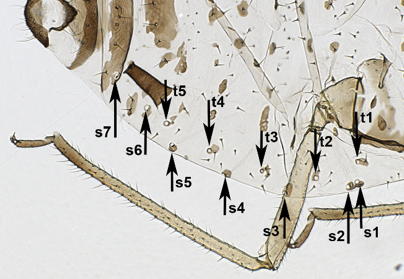 (single black arrow). The setaseta:
A socketed, hairlike extension of the body wall. Setae are sometimes called hairs. length should not include the tubercletubercle:
Projecting structure occurring on the surface of the cuticle. The functions of tubercles are varied, ranging from muscle attachment points to grasping points for ant mandibles. Marginal abdominal tubercles are important to aphid identification. The term tubercle can also refer to a protuberance of the head near the margin of the antennal socket: see antennal tubercle., but unlike this example, in most cases, the tubercletubercle:
Projecting structure occurring on the surface of the cuticle. The functions of tubercles are varied, ranging from muscle attachment points to grasping points for ant mandibles. Marginal abdominal tubercles are important to aphid identification. The term tubercle can also refer to a protuberance of the head near the margin of the antennal socket: see antennal tubercle. base is extremely small and accidentally including it in a measurement is inconsequential. Note that these setaeseta:
A socketed, hairlike extension of the body wall. Setae are sometimes called hairs. are spatulate, having a broadened tip (white arrow).
Dorsaldorsal:
Pertaining to the upper surface of the body or structure.
abdominal setaeseta:
A socketed, hairlike extension of the body wall. Setae are sometimes called hairs. can sometimes be hard to distinguish from ventralventral:
Of or pertaining to the lower surface of the body or structure.
abdominal setaeseta:
A socketed, hairlike extension of the body wall. Setae are sometimes called hairs. because the abdomenabdomen:
Third main body region of the aphid, consisting of eight segments.
is flattened in slide-prepared aphids. The focal planes for dorsaldorsal:
Pertaining to the upper surface of the body or structure.
and ventral setaeseta:
A socketed, hairlike extension of the body wall. Setae are sometimes called hairs. are often close, and often overlap if the dorsumdorsum:
The back of the insect. See also tergum.
or venterventer:
The lower aspect of the body, or the belly of the insect.
is not completely flattened. Although ventral setaeseta:
A socketed, hairlike extension of the body wall. Setae are sometimes called hairs. tend to be longer and thinner than dorsal setaeseta:
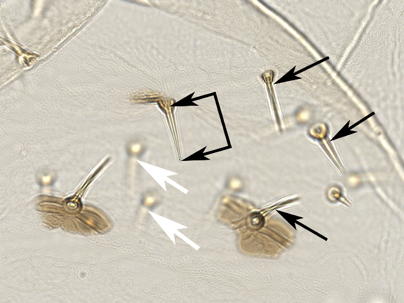
A socketed, hairlike extension of the body wall. Setae are sometimes called hairs., be sure to focus up and down on the specimen to help distinguish them. The black arrows point to dorsal setaeseta:
A socketed, hairlike extension of the body wall. Setae are sometimes called hairs., several of which are on scleroitesscleroite:
A small sclerite restricted to and encircling the base of a single seta.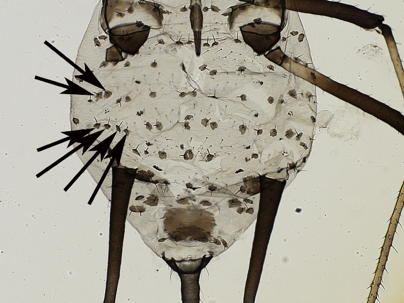 . The white arrows point to ventral setaeseta:
A socketed, hairlike extension of the body wall. Setae are sometimes called hairs. which are out of focus.
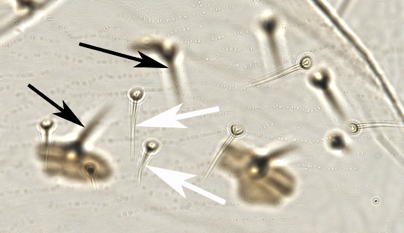
The black arrows point to dorsal setaeseta:
A socketed, hairlike extension of the body wall. Setae are sometimes called hairs. out of focus, several of which are on scleroitesscleroite:
A small sclerite restricted to and encircling the base of a single seta.. The white arrows point to ventral setaeseta:
A socketed, hairlike extension of the body wall. Setae are sometimes called hairs..
The number of setaeseta:
A socketed, hairlike extension of the body wall. Setae are sometimes called hairs. on the eighth abdominal tergumtergum:
The dorsal cuticle of the body.
(the dorsumdorsum:
The back of the insect. See also tergum.
of the last abdominalabdominal:
Pertaining or belonging to the abdomen.
segment) can be important to identify some species of aphid.
The eighth tergum setaeseta:
A socketed, hairlike extension of the body wall. Setae are sometimes called hairs. are often all or mostly located on a tergitetergite:
A dorsal sclerite, or subdivisions thereof.
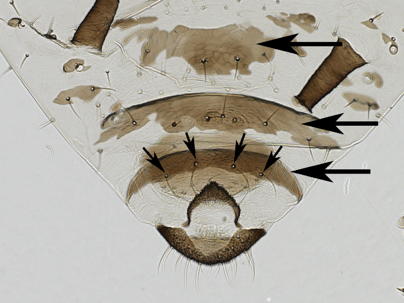
. Here four small arrows point to the setaeseta:
A socketed, hairlike extension of the body wall. Setae are sometimes called hairs., whereas the three large arrows point to the sixth, seventh, and eighth abdominal tergitestergite:
A dorsal sclerite, or subdivisions thereof.
.
Most aphids have two or four setaeseta:
A socketed, hairlike extension of the body wall. Setae are sometimes called hairs. on their eighth abdominal tergumtergum:
The dorsal cuticle of the body.
.
These setaeseta:
A socketed, hairlike extension of the body wall. Setae are sometimes called hairs. are located on separate scleritessclerite:
A thickened and darkened region of the cuticle resembling a plate.
.
Authors: Favret and Miller
Content updated March 2014; nomenclature updated February 2026
idtools.org