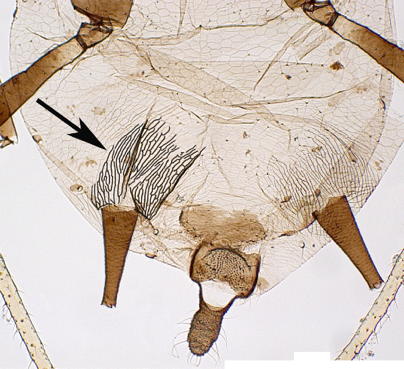
Consisting of abdominal striationsabdominal striation:
A row of polygonal ridges, bearing shortened spines, on the dorsal lateral surface of abdominal segments 5–7 for stridulation. See rastral spines.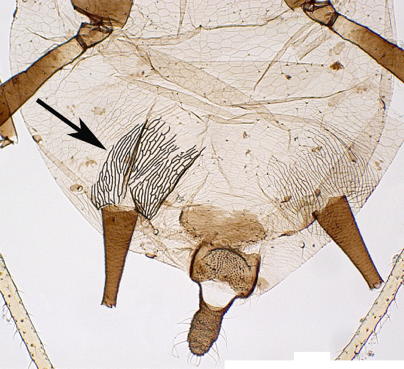 and rastral spinesrastral spine:
A row of polygonal ridges, bearing shortened spines, on the dorsal lateral surface of abdominal segments 5–7 for stridulation. See abdominal striation.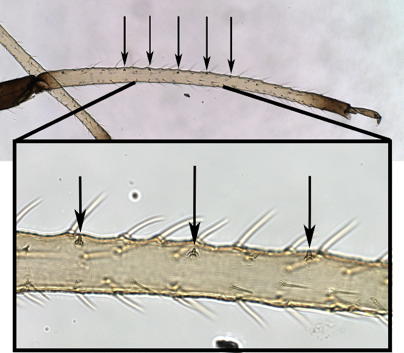
Found principally in Toxoptera, the stridulatory apparatusstridulatory apparatus:
Sound producing organ consisting of a row of peg-like setae on the inner surfaces of the metatibiae and striations on the ventral lateral areas of abdominal segments 5 and 6. consists of ridges on the abdomenabdomen:
Third main body region of the aphid, consisting of eight segments.
and pegs on the hind tibiatibia:
The fourth and longest segment of the leg basally attached to the femur and distally attached to the tarsus.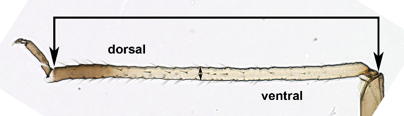 . The aphid produces sound by rubbing the pegs on its legsleg:
One of six ambulatory appendages of the thorax. Each leg is composed of the coxa, trochanter, femur, tibia, basitarsus, distitarsus, and tarsal claw.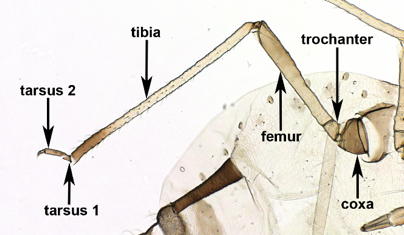 across the abdominalabdominal:
Pertaining or belonging to the abdomen.
ridges. Aphis eugeniae exhibits the tibial pegstibial peg:
A row of peglike setae on the inner surface of the metatibiae for stridulation. See rastral setae. but not the abdominal striationsabdominal striation:
A row of polygonal ridges, bearing shortened spines, on the dorsal lateral surface of abdominal segments 5–7 for stridulation. See rastral spines..
The abdominalabdominal:
Pertaining or belonging to the abdomen.
portion of the stridulatory apparatusstridulatory apparatus:
Sound producing organ consisting of a row of peg-like setae on the inner surfaces of the metatibiae and striations on the ventral lateral areas of abdominal segments 5 and 6. consists of striations, or ridges, on the ventralventral:
Of or pertaining to the lower surface of the body or structure.
lateral regions of abdominalabdominal:
Pertaining or belonging to the abdomen.
segments 5 and 6, near the siphunculisiphunculus:
Paired cylindrical chamber on the dorsal lateral surface of sixth abdominal segment from which alarm pheromones are expelled. See cornicle.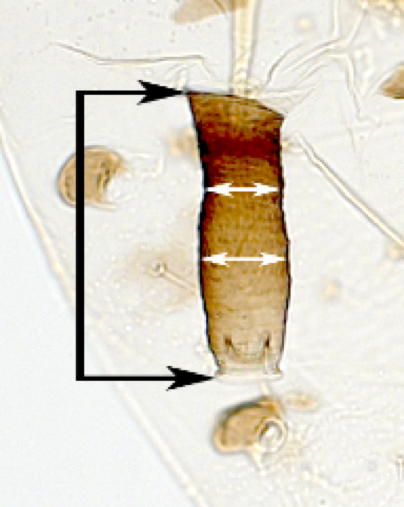 .
.
The image here shows the striations, highlighted for clarity.
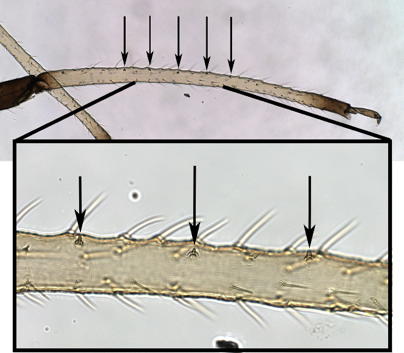
Along most of the length of the hind tibiatibia:
The fourth and longest segment of the leg basally attached to the femur and distally attached to the tarsus. is a row of spines or peg-like setaeseta:
A socketed, hairlike extension of the body wall. Setae are sometimes called hairs.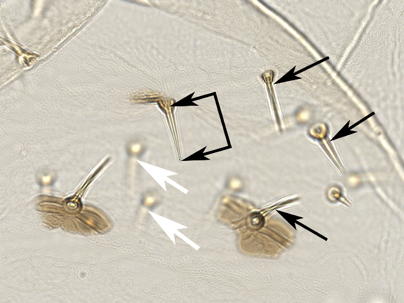 .
.
This image highlights the tibial pegstibial peg:
A row of peglike setae on the inner surface of the metatibiae for stridulation. See rastral setae., which are different than the other tibial setaeseta:
A socketed, hairlike extension of the body wall. Setae are sometimes called hairs..
Authors: Favret and Miller
Content updated March 2014; nomenclature updated February 2026
idtools.org