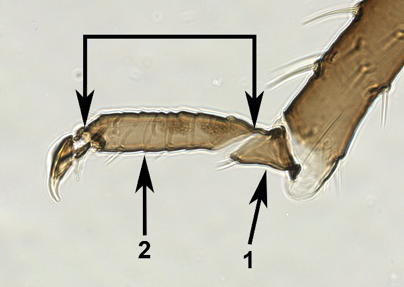
As in all insects, aphids have three pairs of legsleg:
One of six ambulatory appendages of the thorax. Each leg is composed of the coxa, trochanter, femur, tibia, basitarsus, distitarsus, and tarsal claw.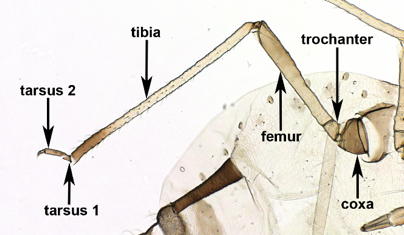 , one on each segment of the thoraxthorax:
The three segmented middle region of the insect body, sometimes bearing 2 pairs of wings and always 3 pairs of legs. Divisible into the prothorax, mesothorax, and metathorax.
The three pairs of legsleg:
One of six ambulatory appendages of the thorax. Each leg is composed of the coxa, trochanter, femur, tibia, basitarsus, distitarsus, and tarsal claw. are alternately called 1) the front legsleg:
One of six ambulatory appendages of the thorax. Each leg is composed of the coxa, trochanter, femur, tibia, basitarsus, distitarsus, and tarsal claw., middle legsleg:
One of six ambulatory appendages of the thorax. Each leg is composed of the coxa, trochanter, femur, tibia, basitarsus, distitarsus, and tarsal claw., and hind legsleg:
One of six ambulatory appendages of the thorax. Each leg is composed of the coxa, trochanter, femur, tibia, basitarsus, distitarsus, and tarsal claw. or 2) the forelegs, midlegs, and hindlegs, or 3) the prothroacic legsleg:
One of six ambulatory appendages of the thorax. Each leg is composed of the coxa, trochanter, femur, tibia, basitarsus, distitarsus, and tarsal claw., mesothoracic legsleg:
One of six ambulatory appendages of the thorax. Each leg is composed of the coxa, trochanter, femur, tibia, basitarsus, distitarsus, and tarsal claw., and metathoracic legsleg:
One of six ambulatory appendages of the thorax. Each leg is composed of the coxa, trochanter, femur, tibia, basitarsus, distitarsus, and tarsal claw.. In turn, the various segments of each legleg:
One of six ambulatory appendages of the thorax. Each leg is composed of the coxa, trochanter, femur, tibia, basitarsus, distitarsus, and tarsal claw. can also be distinguished. The tibiatibia:
The fourth and longest segment of the leg basally attached to the femur and distally attached to the tarsus.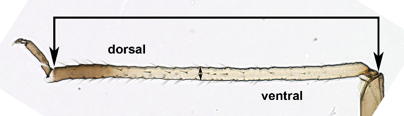 , for example, might be called the front tibiatibia:
The fourth and longest segment of the leg basally attached to the femur and distally attached to the tarsus., prothoracic tibiatibia:
The fourth and longest segment of the leg basally attached to the femur and distally attached to the tarsus., or protibiaprotibia:
The tibia of the prothorax, or the tibia of the foreleg.
; middle tibiatibia:
The fourth and longest segment of the leg basally attached to the femur and distally attached to the tarsus., mesothoracic tibiatibia:
The fourth and longest segment of the leg basally attached to the femur and distally attached to the tarsus., or mesotibiamesotibia:
The tibia of the mesothorax, or the tibia of the midleg.
; and hind tibiatibia:
The fourth and longest segment of the leg basally attached to the femur and distally attached to the tarsus., metathoracic tibiatibia:
The fourth and longest segment of the leg basally attached to the femur and distally attached to the tarsus., or metatibiametatibia:
The tibia of the metathorax, or the tibia of the hindleg.
.
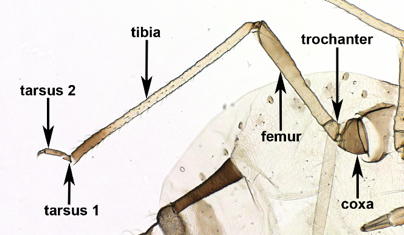
Each legleg:
One of six ambulatory appendages of the thorax. Each leg is composed of the coxa, trochanter, femur, tibia, basitarsus, distitarsus, and tarsal claw. is composed of six segments, the coxacoxa:
The basal segment of the leg. It is attached basally to the body proper and distally to the trochanter.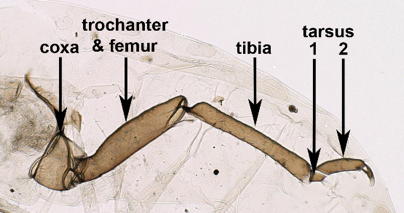 , trochantertrochanter:
The second segment of the insect leg basally attached to the coxa and distally attached to the femur. Rarely fused to and indistinguishable from the femur., femurfemur:
The third and usually the most massive segment of the leg. It is attached basally to the trochanter and distally to the tibia.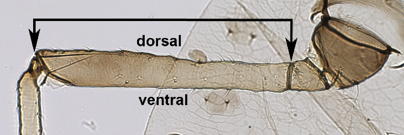 , tibiatibia:
The fourth and longest segment of the leg basally attached to the femur and distally attached to the tarsus., tarsustarsus:
The last two apical segments (tarsomeres) and tarsal claw of the leg.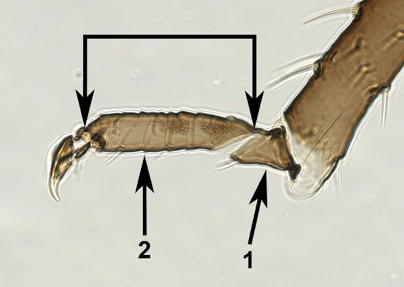 1, and tarsustarsus:
The last two apical segments (tarsomeres) and tarsal claw of the leg. 2.
The six segments are labeled on this hind legleg:
One of six ambulatory appendages of the thorax. Each leg is composed of the coxa, trochanter, femur, tibia, basitarsus, distitarsus, and tarsal claw..
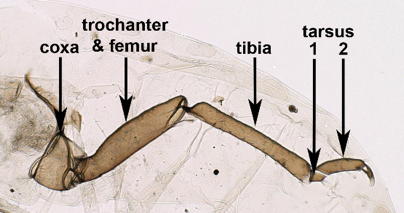
In some rare cases, the trochantertrochanter:
The second segment of the insect leg basally attached to the coxa and distally attached to the femur. Rarely fused to and indistinguishable from the femur. and femurfemur:
The third and usually the most massive segment of the leg. It is attached basally to the trochanter and distally to the tibia. are fused, making for five segments in all. In this case, the length measurement of the 'femur' would be for both sections together.
Note the slight constriction between the trochantertrochanter:
The second segment of the insect leg basally attached to the coxa and distally attached to the femur. Rarely fused to and indistinguishable from the femur. and femurfemur:
The third and usually the most massive segment of the leg. It is attached basally to the trochanter and distally to the tibia.. In some cases there is a faint vestigial line that demarcates the two segments. In these cases, the length measurement for the femurfemur:
The third and usually the most massive segment of the leg. It is attached basally to the trochanter and distally to the tibia. would be from that line to the distaldistal:
Of or pertaining to a position further away, as in towards the apex of an appendage. Opposite of proximal. See also terminal and ultimate.
tip of the segment.
The femurfemur:
The third and usually the most massive segment of the leg. It is attached basally to the trochanter and distally to the tibia. is the third legleg:
One of six ambulatory appendages of the thorax. Each leg is composed of the coxa, trochanter, femur, tibia, basitarsus, distitarsus, and tarsal claw. segment, and the second longest.
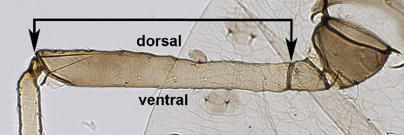
Image showing the length of the femurfemur:
The third and usually the most massive segment of the leg. It is attached basally to the trochanter and distally to the tibia.. Note that there is a dorsaldorsal:
Pertaining to the upper surface of the body or structure.
and ventralventral:
Of or pertaining to the lower surface of the body or structure.
aspect to the femurfemur:
The third and usually the most massive segment of the leg. It is attached basally to the trochanter and distally to the tibia.. Femoral setaseta:
A socketed, hairlike extension of the body wall. Setae are sometimes called hairs.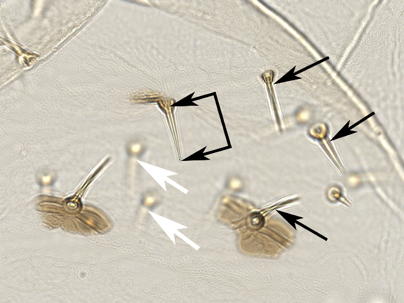 lengths are measured for dorsal setaeseta:
A socketed, hairlike extension of the body wall. Setae are sometimes called hairs..
The tibiatibia:
The fourth and longest segment of the leg basally attached to the femur and distally attached to the tarsus. is the fourth legleg:
One of six ambulatory appendages of the thorax. Each leg is composed of the coxa, trochanter, femur, tibia, basitarsus, distitarsus, and tarsal claw. segment and the longest segment.
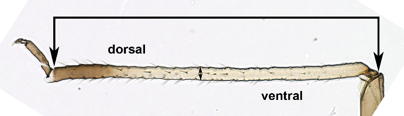
When measuring the length of the legleg:
One of six ambulatory appendages of the thorax. Each leg is composed of the coxa, trochanter, femur, tibia, basitarsus, distitarsus, and tarsal claw., be sure to include the muscle attachment tubercletubercle:
Projecting structure occurring on the surface of the cuticle. The functions of tubercles are varied, ranging from muscle attachment points to grasping points for ant mandibles. Marginal abdominal tubercles are important to aphid identification. The term tubercle can also refer to a protuberance of the head near the margin of the antennal socket: see antennal tubercle.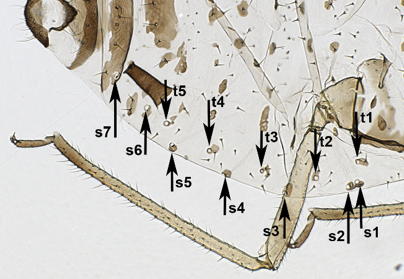 which is at the far basalbasal:
Of or pertaining to the base, as in the first, or basal segment of an appendage. Opposite of terminal and apical. See also proximal.
end, above the "knee". Measure the diameter of the tibiatibia:
The fourth and longest segment of the leg basally attached to the femur and distally attached to the tarsus. near the mid-point of its length. Note that there are dorsaldorsal:
Pertaining to the upper surface of the body or structure.
and ventralventral:
Of or pertaining to the lower surface of the body or structure.
aspects to the tibiatibia:
The fourth and longest segment of the leg basally attached to the femur and distally attached to the tarsus.. When measuring the length of a tibialtibial:
Of or pertaining to the tibia.
seta, measure a dorsal setaseta:
A socketed, hairlike extension of the body wall. Setae are sometimes called hairs. somewhere in the middle half of the tibiatibia:
The fourth and longest segment of the leg basally attached to the femur and distally attached to the tarsus..
Based on muscle attachments, the tarsustarsus:
The last two apical segments (tarsomeres) and tarsal claw of the leg. is composed of two true segments: the two tarsomerestarsomere:
One of two segments of the tarsus, the basitarsus and distitarsus, but not including the tarsal claw. together as one and the tarsal clawtarsal claw:
Curved, distally pointed, paired processes on the distal end of the last tarsal segment.
. In common practice, however, the two tarsomerestarsomere:
One of two segments of the tarsus, the basitarsus and distitarsus, but not including the tarsal claw. are treated as two segments and the tarsal clawtarsal claw:
Curved, distally pointed, paired processes on the distal end of the last tarsal segment.
referred to as such.
The first tarsaltarsal:
Of or pertaining to the tarsus.
segment, also called the basitarsis, or tarsustarsus:
The last two apical segments (tarsomeres) and tarsal claw of the leg. 1, is usually very short. The second tarsaltarsal:
Of or pertaining to the tarsus.
segment, or distitarsusdistitarsus:
Conjunction of distal and tarsus. The last tarsomere, bearing paired claws apically. Also known as the second tarsal segment or tarsus 2., or tarsustarsus:
The last two apical segments (tarsomeres) and tarsal claw of the leg. 2, is longer. When measuring the length of the tarsustarsus:
The last two apical segments (tarsomeres) and tarsal claw of the leg. 2, there is no need to try to find the exact tip of the muscle attachment tubercletubercle:
Projecting structure occurring on the surface of the cuticle. The functions of tubercles are varied, ranging from muscle attachment points to grasping points for ant mandibles. Marginal abdominal tubercles are important to aphid identification. The term tubercle can also refer to a protuberance of the head near the margin of the antennal socket: see antennal tubercle. at its basalbasal:
Of or pertaining to the base, as in the first, or basal segment of an appendage. Opposite of terminal and apical. See also proximal.
end.
Authors: Favret and Miller
Content updated March 2014; nomenclature updated February 2026
idtools.org