The aphid's tail
The caudacauda:
A taillike process or extension of the eighth abdominal segment.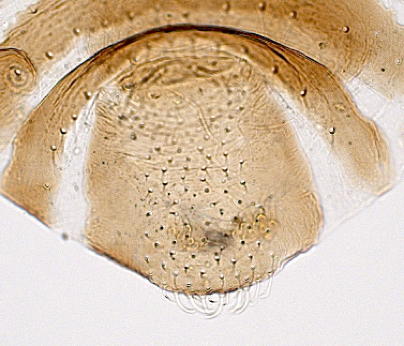 takes on a diverse variety of shapes and sizes. The longer caudas are used to flick droplets of honeydewhoneydew:
Aphid excrement made sweet by the concentration of sugars in plant phloem. Honeydew is implicated in the growth of molds that can harm plants. It attracts ants, which often form mutualistic symbioses with aphids, whereby the ants milk the aphids for their honeydew, and in return defend the aphids from predators.
away from the aphid as it is excreted. Its length, its width at the basebase:
The bottom end of a structure or appendage. The term is often used to describe that portion of the terminal antennal segment that is not the processus terminalis.
, and the number of setaeseta:
A socketed, hairlike extension of the body wall. Setae are sometimes called hairs.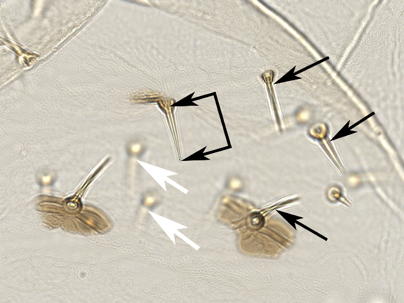 on it are important features for identifying aphids.
Most aphids have a somewhat conical-shaped caudacauda:
A taillike process or extension of the eighth abdominal segment. and usually bears setaeseta:
A socketed, hairlike extension of the body wall. Setae are sometimes called hairs..
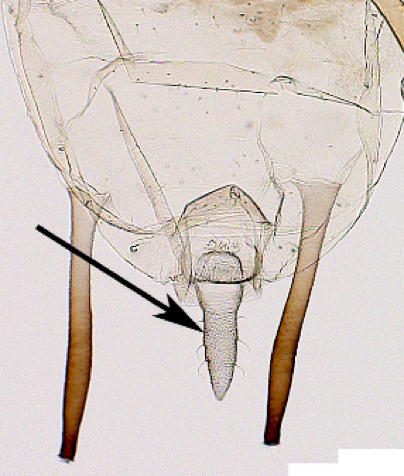
The caudacauda:
A taillike process or extension of the eighth abdominal segment. here is unpigmented and carries six visible setaeseta:
A socketed, hairlike extension of the body wall. Setae are sometimes called hairs..
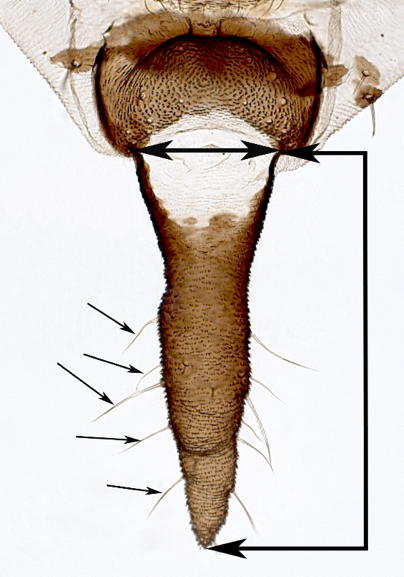
Caudacauda:
A taillike process or extension of the eighth abdominal segment. length is measured from the center of the basebase:
The bottom end of a structure or appendage. The term is often used to describe that portion of the terminal antennal segment that is not the processus terminalis.
(in the middle of the line between the two lateral marginsmargin:
The side of the body or a structure.
) to the tip. The basalbasal:
Of or pertaining to the base, as in the first, or basal segment of an appendage. Opposite of terminal and apical. See also proximal.
width of the caudacauda:
A taillike process or extension of the eighth abdominal segment. is measured from the two lateral marginsmargin:
The side of the body or a structure.
. Sometimes the basal marginsmargin:
The side of the body or a structure.
curve outward away from the rest of the caudacauda:
A taillike process or extension of the eighth abdominal segment.. It is best to make the measurement from the inflection points as it is often difficult to find just where the curve ends.
This caudacauda:
A taillike process or extension of the eighth abdominal segment. is pigmented dark. The arrows highlight the length, basalbasal:
Of or pertaining to the base, as in the first, or basal segment of an appendage. Opposite of terminal and apical. See also proximal.
width, and some of the caudal setaeseta:
A socketed, hairlike extension of the body wall. Setae are sometimes called hairs..
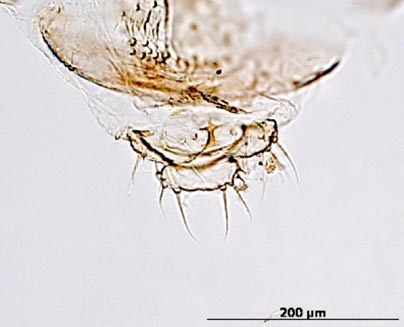
Some aphids have a caudacauda:
A taillike process or extension of the eighth abdominal segment. shaped like a knob.
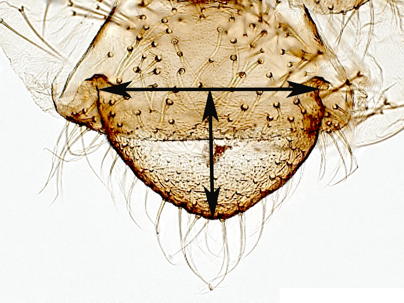
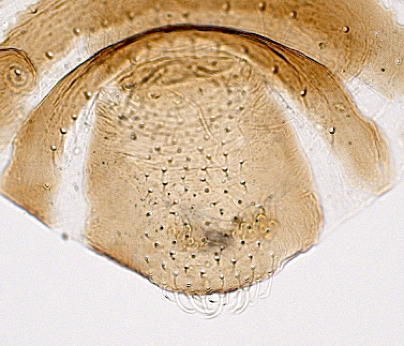
Some caudas are reduced as simple domes.
Length and basalbasal:
Of or pertaining to the base, as in the first, or basal segment of an appendage. Opposite of terminal and apical. See also proximal.
width measurements of dome-shaped caudas are the same as longer ones (see black arrows). Counting the setaeseta:
A socketed, hairlike extension of the body wall. Setae are sometimes called hairs. on them is difficult, so setalsetal:
Of or pertaining to the seta.
counts on these caudas are not part of the AphID key.
In some cases the caudacauda:
A taillike process or extension of the eighth abdominal segment. may be indistinguishable.
This caudacauda:
A taillike process or extension of the eighth abdominal segment. is not measureable.
Authors: Favret and Miller
Content updated March 2014; nomenclature updated February 2026
idtools.org