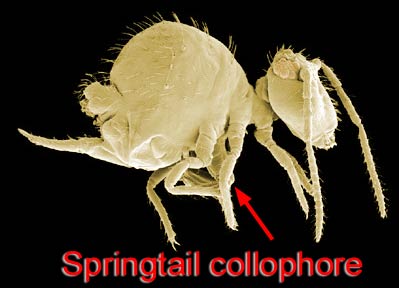
Springtails have a ventralventral:
relating to the lower or under side; opposed to dorsal.
tube, the collophore, near the bases of the third pair of legs that is thought to be used in maintaining water balance.
misinterpretations allowed: Both opilionids and some mites have an eversible ovipositorovipositor:
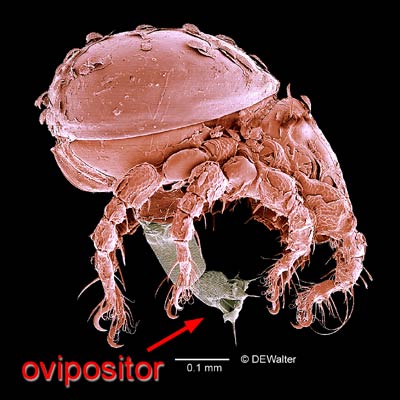
an extrusible organ for laying eggs. Female oribatids have a well developed ovipositor that ends in three finger-like projections. Ovipositors are less well developed or absent in other mites.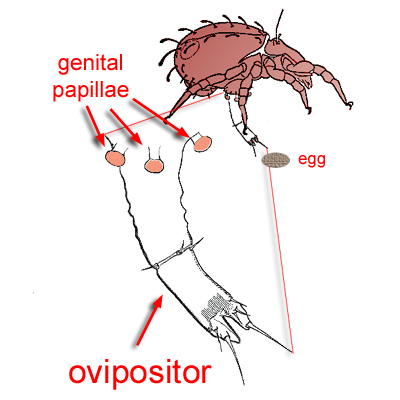 behind the legs that could be confused with a collophore. (You can choose to disable "Allow misinterpretations" in the Preferences (gear icon) options.)
Some apterygote insects and hexapods (diplurans, proturans) retain paired remnants of abdominal limbs called styli (possibly a coxal branch) that are often associated with eversable sacks—probably osmoregulatory in function.
Tritonymphs and adults of acariform mites primitively have three pairs of segmented appendages in the acetabulum of the genital opening called genital papillaegenital papillae:
1-3 pairs of extrusible finger-like to button-like projections, usually retracted into in the genital vestibule of acariform mites; sometimes formed as sessile disks around the genital opening; thought to be osmoregulatory structures; modified or multiplied and dispersed over the body in many freshwater mites. Genital papillae are absent in the larva, but may be added ontogenetically: protonymphs have one pair, deutonymphs two pairs, and tritonymphs (and adults) three pairs. The tritonymphal pair of papillae is often lost. The serially homologous Claparède's organ is usually present in the larvae (and prelarvae) of mites exhibiting genital papillae in nymphs and adults (Oudeman's Rule).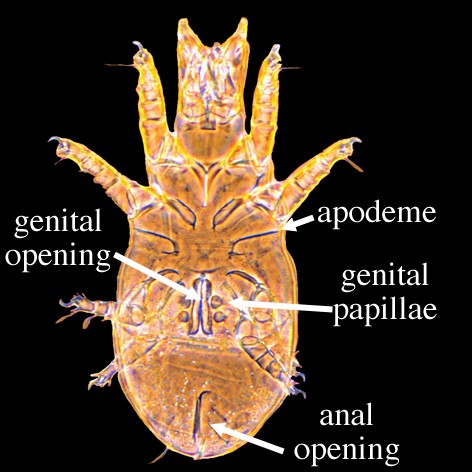 . Larvae lack these structures (and genital acetabulae), protonymphs have one pair, and deutonymphs two pairs. In most mites with genital papillaegenital papillae:
1-3 pairs of extrusible finger-like to button-like projections, usually retracted into in the genital vestibule of acariform mites; sometimes formed as sessile disks around the genital opening; thought to be osmoregulatory structures; modified or multiplied and dispersed over the body in many freshwater mites. Genital papillae are absent in the larva, but may be added ontogenetically: protonymphs have one pair, deutonymphs two pairs, and tritonymphs (and adults) three pairs. The tritonymphal pair of papillae is often lost. The serially homologous Claparède's organ is usually present in the larvae (and prelarvae) of mites exhibiting genital papillae in nymphs and adults (Oudeman's Rule)., their structure is simplesimple:
unadorned; simple setae are needle-like and without hairs or pectins.
, button- or knob-like. The maximum number of genital papillaegenital papillae:
1-3 pairs of extrusible finger-like to button-like projections, usually retracted into in the genital vestibule of acariform mites; sometimes formed as sessile disks around the genital opening; thought to be osmoregulatory structures; modified or multiplied and dispersed over the body in many freshwater mites. Genital papillae are absent in the larva, but may be added ontogenetically: protonymphs have one pair, deutonymphs two pairs, and tritonymphs (and adults) three pairs. The tritonymphal pair of papillae is often lost. The serially homologous Claparède's organ is usually present in the larvae (and prelarvae) of mites exhibiting genital papillae in nymphs and adults (Oudeman's Rule). is reduced to two pairs in many acariform mites and they are lost in most derived Prostigmata.
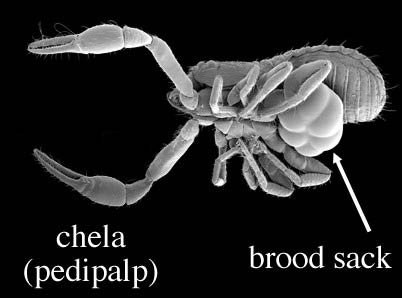
Several different kinds of arachnids (e.g., pseudoscorpions, whipscorpions) brood their developing eggs in a sack-like structure on their venterventer:
the lower or under side; opposed to dorsum.
. Mites never do this, although some oribatid mites are known to carry eggs on their backs. Spiders typically carry or guard a silken egg case. Some centipedes wrap their bodies around their developing eggs or young hatchlings.
Isopods and amphipods have expanded coxal bases that are used to carry and shelter their eggs. The pouch-like region protected by the coxal plates is called a marsupium.
Scorpions have a pair of ventralventral:
relating to the lower or under side; opposed to dorsal.
, comb-like processes called pectines. These are better developed in males than in females and may function in mate location and other sensory behaviors.
Only acariform mites and opilionids have an elongate ovipositorovipositor:
an extrusible organ for laying eggs. Female oribatids have a well developed ovipositor that ends in three finger-like projections. Ovipositors are less well developed or absent in other mites. that can be extruded from the genital region in the middle of the body venterventer:
the lower or under side; opposed to dorsum.
. In mites, the ovipositorovipositor:
an extrusible organ for laying eggs. Female oribatids have a well developed ovipositor that ends in three finger-like projections. Ovipositors are less well developed or absent in other mites. ends in 3-fingers and in opilionids in 2 processes. Male opilionids have a penis that is everted from the genital opening.
Misinterpretations allowed: Springtails have a short tube, the collophore, that is produced ventrally from the middle of the bodybody:
the idiosoma of mites.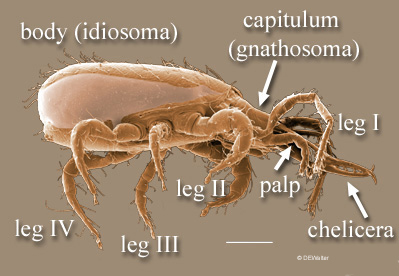 , and could be confused with an ovipositorovipositor:
an extrusible organ for laying eggs. Female oribatids have a well developed ovipositor that ends in three finger-like projections. Ovipositors are less well developed or absent in other mites., but it is cylindrical and is not associated with sclerotised plates that open outward.
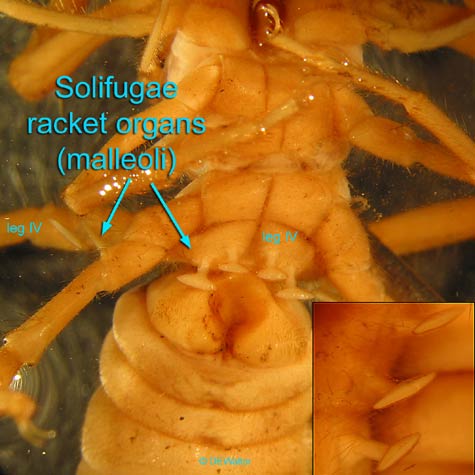
Solfugids have 3–5 pairs of small, racket-shaped structures on the basalbasal:
towards the base of a structure; on a limb, towards the insertion on the body.
segments of legs IV.
The heteromorphicheteromorphic:
having different morphological forms; referring either to different forms within a particular life stage (e.g., normal and heteromorphic deutonymphs in some Mesostigmata; protogynes vs. deutogynes in Eriophyoidea; heteromorphic vs. homeomorphic males in the Astigmata) or to a developmental stage that differs radically from other stages (e.g., the heteromorphic deutonymph or hypopus in the Astigmata).
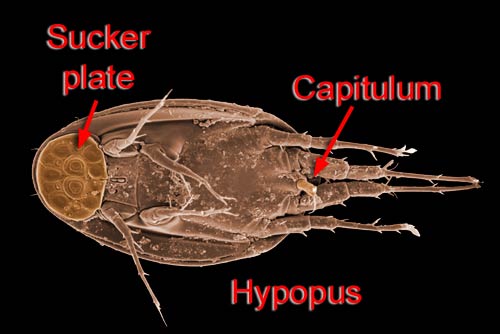
deutonymph of the Astigmata (in older literature called hypopus or hypopodehypopus:
(pl. hypopi) (also hypopode) the heteromorphic deutonymph produced by many astigmatans, usually as a stage that is phoretic on insects and having a large ventral sucker plate. Hypopi lack functional mouthparts and the capitulum is reduced to a small nub bearing a pair of processes, but some appear to feed by absorbing fluids through their cuticles.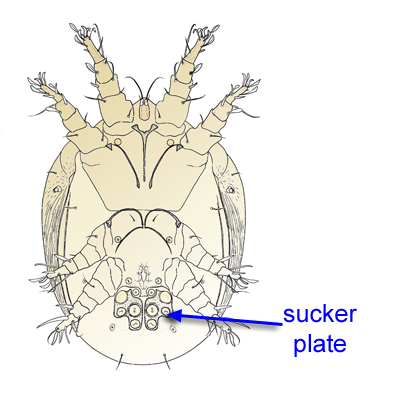 ) is a specialized dispersal morph with atrophied mouthparts and usually with a well developed sucker platesucker plate:
an array of modified setae in the anal region of the heteromorphic deutonymphs (hypopi) of Astigmatina.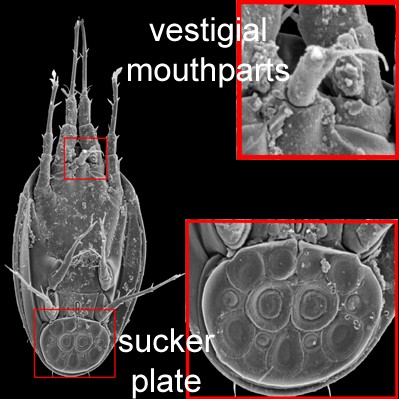 on the venterventer:
the lower or under side; opposed to dorsum.
. A few Mesostigmata associated with millipedes and centipedes (Heterozerconoidea) have a pair of ventralventral:
relating to the lower or under side; opposed to dorsal.
suckers, as do many male astigmatans.
Author: David E. Walter
Content last updated Sept. 2006, unless indicated otherwise
Lucid key player updated Sept. 2025
idtools.org