Mandibulate arthropods typically have sensory/manipulative branches on the postmandibular mouth parts: the maxilla and, if present, labium (2nd maxilla). These palps may be long and somewhat leg-like, reduced to small nubs, or highly modified as stylets or their supports. In entognath arthropods the palps may be withdrawn into the head capsulecapsule:
as in gnathosomal capsule, the fused chelicerae and subcapitulum characteristic of Tarsonemina and some other Prostigmata (e.g., Cheyletoidea, Myobioidea) (also tegmen, rostral shield).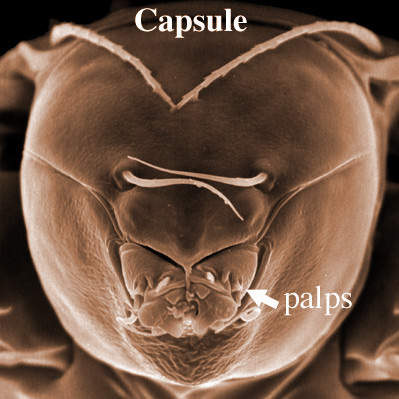 .
.
Onychophorans do not have jointed limbs but do have a pair of small processes near the mouth that produce a gluey secretion used to capture and hold prey called oral papillae or glue glands.
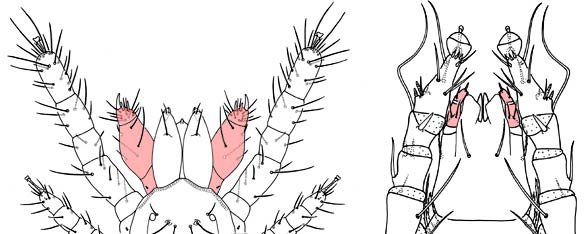
Most arachnids have well-developed pedipalps with multiple segments. In some mites (Endeostigmata, Oribatida, and Mesostigmata) palps may have 5 or even 6 segments. A 5-segmented palppalp:
(= pedipalp) the second pair of limbs in arachnids, used in feeding and originating on either side of the chelicerae. In mites, the palps may be vestigial, with only a few segments, or have a maximum of 5 freely articulating segments (rarely the femur is subdivided) and a distal or subdistal apotele.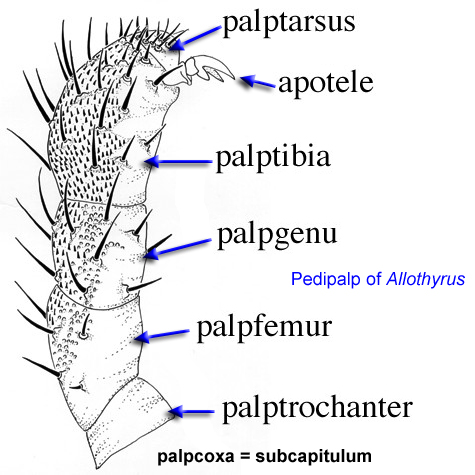 consists of the trochantertrochanter:
the leg segment between the coxa and the femur.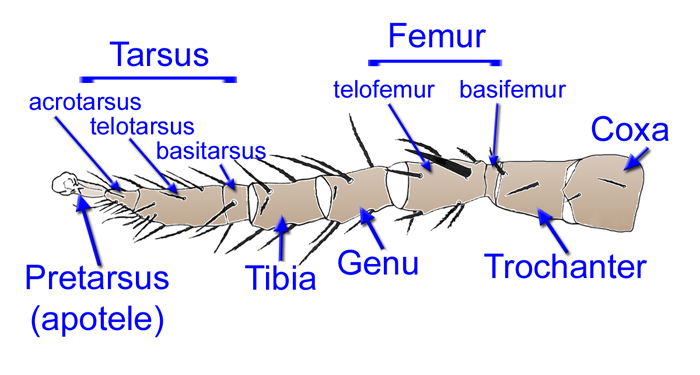 , femurfemur:
(pl. femora) major leg segment between trochanter and genu; often subdivided into a basifemur and a telofemur., genugenu:
(pl. genua) (= patella) the 4th leg segment, between the femur and tibia.
, tibiatibia:
(pl. tibiae) the leg segment between the genu and the tarsus., and tarsustarsus:
(pl. tarsi) the subdistal leg segment between the tibia and the pretarsus (apotele).
. In contrast, a 6-segmented palppalp:
(= pedipalp) the second pair of limbs in arachnids, used in feeding and originating on either side of the chelicerae. In mites, the palps may be vestigial, with only a few segments, or have a maximum of 5 freely articulating segments (rarely the femur is subdivided) and a distal or subdistal apotele. results from subdivision of the femurfemur:
(pl. femora) major leg segment between trochanter and genu; often subdivided into a basifemur and a telofemur. into a basifemurbasifemur:
a basal subdivision of the femur of the leg or palp.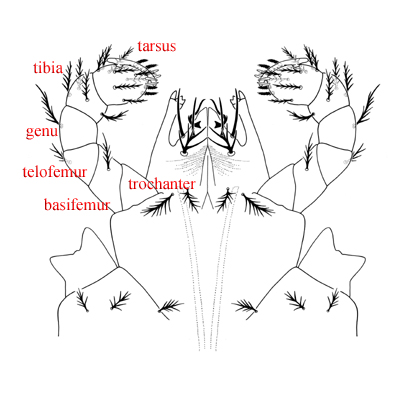 and telofemurtelofemur:
(pl. telofemora) a distal division of the femur.. In all mites, the palpal coxae are fused to form the subcapitulumsubcapitulum:
(also infracapitulum) the venter of the capitulum; the ventral faces of the fused palpcoxae; apparently formed independently in the two superorders of mites.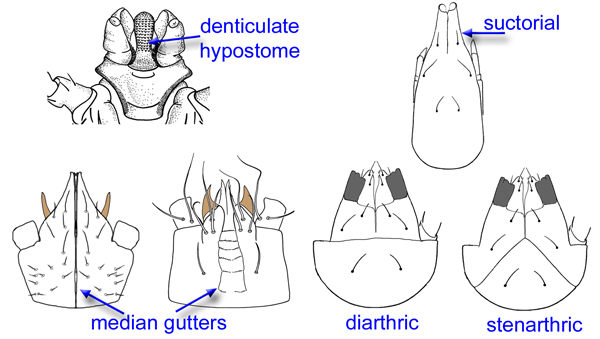 .
.
All arachnids, except for a few mites, have well developed pedipalps. In many groups of mites the number of free segments is reduced to 1–4.
Author: David E. Walter
Content last updated Sept. 2006, unless indicated otherwise
Lucid key player updated Sept. 2025
idtools.org