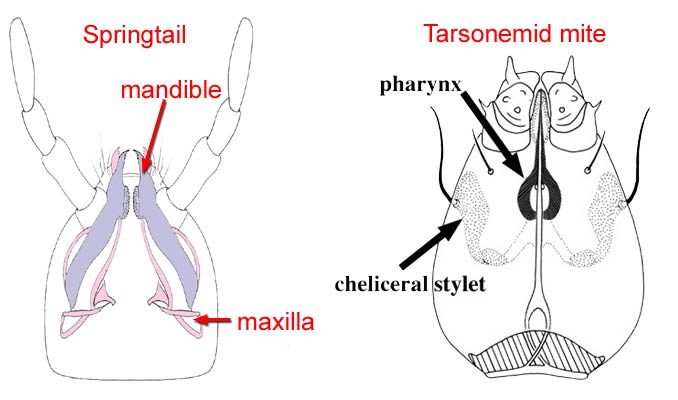
The mandibles of insects are often easy to see, especially in beetles and ants, but in true bugs and thrips the mandibles have been modified into piercing stylets. Similar modifications occur to the chelicerae of some mites.
The mouthparts of Collembola, Diplura, Symphyla, Protura, and some mites are difficult to see because they are enclosed within the head or gnathosomal capsulegnathosomal capsule:
a fusion of the gnathosomal elements (chelicerae and subcapitulum) into a single structure, as seen in protigmatans such as Heterostigmata, Myobiidae, and Cheyletoidea (also tegmen).
. On a cleared and slided specimen, the mouthparts can be seen to include a pair of opposed mandibles, sometimes with a molar grinding area, or stylets. Mites with a well developed gnathosomal capsulegnathosomal capsule:
a fusion of the gnathosomal elements (chelicerae and subcapitulum) into a single structure, as seen in protigmatans such as Heterostigmata, Myobiidae, and Cheyletoidea (also tegmen).
might seem not to have mouthparts. Maggots (larval flies, Insecta) have internal mouthparts, but they are often highly modified hooks.
Under their heads, centipedes have a pair of limbs modified as poison claws that clasp towards the midline of the bodybody:
the idiosoma of mites.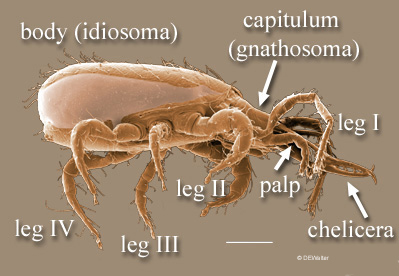 .
.
The true bugs (Insecta) are characterized by beak-like mouthparts. The beaks can be short and sharp as in many predatory bugs, more elongate as in plant-feeding forms such as aphids and whiteflies, or a long flexible tube as in scale insects.
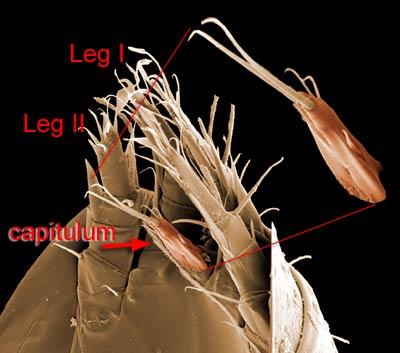
Some springtails have short buccal cones. Snout mites have elongate capituli (=gnathosomas) that taper into a needle-like snout with a pair of small hookhook:
(as in cheliceral hook) the distal hook-like tips of chelicerae in the Mesostigmata, as opposed to cheliceral teeth.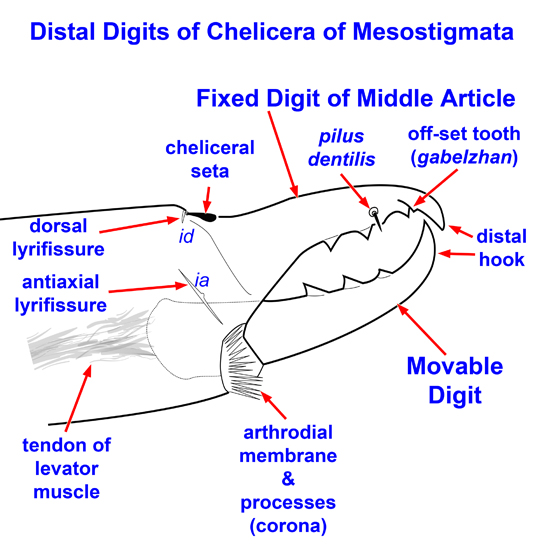 -like fixed digits at the tip.
Tardigrades have a complex internal pharyngial apparatus composed of a series of rods and struts. Stylets are also present, but these often fade or dissolve in mounts.
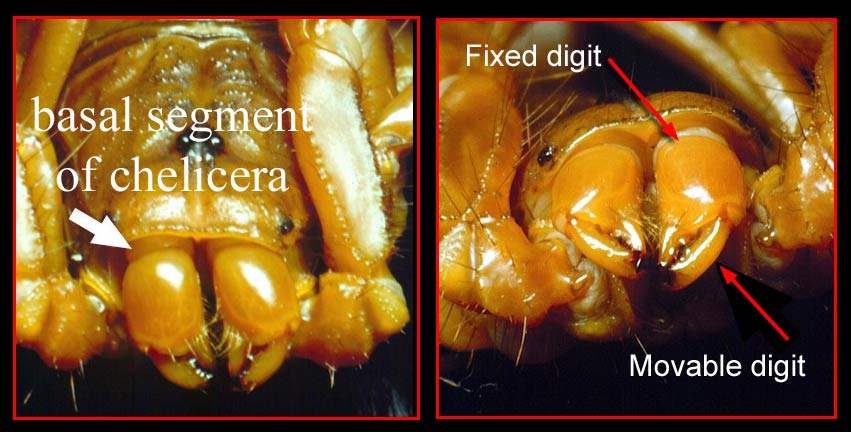
The first pair of limbs in arachnids are called chelicerae. Primitively these are pincer-like and composed of 3-segments: basal articlebasal article:
the most basal of the maximum of three segments of the chelicera; usually absent or obscure in Acariformes.
, middle article (ending in a fixed digitfixed digit:
the distal extension of the middle article of the chelicera; usually bearing teeth and a distal hook and opposed to the movable digit in chelate-dentate forms, but often regressed; in Mesostigmata the fixed digit may bear the pilus dentilis.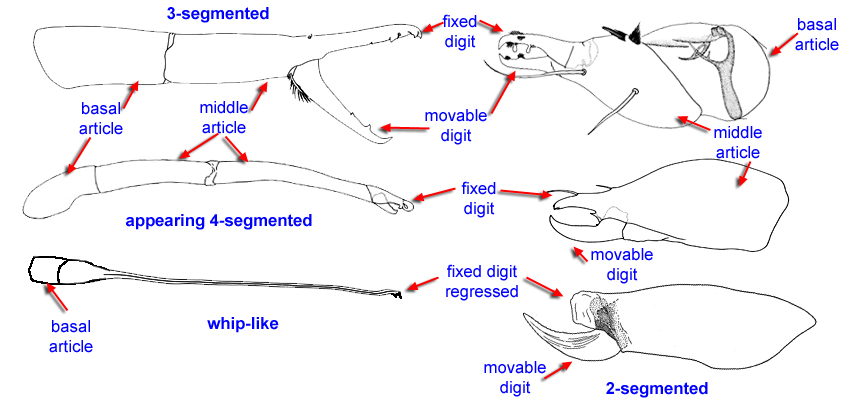 ) and the movable digit. In some groups the basal articlebasal article:
the most basal of the maximum of three segments of the chelicera; usually absent or obscure in Acariformes.
is strongly reduced, modified or lost. In others, e.g., spiders, most whipscorpions, and many mites, the fixed digitfixed digit:
the distal extension of the middle article of the chelicera; usually bearing teeth and a distal hook and opposed to the movable digit in chelate-dentate forms, but often regressed; in Mesostigmata the fixed digit may bear the pilus dentilis. is reduced and the movable digit is fang or stylet-likestylet-like:
referring to chelicerae or movable digits that are slender, elongate, and usually acuminate. Stylet-like chelicerae may be composed of the entire chelicera (as in some parasitic Dermanyssoidea or the endeostigmatan genus Bimichaelia) or only the movable digits (as in many Prostigmata). If the cheliceral stylets are especially elongate, they may be called whip-like stylets (e.g., in spider mites and their relatives).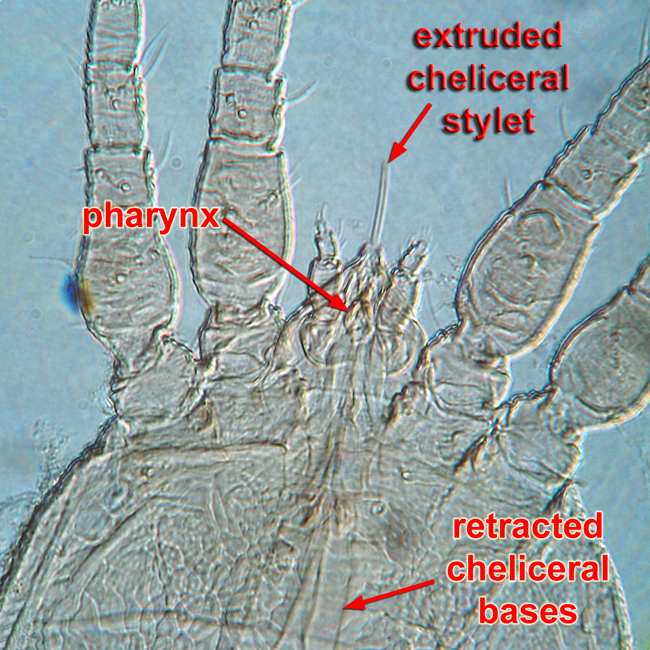 .
.
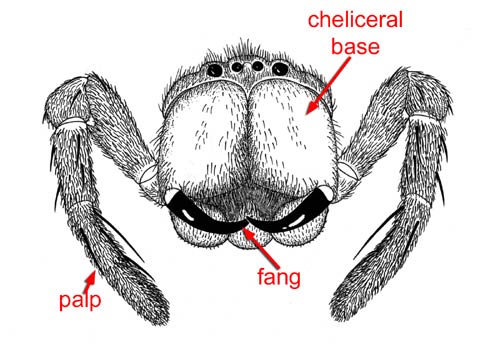
The fangs of spiders and amblypygids are distinctive modifications of the arachnid chelicerae and consist of a tubular basalbasal:
towards the base of a structure; on a limb, towards the insertion on the body.
segment (sometimes with teeth on its margin) and a distaldistal:
towards the free end of an appendage.
fang. Some groups of mites have similar chelicerae.
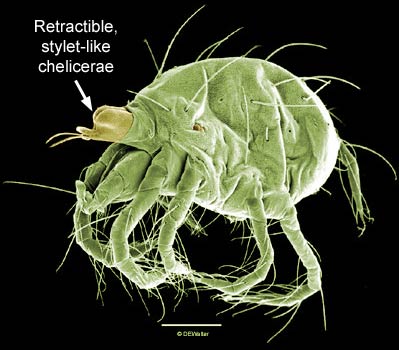
Mandibles (and associated mouthparts) or chelicerae have been converted into needle-like stylets in a variety of plant-feeding and parasitic insects and mites.
Regression of the fixed digitfixed digit:
the distal extension of the middle article of the chelicera; usually bearing teeth and a distal hook and opposed to the movable digit in chelate-dentate forms, but often regressed; in Mesostigmata the fixed digit may bear the pilus dentilis. is sometimes accompanied by hookhook:
(as in cheliceral hook) the distal hook-like tips of chelicerae in the Mesostigmata, as opposed to cheliceral teeth.-like or clawclaw:
like - having a distal hook; resembling a claw.
-like movable digits in a variety of groups of mites, mostly predators or parasites.
Functional mouthparts are absent in a few groups of insects and mites and from all hypopi, the dispersal stagestage:
a distinct developmental form, e.g., the egg, larval, nymphal and adult stages. Since mite instars are usually morphologically distinct, they are also stages (and see stase). Some authors, however, insist that instar should be apolysis to apolysis and stage ecdysis to ecdysis. Since apolysis can be a discontinuous process and, in any case, is difficult to determine, in practice the difference between a stage and an instar is abstract and of importance only if you have a contentious referee.
of mites in the suborder Astigmata. Chelicerae are entirely absent and palps are represented by a pair of bristle-like processes.
Author: David E. Walter
Content last updated Sept. 2006, unless indicated otherwise
Lucid key player updated Sept. 2025
idtools.org