Many large arachnids (e.g., spiders, scorpions, whip-scorpions) have one or more pairs of slit-like openings to internal book lungs. Mites never have book lungs and exchange gases either directly through the cuticle or via tracheal spiracles—often with an associated peritremeperitreme:
a groove or gutter on the surface connecting to a stigmatal opening. In Mesostigmata the peritremes are lateral and run above the coxae of the legs and usually run to near the anterior margin of the idiosoma, but they may be very short or vestigial. In Prostigmata peritremes are usually found on the anterior margin of the idiosoma, as short processes to either side of the capitulum (emergent peritremes), or as simple to complex lines or reticulations of short, connected chambers on the dorsal surface of the chelicerae or stylophore.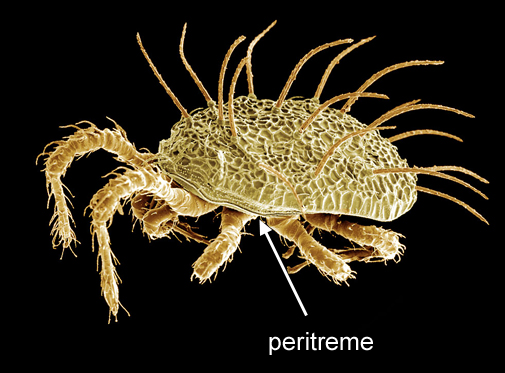 .
.
Spiracles and tracheaetracheae:
the long, filamentous tubes that ramify through the body of some mites for the exchange of gases.
have evolved independently in many groups of terrestrial arthropods. Hexapods and myriapods with tracheaetracheae:
the long, filamentous tubes that ramify through the body of some mites for the exchange of gases.
typically have paired stigmatal openings on several thoracic and abdominal segments, and rarely just behind the head (some springtails) or at the basebase:
the usually columnar basal part of the tritosternum; sometimes expanded and rectangular or otherwise modified; the most basal part of any structure.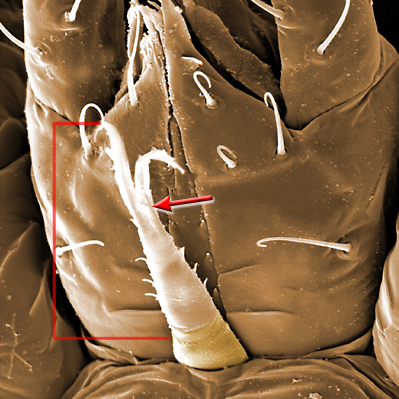 of the antennae (symphylans).
The spiracular openings of mites, when present, are usually above or behind the bases of legs III-IV (often appearing ventralventral:
relating to the lower or under side; opposed to dorsal.
on a slide-mounted specimen), on the leading edge of the idiosoma, or between the cheliceralcheliceral:
of or pertaining to the chelicera.
bases.
Mesostigmatic mites have a single pair of stigmatal openings above the bases of legs III–IV (often appearing ventralventral:
relating to the lower or under side; opposed to dorsal.
on a slide-mounted specimen). Most of the time the stigmatal openings connect to a relatively long peritremeperitreme:
a groove or gutter on the surface connecting to a stigmatal opening. In Mesostigmata the peritremes are lateral and run above the coxae of the legs and usually run to near the anterior margin of the idiosoma, but they may be very short or vestigial. In Prostigmata peritremes are usually found on the anterior margin of the idiosoma, as short processes to either side of the capitulum (emergent peritremes), or as simple to complex lines or reticulations of short, connected chambers on the dorsal surface of the chelicerae or stylophore. (shallow gutter) that runs along the bases of the legs, typically on a narrow plate. In some species, the peritremeperitreme:
a groove or gutter on the surface connecting to a stigmatal opening. In Mesostigmata the peritremes are lateral and run above the coxae of the legs and usually run to near the anterior margin of the idiosoma, but they may be very short or vestigial. In Prostigmata peritremes are usually found on the anterior margin of the idiosoma, as short processes to either side of the capitulum (emergent peritremes), or as simple to complex lines or reticulations of short, connected chambers on the dorsal surface of the chelicerae or stylophore. is very short or absent.
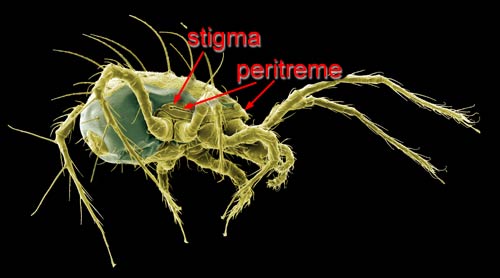
Hard ticks have a single pair of stigmatal openings on sieve plates behind the bases of legs IV.
Many acariform mites (especially Oribatida) have a pair of well developed bothridial sensillasensillum:
(pl. sensilla) (also sensillae; 'sensillus' is incorrect) a sensory structure; sensilla is often used for the bothridial seta in Acariformes.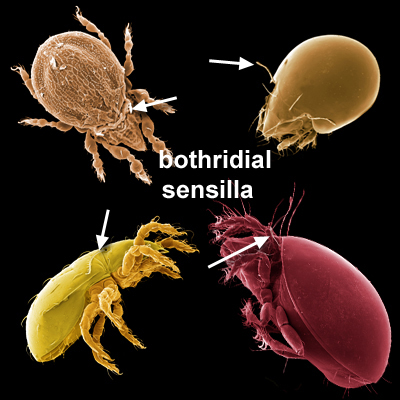 (see Character 26d) on the prodorsumprodorsum:
the dorsal surface of the propodosoma.
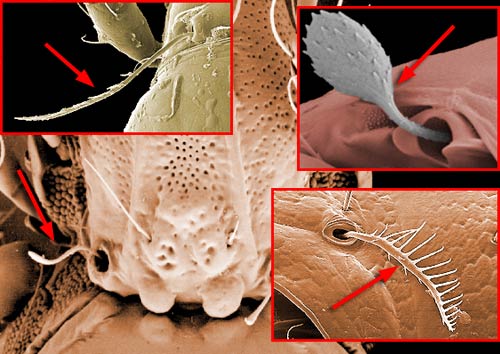
. The cup-like bases (bothridia) of these structures resemble a stigmatal opening and were once thought to be respiratory organs, but apparently this is rarely true, and their primary function appears to be sensing air currents. The sensillasensillum:
(pl. sensilla) (also sensillae; 'sensillus' is incorrect) a sensory structure; sensilla is often used for the bothridial seta in Acariformes. come in various shapes from setiform to pectinatepectinate:
a seta or other process having comb-like teeth on one side (see bipectinate).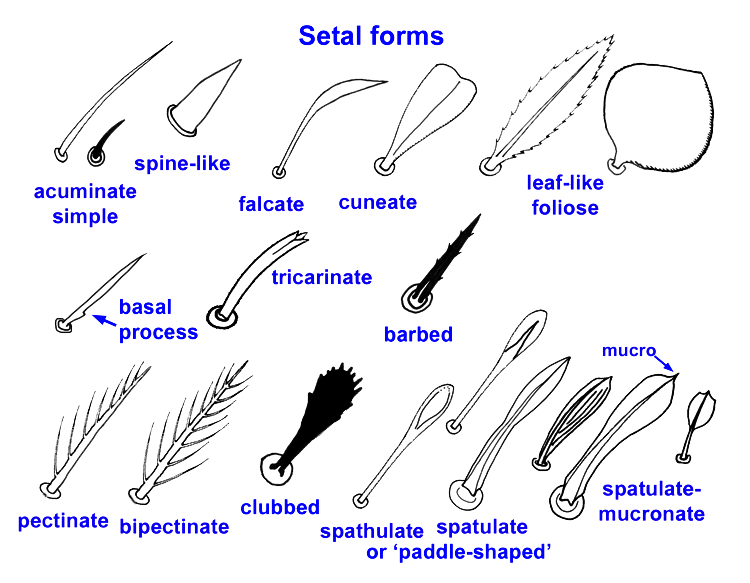 to plumose to club-shaped. They are variously called pseudostigmatic organs, trichobothriatrichobothrium:
(pl. trichobothria) (= bothridial sensillum) an often elaborately modified seta set in a cup-like base; forms include filiform, ciliate, pectinate or variously thickened or clubbed (bat-like to globose or capitate).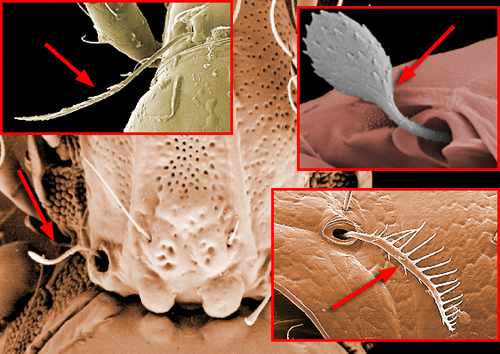 , or bothridial sensillasensillum:
(pl. sensilla) (also sensillae; 'sensillus' is incorrect) a sensory structure; sensilla is often used for the bothridial seta in Acariformes..
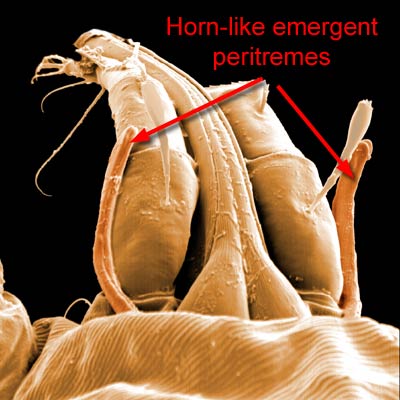
Horn-like emergentemergent:
rising above, projecting, as in the peritremes of some Prostigmata which range from small bumps to elongate processes.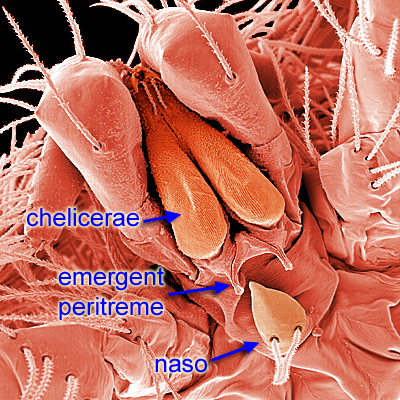 peritremes occur in a few groups of Prostigmata.
Some Oribatida have 4 or more pairs of secretory structures called area porosaearea porosae:
usually round to oval aggregations of pore-like areas of the cuticle; usually referring to the octotaxic system of the Oribatida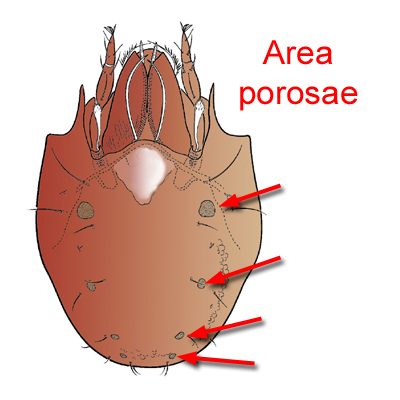 . This octotactic system is useful for identification of different groups, and is easily recognized in some taxa. Some of these porose areas do appear to have a respiratory function.
The Prostigmata is defined by it's prodorsal stigmatal openings, typically between the cheliceralcheliceral:
of or pertaining to the chelicera.
bases or rarely on the 'shoulders' area (Heterostigmata). In some prostigmatans, a peritremeperitreme:
a groove or gutter on the surface connecting to a stigmatal opening. In Mesostigmata the peritremes are lateral and run above the coxae of the legs and usually run to near the anterior margin of the idiosoma, but they may be very short or vestigial. In Prostigmata peritremes are usually found on the anterior margin of the idiosoma, as short processes to either side of the capitulum (emergent peritremes), or as simple to complex lines or reticulations of short, connected chambers on the dorsal surface of the chelicerae or stylophore. is formed on the edge of the prodorsumprodorsum:
the dorsal surface of the propodosoma.
or on the cheliceralcheliceral:
of or pertaining to the chelicera.
bases (or stylophorestylophore:
chelicerae formed of fused cheliceral bases bearing stylet-like movable digits as in Raphignathae (Prostigmata), e.g., the plant parasitic spider mites and their relatives (Tetranychoidea). In predatory and parasitic Cheyletoidea and parasitic Myobiidae, the stylophore and subcapitulum are fused into a gnathosomal capsule.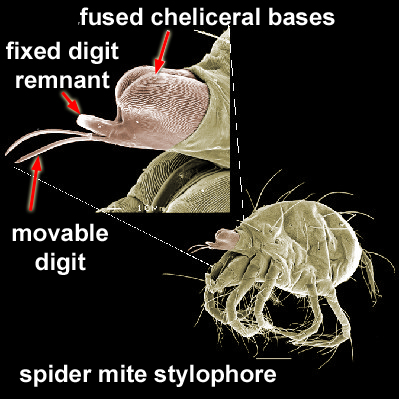 , if present).
Author: David E. Walter
Content last updated Sept. 2006, unless indicated otherwise
Lucid key player updated Sept. 2025
idtools.org