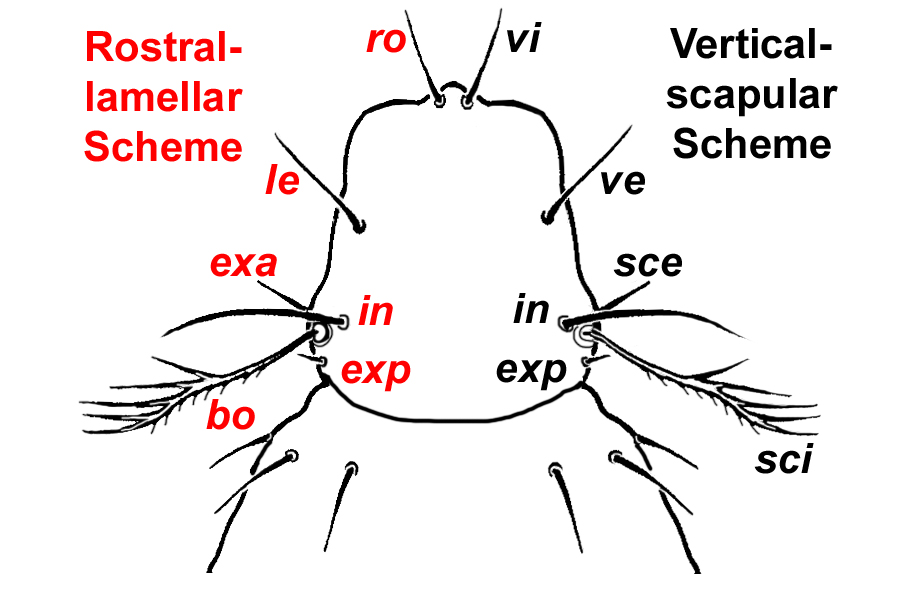
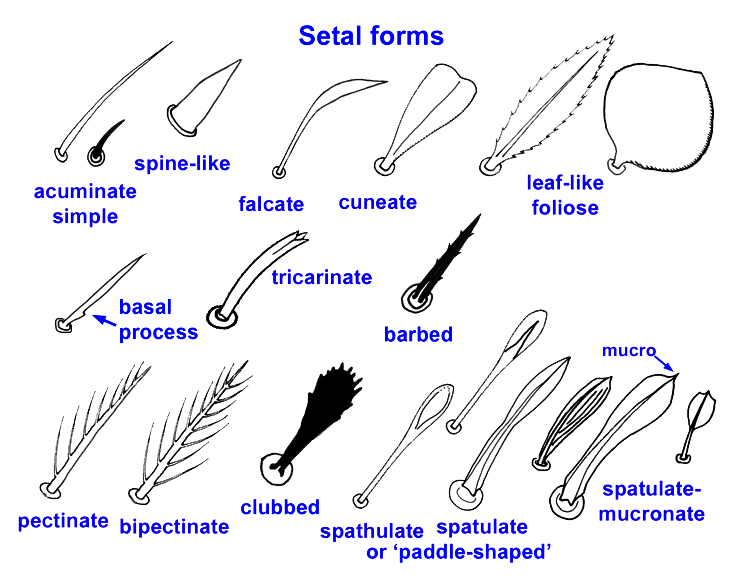
This supplemental glossary gathers together mite terms that use abbreviations, also known as "notations," as their name. The majority of such terms in this glossary are for setae, but you will also find here terms and definitions for cupules, glands, lyrifissures, and segments. Note that not all terms concerning setae, glands, cupules, etc. are abbreviations; this separate glossary contains only those terms that are abbreviations, which are not included in the main glossary.
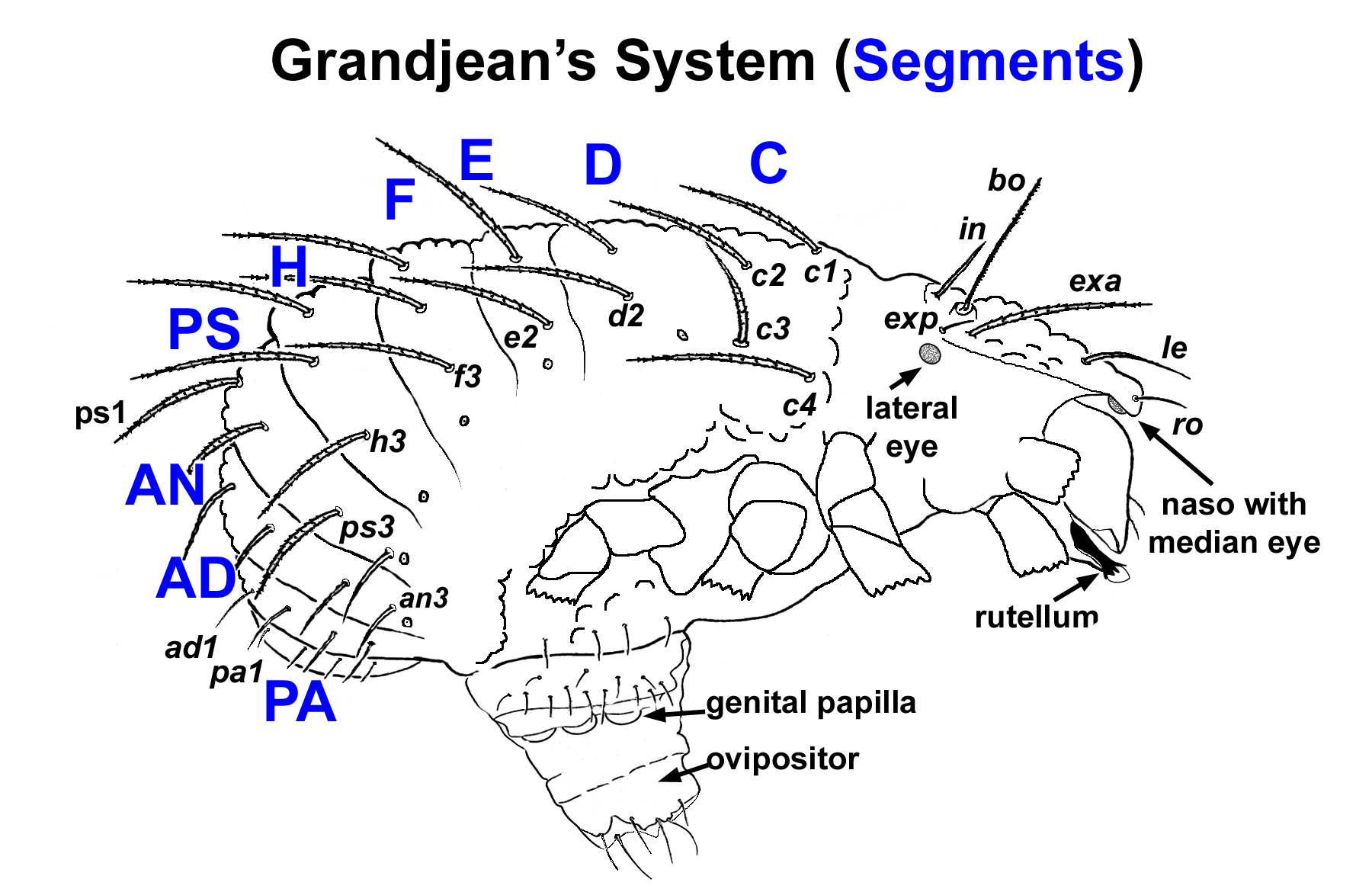
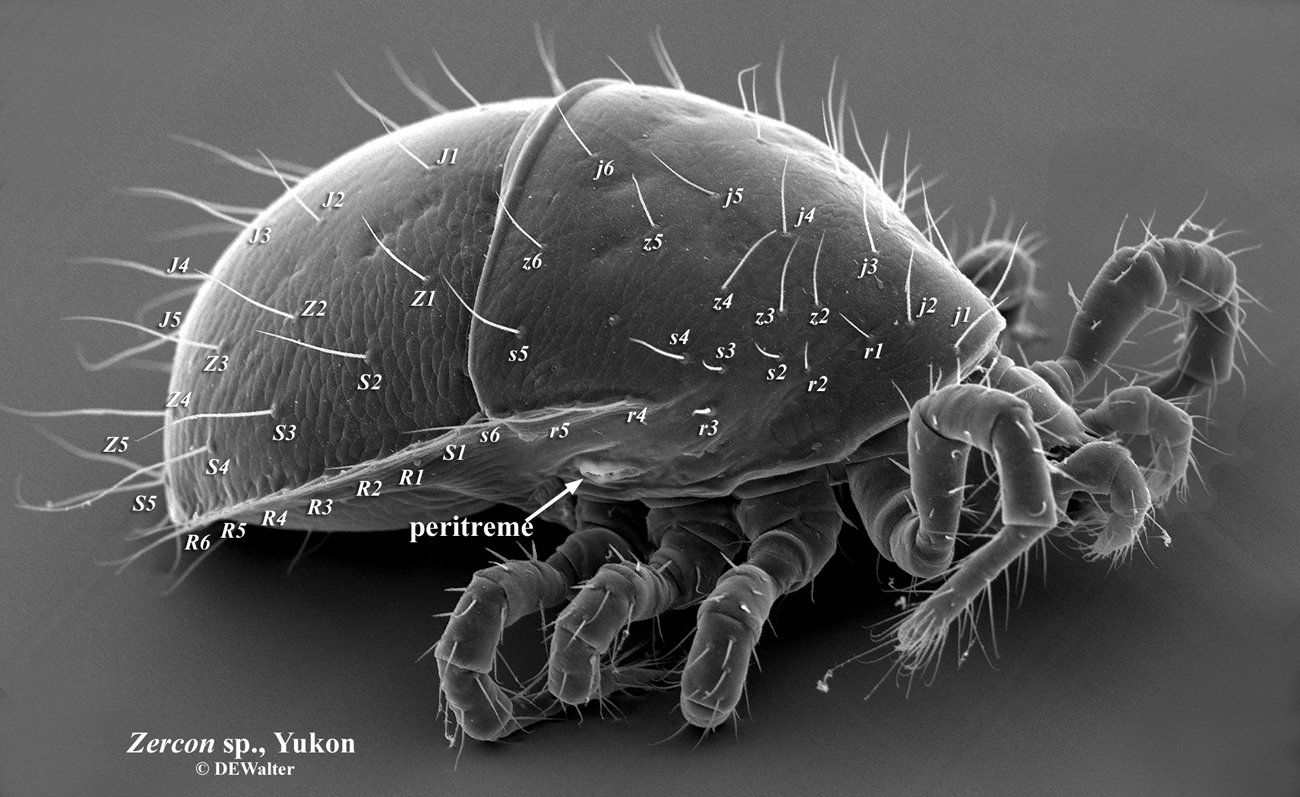
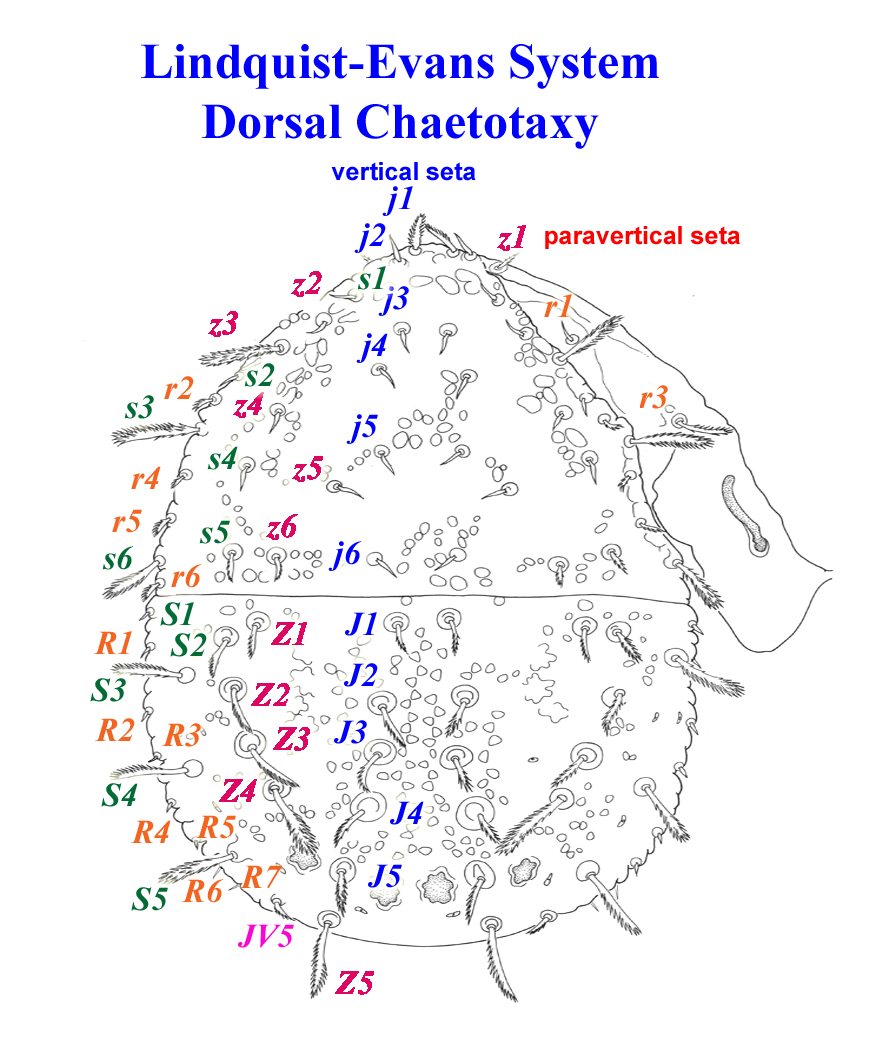
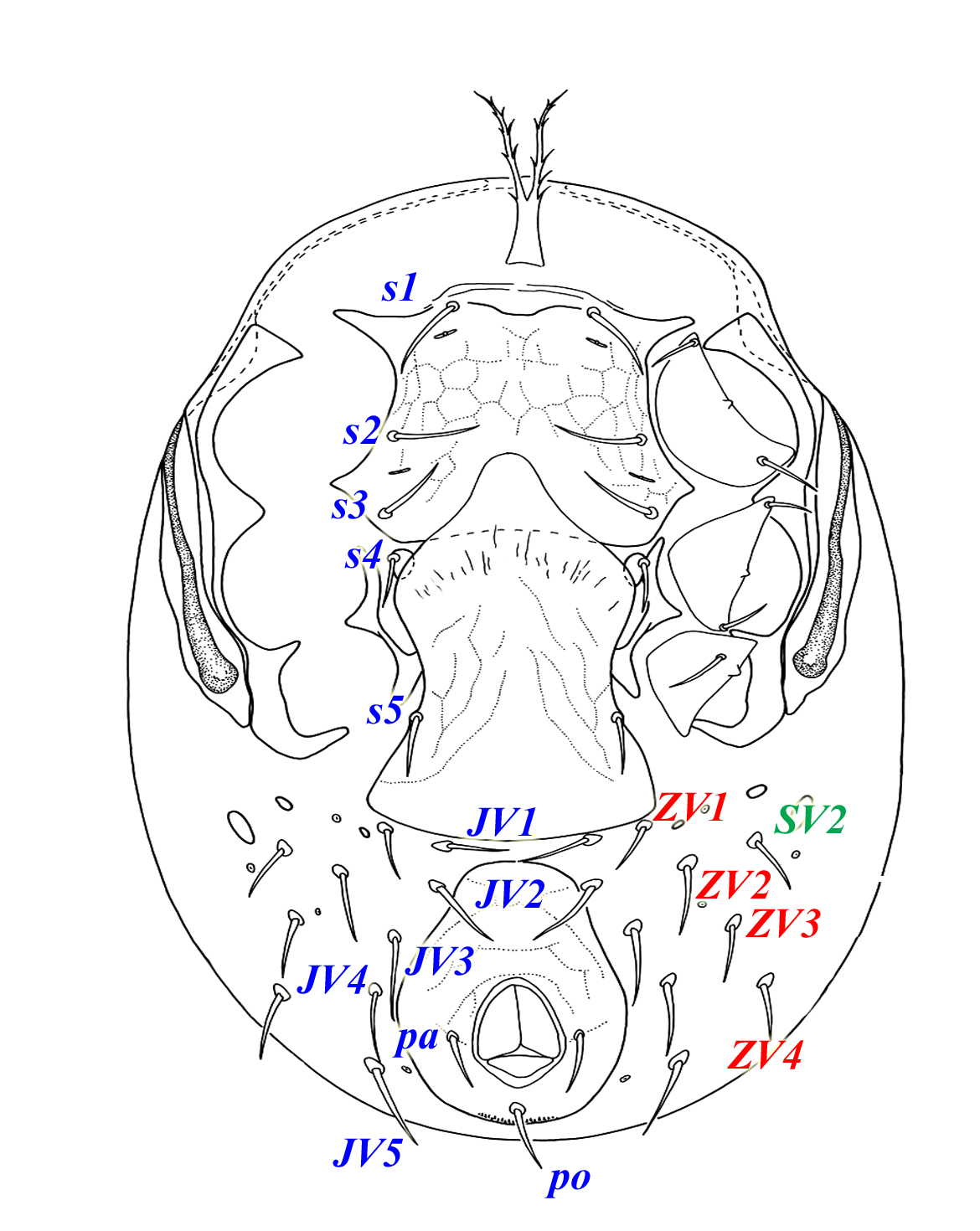
Many of the definitions refer to the same five reference images or illustrations. These five images are presented here for your convenience.
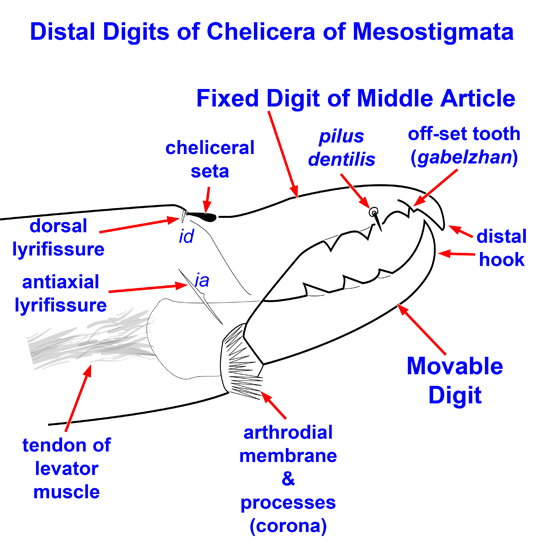
ia: designation for the anteriormost pair of cupules in acariform mites; typically lateral and associated with the border of segments C–D; also the antiaxial lyrifissureantiaxial lyrifissure:
the lyrifissure on the outer face of the chelicera in Mesostigmata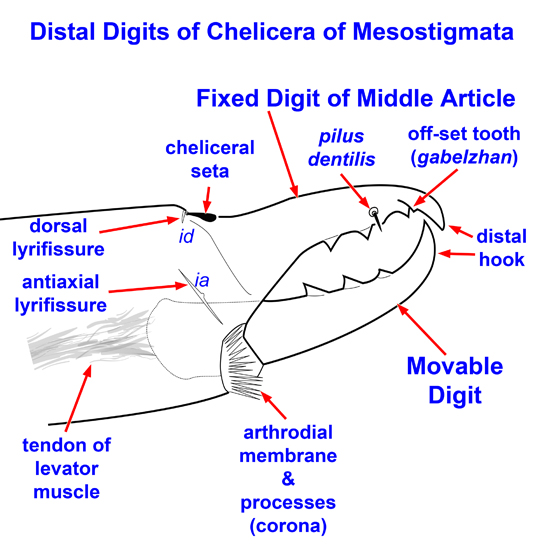 on the chelicerachelicera:
a limb on the presumed first body segment in chelicerate arthropods, the primary mouthparts. In mites the chelicerae are primitively chelate-dentate, but may be modified into almost unrecognizable forms. In Acariformes, the chelicerae are usually 2-segmented, but in other mites and some basal acariforms they have three segments. Rarely, in some Uropodoidea (Mesostigmata), a subdivision makes them appear 4-segmented.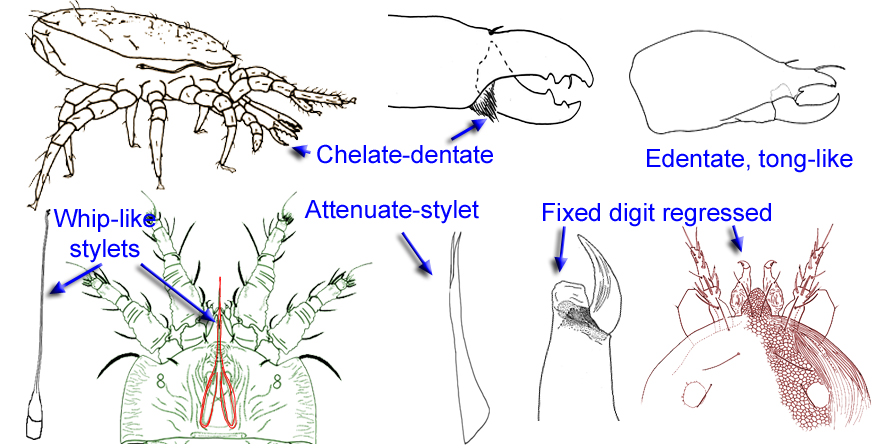 of Mesostigmata (see image at right).
iad: designation for the posteriormost pair of cupules in acariform mites; typically ventralventral:
relating to the lower or under side; opposed to dorsal.
and associated with segment AD.
ih: designation for a pair of cupules in acariform mites; typically lateral and associated with segment H.
im: designation for second anteriormost pair of cupules in acariform mites; typically lateral and associated with segment E.
ip: designation for a pair of cupules in acariform mites; typically lateral and associated with segment F.
ips: designation for the penultimate pair of cupules in acariform mites; typically lateral and associated with segment PS.
gdJ, gdS, gdZ: designations for opisthonotal glandsopisthonotal glands:
see oil glands
associated with particular setalsetal:
of or pertaining to a seta.
rows based on the works of Krantz and Redmond (1987: Identification of glandular and poroidal idionotal systems in Macrocheles perglaber F & P (Acari: Macrochelidae). Exp. Appl. Acarol. 3: 243–253) and Johnston and Moraza (1991: The idiosomalidiosomal:
(idiosomatic) adjectival form of idiosoma.
adenotaxy and poroidotaxy of Zerconidae (Mesostigmata: Zerconina). pp. 349–356 in Dusabek & Bukva (eds) Modern Acarology Vol. 2).
gdj, gds, gdz: designations for podonotalpodonotal:
relating to the dorsal podosoma, the region of the idiosoma over the legs.
glands associated with particular setalsetal:
of or pertaining to a seta.
rows based on the works of Krantz and Redmond (1987: Identification of glandular and poroidal idionotal systems in Macrocheles perglaber F & P (Acari: Macrochelidae). Exp. Appl. Acarol. 3: 243–253) and Johnston and Moraza (1991: The idiosomalidiosomal:
(idiosomatic) adjectival form of idiosoma.
adenotaxy and poroidotaxy of Zerconidae (Mesostigmata: Zerconina). pp. 349–356 in Dusabek & Bukva (eds) Modern Acarology Vol. 2).
id: designation for the dorsal lyrifissuredorsal lyrifissure:
the dorsal lyrifissure posteriad the cheliceral seta in Mesostigmata. on the chelicerachelicera:
a limb on the presumed first body segment in chelicerate arthropods, the primary mouthparts. In mites the chelicerae are primitively chelate-dentate, but may be modified into almost unrecognizable forms. In Acariformes, the chelicerae are usually 2-segmented, but in other mites and some basal acariforms they have three segments. Rarely, in some Uropodoidea (Mesostigmata), a subdivision makes them appear 4-segmented. of Mesostigmata. (See image at right.)
idJ, idS idZ: designations for opisthonotalopisthonotal:
dorsal opisthosoma.
lyrifissures associated with particular setalsetal:
of or pertaining to a seta.
rows based on the works of Krantz and Redmond (1987: Identification of glandular and poroidal idionotal systems in Macrocheles perglaber F & P (Acari: Macrochelidae). Exp. Appl. Acarol. 3: 243–253) and Johnston and Moraza (1991: The idiosomalidiosomal:
(idiosomatic) adjectival form of idiosoma.
adenotaxy and poroidotaxy of Zerconidae (Mesostigmata: Zerconina). pp. 349–356 in Dusabek & Bukva (eds) Modern Acarology Vol. 2).
idj, ids, idz: designations for podonotalpodonotal:
relating to the dorsal podosoma, the region of the idiosoma over the legs.
lyrifissures associated with particular setalsetal:
of or pertaining to a seta.
rows based on the works of Krantz and Redmond (1987: Identification of glandular and poroidal idionotal systems in Macrocheles perglaber F & P (Acari: Macrochelidae). Exp. Appl. Acarol. 3: 243–253) and Johnston and Moraza (1991: The idiosomalidiosomal:
(idiosomatic) adjectival form of idiosoma.
adenotaxy and poroidotaxy of Zerconidae (Mesostigmata: Zerconina). pp. 349–356 in Dusabek & Bukva (eds) Modern Acarology Vol. 2).
iv 1-5: designation for the sternal poressternal pores:
(designations = stp or iv) in Mesostigmata, the lyrifissures in the intercoxal region; stp1-2 often occur on the sternal shield and stp3 is associated with the metasternal setae on a combined sternal-metasternal shield, on a separate sternal platelet, or in soft cuticle.
(lyrifissures) in the Mesostigmata (see sternal poressternal pores:
(designations = stp or iv) in Mesostigmata, the lyrifissures in the intercoxal region; stp1-2 often occur on the sternal shield and stp3 is associated with the metasternal setae on a combined sternal-metasternal shield, on a separate sternal platelet, or in soft cuticle.
). Also sometimes used for ventral setaeventral setae:
in the Lindquist-Evans system used in the Mesostigmata, the ventral region has up to three longitudinal rows (Jv, Zv, Lv) with 1-5 transverse row designations.
in some groups, e.g., Uropodina.
stp: sternal lyrifissure (porepore:
a pore-like opening or structure in the cuticle. In Mesostigmata, lyrifissures and true pore openings are often difficult to separate and both tend to be called 'pores', e.g., the sternal pores stp1-3.
) siglasigla:
designations for setae.
in Mesostigmata; stp1–3 (also iv 1–3)
AD: adanal segment in acariform mites; added on the deutonymphdeutonymph:
(also deuteronymph) the second nymphal stage or instar.
, see anamorphosis. (See Grandjean systemGrandjean system:
the primary system for designation of hysterosomal setae used in the Acariformes. Hypothesized segments (anterior to posterior) are C, D, E, F, H, PS (pseudanal), AD (adanal), AN (anal) and PA (peranal) (see anamorphosis). 'G' is not used, to avoid confusion with the genital segment, which is treated separately. Setae are designated from the midline to the sides from 1-x, e.g., c1, c2, c3, c4 (also cp).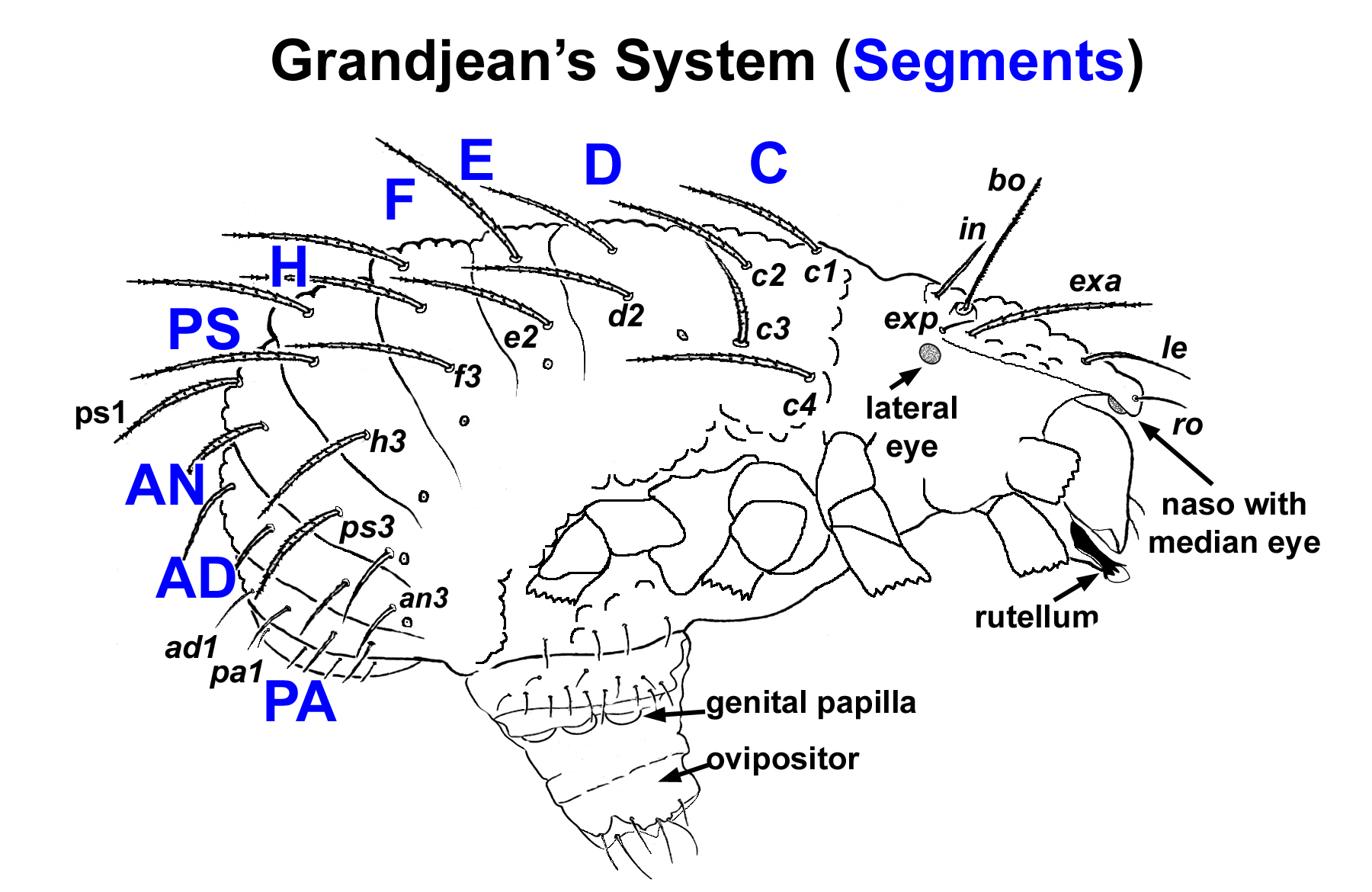 .)
.)
AN: anal segment in acariform mites; added on the protonymphprotonymph:
the first nymphal stage or instar, usually octopod.
, see anamorphosis. (See Grandjean systemGrandjean system:
the primary system for designation of hysterosomal setae used in the Acariformes. Hypothesized segments (anterior to posterior) are C, D, E, F, H, PS (pseudanal), AD (adanal), AN (anal) and PA (peranal) (see anamorphosis). 'G' is not used, to avoid confusion with the genital segment, which is treated separately. Setae are designated from the midline to the sides from 1-x, e.g., c1, c2, c3, c4 (also cp)..)
C: a designation used for the anterior region (apparent segment) of the hysterosoma in Acariformes. (See Grandjean systemGrandjean system:
the primary system for designation of hysterosomal setae used in the Acariformes. Hypothesized segments (anterior to posterior) are C, D, E, F, H, PS (pseudanal), AD (adanal), AN (anal) and PA (peranal) (see anamorphosis). 'G' is not used, to avoid confusion with the genital segment, which is treated separately. Setae are designated from the midline to the sides from 1-x, e.g., c1, c2, c3, c4 (also cp)..)
D: a designation used for the second region (apparent segment) of the hysterosoma in Acariformes. (See Grandjean systemGrandjean system:
the primary system for designation of hysterosomal setae used in the Acariformes. Hypothesized segments (anterior to posterior) are C, D, E, F, H, PS (pseudanal), AD (adanal), AN (anal) and PA (peranal) (see anamorphosis). 'G' is not used, to avoid confusion with the genital segment, which is treated separately. Setae are designated from the midline to the sides from 1-x, e.g., c1, c2, c3, c4 (also cp)..)
E: a designation used for the third region (apparent segment) of the hysterosoma in Acariformes. (See Grandjean systemGrandjean system:
the primary system for designation of hysterosomal setae used in the Acariformes. Hypothesized segments (anterior to posterior) are C, D, E, F, H, PS (pseudanal), AD (adanal), AN (anal) and PA (peranal) (see anamorphosis). 'G' is not used, to avoid confusion with the genital segment, which is treated separately. Setae are designated from the midline to the sides from 1-x, e.g., c1, c2, c3, c4 (also cp)..)
F: a designation used for the fourth region (apparent segment) of the hysterosoma in Acariformes. (See Grandjean systemGrandjean system:
the primary system for designation of hysterosomal setae used in the Acariformes. Hypothesized segments (anterior to posterior) are C, D, E, F, H, PS (pseudanal), AD (adanal), AN (anal) and PA (peranal) (see anamorphosis). 'G' is not used, to avoid confusion with the genital segment, which is treated separately. Setae are designated from the midline to the sides from 1-x, e.g., c1, c2, c3, c4 (also cp)..)
H: a designation used for the fifth region (apparent segment) of the hysterosoma in Acariformes. (NB—H comes after F and before PS, 'G' is not used to avoid confusion with the genital region). (See Grandjean systemGrandjean system:
the primary system for designation of hysterosomal setae used in the Acariformes. Hypothesized segments (anterior to posterior) are C, D, E, F, H, PS (pseudanal), AD (adanal), AN (anal) and PA (peranal) (see anamorphosis). 'G' is not used, to avoid confusion with the genital segment, which is treated separately. Setae are designated from the midline to the sides from 1-x, e.g., c1, c2, c3, c4 (also cp)..)
PA: peranal segment in acariform mites; added on the tritonymphtritonymph:
the third, and final, nymphal stage or instar present in Opilioacarida, Holothyrida, Argasidae, and many Acariformes.
, see anamorphosis. (See Grandjean systemGrandjean system:
the primary system for designation of hysterosomal setae used in the Acariformes. Hypothesized segments (anterior to posterior) are C, D, E, F, H, PS (pseudanal), AD (adanal), AN (anal) and PA (peranal) (see anamorphosis). 'G' is not used, to avoid confusion with the genital segment, which is treated separately. Setae are designated from the midline to the sides from 1-x, e.g., c1, c2, c3, c4 (also cp)..)
PS: pseudanalpseudanal:
referring to the setae or other structures on segment PS in acariform mites.
segment in acariform mites; 'anal' segment in the larva, see anamorphosis. (See Grandjean systemGrandjean system:
the primary system for designation of hysterosomal setae used in the Acariformes. Hypothesized segments (anterior to posterior) are C, D, E, F, H, PS (pseudanal), AD (adanal), AN (anal) and PA (peranal) (see anamorphosis). 'G' is not used, to avoid confusion with the genital segment, which is treated separately. Setae are designated from the midline to the sides from 1-x, e.g., c1, c2, c3, c4 (also cp)..)
Setae are named based on their segment, position on the segment, position relative to the bodybody:
the idiosoma of mites.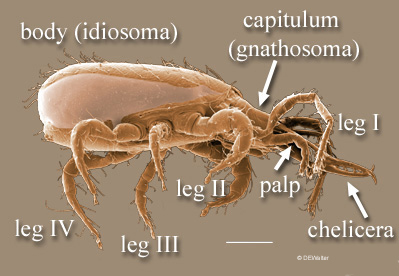 axis [' = paraxialparaxial:
against the axis of the body (also adaxial), e.g., the inner face of the chelicera.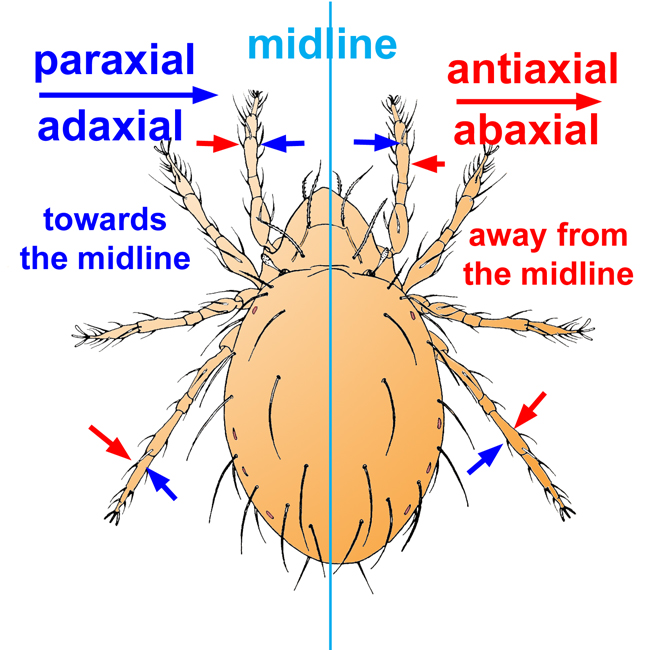 ; " = antiaxial], and relationship to other setae in the whorlwhorl:
one of the whorls or verticils of birefringent setae on the leg segments of acariform mites.
, e.g., for the genuagenu:
(pl. genua) (= patella) the 4th leg segment, between the femur and tibia.
and tibiaetibia:
(pl. tibiae) the leg segment between the genu and the tarsus.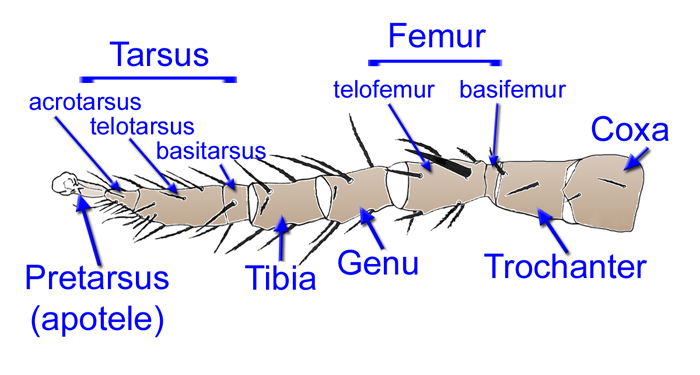 of oribatid mites with 5 setae per whorlwhorl:
one of the whorls or verticils of birefringent setae on the leg segments of acariform mites.
: dorsaldorsal:
relating to the upper or back side; opposed to ventral.
(d), anterolateral (al'), anteroventral (v'), posteroventral (v'' )and posterolateral (pl'); 7 setae per whorlwhorl:
one of the whorls or verticils of birefringent setae on the leg segments of acariform mites.
: dorsolateral (ls'), anterior ventrilateral (li'), anterior subtibial (st'), posteriorposterior:
the back part of the body or towards that region in comparison, e.g., 'posterior to'.
subtibial (st"), posteriorposterior:
the back part of the body or towards that region in comparison, e.g., 'posterior to'.
ventrolateral (li"). and posteriorposterior:
the back part of the body or towards that region in comparison, e.g., 'posterior to'.
dorsolateral (ls"). The designations for tarsal setae are even more complex and have acquired names as well as designations. The two most distaldistal:
towards the free end of an appendage.
pairs (at basebase:
the usually columnar basal part of the tritosternum; sometimes expanded and rectangular or otherwise modified; the most basal part of any structure.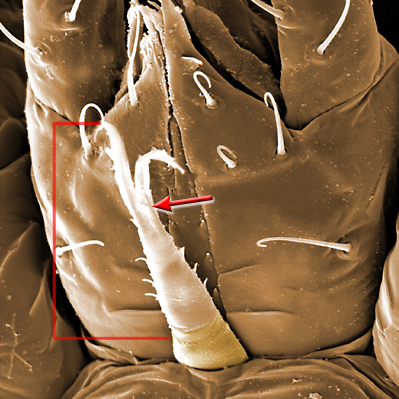 of ambulacrum) are the dorsal proralsprorals:
(p) the most distal pair (at base of ambulacrum) of dorsal setae on the tarsus of acariform mites (see whorl).
(p) and the ventralventral:
relating to the lower or under side; opposed to dorsal.
unguinals (u); On the dorsal tarsustarsus:
(pl. tarsi) the subdistal leg segment between the tibia and the pretarsus (apotele).
behind the proralsprorals:
(p) the most distal pair (at base of ambulacrum) of dorsal setae on the tarsus of acariform mites (see whorl).
moving basally are the iterals (it), tectalstectals:
(tc) a pair of dorsal tarsal setae between the iterals and the fastigals on the tarsi of acariform mites (see whorl).
(tc), and fastigials (ft). On the ventralventral:
relating to the lower or under side; opposed to dorsal.
tarsus behind the unguinalsunguinals:
(u) the distalmost ventral pair of setae at the base of the ambulacrum on the tarsi of acariform mites (see whorl).
is the subunguinal setasubunguinal seta:
(s) an unpaired seta between the unguinal and anterolateral pairs on the tarsi of acariform mites (see whorl).
(s), followed by the anterolateralsanterolaterals:
(a) a pair of ventral setae between the subunguinal seta and the primiventrals on the tarsi of acariform mites (see whorl)
(a), primiventralsprimiventrals:
(pv) a pair of ventral setae between the anterolaterals and the primilaterals on the tarsi of acariform mites (see whorl).
(pv), and primilateralsprimilaterals:
(pl) the most basal pair of ventral (ventrolateral) setae on the tarsi of acariform mites (see whorl). On the ventral tarsus behind the unguinals is the seta (s), followed by the anterolaterals (a), primiventrals (pv), and primilaterals (pl).
(pl). Some of these setae may be modified into eupathidiaeupathidion:
(pl. eupathidia) an optically active but hollow seta with a pore at its tip and found on the palptarsus or leg I tarsus of many acariform mites; probably a chemoreceptor; designation = zeta (Ζ). (Also acanthoides).
(?). Various other designations occur in the Oribatida and Astigmata. Additionally, a hollow birefringent seta called the famulusfamulus:
a hollow and optically active seta-like structure located near the base of the dorsum of tarsus I in acariform mites; designation = e (epsilon).
[e (epsilonepsilon:
(e) designation for the famulus on the tarsi of some acariform mites.
)] may be present, as well as, optically inactive chemosensory solenidia.
a: (anterolateralsanterolaterals:
(a) a pair of ventral setae between the subunguinal seta and the primiventrals on the tarsi of acariform mites (see whorl)
) a pair of ventral setaeventral setae:
in the Lindquist-Evans system used in the Mesostigmata, the ventral region has up to three longitudinal rows (Jv, Zv, Lv) with 1-5 transverse row designations.
between the subunguinal setasubunguinal seta:
(s) an unpaired seta between the unguinal and anterolateral pairs on the tarsi of acariform mites (see whorl).
and the primiventralsprimiventrals:
(pv) a pair of ventral setae between the anterolaterals and the primilaterals on the tarsi of acariform mites (see whorl).
on the tarsitarsus:
(pl. tarsi) the subdistal leg segment between the tibia and the pretarsus (apotele).
of acariform mites (see whorlwhorl:
one of the whorls or verticils of birefringent setae on the leg segments of acariform mites.
).
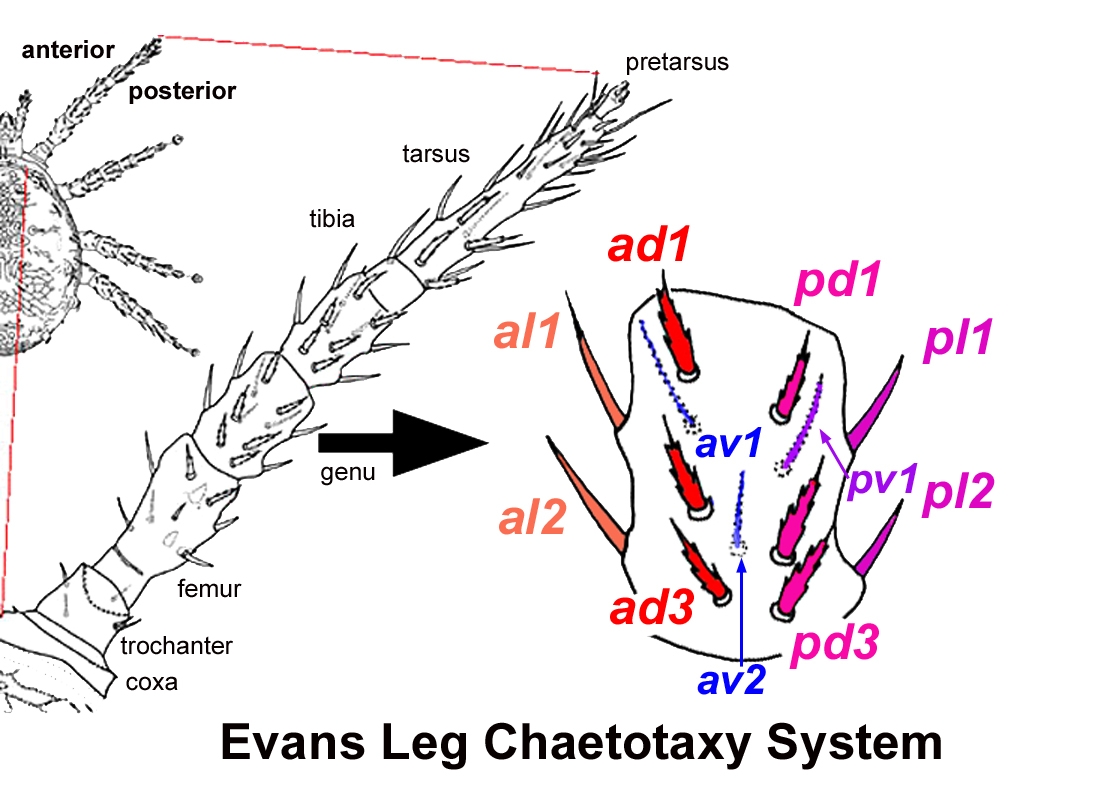
ad 1-3: designations for the setae on the anterior dorsaldorsal:
relating to the upper or back side; opposed to ventral.
surface of a leg or palppalp:
(= pedipalp) the second pair of limbs in arachnids, used in feeding and originating on either side of the chelicerae. In mites, the palps may be vestigial, with only a few segments, or have a maximum of 5 freely articulating segments (rarely the femur is subdivided) and a distal or subdistal apotele.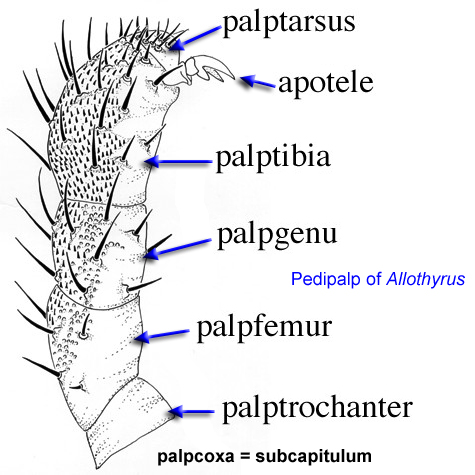 segment in the Mesostigmata (see Evans leg chaetotactic systemEvans leg chaetotactic system:
in Mesostigmata, the nomenclature for the setation of legs segments derived by GO Evans. In essence, the leg is visualized oriented dorso-ventrally and at a right angle to the body midline, such that four aspects are present: dorsal, ventral, anterior lateral, and posterior lateral. Setae are designated in rows for their anterior (ad) or posterior dorsal (pd), ventral (av, pv) or lateral (al, pl) aspects and numbered from distal to basal. For example, a segment with 2 rows of 3 dorsal setae would have three anterior dorsal (ad1-3) and three posterior dorsal (pd1-3) setae. Evans devised a similar system for the palps.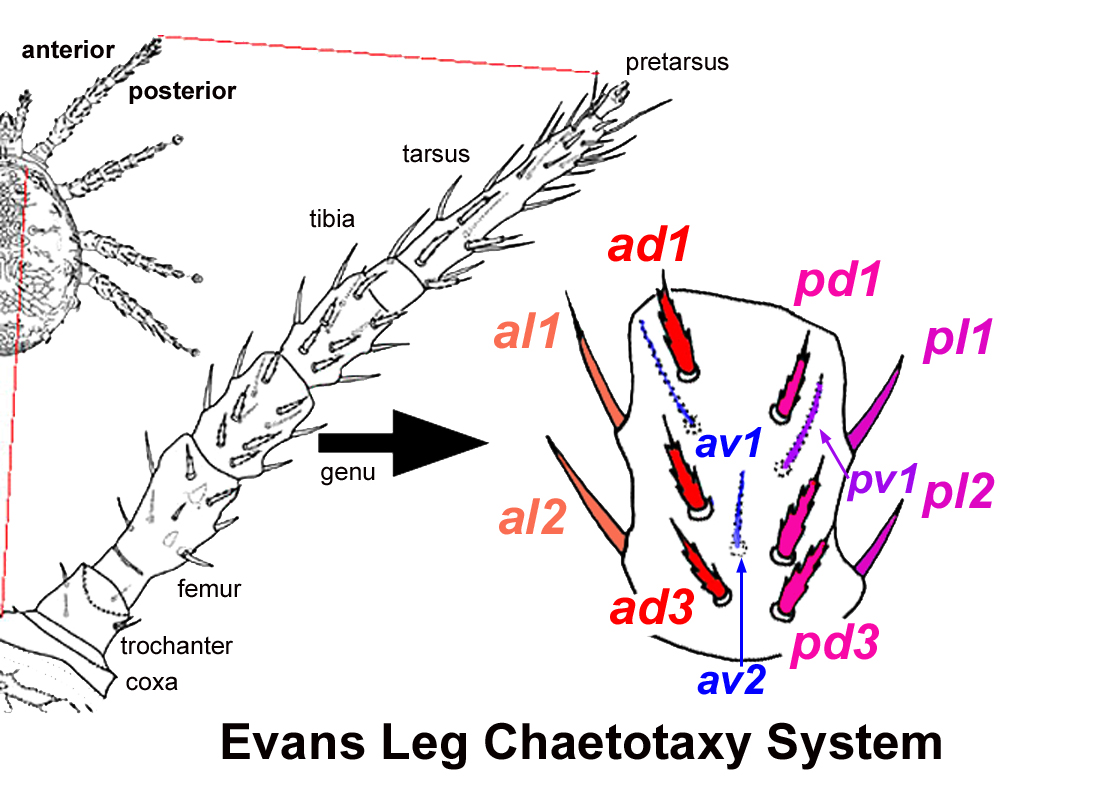 ). Also, the designations for the setae of the adanal segment in Acariformes (see Grandjean systemGrandjean system:
the primary system for designation of hysterosomal setae used in the Acariformes. Hypothesized segments (anterior to posterior) are C, D, E, F, H, PS (pseudanal), AD (adanal), AN (anal) and PA (peranal) (see anamorphosis). 'G' is not used, to avoid confusion with the genital segment, which is treated separately. Setae are designated from the midline to the sides from 1-x, e.g., c1, c2, c3, c4 (also cp).).
ag: a designation used for aggenital or pregenitalpregenital:
in front of (anterior to) the genital opening.
setae in the Acariformes, e.g., ag1–3.
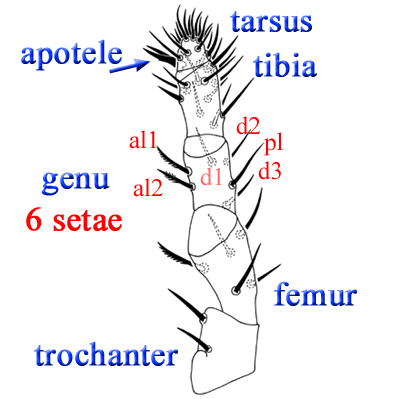
al 1-2: designations for the setae on the anterior lateral surface of a leg or palppalp:
(= pedipalp) the second pair of limbs in arachnids, used in feeding and originating on either side of the chelicerae. In mites, the palps may be vestigial, with only a few segments, or have a maximum of 5 freely articulating segments (rarely the femur is subdivided) and a distal or subdistal apotele. segment in the Mesostigmata. (See image at right and see Evans leg chaetotactic systemEvans leg chaetotactic system:
in Mesostigmata, the nomenclature for the setation of legs segments derived by GO Evans. In essence, the leg is visualized oriented dorso-ventrally and at a right angle to the body midline, such that four aspects are present: dorsal, ventral, anterior lateral, and posterior lateral. Setae are designated in rows for their anterior (ad) or posterior dorsal (pd), ventral (av, pv) or lateral (al, pl) aspects and numbered from distal to basal. For example, a segment with 2 rows of 3 dorsal setae would have three anterior dorsal (ad1-3) and three posterior dorsal (pd1-3) setae. Evans devised a similar system for the palps..)
av 1-3: designations for the setae on the anterior ventralventral:
relating to the lower or under side; opposed to dorsal.
surface of a leg or palppalp:
(= pedipalp) the second pair of limbs in arachnids, used in feeding and originating on either side of the chelicerae. In mites, the palps may be vestigial, with only a few segments, or have a maximum of 5 freely articulating segments (rarely the femur is subdivided) and a distal or subdistal apotele. segment in the Mesostigmata. (See Evans leg chaetotactic systemEvans leg chaetotactic system:
in Mesostigmata, the nomenclature for the setation of legs segments derived by GO Evans. In essence, the leg is visualized oriented dorso-ventrally and at a right angle to the body midline, such that four aspects are present: dorsal, ventral, anterior lateral, and posterior lateral. Setae are designated in rows for their anterior (ad) or posterior dorsal (pd), ventral (av, pv) or lateral (al, pl) aspects and numbered from distal to basal. For example, a segment with 2 rows of 3 dorsal setae would have three anterior dorsal (ad1-3) and three posterior dorsal (pd1-3) setae. Evans devised a similar system for the palps..)
c: a designation used for setae on segment C in the Acariformes, e.g., c1–3. (See Grandjean systemGrandjean system:
the primary system for designation of hysterosomal setae used in the Acariformes. Hypothesized segments (anterior to posterior) are C, D, E, F, H, PS (pseudanal), AD (adanal), AN (anal) and PA (peranal) (see anamorphosis). 'G' is not used, to avoid confusion with the genital segment, which is treated separately. Setae are designated from the midline to the sides from 1-x, e.g., c1, c2, c3, c4 (also cp)..)
d: a designation used for setae on segment D in the Acariformes, e.g., d1–2. (See Grandjean systemGrandjean system:
the primary system for designation of hysterosomal setae used in the Acariformes. Hypothesized segments (anterior to posterior) are C, D, E, F, H, PS (pseudanal), AD (adanal), AN (anal) and PA (peranal) (see anamorphosis). 'G' is not used, to avoid confusion with the genital segment, which is treated separately. Setae are designated from the midline to the sides from 1-x, e.g., c1, c2, c3, c4 (also cp)..)
D1-5; DC1-5: Dorsocentral opisthosomalopisthosomal:
(opisthosomatic) adjectival form of opisthosoma.
setae of spider mites in Pritchard and Baker (1955. A revision of the spider mitespider mite:
a member of the family Tetranychidae (Prostigmata).
family Tetranychidae. Mem. Pac. Coast Entomol. Soc. 2: 1–472.). D1 = c1; D2 = d1; D3 = e1; D4 = f1; D5 = h1 in the Grandjean systemGrandjean system:
the primary system for designation of hysterosomal setae used in the Acariformes. Hypothesized segments (anterior to posterior) are C, D, E, F, H, PS (pseudanal), AD (adanal), AN (anal) and PA (peranal) (see anamorphosis). 'G' is not used, to avoid confusion with the genital segment, which is treated separately. Setae are designated from the midline to the sides from 1-x, e.g., c1, c2, c3, c4 (also cp)..
e: a designation used for setae on segment E in the Acariformes, e.g., e1–2. (See Grandjean systemGrandjean system:
the primary system for designation of hysterosomal setae used in the Acariformes. Hypothesized segments (anterior to posterior) are C, D, E, F, H, PS (pseudanal), AD (adanal), AN (anal) and PA (peranal) (see anamorphosis). 'G' is not used, to avoid confusion with the genital segment, which is treated separately. Setae are designated from the midline to the sides from 1-x, e.g., c1, c2, c3, c4 (also cp)..)
ep: the epicoxal of the palpcoxa in acariform mites.
ep1: the epicoxal setaepicoxal seta:
a minute, usually peg-like seta on the dorsal face of the palpcoxa (ep) or coxae of legs I (ep1) in some acariform mites.
of coxacoxa:
the basal segment of the leg, articulating with (Parasitiformes) or fused to (Acariformes) the body wall. I in acariform mites.
f: a designation used for setae on segment F in the Acariformes, e.g., f1–2. (See Grandjean systemGrandjean system:
the primary system for designation of hysterosomal setae used in the Acariformes. Hypothesized segments (anterior to posterior) are C, D, E, F, H, PS (pseudanal), AD (adanal), AN (anal) and PA (peranal) (see anamorphosis). 'G' is not used, to avoid confusion with the genital segment, which is treated separately. Setae are designated from the midline to the sides from 1-x, e.g., c1, c2, c3, c4 (also cp)..)
ft: designation for the fastigalsfastigals:
(ft) the most basal pair of dorsal tarsal setae on the tarsi of acariform mites (see whorl).
, the most basalbasal:
towards the base of a structure; on a limb, towards the insertion on the body.
pair of dorsaldorsal:
relating to the upper or back side; opposed to ventral.
tarsal setae on the tarsitarsus:
(pl. tarsi) the subdistal leg segment between the tibia and the pretarsus (apotele).
of acariform mites (see whorlwhorl:
one of the whorls or verticils of birefringent setae on the leg segments of acariform mites.
).
g: a designation used for genital setae, e.g., g1.
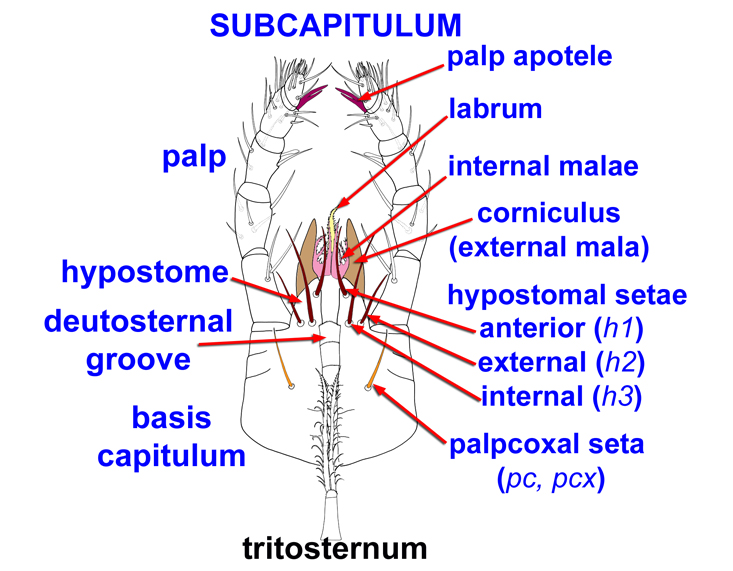
h: a designation used for setae on segment H in the Acariformes, e.g., h1–3 (see Grandjean systemGrandjean system:
the primary system for designation of hysterosomal setae used in the Acariformes. Hypothesized segments (anterior to posterior) are C, D, E, F, H, PS (pseudanal), AD (adanal), AN (anal) and PA (peranal) (see anamorphosis). 'G' is not used, to avoid confusion with the genital segment, which is treated separately. Setae are designated from the midline to the sides from 1-x, e.g., c1, c2, c3, c4 (also cp).); also a designation used for the hypostomal (hypostomatic) setae (h1–3) in Mesostigmata. (See image at right.)
H: the humeral seta of spider mites in the Pritchard & BakerPritchard & Baker:
A system of setal designations of spider mites in Pritchard & Baker 1955 (A revision of the spider mite family Tetranychidae. Mem. Pac. Coast Entomol. Soc. 2: 1-472.). Dorsocentrals: D1 = c1; D2 = d1; D3 = e1; D4 = f1; D5 = h1; Dorsolaterals: L1 = c2; L2 = d2; L3 = e2; L4 = f2; Sublaterals: 1st sublaterals = c3; 2nd sublaterals = d3; 3rd sublaterals = e3; Humerals: H = c3; also Inner sacrals (or DC4) = f1; Outer sacrals (or L4) = f2; Clunals (or DC5) = h1 or f3; Postanals (or posterior para-anals) = h2; Anterior para-anals = h3; Anals = ps1-3; 1st genitals (or anteromedial genitals) = g1; 2nd genitals (or posterolateral genitals)= g2; Pregenitals = ag in the Grandjean system.
system; H = c3 in the Grandjean systemGrandjean system:
the primary system for designation of hysterosomal setae used in the Acariformes. Hypothesized segments (anterior to posterior) are C, D, E, F, H, PS (pseudanal), AD (adanal), AN (anal) and PA (peranal) (see anamorphosis). 'G' is not used, to avoid confusion with the genital segment, which is treated separately. Setae are designated from the midline to the sides from 1-x, e.g., c1, c2, c3, c4 (also cp)..
i-series: obsolete designation for the j-series in the Lindquist-Evans systemLindquist-Evans system:
the system of setal signatures proposed by EE Lindquist & GO Evans (1965) and the dominant nomenclature used in the Mesostigmata in the more modern literature. Dorsally, the setae are designated by minor (on the pronotum or podonotum) and major (on the opisthonotum) Arabic letters representing longitudinal rows (from the midline to the lateral margin, j-J, z-Z, s-S, r-R, and an additional UR or submarginal row posteriorly) and Arabic numbers designating transverse rows (of hypothesized segments) from 1-6 on the pronotum and 1-5 (or higher in the UR-series) on the opisthonotum. (Origins: i=>j [Ger.] innen, inner]; z [Ger.] zwischen, between]; s [Ger.] seite, side]; r [Ger.] rand, margin; UR [Ger.] unterer rand, under margin.) See also, modifications by Lindquist (1994) and Lindquist & Moraza. Ventrally, idiosomal setae are treated as belonging to three regions: the sternal (intercoxal), the ventral, and the anal. Three pairs of sternal setae are present in the larva (st1-3); the genital seta st5 is added in the protonymph; and the metasternal seta st4 is added in the deutonymph. The 'metasternal' seta probably has more to do with the genital than the sternal region and is the only 'sternal' seta that sometimes is not expressed. The ventral region has up to three longitudinal rows (JV, ZV, and rarely SV [Lv]) with 1-5 transverse row designations. The anal region has a pair of paranal setae (pa) and an unpaired postanal seta (po).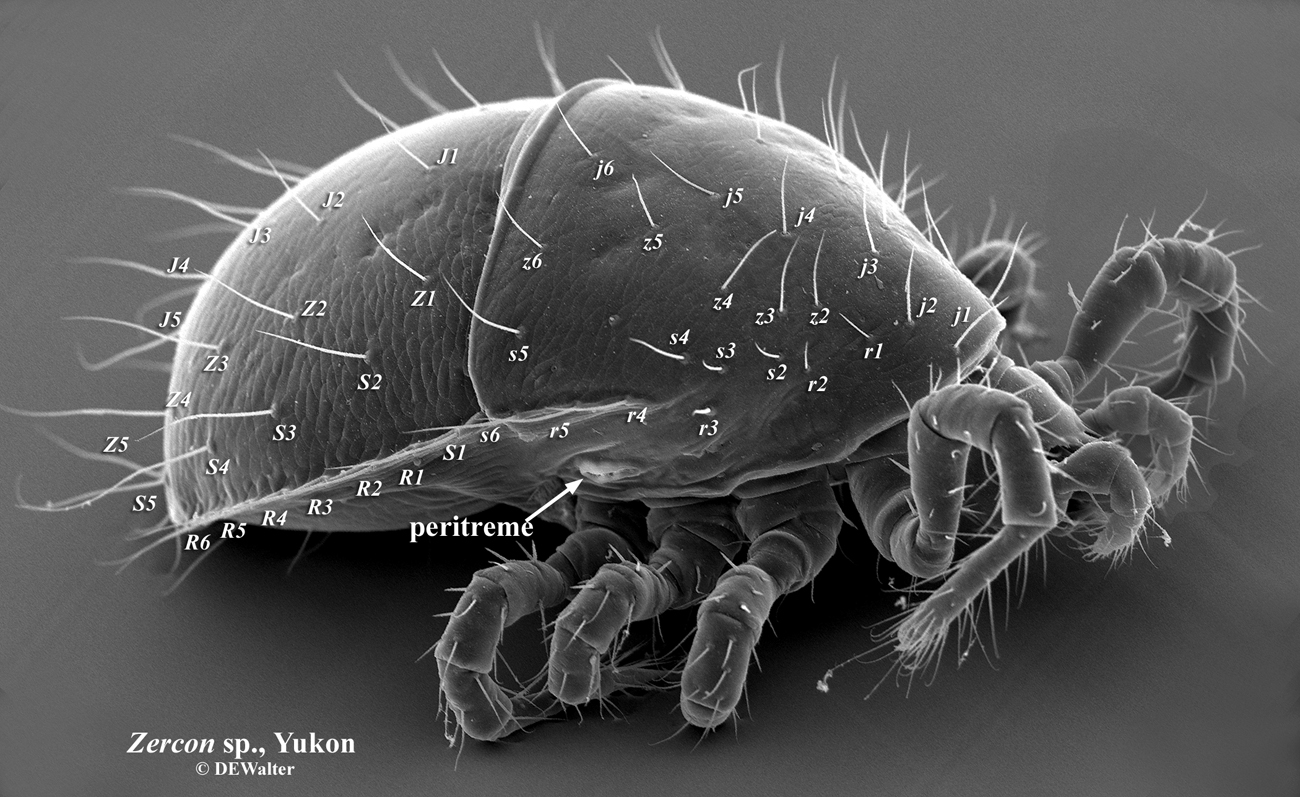 (from the German innen or inner).
iterals (it): a pair of dorsaldorsal:
relating to the upper or back side; opposed to ventral.
tarsal setae between the proralsprorals:
(p) the most distal pair (at base of ambulacrum) of dorsal setae on the tarsus of acariform mites (see whorl).
and the tectalstectals:
(tc) a pair of dorsal tarsal setae between the iterals and the fastigals on the tarsi of acariform mites (see whorl).
on the tarsitarsus:
(pl. tarsi) the subdistal leg segment between the tibia and the pretarsus (apotele).
of acariform mites (see whorlwhorl:
one of the whorls or verticils of birefringent setae on the leg segments of acariform mites.
).
J-series: In the Lindquist-Evans systemLindquist-Evans system:
the system of setal signatures proposed by EE Lindquist & GO Evans (1965) and the dominant nomenclature used in the Mesostigmata in the more modern literature. Dorsally, the setae are designated by minor (on the pronotum or podonotum) and major (on the opisthonotum) Arabic letters representing longitudinal rows (from the midline to the lateral margin, j-J, z-Z, s-S, r-R, and an additional UR or submarginal row posteriorly) and Arabic numbers designating transverse rows (of hypothesized segments) from 1-6 on the pronotum and 1-5 (or higher in the UR-series) on the opisthonotum. (Origins: i=>j [Ger.] innen, inner]; z [Ger.] zwischen, between]; s [Ger.] seite, side]; r [Ger.] rand, margin; UR [Ger.] unterer rand, under margin.) See also, modifications by Lindquist (1994) and Lindquist & Moraza. Ventrally, idiosomal setae are treated as belonging to three regions: the sternal (intercoxal), the ventral, and the anal. Three pairs of sternal setae are present in the larva (st1-3); the genital seta st5 is added in the protonymph; and the metasternal seta st4 is added in the deutonymph. The 'metasternal' seta probably has more to do with the genital than the sternal region and is the only 'sternal' seta that sometimes is not expressed. The ventral region has up to three longitudinal rows (JV, ZV, and rarely SV [Lv]) with 1-5 transverse row designations. The anal region has a pair of paranal setae (pa) and an unpaired postanal seta (po). used in the Mesostigmata, the most median longitudinal row of opisthonotalopisthonotal:
dorsal opisthosoma.
setae running from the anterior setae J1 to the clunal setaeclunal setae:
in Mesostigmata, setae J5, which are usually the most posterior pair of median opisthonotal setae.
J5 at or near the posteriorposterior:
the back part of the body or towards that region in comparison, e.g., 'posterior to'.
margin of the opisthonotal shieldopisthonotal shield:
the posterior shield in mesostigmatans with divided dorsal shields.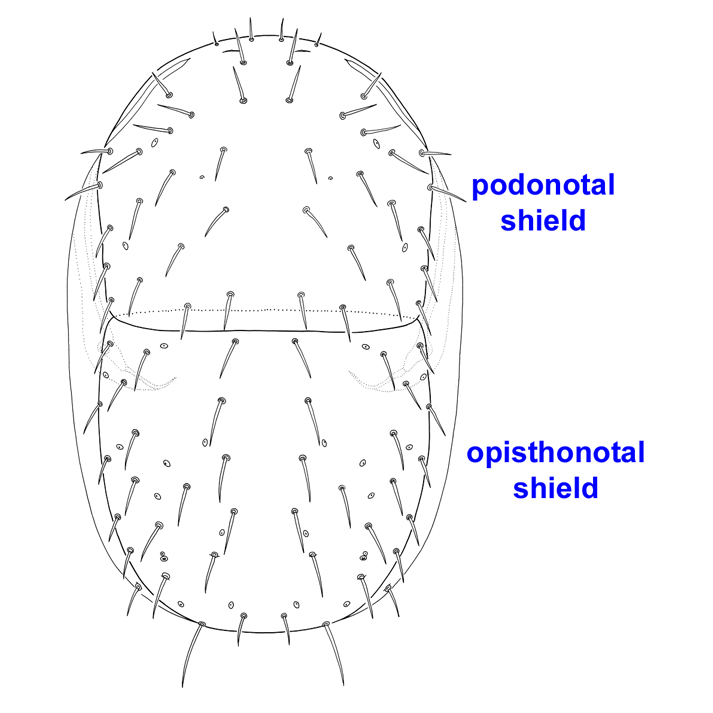 or region.
j-series: In the Lindquist-Evans systemLindquist-Evans system:
the system of setal signatures proposed by EE Lindquist & GO Evans (1965) and the dominant nomenclature used in the Mesostigmata in the more modern literature. Dorsally, the setae are designated by minor (on the pronotum or podonotum) and major (on the opisthonotum) Arabic letters representing longitudinal rows (from the midline to the lateral margin, j-J, z-Z, s-S, r-R, and an additional UR or submarginal row posteriorly) and Arabic numbers designating transverse rows (of hypothesized segments) from 1-6 on the pronotum and 1-5 (or higher in the UR-series) on the opisthonotum. (Origins: i=>j [Ger.] innen, inner]; z [Ger.] zwischen, between]; s [Ger.] seite, side]; r [Ger.] rand, margin; UR [Ger.] unterer rand, under margin.) See also, modifications by Lindquist (1994) and Lindquist & Moraza. Ventrally, idiosomal setae are treated as belonging to three regions: the sternal (intercoxal), the ventral, and the anal. Three pairs of sternal setae are present in the larva (st1-3); the genital seta st5 is added in the protonymph; and the metasternal seta st4 is added in the deutonymph. The 'metasternal' seta probably has more to do with the genital than the sternal region and is the only 'sternal' seta that sometimes is not expressed. The ventral region has up to three longitudinal rows (JV, ZV, and rarely SV [Lv]) with 1-5 transverse row designations. The anal region has a pair of paranal setae (pa) and an unpaired postanal seta (po). used in the Mesostigmata, the most median longitudinal row of prodorsal setaeprodorsal setae:
the setae on the prodorsum of acariform mites. Two competing chaetotactic systems are used for designations: the Rostral-lamellar and Vertical-scapular systems. 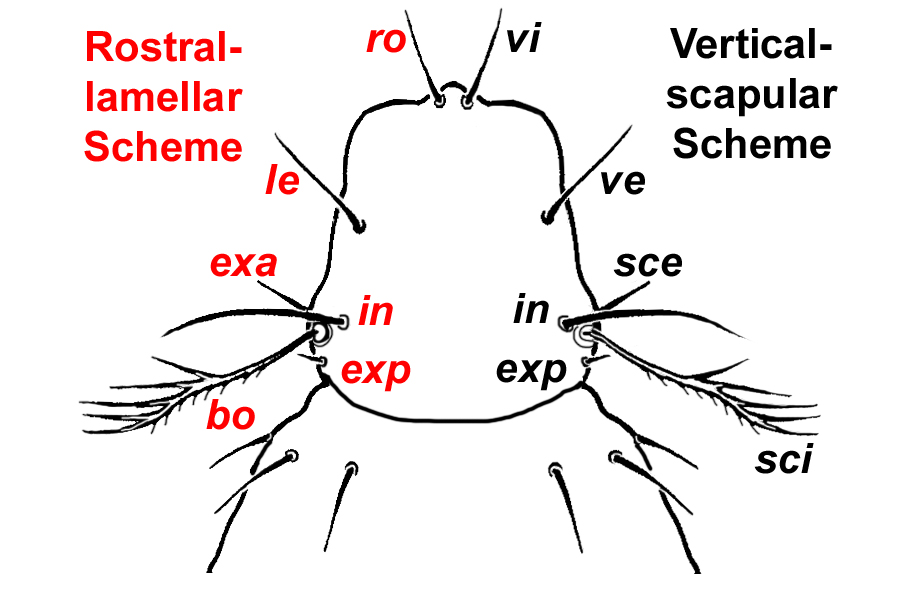 running from the anterior vertical setae j1 to setae j6 at or near the posteriorposterior:
the back part of the body or towards that region in comparison, e.g., 'posterior to'.
margin of the pronotal shield or region (from the German innen or inner, Hirschmann's designation for the innermost longitudinal series).
Jx: designation for an extra seta in the J-series (i.e., not assignable to setae J1–5 in the Lindquist-Evans systemLindquist-Evans system:
the system of setal signatures proposed by EE Lindquist & GO Evans (1965) and the dominant nomenclature used in the Mesostigmata in the more modern literature. Dorsally, the setae are designated by minor (on the pronotum or podonotum) and major (on the opisthonotum) Arabic letters representing longitudinal rows (from the midline to the lateral margin, j-J, z-Z, s-S, r-R, and an additional UR or submarginal row posteriorly) and Arabic numbers designating transverse rows (of hypothesized segments) from 1-6 on the pronotum and 1-5 (or higher in the UR-series) on the opisthonotum. (Origins: i=>j [Ger.] innen, inner]; z [Ger.] zwischen, between]; s [Ger.] seite, side]; r [Ger.] rand, margin; UR [Ger.] unterer rand, under margin.) See also, modifications by Lindquist (1994) and Lindquist & Moraza. Ventrally, idiosomal setae are treated as belonging to three regions: the sternal (intercoxal), the ventral, and the anal. Three pairs of sternal setae are present in the larva (st1-3); the genital seta st5 is added in the protonymph; and the metasternal seta st4 is added in the deutonymph. The 'metasternal' seta probably has more to do with the genital than the sternal region and is the only 'sternal' seta that sometimes is not expressed. The ventral region has up to three longitudinal rows (JV, ZV, and rarely SV [Lv]) with 1-5 transverse row designations. The anal region has a pair of paranal setae (pa) and an unpaired postanal seta (po).) on the opisthonotum in the Mesostigmata.
L1-4: lateral dorsal hysterosomalhysterosomal:
(hysterosomal) adjectival form of hysterosoma.
setae of spider mites in the Pritchard and Baker (1955. A revision of the spider mitespider mite:
a member of the family Tetranychidae (Prostigmata).
family Tetranychidae. Mem. Pac. Coast Entomol. Soc. 2: 1–472.). L1 = c2; L2 = d2; L3 = e2; L4 = f2 in the Grandjean systemGrandjean system:
the primary system for designation of hysterosomal setae used in the Acariformes. Hypothesized segments (anterior to posterior) are C, D, E, F, H, PS (pseudanal), AD (adanal), AN (anal) and PA (peranal) (see anamorphosis). 'G' is not used, to avoid confusion with the genital segment, which is treated separately. Setae are designated from the midline to the sides from 1-x, e.g., c1, c2, c3, c4 (also cp)..
MS: metasternal seta (st4)
p: a proral seta (see whorlwhorl:
one of the whorls or verticils of birefringent setae on the leg segments of acariform mites.
).
p1, p2, p3: in Mesostigmata (Zerconidae), designations for setae on the peritrematalperitrematal:
(peritrematic) of or referring to the peritreme; adjectival form of peritreme.
shield (variously z1, r1, r2, r3 of the Lindquist-Evans systemLindquist-Evans system:
the system of setal signatures proposed by EE Lindquist & GO Evans (1965) and the dominant nomenclature used in the Mesostigmata in the more modern literature. Dorsally, the setae are designated by minor (on the pronotum or podonotum) and major (on the opisthonotum) Arabic letters representing longitudinal rows (from the midline to the lateral margin, j-J, z-Z, s-S, r-R, and an additional UR or submarginal row posteriorly) and Arabic numbers designating transverse rows (of hypothesized segments) from 1-6 on the pronotum and 1-5 (or higher in the UR-series) on the opisthonotum. (Origins: i=>j [Ger.] innen, inner]; z [Ger.] zwischen, between]; s [Ger.] seite, side]; r [Ger.] rand, margin; UR [Ger.] unterer rand, under margin.) See also, modifications by Lindquist (1994) and Lindquist & Moraza. Ventrally, idiosomal setae are treated as belonging to three regions: the sternal (intercoxal), the ventral, and the anal. Three pairs of sternal setae are present in the larva (st1-3); the genital seta st5 is added in the protonymph; and the metasternal seta st4 is added in the deutonymph. The 'metasternal' seta probably has more to do with the genital than the sternal region and is the only 'sternal' seta that sometimes is not expressed. The ventral region has up to three longitudinal rows (JV, ZV, and rarely SV [Lv]) with 1-5 transverse row designations. The anal region has a pair of paranal setae (pa) and an unpaired postanal seta (po).)
P1, P2, P3: prodorsal setaeprodorsal setae:
the setae on the prodorsum of acariform mites. Two competing chaetotactic systems are used for designations: the Rostral-lamellar and Vertical-scapular systems. of spider mites in the Pritchard and Baker (1955. A revision of the spider mitespider mite:
a member of the family Tetranychidae (Prostigmata).
family Tetranychidae. Mem. Pac. Coast Entomol. Soc. 2: 1–472.). P1 = v2; P2 = sc1; P3 = sc2 in the Grandjean systemGrandjean system:
the primary system for designation of hysterosomal setae used in the Acariformes. Hypothesized segments (anterior to posterior) are C, D, E, F, H, PS (pseudanal), AD (adanal), AN (anal) and PA (peranal) (see anamorphosis). 'G' is not used, to avoid confusion with the genital segment, which is treated separately. Setae are designated from the midline to the sides from 1-x, e.g., c1, c2, c3, c4 (also cp)..
pa: designation for setae on the peranal segment in acariform mites (see Grandjean systemGrandjean system:
the primary system for designation of hysterosomal setae used in the Acariformes. Hypothesized segments (anterior to posterior) are C, D, E, F, H, PS (pseudanal), AD (adanal), AN (anal) and PA (peranal) (see anamorphosis). 'G' is not used, to avoid confusion with the genital segment, which is treated separately. Setae are designated from the midline to the sides from 1-x, e.g., c1, c2, c3, c4 (also cp).) or for the paranal setaeparanal setae:
(also adanal setae) the pair of seta inserted laterad the anal opening in the Mesostigmata; usually designated pa or PAR; the anterior (= h3) and posterior (= h2) para-anals in the Pritchard & Baker System.
in Mesostigmata.
PAR setae : the paranal air of seta inserted laterad the anal opening in the Mesostigmata; usually designated pa.
pc (also pcx) : designation used for the pair of palpcoxal setae, the most basalbasal:
towards the base of a structure; on a limb, towards the insertion on the body.
setae on the subcapitulumsubcapitulum:
(also infracapitulum) the venter of the capitulum; the ventral faces of the fused palpcoxae; apparently formed independently in the two superorders of mites.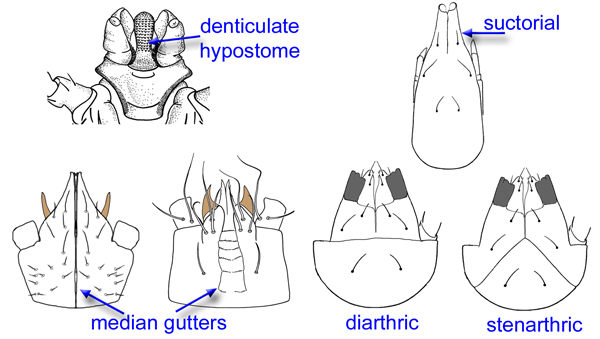 of mesostigmatans and not to be confused with the more anterior hypostomal setae.
pd 1–3: designations for the setae on the posteriorposterior:
the back part of the body or towards that region in comparison, e.g., 'posterior to'.
dorsal surface of a leg or palppalp:
(= pedipalp) the second pair of limbs in arachnids, used in feeding and originating on either side of the chelicerae. In mites, the palps may be vestigial, with only a few segments, or have a maximum of 5 freely articulating segments (rarely the femur is subdivided) and a distal or subdistal apotele. segment in the Mesostigmata. (See Evans leg chaetotactic systemEvans leg chaetotactic system:
in Mesostigmata, the nomenclature for the setation of legs segments derived by GO Evans. In essence, the leg is visualized oriented dorso-ventrally and at a right angle to the body midline, such that four aspects are present: dorsal, ventral, anterior lateral, and posterior lateral. Setae are designated in rows for their anterior (ad) or posterior dorsal (pd), ventral (av, pv) or lateral (al, pl) aspects and numbered from distal to basal. For example, a segment with 2 rows of 3 dorsal setae would have three anterior dorsal (ad1-3) and three posterior dorsal (pd1-3) setae. Evans devised a similar system for the palps..)
pl 1–2: designations for the setae on the posteriorposterior:
the back part of the body or towards that region in comparison, e.g., 'posterior to'.
lateral surface of a leg or palppalp:
(= pedipalp) the second pair of limbs in arachnids, used in feeding and originating on either side of the chelicerae. In mites, the palps may be vestigial, with only a few segments, or have a maximum of 5 freely articulating segments (rarely the femur is subdivided) and a distal or subdistal apotele. segment in the Mesostigmata. (See Evans leg chaetotactic systemEvans leg chaetotactic system:
in Mesostigmata, the nomenclature for the setation of legs segments derived by GO Evans. In essence, the leg is visualized oriented dorso-ventrally and at a right angle to the body midline, such that four aspects are present: dorsal, ventral, anterior lateral, and posterior lateral. Setae are designated in rows for their anterior (ad) or posterior dorsal (pd), ventral (av, pv) or lateral (al, pl) aspects and numbered from distal to basal. For example, a segment with 2 rows of 3 dorsal setae would have three anterior dorsal (ad1-3) and three posterior dorsal (pd1-3) setae. Evans devised a similar system for the palps..)
po seta: the unpaired median seta inserted posteriorposterior:
the back part of the body or towards that region in comparison, e.g., 'posterior to'.
to the anal opening in the Mesostigmata; usually designated po or POS.
pl: (primilaterals) the most basalbasal:
towards the base of a structure; on a limb, towards the insertion on the body.
pair of ventralventral:
relating to the lower or under side; opposed to dorsal.
(ventrolateral) setae on the tarsitarsus:
(pl. tarsi) the subdistal leg segment between the tibia and the pretarsus (apotele).
of acariform mites (see whorlwhorl:
one of the whorls or verticils of birefringent setae on the leg segments of acariform mites.
). On the ventralventral:
relating to the lower or under side; opposed to dorsal.
tarsus behind the unguinalsunguinals:
(u) the distalmost ventral pair of setae at the base of the ambulacrum on the tarsi of acariform mites (see whorl).
is the seta (s), followed by the anterolateralsanterolaterals:
(a) a pair of ventral setae between the subunguinal seta and the primiventrals on the tarsi of acariform mites (see whorl)
(a), primiventralsprimiventrals:
(pv) a pair of ventral setae between the anterolaterals and the primilaterals on the tarsi of acariform mites (see whorl).
(pv), and primilateralsprimilaterals:
(pl) the most basal pair of ventral (ventrolateral) setae on the tarsi of acariform mites (see whorl). On the ventral tarsus behind the unguinals is the seta (s), followed by the anterolaterals (a), primiventrals (pv), and primilaterals (pl).
(pl).
pv: (primiventrals) a pair of ventral setaeventral setae:
in the Lindquist-Evans system used in the Mesostigmata, the ventral region has up to three longitudinal rows (Jv, Zv, Lv) with 1-5 transverse row designations.
between the anterolateralsanterolaterals:
(a) a pair of ventral setae between the subunguinal seta and the primiventrals on the tarsi of acariform mites (see whorl)
and the primilateralsprimilaterals:
(pl) the most basal pair of ventral (ventrolateral) setae on the tarsi of acariform mites (see whorl). On the ventral tarsus behind the unguinals is the seta (s), followed by the anterolaterals (a), primiventrals (pv), and primilaterals (pl).
on the tarsitarsus:
(pl. tarsi) the subdistal leg segment between the tibia and the pretarsus (apotele).
of acariform mites (see whorlwhorl:
one of the whorls or verticils of birefringent setae on the leg segments of acariform mites.
).
ps: designation used for the setae in the PS region, e.g., ps1–2. (See Grandjean systemGrandjean system:
the primary system for designation of hysterosomal setae used in the Acariformes. Hypothesized segments (anterior to posterior) are C, D, E, F, H, PS (pseudanal), AD (adanal), AN (anal) and PA (peranal) (see anamorphosis). 'G' is not used, to avoid confusion with the genital segment, which is treated separately. Setae are designated from the midline to the sides from 1-x, e.g., c1, c2, c3, c4 (also cp)..)
pv 1–3: designations for the setae on the posterior ventralventral:
relating to the lower or under side; opposed to dorsal.
surface of a leg or palppalp:
(= pedipalp) the second pair of limbs in arachnids, used in feeding and originating on either side of the chelicerae. In mites, the palps may be vestigial, with only a few segments, or have a maximum of 5 freely articulating segments (rarely the femur is subdivided) and a distal or subdistal apotele. segment in the Mesostigmata. (See Evans leg chaetotactic systemEvans leg chaetotactic system:
in Mesostigmata, the nomenclature for the setation of legs segments derived by GO Evans. In essence, the leg is visualized oriented dorso-ventrally and at a right angle to the body midline, such that four aspects are present: dorsal, ventral, anterior lateral, and posterior lateral. Setae are designated in rows for their anterior (ad) or posterior dorsal (pd), ventral (av, pv) or lateral (al, pl) aspects and numbered from distal to basal. For example, a segment with 2 rows of 3 dorsal setae would have three anterior dorsal (ad1-3) and three posterior dorsal (pd1-3) setae. Evans devised a similar system for the palps..)
ro (= vi) : the rostral setarostral seta:
the anteriormost pair of prodorsal setae or an unpaired median seta (Nematalycoidea) in the Acariformes; when a naso is present, it often carries the rostral setae; various designations: ro, vi, v1., the most anterior seta on the prodorsumprodorsum:
the dorsal surface of the propodosoma.
of acariform mites, often associated with a naso. (See image at right.)
r-series: In the Lindquist-Evans systemLindquist-Evans system:
the system of setal signatures proposed by EE Lindquist & GO Evans (1965) and the dominant nomenclature used in the Mesostigmata in the more modern literature. Dorsally, the setae are designated by minor (on the pronotum or podonotum) and major (on the opisthonotum) Arabic letters representing longitudinal rows (from the midline to the lateral margin, j-J, z-Z, s-S, r-R, and an additional UR or submarginal row posteriorly) and Arabic numbers designating transverse rows (of hypothesized segments) from 1-6 on the pronotum and 1-5 (or higher in the UR-series) on the opisthonotum. (Origins: i=>j [Ger.] innen, inner]; z [Ger.] zwischen, between]; s [Ger.] seite, side]; r [Ger.] rand, margin; UR [Ger.] unterer rand, under margin.) See also, modifications by Lindquist (1994) and Lindquist & Moraza. Ventrally, idiosomal setae are treated as belonging to three regions: the sternal (intercoxal), the ventral, and the anal. Three pairs of sternal setae are present in the larva (st1-3); the genital seta st5 is added in the protonymph; and the metasternal seta st4 is added in the deutonymph. The 'metasternal' seta probably has more to do with the genital than the sternal region and is the only 'sternal' seta that sometimes is not expressed. The ventral region has up to three longitudinal rows (JV, ZV, and rarely SV [Lv]) with 1-5 transverse row designations. The anal region has a pair of paranal setae (pa) and an unpaired postanal seta (po). used in the Mesostigmata, the longitudinal row of marginal prodorsal setaeprodorsal setae:
the setae on the prodorsum of acariform mites. Two competing chaetotactic systems are used for designations: the Rostral-lamellar and Vertical-scapular systems. laterad the s-series and running from the anterior setae r1 (usually absent) to setae r6 at or near the posteriorposterior:
the back part of the body or towards that region in comparison, e.g., 'posterior to'.
margin of the pronotal shield or region. Setae r3 and r4 are in the humeral angle and one or both often project at right angles to the bodybody:
the idiosoma of mites.; other r-series setae are often in the soft cuticle. (From the German rand, margin)
R-series: In the Lindquist-Evans systemLindquist-Evans system:
the system of setal signatures proposed by EE Lindquist & GO Evans (1965) and the dominant nomenclature used in the Mesostigmata in the more modern literature. Dorsally, the setae are designated by minor (on the pronotum or podonotum) and major (on the opisthonotum) Arabic letters representing longitudinal rows (from the midline to the lateral margin, j-J, z-Z, s-S, r-R, and an additional UR or submarginal row posteriorly) and Arabic numbers designating transverse rows (of hypothesized segments) from 1-6 on the pronotum and 1-5 (or higher in the UR-series) on the opisthonotum. (Origins: i=>j [Ger.] innen, inner]; z [Ger.] zwischen, between]; s [Ger.] seite, side]; r [Ger.] rand, margin; UR [Ger.] unterer rand, under margin.) See also, modifications by Lindquist (1994) and Lindquist & Moraza. Ventrally, idiosomal setae are treated as belonging to three regions: the sternal (intercoxal), the ventral, and the anal. Three pairs of sternal setae are present in the larva (st1-3); the genital seta st5 is added in the protonymph; and the metasternal seta st4 is added in the deutonymph. The 'metasternal' seta probably has more to do with the genital than the sternal region and is the only 'sternal' seta that sometimes is not expressed. The ventral region has up to three longitudinal rows (JV, ZV, and rarely SV [Lv]) with 1-5 transverse row designations. The anal region has a pair of paranal setae (pa) and an unpaired postanal seta (po). used in the Mesostigmata, the longitudinal row of opisthodorsal setae laterad the S-series, mesad the UR-series, and running from the setae R1 to setae R6 (sometimes more) at or near the lateral margin of the opisthonotalopisthonotal:
dorsal opisthosoma.
region. R-series setae are usually inserted in soft cuticle.
s1: the internal scapular setascapular seta:
2 pairs of setae (sci, sce) on the prodorsum of Prostigmata, often inserted on either side of the eyes; see Vertical-scapular system.
(also sci, sc1, si) on the prodorsumprodorsum:
the dorsal surface of the propodosoma.
in the Prostigmata; see Vertical-scapular systemVertical-scapular system:
a system of designations for the prodorsal setae in Acariformes, especially in the Endeostigmata and Prostigmata. Prodorsal setae exp, in or both are often lost. In the Prostigmata, the prodorsal setae are represented at their maximum by the interior and exterior vertical (vi, also v1; ve, also v2, z2) and internal and external scapular setae (sci, also si, s1; sce, also se, s2) (a possible exception exists in Pilorhagidia which has 5 pairs). In Astigmata, the traditional designations follow those used in the Prostigmata; however, the purported internal scapular setae (sci or si) actually are in. In Oribatida, the Rostral-lamellar system is more commonly used (ro, le, bo, exa, in, exp, respectively)..
s1: the internal scapular setascapular seta:
2 pairs of setae (sci, sce) on the prodorsum of Prostigmata, often inserted on either side of the eyes; see Vertical-scapular system.
(also sci, sc1, si) on the prodorsumprodorsum:
the dorsal surface of the propodosoma.
in the Prostigmata; see Vertical-scapular systemVertical-scapular system:
a system of designations for the prodorsal setae in Acariformes, especially in the Endeostigmata and Prostigmata. Prodorsal setae exp, in or both are often lost. In the Prostigmata, the prodorsal setae are represented at their maximum by the interior and exterior vertical (vi, also v1; ve, also v2, z2) and internal and external scapular setae (sci, also si, s1; sce, also se, s2) (a possible exception exists in Pilorhagidia which has 5 pairs). In Astigmata, the traditional designations follow those used in the Prostigmata; however, the purported internal scapular setae (sci or si) actually are in. In Oribatida, the Rostral-lamellar system is more commonly used (ro, le, bo, exa, in, exp, respectively)..
sc1: the internal scapular setascapular seta:
2 pairs of setae (sci, sce) on the prodorsum of Prostigmata, often inserted on either side of the eyes; see Vertical-scapular system.
(also sci, s1, si) on the prodorsumprodorsum:
the dorsal surface of the propodosoma.
in the Prostigmata; see Vertical-scapular systemVertical-scapular system:
a system of designations for the prodorsal setae in Acariformes, especially in the Endeostigmata and Prostigmata. Prodorsal setae exp, in or both are often lost. In the Prostigmata, the prodorsal setae are represented at their maximum by the interior and exterior vertical (vi, also v1; ve, also v2, z2) and internal and external scapular setae (sci, also si, s1; sce, also se, s2) (a possible exception exists in Pilorhagidia which has 5 pairs). In Astigmata, the traditional designations follow those used in the Prostigmata; however, the purported internal scapular setae (sci or si) actually are in. In Oribatida, the Rostral-lamellar system is more commonly used (ro, le, bo, exa, in, exp, respectively)..
sc2: the external scapular setascapular seta:
2 pairs of setae (sci, sce) on the prodorsum of Prostigmata, often inserted on either side of the eyes; see Vertical-scapular system.
(also sce, s2, se) on the prodorsumprodorsum:
the dorsal surface of the propodosoma.
in the Prostigmata; see Vertical-scapular systemVertical-scapular system:
a system of designations for the prodorsal setae in Acariformes, especially in the Endeostigmata and Prostigmata. Prodorsal setae exp, in or both are often lost. In the Prostigmata, the prodorsal setae are represented at their maximum by the interior and exterior vertical (vi, also v1; ve, also v2, z2) and internal and external scapular setae (sci, also si, s1; sce, also se, s2) (a possible exception exists in Pilorhagidia which has 5 pairs). In Astigmata, the traditional designations follow those used in the Prostigmata; however, the purported internal scapular setae (sci or si) actually are in. In Oribatida, the Rostral-lamellar system is more commonly used (ro, le, bo, exa, in, exp, respectively)..
sci: the internal scapular setascapular seta:
2 pairs of setae (sci, sce) on the prodorsum of Prostigmata, often inserted on either side of the eyes; see Vertical-scapular system.
(also sc1, s1, si) on the prodorsumprodorsum:
the dorsal surface of the propodosoma.
in the Prostigmata; see Vertical-scapular systemVertical-scapular system:
a system of designations for the prodorsal setae in Acariformes, especially in the Endeostigmata and Prostigmata. Prodorsal setae exp, in or both are often lost. In the Prostigmata, the prodorsal setae are represented at their maximum by the interior and exterior vertical (vi, also v1; ve, also v2, z2) and internal and external scapular setae (sci, also si, s1; sce, also se, s2) (a possible exception exists in Pilorhagidia which has 5 pairs). In Astigmata, the traditional designations follow those used in the Prostigmata; however, the purported internal scapular setae (sci or si) actually are in. In Oribatida, the Rostral-lamellar system is more commonly used (ro, le, bo, exa, in, exp, respectively)..
se: the external scapular setascapular seta:
2 pairs of setae (sci, sce) on the prodorsum of Prostigmata, often inserted on either side of the eyes; see Vertical-scapular system.
(also sce, sc2, s2) on the prodorsumprodorsum:
the dorsal surface of the propodosoma.
in the Prostigmata; see Vertical-scapular systemVertical-scapular system:
a system of designations for the prodorsal setae in Acariformes, especially in the Endeostigmata and Prostigmata. Prodorsal setae exp, in or both are often lost. In the Prostigmata, the prodorsal setae are represented at their maximum by the interior and exterior vertical (vi, also v1; ve, also v2, z2) and internal and external scapular setae (sci, also si, s1; sce, also se, s2) (a possible exception exists in Pilorhagidia which has 5 pairs). In Astigmata, the traditional designations follow those used in the Prostigmata; however, the purported internal scapular setae (sci or si) actually are in. In Oribatida, the Rostral-lamellar system is more commonly used (ro, le, bo, exa, in, exp, respectively)..
seta: (pl. setae, from Latin = bristle) cuticular process composed of a hollow shaft (sometimes filled with a refractive material) produced from a membranous socket (the alveolus); the hairhair:
usually referring to a seta; considered an imprecise and misleading term for seta.
-like, spine-likespine-like:
a seta or other structure that resembles a thorn or spine; spiniform.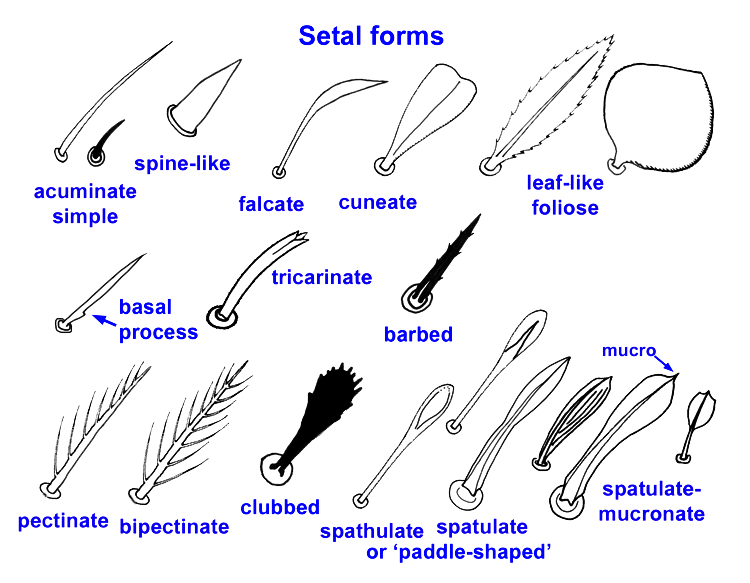 , branched or variously expanded structures on the surfaces of the legs and bodybody:
the idiosoma of mites.. Most setae function as mechanoreceptors, but others (e.g., solenidiasolenidion:
(pl. solenidia) a hollow, optically inactive chemosensory seta on the limbs of acariform mites appearing to have transverse rows of minute pores (actually pore canals) under light microscopy, (the transverse pattern is often not apparent in SEM); often bulbous or otherwise modified; sometimes associated with a companion seta. Solenidia are designated with Greek letters by leg segment: Ω (omega) on the tarsus, Φ (phi) on the tibia, and Σ (sigma) on the genu.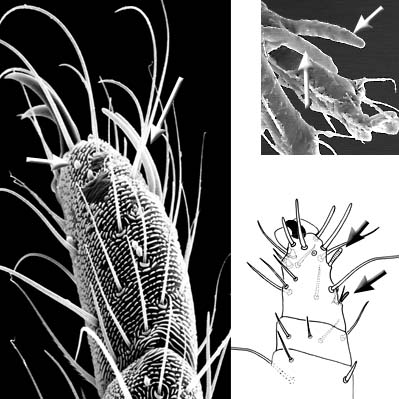 ) are chemoreceptors or have unknown or ambiguous functions. (See image at right.)
si: the internal scapular setascapular seta:
2 pairs of setae (sci, sce) on the prodorsum of Prostigmata, often inserted on either side of the eyes; see Vertical-scapular system.
(also sci, sc1, s1) on the prodorsumprodorsum:
the dorsal surface of the propodosoma.
in the Prostigmata; see Vertical-scapular systemVertical-scapular system:
a system of designations for the prodorsal setae in Acariformes, especially in the Endeostigmata and Prostigmata. Prodorsal setae exp, in or both are often lost. In the Prostigmata, the prodorsal setae are represented at their maximum by the interior and exterior vertical (vi, also v1; ve, also v2, z2) and internal and external scapular setae (sci, also si, s1; sce, also se, s2) (a possible exception exists in Pilorhagidia which has 5 pairs). In Astigmata, the traditional designations follow those used in the Prostigmata; however, the purported internal scapular setae (sci or si) actually are in. In Oribatida, the Rostral-lamellar system is more commonly used (ro, le, bo, exa, in, exp, respectively)..
S-series: In the Lindquist-Evans systemLindquist-Evans system:
the system of setal signatures proposed by EE Lindquist & GO Evans (1965) and the dominant nomenclature used in the Mesostigmata in the more modern literature. Dorsally, the setae are designated by minor (on the pronotum or podonotum) and major (on the opisthonotum) Arabic letters representing longitudinal rows (from the midline to the lateral margin, j-J, z-Z, s-S, r-R, and an additional UR or submarginal row posteriorly) and Arabic numbers designating transverse rows (of hypothesized segments) from 1-6 on the pronotum and 1-5 (or higher in the UR-series) on the opisthonotum. (Origins: i=>j [Ger.] innen, inner]; z [Ger.] zwischen, between]; s [Ger.] seite, side]; r [Ger.] rand, margin; UR [Ger.] unterer rand, under margin.) See also, modifications by Lindquist (1994) and Lindquist & Moraza. Ventrally, idiosomal setae are treated as belonging to three regions: the sternal (intercoxal), the ventral, and the anal. Three pairs of sternal setae are present in the larva (st1-3); the genital seta st5 is added in the protonymph; and the metasternal seta st4 is added in the deutonymph. The 'metasternal' seta probably has more to do with the genital than the sternal region and is the only 'sternal' seta that sometimes is not expressed. The ventral region has up to three longitudinal rows (JV, ZV, and rarely SV [Lv]) with 1-5 transverse row designations. The anal region has a pair of paranal setae (pa) and an unpaired postanal seta (po). used in the Mesostigmata, the longitudinal row of opisthodorsal setae laterad the Z-series, mesad the R-series, and running from the setae S1 to setae S5 at or near the postero-lateral margin of the opisthonotal shieldopisthonotal shield:
the posterior shield in mesostigmatans with divided dorsal shields. or region.
s-series: In the Lindquist-Evans systemLindquist-Evans system:
the system of setal signatures proposed by EE Lindquist & GO Evans (1965) and the dominant nomenclature used in the Mesostigmata in the more modern literature. Dorsally, the setae are designated by minor (on the pronotum or podonotum) and major (on the opisthonotum) Arabic letters representing longitudinal rows (from the midline to the lateral margin, j-J, z-Z, s-S, r-R, and an additional UR or submarginal row posteriorly) and Arabic numbers designating transverse rows (of hypothesized segments) from 1-6 on the pronotum and 1-5 (or higher in the UR-series) on the opisthonotum. (Origins: i=>j [Ger.] innen, inner]; z [Ger.] zwischen, between]; s [Ger.] seite, side]; r [Ger.] rand, margin; UR [Ger.] unterer rand, under margin.) See also, modifications by Lindquist (1994) and Lindquist & Moraza. Ventrally, idiosomal setae are treated as belonging to three regions: the sternal (intercoxal), the ventral, and the anal. Three pairs of sternal setae are present in the larva (st1-3); the genital seta st5 is added in the protonymph; and the metasternal seta st4 is added in the deutonymph. The 'metasternal' seta probably has more to do with the genital than the sternal region and is the only 'sternal' seta that sometimes is not expressed. The ventral region has up to three longitudinal rows (JV, ZV, and rarely SV [Lv]) with 1-5 transverse row designations. The anal region has a pair of paranal setae (pa) and an unpaired postanal seta (po). used in the Mesostigmata, the longitudinal row of prodorsal setaeprodorsal setae:
the setae on the prodorsum of acariform mites. Two competing chaetotactic systems are used for designations: the Rostral-lamellar and Vertical-scapular systems. laterad the z-series, mesad the r-series, and running from the anterior setae s1 to setae s6 at or near the posteriorposterior:
the back part of the body or towards that region in comparison, e.g., 'posterior to'.
margin of the pronotal shield or region. [From the German seite, side]
st: sternal setal siglasigla:
designations for setae.
in Mesostigmata; st1–5
st4 (= MS) : the metasternal seta in the Mesostigmata.
s: (subunguinal setasubunguinal seta:
(s) an unpaired seta between the unguinal and anterolateral pairs on the tarsi of acariform mites (see whorl).
) an unpaired seta between the unguinal and anterolateral pairs on the tarsitarsus:
(pl. tarsi) the subdistal leg segment between the tibia and the pretarsus (apotele).
of acariform mites (see whorlwhorl:
one of the whorls or verticils of birefringent setae on the leg segments of acariform mites.
).
Sx: designation for an extra seta in the S-series (i.e., not assignable to setae S1–5 in the Lindquist-Evans systemLindquist-Evans system:
the system of setal signatures proposed by EE Lindquist & GO Evans (1965) and the dominant nomenclature used in the Mesostigmata in the more modern literature. Dorsally, the setae are designated by minor (on the pronotum or podonotum) and major (on the opisthonotum) Arabic letters representing longitudinal rows (from the midline to the lateral margin, j-J, z-Z, s-S, r-R, and an additional UR or submarginal row posteriorly) and Arabic numbers designating transverse rows (of hypothesized segments) from 1-6 on the pronotum and 1-5 (or higher in the UR-series) on the opisthonotum. (Origins: i=>j [Ger.] innen, inner]; z [Ger.] zwischen, between]; s [Ger.] seite, side]; r [Ger.] rand, margin; UR [Ger.] unterer rand, under margin.) See also, modifications by Lindquist (1994) and Lindquist & Moraza. Ventrally, idiosomal setae are treated as belonging to three regions: the sternal (intercoxal), the ventral, and the anal. Three pairs of sternal setae are present in the larva (st1-3); the genital seta st5 is added in the protonymph; and the metasternal seta st4 is added in the deutonymph. The 'metasternal' seta probably has more to do with the genital than the sternal region and is the only 'sternal' seta that sometimes is not expressed. The ventral region has up to three longitudinal rows (JV, ZV, and rarely SV [Lv]) with 1-5 transverse row designations. The anal region has a pair of paranal setae (pa) and an unpaired postanal seta (po).) on the opisthonotum in the Mesostigmata.
tc: (tectalstectals:
(tc) a pair of dorsal tarsal setae between the iterals and the fastigals on the tarsi of acariform mites (see whorl).
) a pair of dorsaldorsal:
relating to the upper or back side; opposed to ventral.
tarsal setae between the iterals and the fastigalsfastigals:
(ft) the most basal pair of dorsal tarsal setae on the tarsi of acariform mites (see whorl).
on the tarsitarsus:
(pl. tarsi) the subdistal leg segment between the tibia and the pretarsus (apotele).
of acariform mites (see whorlwhorl:
one of the whorls or verticils of birefringent setae on the leg segments of acariform mites.
).
u: (unguinalsunguinals:
(u) the distalmost ventral pair of setae at the base of the ambulacrum on the tarsi of acariform mites (see whorl).
) the distalmost ventralventral:
relating to the lower or under side; opposed to dorsal.
pair of setae at the basebase:
the usually columnar basal part of the tritosternum; sometimes expanded and rectangular or otherwise modified; the most basal part of any structure. of the ambulacrum on the tarsitarsus:
(pl. tarsi) the subdistal leg segment between the tibia and the pretarsus (apotele).
of acariform mites (see whorlwhorl:
one of the whorls or verticils of birefringent setae on the leg segments of acariform mites.
).
UR series: in the Lindquist-Evans systemLindquist-Evans system:
the system of setal signatures proposed by EE Lindquist & GO Evans (1965) and the dominant nomenclature used in the Mesostigmata in the more modern literature. Dorsally, the setae are designated by minor (on the pronotum or podonotum) and major (on the opisthonotum) Arabic letters representing longitudinal rows (from the midline to the lateral margin, j-J, z-Z, s-S, r-R, and an additional UR or submarginal row posteriorly) and Arabic numbers designating transverse rows (of hypothesized segments) from 1-6 on the pronotum and 1-5 (or higher in the UR-series) on the opisthonotum. (Origins: i=>j [Ger.] innen, inner]; z [Ger.] zwischen, between]; s [Ger.] seite, side]; r [Ger.] rand, margin; UR [Ger.] unterer rand, under margin.) See also, modifications by Lindquist (1994) and Lindquist & Moraza. Ventrally, idiosomal setae are treated as belonging to three regions: the sternal (intercoxal), the ventral, and the anal. Three pairs of sternal setae are present in the larva (st1-3); the genital seta st5 is added in the protonymph; and the metasternal seta st4 is added in the deutonymph. The 'metasternal' seta probably has more to do with the genital than the sternal region and is the only 'sternal' seta that sometimes is not expressed. The ventral region has up to three longitudinal rows (JV, ZV, and rarely SV [Lv]) with 1-5 transverse row designations. The anal region has a pair of paranal setae (pa) and an unpaired postanal seta (po)., the posteriorposterior:
the back part of the body or towards that region in comparison, e.g., 'posterior to'.
submarginal row of setae.
v1: the internal vertical seta (also vi) on the prodorsumprodorsum:
the dorsal surface of the propodosoma.
in the Prostigmata.
v2: the external vertical seta (also ve) on the prodorsumprodorsum:
the dorsal surface of the propodosoma.
in the Prostigmata.
ve: the external vertical seta (also v2, z2) on the prodorsumprodorsum:
the dorsal surface of the propodosoma.
in the Prostigmata; see Vertical-scapular systemVertical-scapular system:
a system of designations for the prodorsal setae in Acariformes, especially in the Endeostigmata and Prostigmata. Prodorsal setae exp, in or both are often lost. In the Prostigmata, the prodorsal setae are represented at their maximum by the interior and exterior vertical (vi, also v1; ve, also v2, z2) and internal and external scapular setae (sci, also si, s1; sce, also se, s2) (a possible exception exists in Pilorhagidia which has 5 pairs). In Astigmata, the traditional designations follow those used in the Prostigmata; however, the purported internal scapular setae (sci or si) actually are in. In Oribatida, the Rostral-lamellar system is more commonly used (ro, le, bo, exa, in, exp, respectively)..
vi: the internal vertical seta (also v1) on the prodorsumprodorsum:
the dorsal surface of the propodosoma.
in the Prostigmata; see Vertical-scapular systemVertical-scapular system:
a system of designations for the prodorsal setae in Acariformes, especially in the Endeostigmata and Prostigmata. Prodorsal setae exp, in or both are often lost. In the Prostigmata, the prodorsal setae are represented at their maximum by the interior and exterior vertical (vi, also v1; ve, also v2, z2) and internal and external scapular setae (sci, also si, s1; sce, also se, s2) (a possible exception exists in Pilorhagidia which has 5 pairs). In Astigmata, the traditional designations follow those used in the Prostigmata; however, the purported internal scapular setae (sci or si) actually are in. In Oribatida, the Rostral-lamellar system is more commonly used (ro, le, bo, exa, in, exp, respectively)..
z2: the external vertical seta (also v2, ve) on the prodorsumprodorsum:
the dorsal surface of the propodosoma.
in the Prostigmata, especially in spider mites; see Vertical-scapular systemVertical-scapular system:
a system of designations for the prodorsal setae in Acariformes, especially in the Endeostigmata and Prostigmata. Prodorsal setae exp, in or both are often lost. In the Prostigmata, the prodorsal setae are represented at their maximum by the interior and exterior vertical (vi, also v1; ve, also v2, z2) and internal and external scapular setae (sci, also si, s1; sce, also se, s2) (a possible exception exists in Pilorhagidia which has 5 pairs). In Astigmata, the traditional designations follow those used in the Prostigmata; however, the purported internal scapular setae (sci or si) actually are in. In Oribatida, the Rostral-lamellar system is more commonly used (ro, le, bo, exa, in, exp, respectively)..
Z-series: In the Lindquist-Evans systemLindquist-Evans system:
the system of setal signatures proposed by EE Lindquist & GO Evans (1965) and the dominant nomenclature used in the Mesostigmata in the more modern literature. Dorsally, the setae are designated by minor (on the pronotum or podonotum) and major (on the opisthonotum) Arabic letters representing longitudinal rows (from the midline to the lateral margin, j-J, z-Z, s-S, r-R, and an additional UR or submarginal row posteriorly) and Arabic numbers designating transverse rows (of hypothesized segments) from 1-6 on the pronotum and 1-5 (or higher in the UR-series) on the opisthonotum. (Origins: i=>j [Ger.] innen, inner]; z [Ger.] zwischen, between]; s [Ger.] seite, side]; r [Ger.] rand, margin; UR [Ger.] unterer rand, under margin.) See also, modifications by Lindquist (1994) and Lindquist & Moraza. Ventrally, idiosomal setae are treated as belonging to three regions: the sternal (intercoxal), the ventral, and the anal. Three pairs of sternal setae are present in the larva (st1-3); the genital seta st5 is added in the protonymph; and the metasternal seta st4 is added in the deutonymph. The 'metasternal' seta probably has more to do with the genital than the sternal region and is the only 'sternal' seta that sometimes is not expressed. The ventral region has up to three longitudinal rows (JV, ZV, and rarely SV [Lv]) with 1-5 transverse row designations. The anal region has a pair of paranal setae (pa) and an unpaired postanal seta (po). used in the Mesostigmata, the longitudinal row of opisthodorsal setae laterad the J-series, mesad the S-series, and running from the setae Z1 to setae Z5 at or near the posteriorposterior:
the back part of the body or towards that region in comparison, e.g., 'posterior to'.
margin of the opisthonotal shieldopisthonotal shield:
the posterior shield in mesostigmatans with divided dorsal shields. or region. Setae Z5 are often elongate and project posteriorly well beyond the bodybody:
the idiosoma of mites. margin.
z-series: In the Lindquist-Evans systemLindquist-Evans system:
the system of setal signatures proposed by EE Lindquist & GO Evans (1965) and the dominant nomenclature used in the Mesostigmata in the more modern literature. Dorsally, the setae are designated by minor (on the pronotum or podonotum) and major (on the opisthonotum) Arabic letters representing longitudinal rows (from the midline to the lateral margin, j-J, z-Z, s-S, r-R, and an additional UR or submarginal row posteriorly) and Arabic numbers designating transverse rows (of hypothesized segments) from 1-6 on the pronotum and 1-5 (or higher in the UR-series) on the opisthonotum. (Origins: i=>j [Ger.] innen, inner]; z [Ger.] zwischen, between]; s [Ger.] seite, side]; r [Ger.] rand, margin; UR [Ger.] unterer rand, under margin.) See also, modifications by Lindquist (1994) and Lindquist & Moraza. Ventrally, idiosomal setae are treated as belonging to three regions: the sternal (intercoxal), the ventral, and the anal. Three pairs of sternal setae are present in the larva (st1-3); the genital seta st5 is added in the protonymph; and the metasternal seta st4 is added in the deutonymph. The 'metasternal' seta probably has more to do with the genital than the sternal region and is the only 'sternal' seta that sometimes is not expressed. The ventral region has up to three longitudinal rows (JV, ZV, and rarely SV [Lv]) with 1-5 transverse row designations. The anal region has a pair of paranal setae (pa) and an unpaired postanal seta (po). used in the Mesostigmata, the longitudinal row of prodorsal setaeprodorsal setae:
the setae on the prodorsum of acariform mites. Two competing chaetotactic systems are used for designations: the Rostral-lamellar and Vertical-scapular systems. laterad the j-series, mesad the s-series, and running from the anterior paravertical setae z1 to setae z6 at or near the posteriorposterior:
the back part of the body or towards that region in comparison, e.g., 'posterior to'.
margin of the pronotal shield or region. [From the German zwischen, between {the j and s}]
Zx: designation for an extra seta in the Z-series (i.e., not assignable to setae Z1–5 in the Lindquist-Evans systemLindquist-Evans system:
the system of setal signatures proposed by EE Lindquist & GO Evans (1965) and the dominant nomenclature used in the Mesostigmata in the more modern literature. Dorsally, the setae are designated by minor (on the pronotum or podonotum) and major (on the opisthonotum) Arabic letters representing longitudinal rows (from the midline to the lateral margin, j-J, z-Z, s-S, r-R, and an additional UR or submarginal row posteriorly) and Arabic numbers designating transverse rows (of hypothesized segments) from 1-6 on the pronotum and 1-5 (or higher in the UR-series) on the opisthonotum. (Origins: i=>j [Ger.] innen, inner]; z [Ger.] zwischen, between]; s [Ger.] seite, side]; r [Ger.] rand, margin; UR [Ger.] unterer rand, under margin.) See also, modifications by Lindquist (1994) and Lindquist & Moraza. Ventrally, idiosomal setae are treated as belonging to three regions: the sternal (intercoxal), the ventral, and the anal. Three pairs of sternal setae are present in the larva (st1-3); the genital seta st5 is added in the protonymph; and the metasternal seta st4 is added in the deutonymph. The 'metasternal' seta probably has more to do with the genital than the sternal region and is the only 'sternal' seta that sometimes is not expressed. The ventral region has up to three longitudinal rows (JV, ZV, and rarely SV [Lv]) with 1-5 transverse row designations. The anal region has a pair of paranal setae (pa) and an unpaired postanal seta (po).) on the opisthonotum in the Mesostigmata.
Author: David E. Walter
Content last updated Sept. 2006, unless indicated otherwise
Lucid key player updated Sept. 2025
idtools.org