Suctorialsuctorial:
in reference to mouthparts that appear to be used to suck-up fluids, although in most cases this has not been demonstrated and may not be true. Typically the chelicerae are stylet-like and the subcapitulum is modified anteriorly into a tube that supports the stylets, e.g., in the endeostigmatan genus Bimichaelia and the oribatid superfamily Suctobelboidea.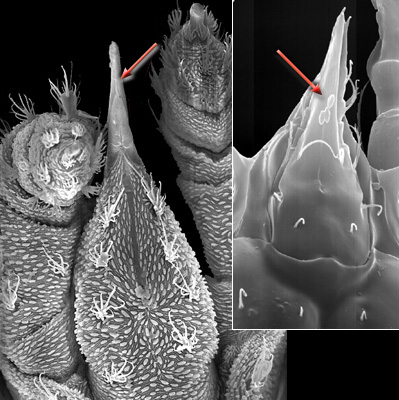 mouthparts have developed in a number of arthropod groups, but usually as projecting, snout-like structures. Only insects have distinct beaks on the underside of the head.
Mandibulate arthropods typically have a clearly defined segmental arrangement of mouthparts ventrally on the head. The exception are those entognathous taxa where the head capsulecapsule:
as in gnathosomal capsule, the fused chelicerae and subcapitulum characteristic of Tarsonemina and some other Prostigmata (e.g., Cheyletoidea, Myobioidea) (also tegmen, rostral shield).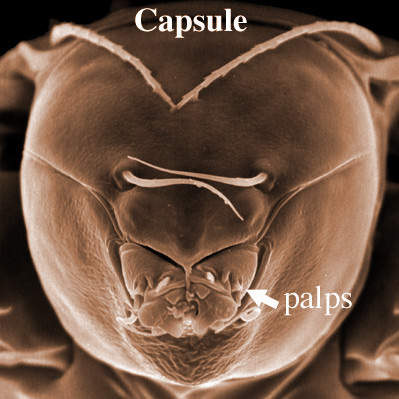 envelopes the mouthparts.
Arachnids have only two pairs of segmental limbs devoted primarily to feeding: the chelicerae and the pedipalps. Typically, the coxae of the pedipalps are flattened and have processes that extend towards the midline or even fuse to form a floor to the buccal opening.
Ticks (Ixodida) have a distinctive holdfast structure composed of a projecting hypostome covered with posteriorly projecting denticlesdenticles:
small tooth-like processes, e.g., on the subcapitula of ticks and many mesostigmatans.
.
In Mesostigmata and Holothyrida, the anterior margin of the hypostome carries a pair of corniculicorniculus:
(pl. corniculi) (also, external malae) a usually horn-like process (sometimes toothed, bifurcate, trifurcate, spine-like, spatulate, or membranous) on the subcapitulum of parasitiform mites that usually supports the salivary styli. A toothed corniculus could be confused with a rutellum, a possibly homologous structure in Acariformes and Opilioacarida. Phytoseiid image is spatulate corniculus.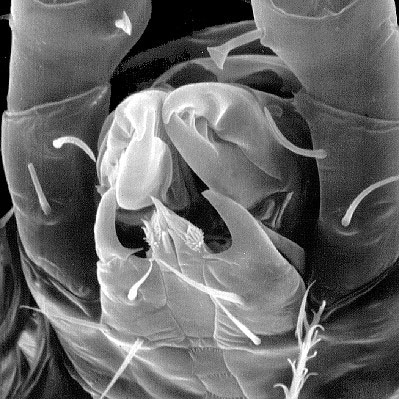 (singular: corniculuscorniculus:
(pl. corniculi) (also, external malae) a usually horn-like process (sometimes toothed, bifurcate, trifurcate, spine-like, spatulate, or membranous) on the subcapitulum of parasitiform mites that usually supports the salivary styli. A toothed corniculus could be confused with a rutellum, a possibly homologous structure in Acariformes and Opilioacarida. Phytoseiid image is spatulate corniculus.) or horn-like (sometimes toothed or bifurcatebifurcate:
split into two distally or with two projections. 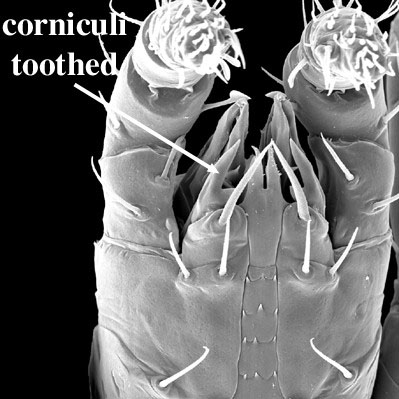 ) processes that are thought to represent hypertrophied setae. In many acariform mites, a pair of toothed to chisel-like processes are present in the same region and are called rutellarutellum:
(pl. rutella) In Sarcoptiformes, the hypertrophied setae on the hypostome, often toothed; not to be confused with a corniculus (although possibly a homologue). In Astigmata, the rutellum may be referred to as a pseudorutellum, although it is the same structure. Various forms of rutella are recognized, including the atelebasic and pantelebasic.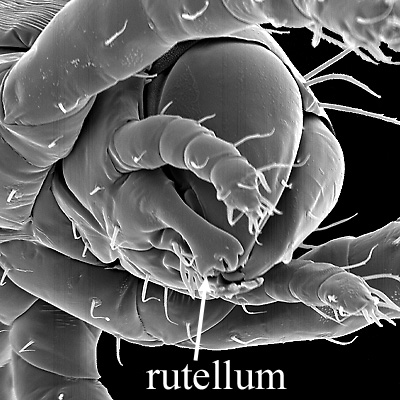 (singular: rutellumrutellum:
(pl. rutella) In Sarcoptiformes, the hypertrophied setae on the hypostome, often toothed; not to be confused with a corniculus (although possibly a homologue). In Astigmata, the rutellum may be referred to as a pseudorutellum, although it is the same structure. Various forms of rutella are recognized, including the atelebasic and pantelebasic.).
Author: David E. Walter
Content last updated Sept. 2006, unless indicated otherwise
Lucid key player updated Sept. 2025
idtools.org