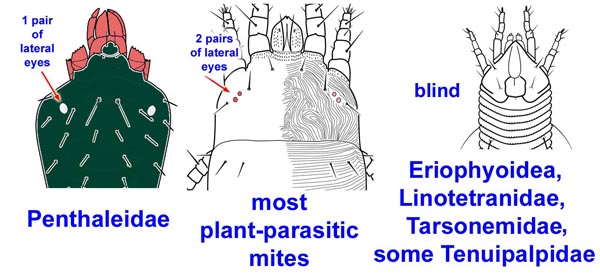
Plant parasitic mites have a
maximum complement of 2 pairs of lateral ocelliocellus:
(pl. ocelli) a simple eye. Mites with eyes usually have one or two pairs of lateral ocelli, but some Opilioacarida have three pairs. Additionally, some acariform mites have one or two median ocelli on the underside of the naso.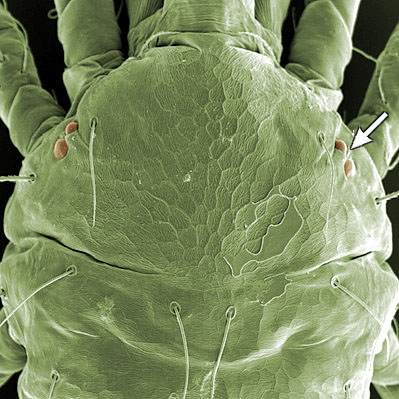 .
.
The Penthaleidae (Eupodoidea) a pair of largish eyes near the insertion of the
external scapular setaescapular seta:
2 pairs of setae (sci, sce) on the prodorsum of Prostigmata, often inserted on either side of the eyes; see Vertical-scapular system.
, sce (=sc2). Unlike most mite eyes,
these are silvery instead of red.
The Eriophyoidea are generally considered to be blind, although an eye-like bulge is discernable on some species.
Members of the Tetranychoidea have either 2 pairs of lateral ocelliocellus:
(pl. ocelli) a simple eye. Mites with eyes usually have one or two pairs of lateral ocelli, but some Opilioacarida have three pairs. Additionally, some acariform mites have one or two median ocelli on the underside of the naso., often reddish in
color, or are blind (e.g., all Linotetranidae, some Tenuipalpidae, and one species of Tuckerellidae).
All Tarsonemidae (TarsonemoideaTarsonemoidea:
(also Tarsonemina) a superfamily within Prostigmata > infraorder Eleutherengona > hyporder Heterostigmata consisting of two families: Tarsonemidae and Podapolipidae.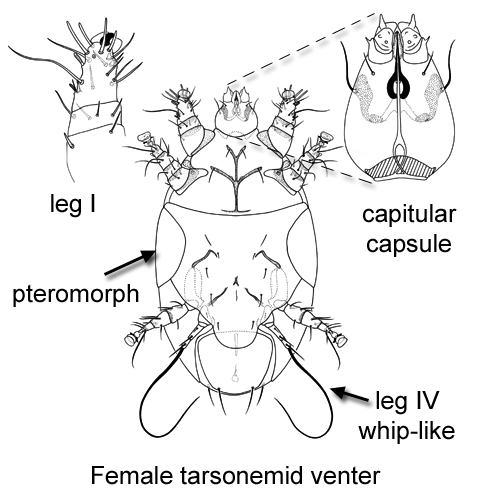 ) are blind.
Author: David E. Walter
Content last updated Sept. 2006, unless indicated otherwise
Lucid key player updated Sept. 2025
idtools.org