Most adult female mites have 4 pairs of legs (octopod), as do the nymphal stages, and only the larva (or prelarvaprelarva:
(also deutovum, prolarva) the first instar in acariform mites having a complete ontogenetic sequence, but absent in derived Prostigmata and Parasitiformes (except Opilioacarida); incompletely formed, without functional mouthparts, often retained within the egg shell or just extruding from it, and usually inactive; hexapod or apodous.
when present) have 3 pairs of legs (hexapodhexapod:
with three pairs of legs (i.e. 6 legs), as in the larvae of mites or the larviform stages of others.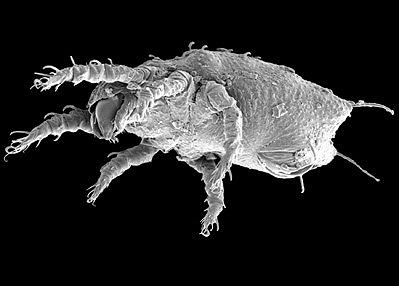 ). Exceptions do occur, especially among the plant-parasitic mites.
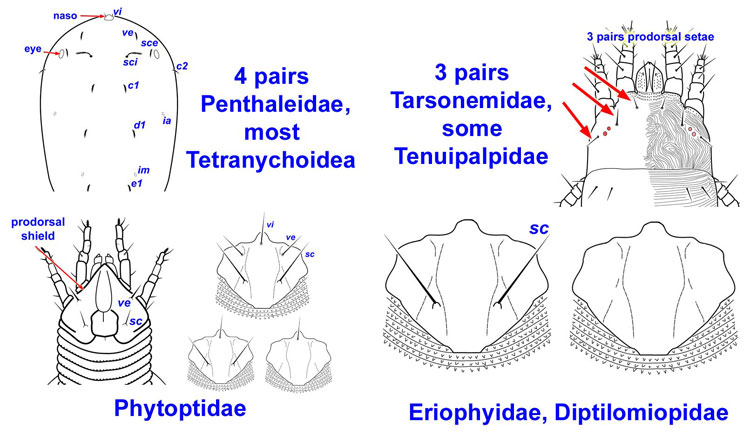
The Penthaleidae (Eupodoidea) have a prodorsumprodorsum:
the dorsal surface of the propodosoma.
with 4 pairs of setae (sometimes with extra setae), including one pair formed as filiformfiliform:
thread-like; long and narrow.
or ciliated trichobothriatrichobothrium:
(pl. trichobothria) (= bothridial sensillum) an often elaborately modified seta set in a cup-like base; forms include filiform, ciliate, pectinate or variously thickened or clubbed (bat-like to globose or capitate).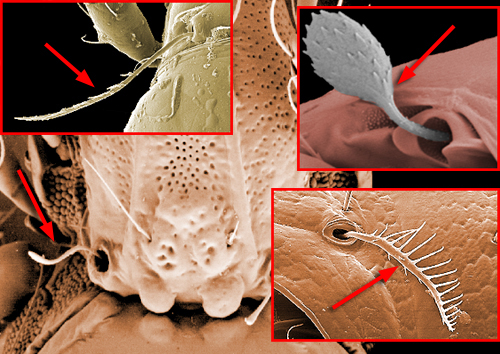 (the internal scapular setaescapular seta:
2 pairs of setae (sci, sce) on the prodorsum of Prostigmata, often inserted on either side of the eyes; see Vertical-scapular system.
, sci) and a lobe over the capitulumgnathosoma:
(= capitulum) the anteriormost part of a mite or ricinuleid, composed of the cheliceral and pedipalpal segments and separated from the body (idiosoma) by a ring of soft cuticle.
called a naso that bears the internal vertical setae, vi.
Eriophyideriophyid:
(eriophyoid) of or relating to a member of the family Eriophyidae (superfamily Eriophyoidea) which contains minute, worm-like and quadripod mites that cause galls, erinea, and other damage to plants.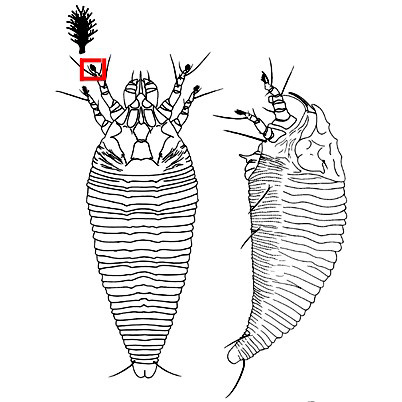 or diptilomiopid Eriophyoidea usually have a distinct prodorsal shieldprodorsal shield:
a shield on the anterior dorsal surface of acariform mites.
that is nude or bears only 1 pair of setae (the scapulars, sc). In the Phytoptidae, however, a single, unpaired median internal vertical seta (vi) or a pair of external vertical setae (ve)—or both are always present, with or without the presence of the scapular setaescapular seta:
2 pairs of setae (sci, sce) on the prodorsum of Prostigmata, often inserted on either side of the eyes; see Vertical-scapular system.
(sc).
Members of the Tetranychoidea usually have the basic 4 pairs of prodorsal setaeprodorsal setae:
the setae on the prodorsum of acariform mites. Two competing chaetotactic systems are used for designations: the Rostral-lamellar and Vertical-scapular systems. 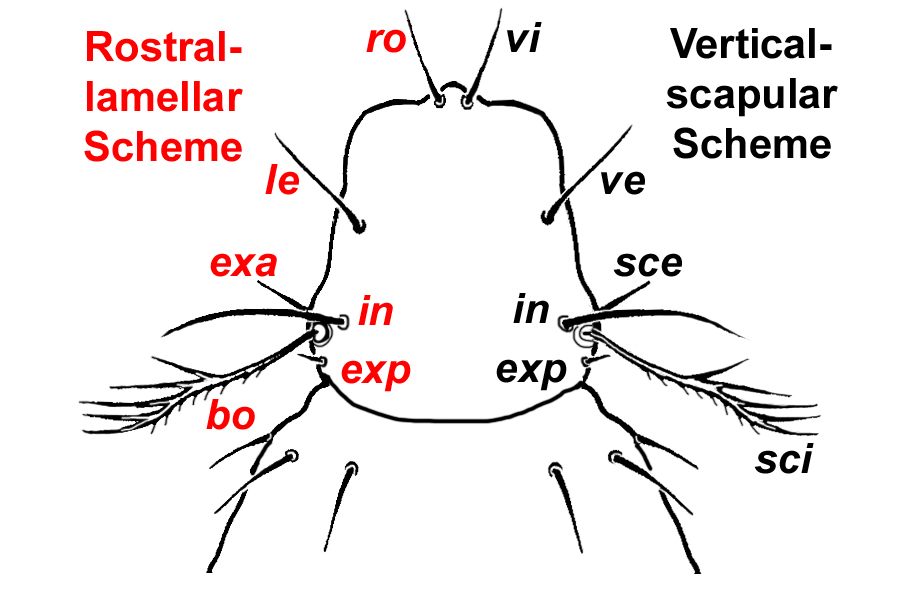 (vi
(vi
Adult female Tarsonemidae (TarsonemoideaTarsonemoidea:
(also Tarsonemina) a superfamily within Prostigmata > infraorder Eleutherengona > hyporder Heterostigmata consisting of two families: Tarsonemidae and Podapolipidae.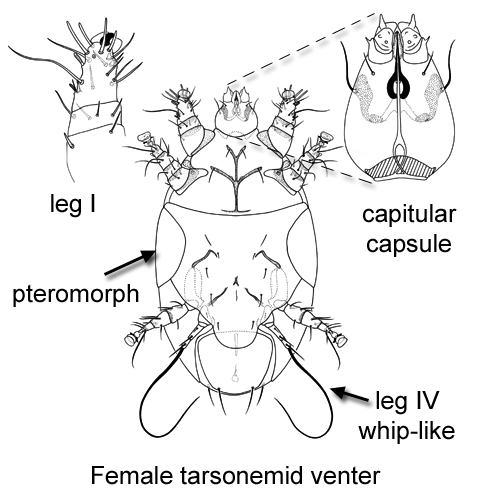 ) have 3 pairs of prodorsal setaeprodorsal setae:
the setae on the prodorsum of acariform mites. Two competing chaetotactic systems are used for designations: the Rostral-lamellar and Vertical-scapular systems. (vi, sce, sci, while males have all 4 pairs), but appear to have only 2 pairs of prodorsal setaeprodorsal setae:
the setae on the prodorsum of acariform mites. Two competing chaetotactic systems are used for designations: the Rostral-lamellar and Vertical-scapular systems. , because the capitiate trichobothriatrichobothrium:
(pl. trichobothria) (= bothridial sensillum) an often elaborately modified seta set in a cup-like base; forms include filiform, ciliate, pectinate or variously thickened or clubbed (bat-like to globose or capitate). (sci) are usually placed under the margin of the prodorsumprodorsum:
the dorsal surface of the propodosoma.
. The external vertical setae (ve) are reduced to a pit. Both 2 and 4 pairs of prodorsal setaeprodorsal setae:
the setae on the prodorsum of acariform mites. Two competing chaetotactic systems are used for designations: the Rostral-lamellar and Vertical-scapular systems. are accepted in this key if 'Mistakes allowed' (the default option) is turned on.
Author: David E. Walter
Content last updated Sept. 2006, unless indicated otherwise
Lucid key player updated Sept. 2025
idtools.org