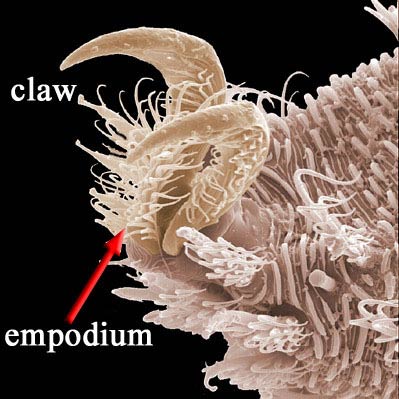
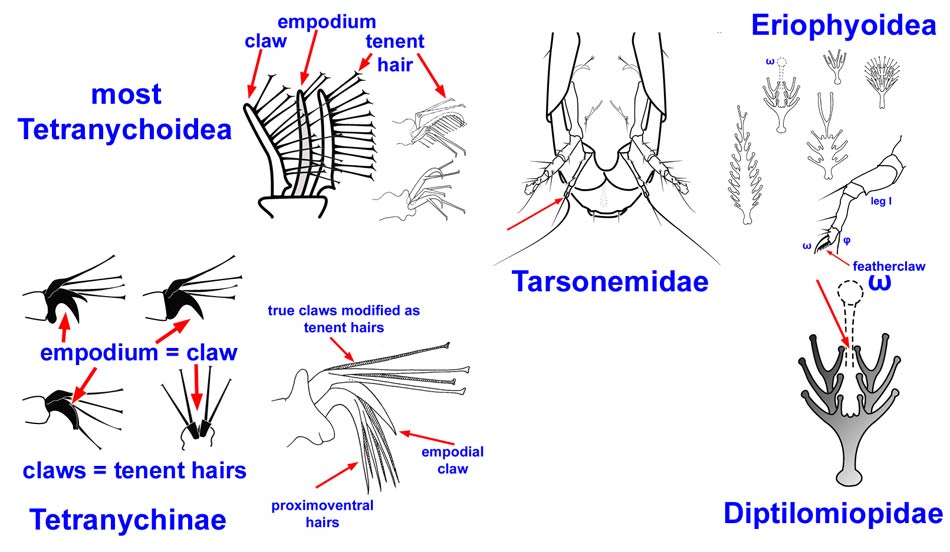
The legs of most mites end in an apoteleapotele:
(Greek apotelein = to complete)—the terminus of an appendage; the most distal leg segment, often consisting of an empodium and a pair of claws. The apotele of a leg is usually treated as equivalent to the pretarsus or some part thereof (e.g., the claws and empodium), but the palptarsal apotele in Mesostigmata is a tined structure originating at the base of the palptarsus and thought to be a remnant of the claws. The chelicerae are also an appendage and terminate in the movable digit.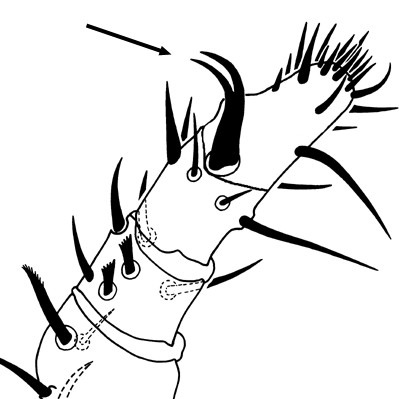 that bears a pair of claws laterally and an empodiumempodium:
(pl. empodia) an unpaired structure arising between the tarsal claws, ranging from pad-like to claw-like and often bearing structures such as tenent hairs, dense setulae, or taking the form of a featherclaw (Eriophyoidea)..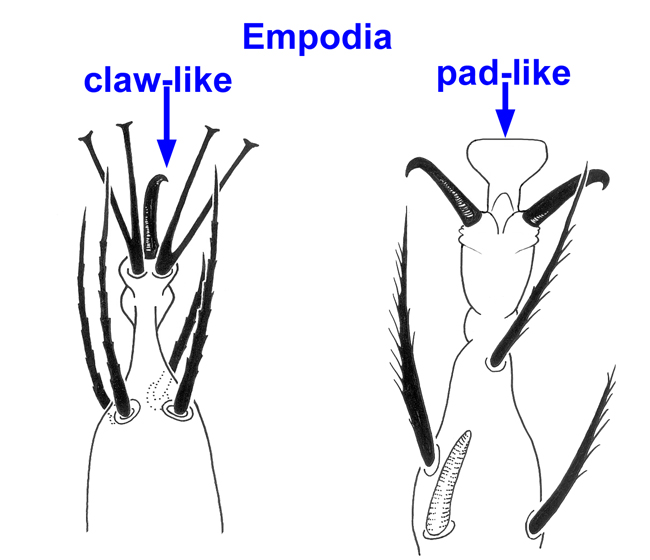 medially.
The Penthaleidae (Eupodoidea) have paired claws and a pad-likepad-like:
in Prostigmata, used to refer to empodia that do not have a distal hook (claw-like); when tenent hairs are present a 'pad-like' empodium may look more like a pincushion; in other Acari, usually a simple, pad-like empodium.
empodium on all of their tarsitarsus:
(pl. tarsi) the subdistal leg segment between the tibia and the pretarsus (apotele).
. Both the claws and the empodiumempodium:
(pl. empodia) an unpaired structure arising between the tarsal claws, ranging from pad-like to claw-like and often bearing structures such as tenent hairs, dense setulae, or taking the form of a featherclaw (Eriophyoidea).. bear setose processes, but these do not end in flattened tips (and so are not considered tenet hairs).
The Eriophyoidea lack claws and have a highly modified, densely branched empodiumempodium:
(pl. empodia) an unpaired structure arising between the tarsal claws, ranging from pad-like to claw-like and often bearing structures such as tenent hairs, dense setulae, or taking the form of a featherclaw (Eriophyoidea).. called a featherclawfeatherclaw:
the highly divided bipectinate empodial claw found in the Eriophyoidea.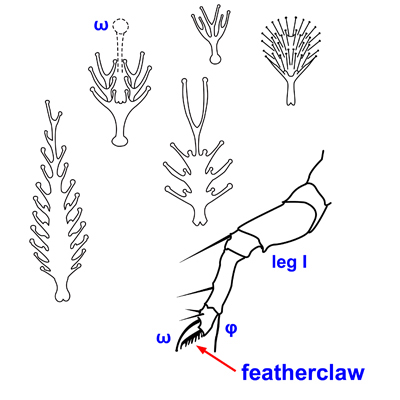 . In the Diptilomiopinae (Diptilomiopidae), the featherclawfeatherclaw:
the highly divided bipectinate empodial claw found in the Eriophyoidea. is deeply divided medially.
Most Tetranychoidea have claws and empodiaempodium:
(pl. empodia) an unpaired structure arising between the tarsal claws, ranging from pad-like to claw-like and often bearing structures such as tenent hairs, dense setulae, or taking the form of a featherclaw (Eriophyoidea).. that bear one or more pairs of seta-like processes that end in flattened tips and are called tenet hairs. The claws may be modified into tenent hairs. In the Tetranychidae, the Bryobiinae have the typical empodiumempodium:
(pl. empodia) an unpaired structure arising between the tarsal claws, ranging from pad-like to claw-like and often bearing structures such as tenent hairs, dense setulae, or taking the form of a featherclaw (Eriophyoidea).. with tenent hairs; in the Tetranychinae, however, the empodiumempodium:
(pl. empodia) an unpaired structure arising between the tarsal claws, ranging from pad-like to claw-like and often bearing structures such as tenent hairs, dense setulae, or taking the form of a featherclaw (Eriophyoidea).. is clawclaw:
like - having a distal hook; resembling a claw.
-like and without tenent hairs (although it may have proximoventral hairsproximoventral hairs:
the hair-like processes on the empodia of some spider mites; apparently represents a finely divided empodium, and not tenent hairs.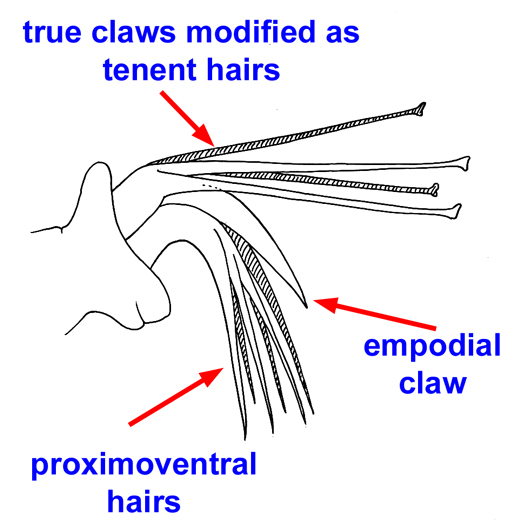 ) or highly regressedregressed:
reduce from normal as, for example, the capitulum of astigmatan deutonymphs or the fixed digit of the chelicerae in varroa.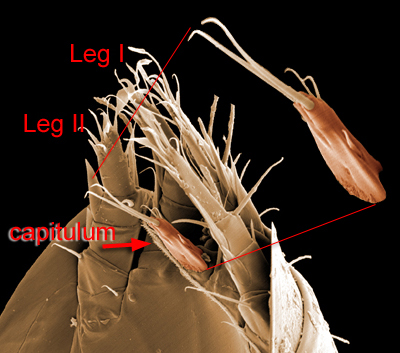 and usually coded as absent.
Adult female Tarsonemidae (TarsonemoideaTarsonemoidea:
(also Tarsonemina) a superfamily within Prostigmata > infraorder Eleutherengona > hyporder Heterostigmata consisting of two families: Tarsonemidae and Podapolipidae.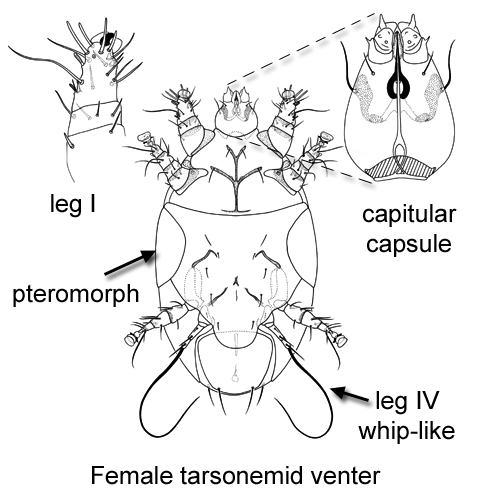 ) have pad-like empodiaempodium:
(pl. empodia) an unpaired structure arising between the tarsal claws, ranging from pad-like to claw-like and often bearing structures such as tenent hairs, dense setulae, or taking the form of a featherclaw (Eriophyoidea).. with paired claws on legs II–III, but leg I has a single clawclaw:
like - having a distal hook; resembling a claw.
and leg IV ends in a whip-likewhip-like:
long, slender and sinuous as in the posterior setae of some phytoseiid mites (Mesostigmata) or the stylets of spider mites and their relatives (Prostigmata: Tetranychoidea).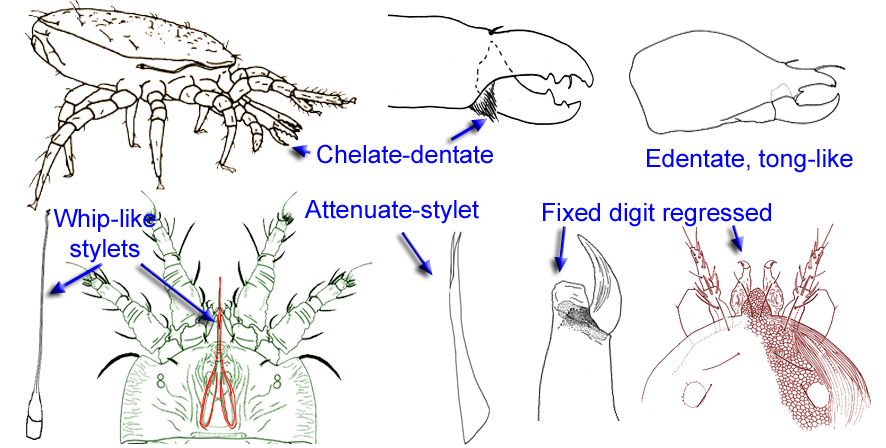 or flagellate seta.
Author: David E. Walter
Content last updated Sept. 2006, unless indicated otherwise
Lucid key player updated Sept. 2025
idtools.org