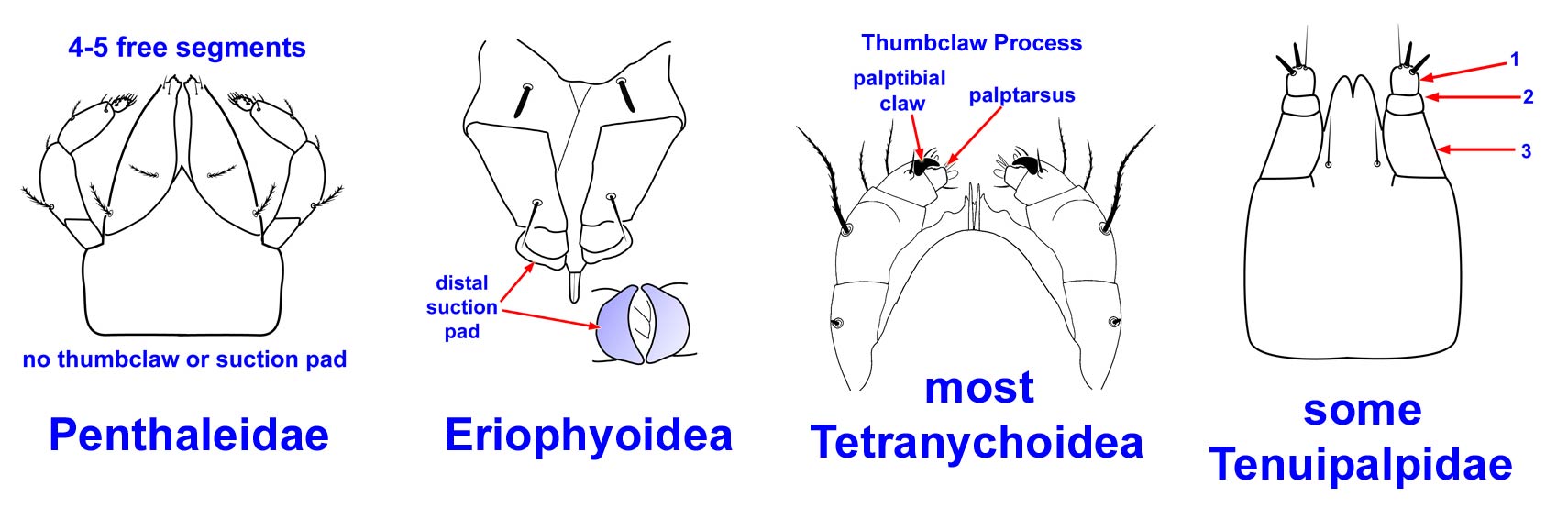
The four superfamilies containing the most important plant-parasitic mites may be separated by modifications of the capitulumgnathosoma:
(= capitulum) the anteriormost part of a mite or ricinuleid, composed of the cheliceral and pedipalpal segments and separated from the body (idiosoma) by a ring of soft cuticle.
.
The Penthaleidae (Eupodoidea) have simplesimple:
unadorned; simple setae are needle-like and without hairs or pectins.
palps, usually with 4 free segments and never have a thumbclaw process.
The Eriophyoidea have the cheliceralcheliceral:
of or pertaining to the chelicera.
stylets closely supported by their stubby palps (4 or fewer difficult to distinguish segments) that end in a pair of suction cups.
The Tetranychoidea have 5 free segments and a thumbclaw process in the Tetranychidae, and usually in the minor families (Allochaetophoridae, Linotetranidae, Tuckerellidae), but the thumbclaw process is lost in the Tenuipalpidae and the palps may be reduced from 5 free segments to 4, 3, 2 or a single rudiment.
The Tarsonemidae (TarsonemoideaTarsonemoidea:
(also Tarsonemina) a superfamily within Prostigmata > infraorder Eleutherengona > hyporder Heterostigmata consisting of two families: Tarsonemidae and Podapolipidae.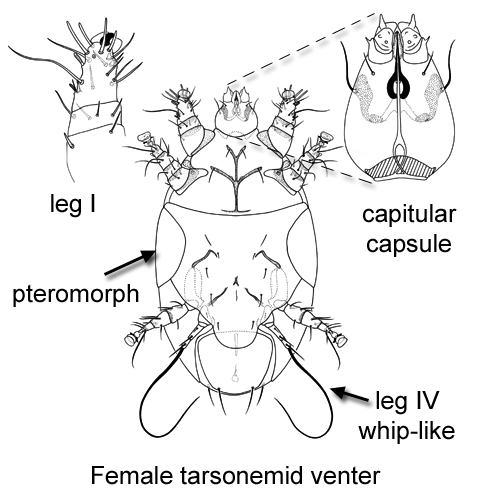 ) have minute palps, typically with 2 segments.
Author: David E. Walter
Content last updated Sept. 2006, unless indicated otherwise
Lucid key player updated Sept. 2025
idtools.org