t
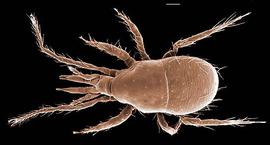
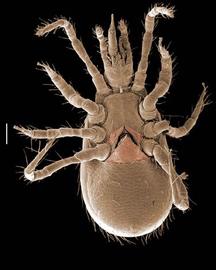
Pergamasinae Juvara-Balş 1972
Superorder Parasitiformes » Order Mesostigmata » Suborder Monogynaspida » Infraorder Gamasina » Hyporder Parasitiae » Superfamily Parasitoidea » Family Parasitidae » Subfamily Pergamasinae
Amblygamasus Berlese, Cycetogamasus Athias-Henriot, Holoparasitus Oudemans, Heteroparasitus Juvara-Bals, Medioparasitus Juvara-Bals, Ologamasiphis Athias-Henriot, Pergamasus Berlese, Paragamasus Hull
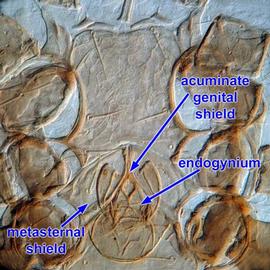
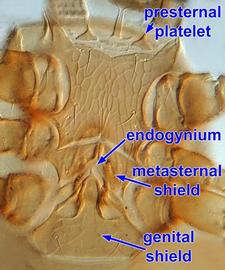
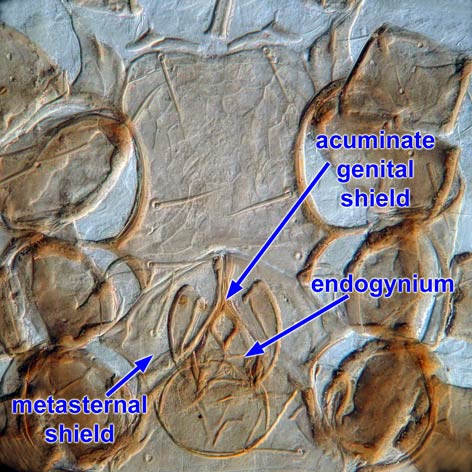
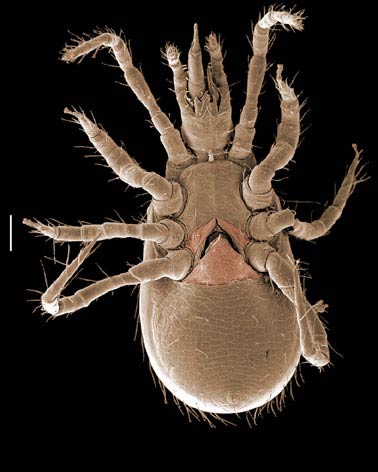
 to a point and flanked by large metasternal shields
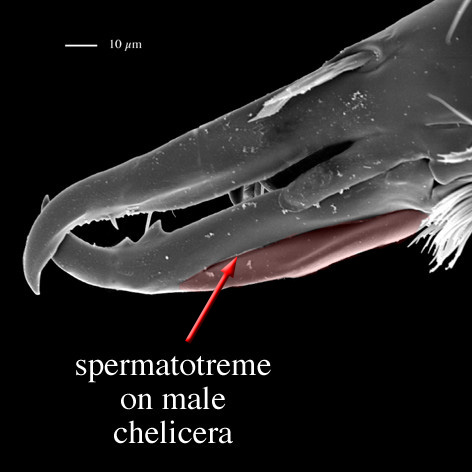 on chelicerae
 I usually with 14 setae, including 4 ventralventral:
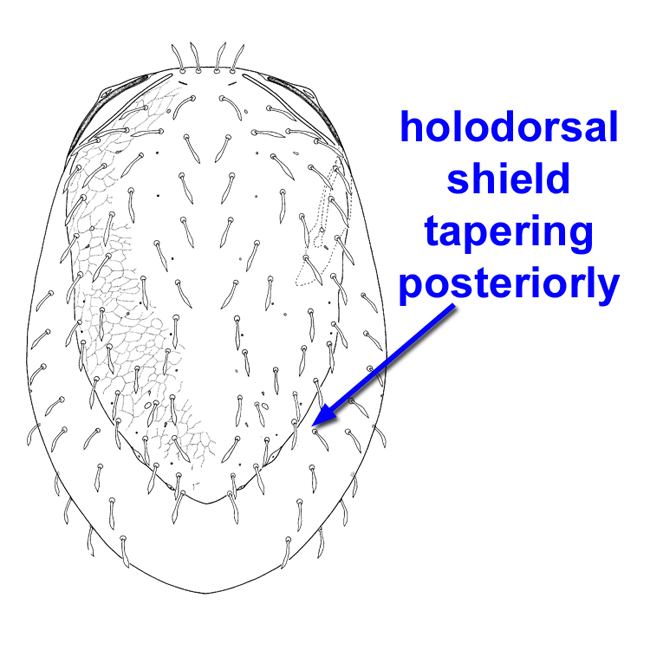
Holodorsal shieldholodorsal shield:
a shield that covers all of the dorsum. In Mesostigmata, the holodorsal shield is often interpreted as resulting from the fusion of podonotal and opisthonotal shields and a suture between these regions is often visible (see recurved and procurved).
separate from ventral opisthogastric shieldopisthogastric shield:
in Mesostigmata, a shield that covers all of the venter behind legs IV including the anal region; a ventrianal shield that incorporates the metapodal and usually the exopodal elements (e.g., in Parasitidae).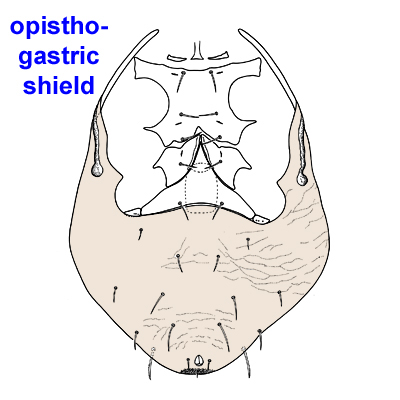 posteriorly.............................. 2
- Dorsaldorsal:
relating to the upper or back side; opposed to ventral.
shield fused to opisthogastric shieldopisthogastric shield:
in Mesostigmata, a shield that covers all of the venter behind legs IV including the anal region; a ventrianal shield that incorporates the metapodal and usually the exopodal elements (e.g., in Parasitidae). posteriorly.............................. Holoparasitus
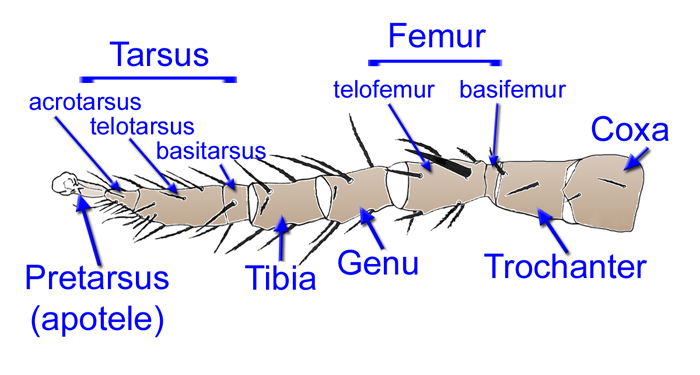
Tarsustarsus:
(pl. tarsi) the subdistal leg segment between the tibia and the pretarsus (apotele).
I with claws and pulvilluspulvillus:
a membranous, pad-like structure associated with the claws in Mesostigmata.
; holodorsal covering most of opisthosomaopisthosoma:
(= abdomen) the posterior body division in arachnids; usually not distinct in mites because of the fusion of the opisthosoma with part of the prosoma to form the idiosoma.
and bearing >20 pairs of setae.............................. 3
- Tarsustarsus:
(pl. tarsi) the subdistal leg segment between the tibia and the pretarsus (apotele).
I without claws and pulvilluspulvillus:
a membranous, pad-like structure associated with the claws in Mesostigmata.
; opisthonotalopisthonotal:
dorsal opisthosoma.
region of holodorsal shieldholodorsal shield:
a shield that covers all of the dorsum. In Mesostigmata, the holodorsal shield is often interpreted as resulting from the fusion of podonotal and opisthonotal shields and a suture between these regions is often visible (see recurved and procurved).
reduced laterally and posteriorly and bearing <12 pairs of setae.............................. Pergamasellus
Opisthonotalopisthonotal:
dorsal opisthosoma.
region of holodorsal shieldholodorsal shield:
a shield that covers all of the dorsum. In Mesostigmata, the holodorsal shield is often interpreted as resulting from the fusion of podonotal and opisthonotal shields and a suture between these regions is often visible (see recurved and procurved).
hypertrichous, with >30 pairs of setae.............................. 4
- Opisthonotalopisthonotal:
dorsal opisthosoma.
region of holodorsal shieldholodorsal shield:
a shield that covers all of the dorsum. In Mesostigmata, the holodorsal shield is often interpreted as resulting from the fusion of podonotal and opisthonotal shields and a suture between these regions is often visible (see recurved and procurved).
with <25 pairs of setae.............................. Paragamasus
Holodorsal and peritrematalperitrematal:
(peritrematic) of or referring to the peritreme; adjectival form of peritreme.
shields completely fused.............................. Amblygamasus
- Peritrematalperitrematal:
(peritrematic) of or referring to the peritreme; adjectival form of peritreme.
shields cseparate from dorsaldorsal:
relating to the upper or back side; opposed to ventral.
shield posteriorly.............................. Pergamasus
Dorsaldorsal:
relating to the upper or back side; opposed to ventral.
shield entireentire:
a shield or sclerite with a continuous margin without incisions.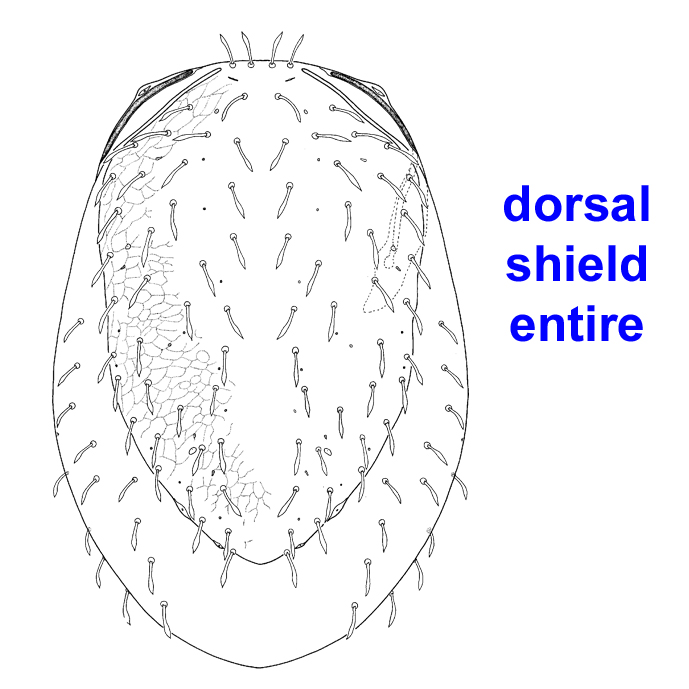 in both sexes and divided in deutonymphs. Peritrematalperitrematal:
(peritrematic) of or referring to the peritreme; adjectival form of peritreme.
shield fully fused to dorsaldorsal:
relating to the upper or back side; opposed to ventral.
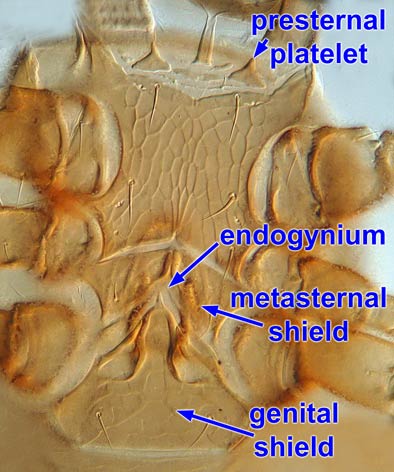
shield. Female sternal shieldsternal shield:
a shield in the anterior intercoxal region of parasitiform mites that bears one or more pairs of sternal setae.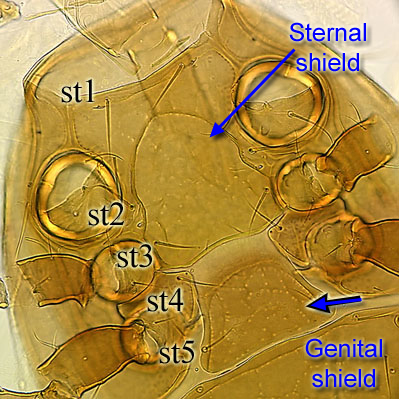 with three pairs of setaeseta:
(pl. setae, from L. = bristle) cuticular process composed of a hollow shaft (sometimes filled with a refractive material) produced from a membranous socket (the alveolus); the hair-like, spine-like, branched or variously expanded structures on the surfaces of the legs and body. Most setae function as mechanoreceptors, but others (e.g., solenidia) are chemoreceptors or have unknown or ambiguous functions.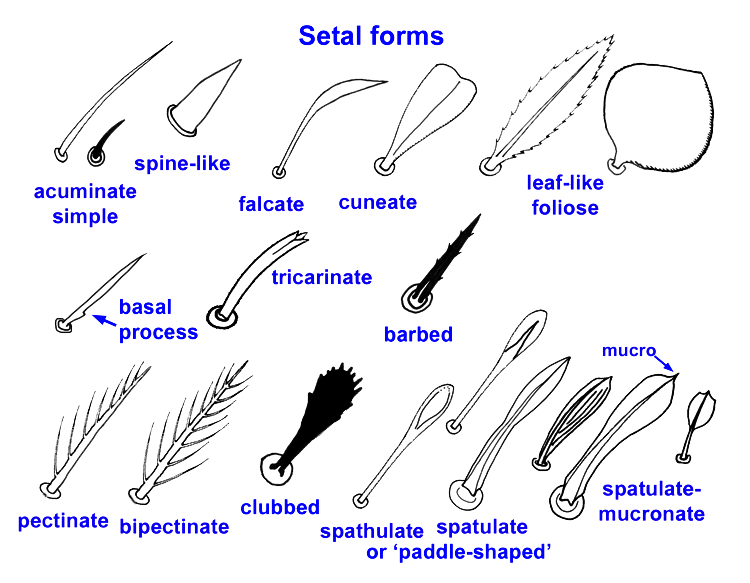 ; genital shieldgenital shield:
a shield or shields covering the genital opening; in female mongynaspine Mesostigmata this shield is usually called the epigynal (epigynial) shield.
sharply triangular, flanked by large metasternal shields, and abutting or fused to a ventrianal shieldventrianal shield:
in Mesostigmata, a ventral shield bearing the anal opening, circum anal setae, and one or more pairs of ventral setae or pores (lyrifissures) [see anal shield]; maybe rather narrow or very broad and covering most of the gaster.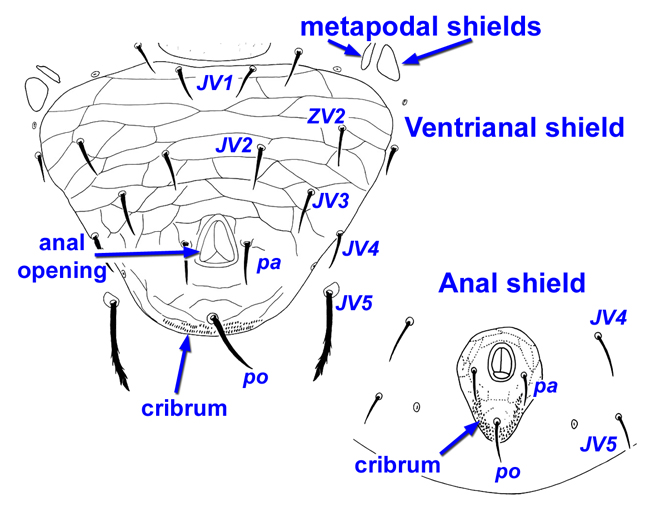 that is variously fused with peritrematalperitrematal:
(peritrematic) of or referring to the peritreme; adjectival form of peritreme.
and other shields. Tibiatibia:
(pl. tibiae) the leg segment between the genu and the tarsus. I typically with four ventral setaeseta:
(pl. setae, from L. = bristle) cuticular process composed of a hollow shaft (sometimes filled with a refractive material) produced from a membranous socket (the alveolus); the hair-like, spine-like, branched or variously expanded structures on the surfaces of the legs and body. Most setae function as mechanoreceptors, but others (e.g., solenidia) are chemoreceptors or have unknown or ambiguous functions., six dorsal setaeseta:
(pl. setae, from L. = bristle) cuticular process composed of a hollow shaft (sometimes filled with a refractive material) produced from a membranous socket (the alveolus); the hair-like, spine-like, branched or variously expanded structures on the surfaces of the legs and body. Most setae function as mechanoreceptors, but others (e.g., solenidia) are chemoreceptors or have unknown or ambiguous functions., and two al setaeseta:
(pl. setae, from L. = bristle) cuticular process composed of a hollow shaft (sometimes filled with a refractive material) produced from a membranous socket (the alveolus); the hair-like, spine-like, branched or variously expanded structures on the surfaces of the legs and body. Most setae function as mechanoreceptors, but others (e.g., solenidia) are chemoreceptors or have unknown or ambiguous functions. (2 3/2 3/2 2); tibiatibia:
(pl. tibiae) the leg segment between the genu and the tarsus. III with eight or nine setaeseta:
(pl. setae, from L. = bristle) cuticular process composed of a hollow shaft (sometimes filled with a refractive material) produced from a membranous socket (the alveolus); the hair-like, spine-like, branched or variously expanded structures on the surfaces of the legs and body. Most setae function as mechanoreceptors, but others (e.g., solenidia) are chemoreceptors or have unknown or ambiguous functions. (2 1/1 2/1 1(2)); chaetotaxychaetotaxy:
the use of setal position and form in taxonomy; see Lindquist-Evans system, Grandjean system, Rostral-lamellar system, etc.
of genugenu:
(pl. genua) (= patella) the 4th leg segment, between the femur and tibia.
IV (2 2/1 3/1 1). Palptarsal apotelepalptarsal apotele:
(= palp apotele, palptarsal claw) the most distal segment of the palp; absent in Acariformes, claw-like in Opilioacarida, and a subdistal, tined structure in the Mesostigmata.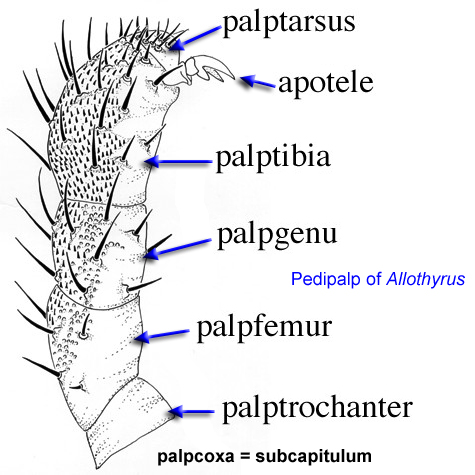 3-tined. Female often with an elaborate endogynium. Male with presternal genital aperturegenital aperture:
the genital opening or acetabulum.
on holoventral or sternitigenital shieldsternogenitalshield:
(also sternitogenital, sternitigenital) in male Mesostigmata, a shield covering the intercoxal region and bearing the genital opening.
, and typically with highly developed spurs on legs II; chelicerae with sperm-holding structure (spermatotremespermatotreme:
a slit-like opening on the movable digit of male Parasitidae that grasps the neck of the spermatophore during sperm transfer; considered to be a foramen left by the distal fusion of a spermatodactyl to the movable digit.) which is coalescedcoalesced:
united, grown together, as for example, the genital and anal regions of some prostigmatans.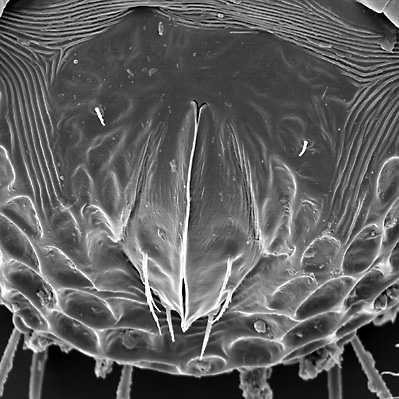 distally with movable digit. Larva without pygidial shieldpygidial shield:
(pygidial sclerite) in Mesostigmata, a shield at the back end of the idiosoma.
; protonymphal pygidial shieldpygidial shield:
(pygidial sclerite) in Mesostigmata, a shield at the back end of the idiosoma.
reduced laterally, generally with 4–5 pairs of setaeseta:
(pl. setae, from L. = bristle) cuticular process composed of a hollow shaft (sometimes filled with a refractive material) produced from a membranous socket (the alveolus); the hair-like, spine-like, branched or variously expanded structures on the surfaces of the legs and body. Most setae function as mechanoreceptors, but others (e.g., solenidia) are chemoreceptors or have unknown or ambiguous functions. (without setaeseta:
(pl. setae, from L. = bristle) cuticular process composed of a hollow shaft (sometimes filled with a refractive material) produced from a membranous socket (the alveolus); the hair-like, spine-like, branched or variously expanded structures on the surfaces of the legs and body. Most setae function as mechanoreceptors, but others (e.g., solenidia) are chemoreceptors or have unknown or ambiguous functions. S4–S5), or shield sometimes absent.
Similar taxa in key. Female Parasitinae have schizodorsal or divided dorsaldorsal:
relating to the upper or back side; opposed to ventral.
shields with the dorsaldorsal:
relating to the upper or back side; opposed to ventral.
hexagon setaeseta:
(pl. setae, from L. = bristle) cuticular process composed of a hollow shaft (sometimes filled with a refractive material) produced from a membranous socket (the alveolus); the hair-like, spine-like, branched or variously expanded structures on the surfaces of the legs and body. Most setae function as mechanoreceptors, but others (e.g., solenidia) are chemoreceptors or have unknown or ambiguous functions. dissimilar in form (usually z5 is larger and ornamented). Veigaiidae may be superficially similar, but have anal shields, a scale-like process above the palp apotelepalptarsal apotele:
(= palp apotele, palptarsal claw) the most distal segment of the palp; absent in Acariformes, claw-like in Opilioacarida, and a subdistal, tined structure in the Mesostigmata., often moustache-likemoustache-like:
having the appearance of a well developed handlebar moustache, as in the internal malae of most species of Veigaia (Mesostigmata). 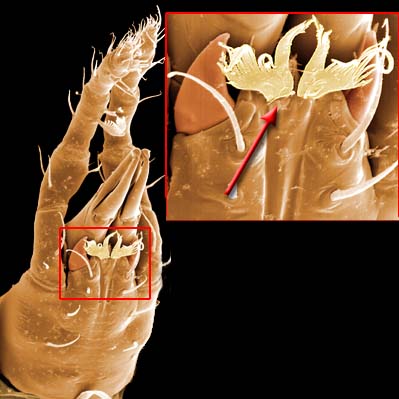 internal malae, and a spermatodactylspermatodactyl:
(also spermadactyl) the 'sperm finger' on the chelicerae of male dermanyssine Mesostigmata used to transfer sperm to the secondary sperm system in the female; spermatodactyls take various forms, from simple finger-like processes to very long, contorted structures. 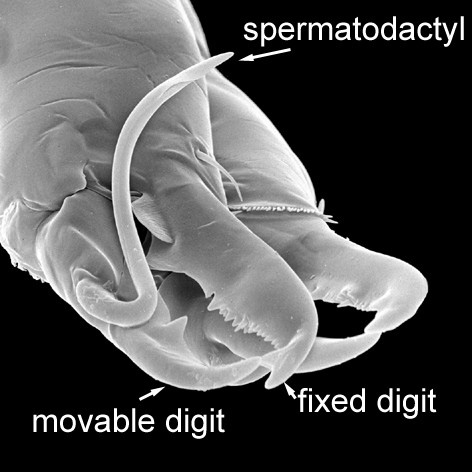 that is free distally on the male chelicerae.
Similar taxa in key. Most members of the suborder Trigynaspida have three shields around the genital opening, but retain setaeseta:
(pl. setae, from L. = bristle) cuticular process composed of a hollow shaft (sometimes filled with a refractive material) produced from a membranous socket (the alveolus); the hair-like, spine-like, branched or variously expanded structures on the surfaces of the legs and body. Most setae function as mechanoreceptors, but others (e.g., solenidia) are chemoreceptors or have unknown or ambiguous functions. av4 and pv4 on an intercalary scleritesclerite:
A component section of an exoskeleton; a plate forming the skeleton of an arthropod.
and excrescences on the movable digit.
Soil-inhabiting predators of small arthropods and other invertebrates. Most species appear to be bisexual and diplodiploidy has been demonstrated in the group. Phoresyphoresy:
a type of migration where mites board larger animals (usually insects or other arthropods) and cease or otherwise alter normal behaviors (e.g., feeding, reproduction, movement) until some cue elicits the departure from the animal and the resumption of normal behavior. Phoresy usually results in the dispersal of populations, but may result in reaggregation, especially for mites using highly specialized habitats (e.g., pitcher plants and other phytotelmata). Some mites hold on to their phoretic carriers with specialized structures (e.g., the anal pedicel in Uropodina; modified legs I in phoretomorphic Pygmephoridae; a specialized tooth on the chelicerae of many Macrocheles), but others simply use their feet or grip a seta with unmodified mouthparts. Phoretic relationships my be highly host specific, very general, or anywhere in between, depending on the species. In earlier work, phoresy was differentiated from parasitism by whether or not feeding occurred on the host. However, recent work has shown that some phoretic mites may also feed on or otherwise harm their host.
is not known in the Pergamasinae.
Author: David E. Walter
Content last updated Sept. 2006, unless indicated otherwise
Lucid key player updated Sept. 2025
idtools.org