Mesostigmata
t
Taxonomy
updated 2025
Classification
Superorder Parasitiformes » Order Mesostigmata » Suborder Monogynaspida » Infraorder Gamasina » Hyporder Parasitiae » Superfamily Parasitoidea » Family Parasitidae » Subfamily Parasitinae
Children
Anadenosternum Athias-Henriot, Carpaidion Athias-Henriot, Colpothylax Athias-Henriot, Cornigamasus Evans and Till, Dicrogamasus Athias-Henriot, Erithosoma Athias-Henriot, Eugamasus Berlese, Leptogamasus Trägårdh, Mixogamasus Juvara-Bals, Nemnichia Oudemans, Oocarpais Berlese, Paracarpais Athias-Henriot, Parasitellus Willmann, Parasitus Latreille, Pergamasellus Evans, Phityogamasus Juvara-Bals and Athias-Henriot, Phorytocarpais Athias-Henriot, Porrhostaspis Mueller, Poecilochirus G. and R. Canestrini, Psilogamasus Athias-Henriot, Rhabdocarpais Athias-Henriot, Trachygamasus Berlese, Zelogamasus Hennessey and Farrier
Diagnostic characters
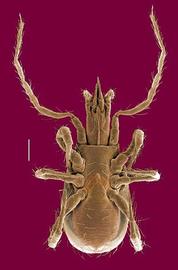
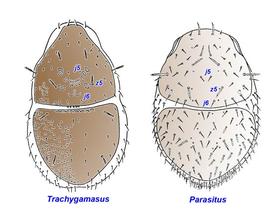
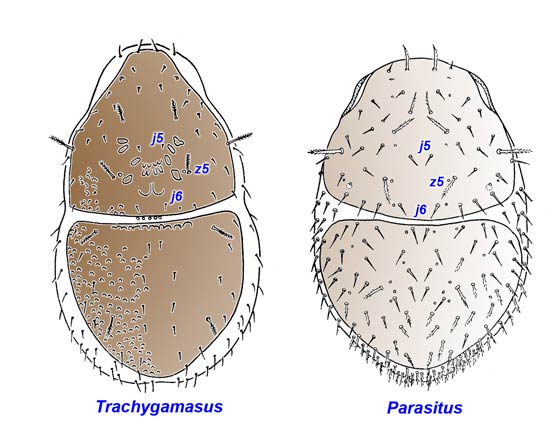
- Female with schizodorsal or divided dorsal shield with setae of dorsal hexagon (j5, z5, j6) usually dissimilar (z5 often thickened and distally pilose)
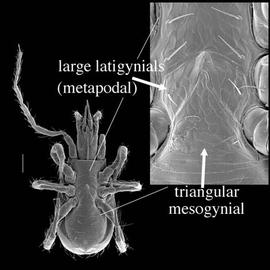
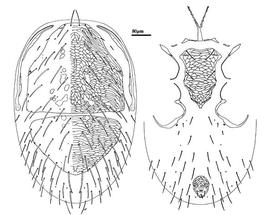
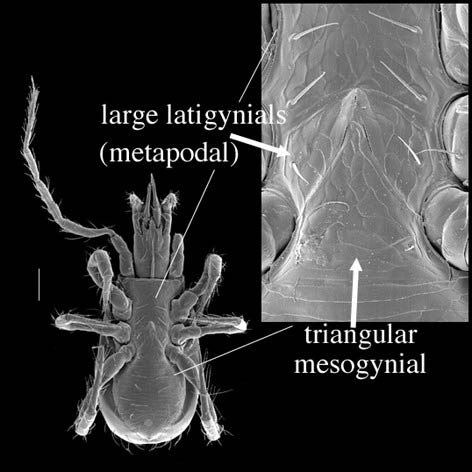
- Genital shield +/- triangular, sharply tapering to a point and flanked by large metasternal shields
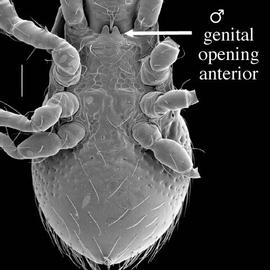
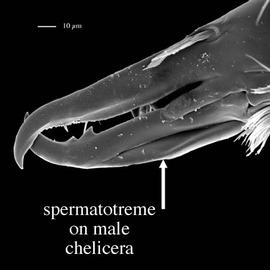
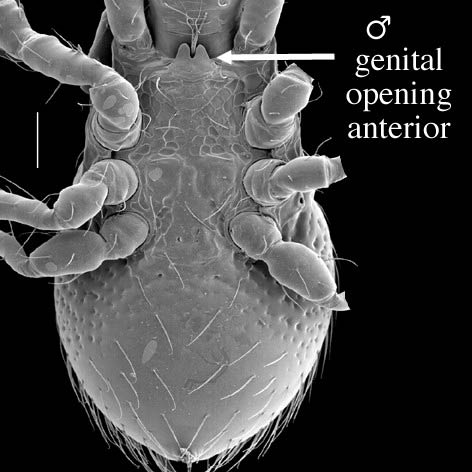
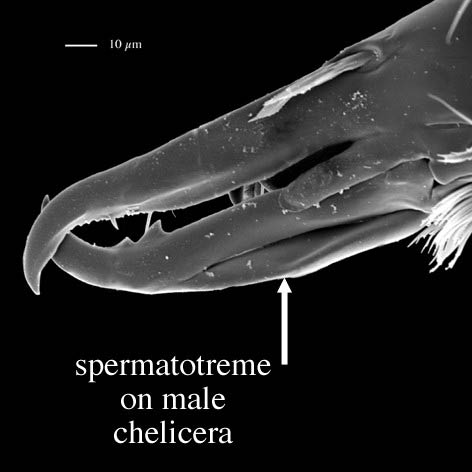
- Male with anterior genital aperture and distally fused spermatotreme on chelicerae
- Tibia I usually with 14 setae, including 4 ventral and 6 dorsal
Key to some Parasitine genera (adult females) (modified from Hyatt 1980)
-
Lateral setae of palp genu (al1–2) entire, either setiform or spatulate.............................. 2
- Lateral setae of palp genu (al1–2) bifid.............................. Eugamasus
-
Posterior ventral region (opisthogaster) with 30 or fewer pairs of setae; associated with a variety of insects, but usually not bumblebees (Bombus).............................. 3
- Opisthogaster with extensive hypertrichy (>40 pairs of setae); associated with bumblebees (Bombus) or their nests.............................. Parasitellus
-
Corniculi of normal length, not reaching the anterior margin of the palp femur; anterior margin of anterior dorsal shield convex.............................. 4
- Corniculi elongate, extending beyond palp femur-genu articulation; margin of anterior dorsal shield concave.............................. Cornigamasus
-
Genital shield (or genital region of hologastric shield) subtriangular, acuminate.............................. 5
- Genital region of hologastric shield distally tricuspid.............................. Porrhostaspis
-
Lateral seta of palp femur (al) entire, usually spatulate.............................. 8
- Lateral seta of palp femur bifid, serrate, or serrate-spatulate.............................. 6
-
Setae of dorsal hexagon dissimilar, seta z5 longer and usually thicker than j5 and j6............................... 7
- Setae of dorsal hexagon similar in size and ornamentation.............................. Vulgarogamasus
-
Sternal shield entire; seta z5 usually thicker than j5 and j6 and distally pilose associated with dung (and dung beetles), compost, etc.............................. Parasitus
- Sternal shield split medially; seta z5 usually longer than j5 and j6 but similar in form; associated with bark beetles.............................. Schizosthetus
-
Dorsal shield completely divided.............................. 9
- Schizodorsal shield.............................. Gamasodes bispinosus group
-
Seta z5 of dorsal hexagon thickened and distally pilose; associated with various insects.............................. 10
- Seta z5 simple; associated with carrion beetles (Silphidae).............................. Poecilochirus
-
Articulation between sternal and metasternal shields oblique; ambulacra of legs II–IV simple, rounded.............................. Gamasodes
- Articulation (or suture) between sternal and metasternal shields transverse; ambulacra of legs II–IV long and acuminate.............................. Trachygamasus
Diagnosis
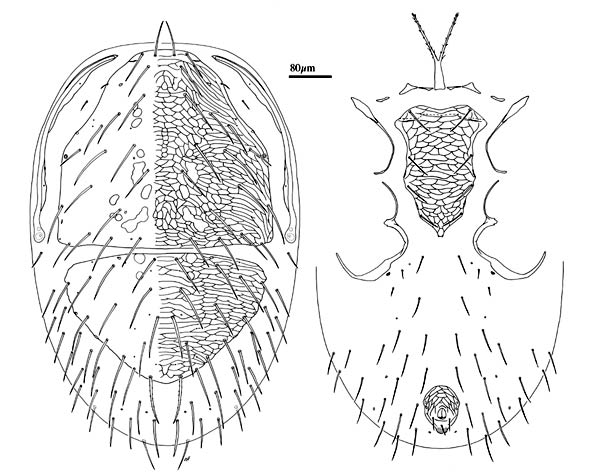
Female dorsal shield with lateral incisions or completely divided, setae of dorsal hexagon dissimilar in form usually
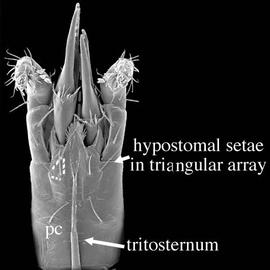
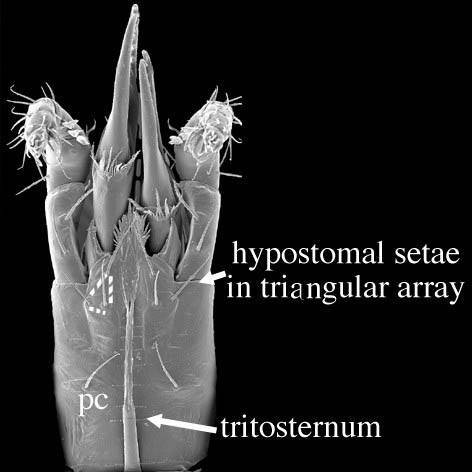
z5 larger and ornamented); dorsal shield entire in males and divided in deutonymphs. Peritrematal shield fully fused to dorsal shield. Female sternal shield with three pairs of setae; genital shield sharply triangular, flanked by large metasternal shields, and abutting or fused to a ventrianal shield that is variously fused with peritrematal and other shields. Tibia I typically with four ventral setae, six dorsal setae, and two al setae (2 3/2 3/2 2); tibia III with eight or nine setae (2 1/1 2/1 1(2)); chaetotaxy of genu IV (2 2/1 3/1 1). Palptarsal apotele 3-tined. Female often with an elaborate endogynium. Male with presternal genital aperture on holoventral or sternitigenital shield, and typically with highly developed spurs on legs II; chelicerae with sperm-holding structure (spermatotreme) which is coalesced distally with movable digit. Larva without pygidial shield; protonymphal pygidial shield reduced laterally, generally with 4–5 pairs of setae (without setae
S4–
S5), or shield sometimes absent; dorsal shield of deutonymph divided, apicotarsus present in deutonymphs.
Similar taxa
Similar taxa in key. Female Pergamasinae have holodorsal shields with the dorsal hexagon setae similar in form (species of Vulgarogamasus of the subfamily Parasitinae also have similar dorsal hexagon setae). Veigaiidae may be superficially similar, but have anal shields, a scale-like process above the palp apotele, often moustache-like internal malae, and a spermatodactyl that is free distally on the male chelicerae.
Similar taxa not in key. Most members of the suborder Trigynaspida have three shields around the genital opening, but retain setae av4 and pv4 on an intercalary sclerite and excrescences on the movable digit.
Ecology and distribution
Predators of small arthropods and other invertebrates. Most species appear to be bisexual and diplodiploidy has been demonstrated in the group. Phoresy is not known in the Pergamasinae, but deutonymphs of Parasitinae are phoretic and are aggressive predators in patchy organic habitats such as dung, carrion, compost, rotting fungi, and beach wrack. Species of Schizothetus are associated with bark beetles in the genera Dendroctonus and Ips.
References
- Al-Amidi et al. 1991Al-Amidi et al. 1991:
Al-Amidi AHK, Dunne R, Downes MJ. 1991. Parasitus bituberosus (Acari: Parasitidae): an agent for control of Lycoriella solani (Diptera: Sciaridae) in mushroom crops. Experimental and Applied Acarology 11: 159–166.
- Athias-Henriot 1980aAthias-Henriot 1980a:
Athias-Henriot C. 1980a. Parasitidae nord-coréens (Parasitiformes): apparentés au genre Neogamasus Tikh., avec création de trois nouveaux genres. Annales Musei Historico-Naturalis Hungarici. 72: 285–294.
- Athias-Henriot 1982aAthias-Henriot 1982a:
Athias-Henriot C. 1982a. Schizosthetus n.g. (type Eugamasus lyriformis McGr. & Farr., 1969) avec deux espèces nouvelles (Parasitiformes, Parasitidae). Acarologia 23: 207–214.
- Athias-Henriot 1982bAthias-Henriot 1982b:
Athias-Henriot C. 1982b. Sur le genre monotypique Parasitus Latr. (Parasitiformes, Parasitidae). Diagnose, définition, distribution. Revue Suisse de Zoologie 89: 3–6.
- Axtell 1981Axtell 1981:
Axtell RC. 1981. Use of predators and parasites in filth fly IPM programs in poultry housing. pp. 26-43. In: Patterson RS, Koehler PG, Morgan PB, and Harris RL, eds. Status of Biological Control of Filth Flies. Proceedings of a Workshop, Feb. 4-5, 1981, University of Florida, Gainesville. USDA Science and Education Administration.
- Beninger 1993Beninger 1993:
Beninger CW. 1993. Egg predation by Poecilochirus carabi (Mesostigmata: Parasitidae) and its effect on reproduction of Nicrophorus vespilloides (Coleoptera: Silphidae). Environmental Entomology 22: 766–769.
- Bhattacharyya 1963Bhattacharyya 1963:
Bhattacharyya SK. 1963. A revision of the British mites of the genus Pergamasus Berlese s.lat. (Acari: Mesostigmata). Bulletin of the British Museum (Natural History), Zoology 11 (2): 131–242 + 8 plates.
- Blackman and Evans 1994Blackman and Evans 1994:
Blackman SW, Evans GO. 1994. Observations on a mite (Poecilochirus davydovae) predatory on the eggs of burying beetles (Nicrophorus vespilloides) with a review of its taxonomic status. Journal of Zoology 234: 217–227.
- Brown and Wilson 1994Brown and Wilson 1994:
Brown JM, Wilson DS. 1994. Poecilochirus carabi: Behavioral and life-history adaptations to different hosts and the consequences of geographical shifts in host communities. pp. 1–22. In: Houck MA, ed. Mites: Ecological and evolutionary analyses of life-history patterns. Chapman & Hall, New York.
- Hennessey and Farrier 1989Hennessey and Farrier 1989:
Hennessey MK, MH Farrier 1989. Mites of the family Parasitidae (Acari: Mesostigmata) inhabiting forest soils of North and South Carolina. NC Agricultural Research Service Technical Bulletin No. 291: 78 pp.
- Hyatt 1980Hyatt 1980:
Hyatt KH. 1980. Mites of the subfamily Parasitinae (Mesostigmata: Parasitidae) in the British Isles. Bulletin of the British Museum (Natural History) Zoology 38: 237–378.
- Hyatt 1987Hyatt 1987:
Hyatt KH. 1987. Mites of the genus Holoparasitus Oudemans, 1936 (Mesostigmata: Parasitidae) in the British Isles. Bulletin of the British Museum (Natural History) Zoology 52: 139–164.
- Juvara-Bals 2002Juvara-Bals 2002:
Juvara-Bals I. 2002. A revision of the genus Heteroparasitus new status, with the description of Heteroparasitus (Medioparasitus) athiasae subgen. n., sp. n. from Spain and with a key to the genera of Pergamasinae (Acari, Gamasida, Parasitidae). Revue Suisse de Zoologie 109: 23–46.
- Krantz 1983Krantz 1983:
Krantz GW. 1983. Mites as biological control agents of dung-breeding flies, with special reference to the Macrochelidae. pp. 91–98. In: Hoy MA, Cunningham GL, Knutson L, eds. Biological control of pests by mites. University of California Agriculture Experiment Station, Special Publication 3304, Berkley.
- Micherdzinski 1969Micherdzinski 1969:
Micherdzinski W. 1969. Die Familie Parasitidae Oudemans 1901 (Acarina, Mesostigmata). Zakład Zoologii Systematycznej Polskiej Akademii Nauk, Krakow. 690 pp.
- Richards and Richards 1976Richards and Richards 1976:
Richards LA, Richards KW. 1976. Parasitid mites associated with bumblebees in Alberta, Canada (Acarina: Parasitidae; Hymenoptera: Apidae). II. Biology. University of Kansas Science Bulletin 51: 1–18.
- Schousboe 1987Schousboe 1987:
Schousboe C. 1987. Deutonymphs of Parasitellus phoretic on Danish bumblebees (Parasitidae, Mesostigmata; Apidae, Hymenoptera). Acarologia 28: 37–41.
- Schwarz and Müller 1992Schwarz and Müller 1992:
Schwarz HH, Müller JK. 1992. The dispersal behaviour of the phoretic mite Poecilochirus carabi (Mesostigmata, Parasitidae): Adaptation to the breeding biology of its carrier Necrophorus vespilloides (Coleoptera, Silphidae). Oecologia 89: 487–493.
- Springett 1968Springett 1968:
Springett BP. 1968. Aspects of the relationship between burying beetles, Necrophorus spp. and the mite, Poecilochirus necrophori Vitz. Journal of Animal Ecology 37: 417–424.
- Wrensch and Johnston 1983Wrensch and Johnston 1983:
Wrensch DL, Johnston DE. 1983. Sexual dimorphism in deutonymphs of mites of the family Parasitidae (Acari: Mesostigmata). Annals of the Entomological Society of America 76: 473–474.