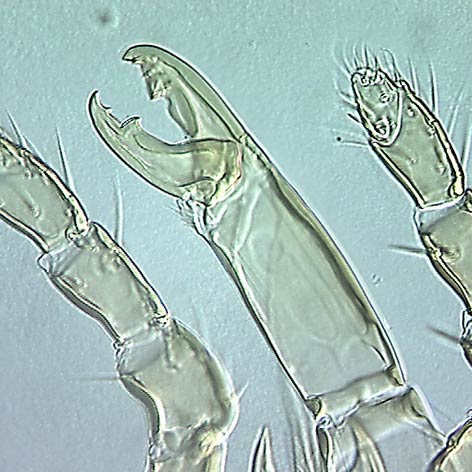
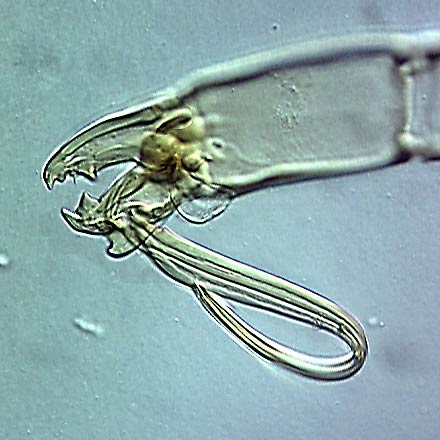
t
Pachylaelapidae Berlese, 1913
Superorder Parasitiformes » Order Mesostigmata » Suborder Monogynaspida » Infraorder Gamasina » Hyporder Dermanyssiae » Superfamily Eviphidoidea » Family Pachylaelapidae
Beaurieuia Oudemans, Brachylaelaps Berlese, Elaphrolaelaps Berlese, Megalolaelaps Berlese [Megalolaelapidae?], Meliponapachys Turk, Olopachys Berlese, Onchodellus Berlese, Neoparasitus Oudemans, Pachylaella Berlese, Pachylaelaps Berlese, Pachyseiulus Moraza & Johnston, Paralaelaps Trägårdh, Platylaelaps Berlese, Pseudolaelaps Berlese (?), Pseudopachys Berlese, Pseudopachyseiulus Moraza & Johnston, Sphaerolaelaps Berlese, (Pachyseius Berlese, Zygoseius Berlese keyed separately)
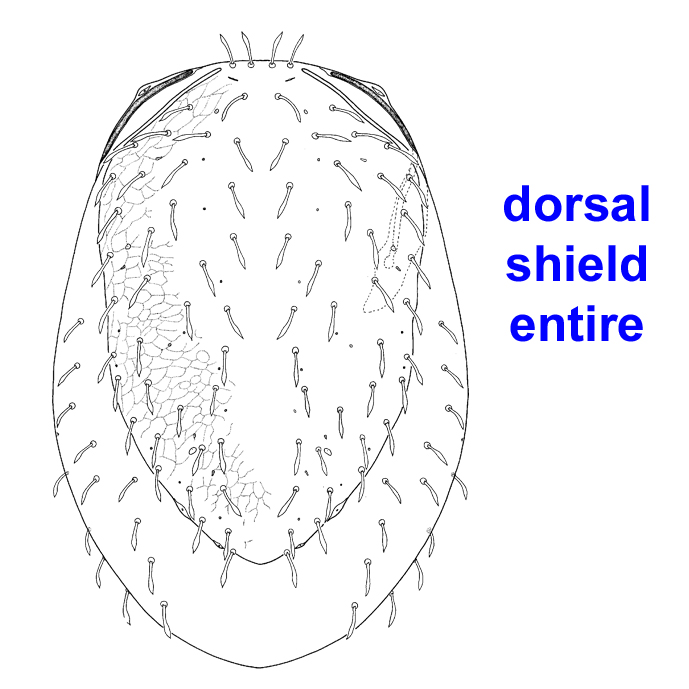 , opisthonotalopisthonotal:
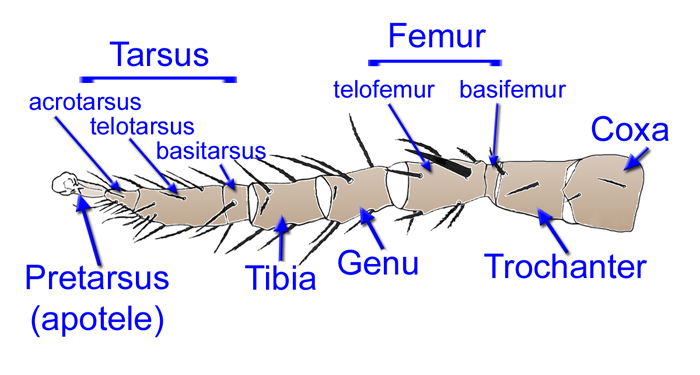 I and genugenu: I with 5 dorsaldorsal: II with spurspur:
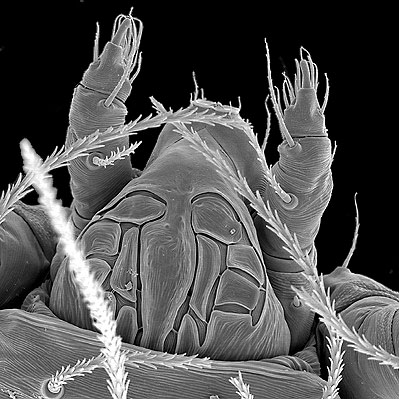 linear.
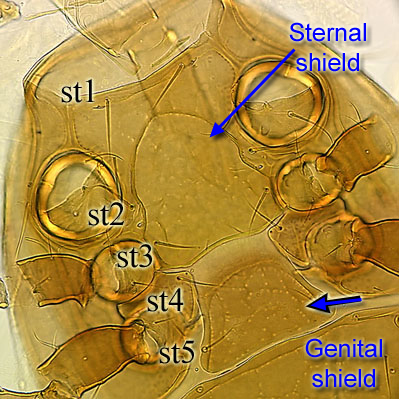 (free in soft cuticle in Pseudopachyseiulus), such that it bears 4 pairs of setae, the genital shieldgenital shield:
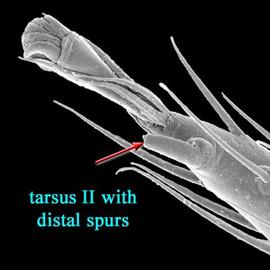
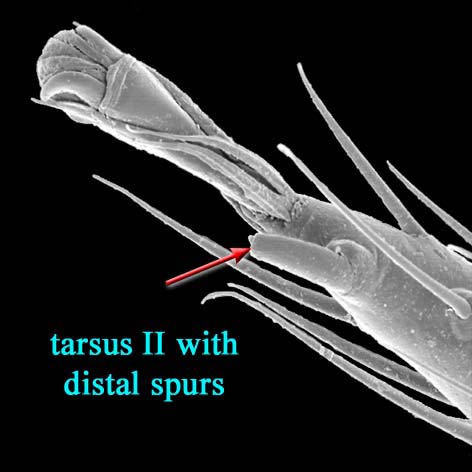
Females (and usually males) with spur-like distaldistal:
towards the free end of an appendage.
setae on tarsus II.............................. 3
- Spurspur:
a projection, usually tooth- or spine-like, from the body or limbs.
-like setae on tarsustarsus:
(pl. tarsi) the subdistal leg segment between the tibia and the pretarsus (apotele).
II absent.............................. 2
Female with subcordate ventrianal shieldventrianal shield:
in Mesostigmata, a ventral shield bearing the anal opening, circum anal setae, and one or more pairs of ventral setae or pores (lyrifissures) [see anal shield]; maybe rather narrow or very broad and covering most of the gaster.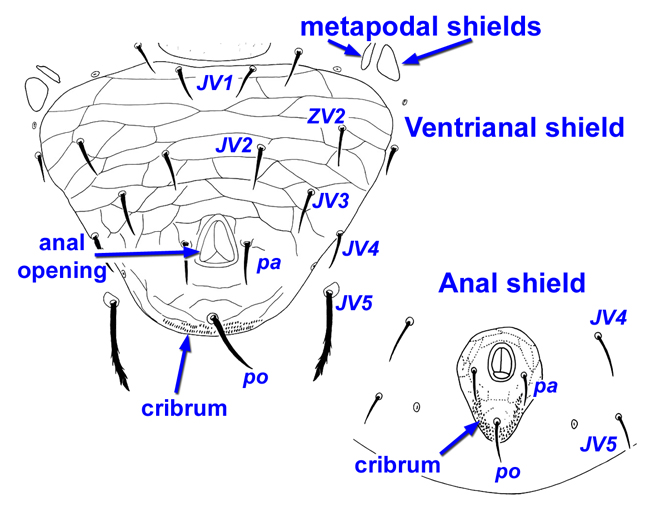 with 13 setae (ZV1–2, JV1–3 + circumanals); genital shieldgenital shield:
a shield or shields covering the genital opening; in female mongynaspine Mesostigmata this shield is usually called the epigynal (epigynial) shield.
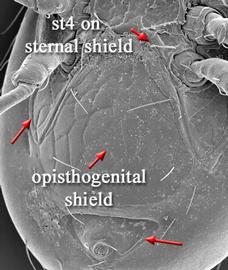
truncate posteriorly and bearing 1 pair of setae; sternal shieldsternal shield:
a shield in the anterior intercoxal region of parasitiform mites that bears one or more pairs of sternal setae. with 3 pairs of setae and convex posteriorposterior:
the back part of the body or towards that region in comparison, e.g., 'posterior to'.
margin; metasternal setae on metasternal-endopodal shield; free-living or on dung beetles.............................. Zygoseius
- Female with anal shield (rarely capturing 1–2 ventral setaeventral setae:
in the Lindquist-Evans system used in the Mesostigmata, the ventral region has up to three longitudinal rows (Jv, Zv, Lv) with 1-5 transverse row designations.
); opisthogenital shield spreading laterally, with 2 pairs of setae and recurvedrecurved:
a curved suture or line of dehiscence that arches posteriorly; opposed to procurved.
posterior margin; associated with ants.............................. Sphaerolaelaps
Female sternal shieldsternal shield:
a shield in the anterior intercoxal region of parasitiform mites that bears one or more pairs of sternal setae. bearing 4 pairs of setae, opisthogenital shield with 2 or more pairs of setae, and anal shield with 3 circumanal setaecircumanal setae:
in Mesostigmata, the three setae (postanal and pair of peranal) setae surrounding the anal opening............................... 4
- Female sternal shieldsternal shield:
a shield in the anterior intercoxal region of parasitiform mites that bears one or more pairs of sternal setae. bearing 3 pairs of setae (st4 on small metasternal shield or in soft cuticle), genital shieldgenital shield:
a shield or shields covering the genital opening; in female mongynaspine Mesostigmata this shield is usually called the epigynal (epigynial) shield.
with 1 pair of seta, and ventrianal shieldventrianal shield:
in Mesostigmata, a ventral shield bearing the anal opening, circum anal setae, and one or more pairs of ventral setae or pores (lyrifissures) [see anal shield]; maybe rather narrow or very broad and covering most of the gaster. with 7–10 setae.............................. Pachyseius
Tibiatibia:
(pl. tibiae) the leg segment between the genu and the tarsus. I with 5 dorsaldorsal:
relating to the upper or back side; opposed to ventral.
setae; palp apotelepalptarsal apotele:
(= palp apotele, palptarsal claw) the most distal segment of the palp; absent in Acariformes, claw-like in Opilioacarida, and a subdistal, tined structure in the Mesostigmata.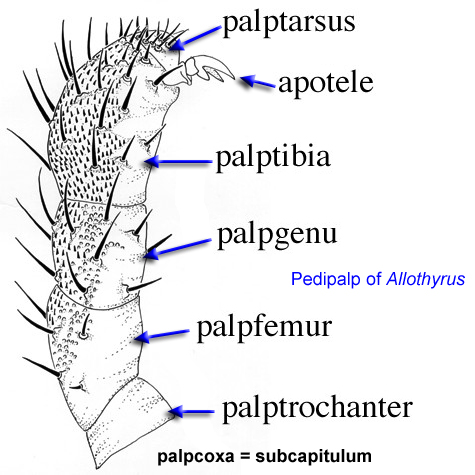 3-tined.............................. 5
- Tibiatibia:
(pl. tibiae) the leg segment between the genu and the tarsus. I with 6 dorsaldorsal:
relating to the upper or back side; opposed to ventral.
setae; palp apotelepalptarsal apotele:
(= palp apotele, palptarsal claw) the most distal segment of the palp; absent in Acariformes, claw-like in Opilioacarida, and a subdistal, tined structure in the Mesostigmata. 2-tined.............................. 6
Genugenu:
(pl. genua) (= patella) the 4th leg segment, between the femur and tibia.
I with 5 dorsaldorsal:
relating to the upper or back side; opposed to ventral.
setae.............................. Onchodellus
- Genugenu:
(pl. genua) (= patella) the 4th leg segment, between the femur and tibia.
I with 6 dorsaldorsal:
relating to the upper or back side; opposed to ventral.
setae.............................. Pachylaelaps
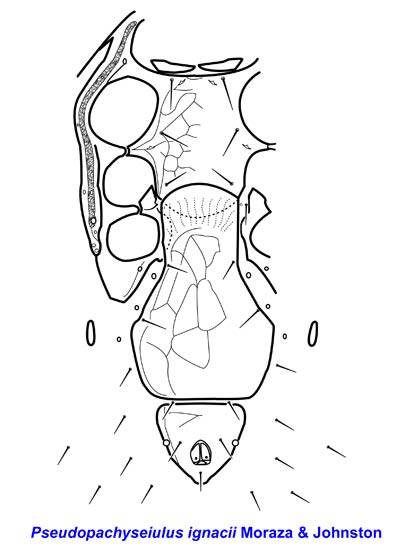
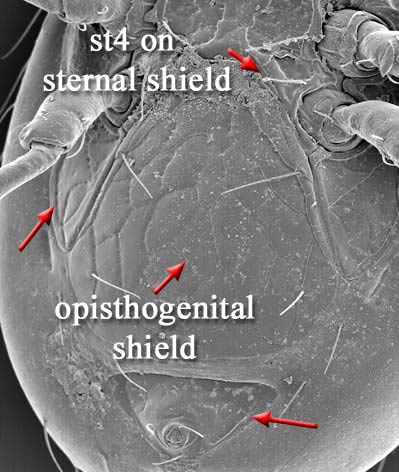
Seta st4 on small metasternal plate; dorsaldorsal:
relating to the upper or back side; opposed to ventral.
shield with 37 pairs of setae.............................. Pachyseiulus
- Seta st4 on in soft cuticle; dorsaldorsal:
relating to the upper or back side; opposed to ventral.
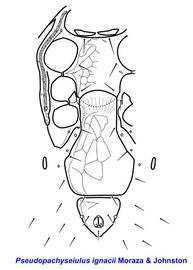
shield with 35 pairs of setae.............................. Pseudopachyseiulus
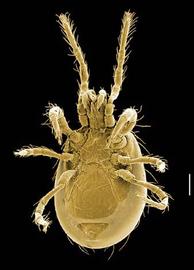
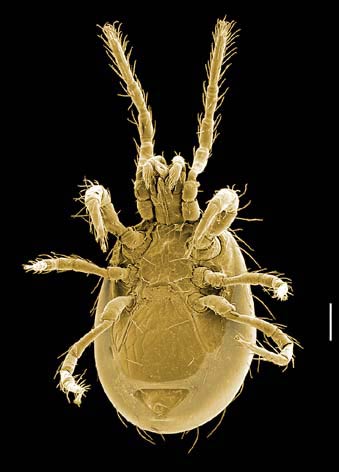
Yellow to brown dermanyssine mesostigmatans with holodorsal shields. Peritremes generally well developed, peritrematalperitrematal:
(peritrematic) of or referring to the peritreme; adjectival form of peritreme.
-exopodal shields often produced posteriorly. Sternal shieldsternal shield:
a shield in the anterior intercoxal region of parasitiform mites that bears one or more pairs of sternal setae. often fused to posteriorposterior:
the back part of the body or towards that region in comparison, e.g., 'posterior to'.
endopodal elements and bearing 3 or 4 pairs of setae (st1–3, +/- 4) and 2–3 pairs of lyrifissures; metasternal seta st4 in soft cuticle (e.g., Pseudopachyseiulus), on a metasternal shield, (e.g., Pachyseius), on sternal shieldsternal shield:
a shield in the anterior intercoxal region of parasitiform mites that bears one or more pairs of sternal setae. (e.g., Pachylaelaps, Pachyseiulus), or on endopodal-metasternal shield (e.g., Zygoseius; genital shieldgenital shield:
a shield or shields covering the genital opening; in female mongynaspine Mesostigmata this shield is usually called the epigynal (epigynial) shield.
usually trapezoidal, subrectangular to oval-tongue-shaped; recurvedrecurved:
a curved suture or line of dehiscence that arches posteriorly; opposed to procurved.
to truncate posteriorly; and bearing 1–2 (rarely more) pair of setae; ventrianal shieldventrianal shield:
in Mesostigmata, a ventral shield bearing the anal opening, circum anal setae, and one or more pairs of ventral setae or pores (lyrifissures) [see anal shield]; maybe rather narrow or very broad and covering most of the gaster. broad with several pairs of ventral setaeventral setae:
in the Lindquist-Evans system used in the Mesostigmata, the ventral region has up to three longitudinal rows (Jv, Zv, Lv) with 1-5 transverse row designations.
to small, triangular and bearing only 3 circumanal setaecircumanal setae:
in Mesostigmata, the three setae (postanal and pair of peranal) setae surrounding the anal opening.. Tarsustarsus:
(pl. tarsi) the subdistal leg segment between the tibia and the pretarsus (apotele).
I with claws; trochantertrochanter:
the leg segment between the coxa and the femur. I with 6 setae; tibiatibia:
(pl. tibiae) the leg segment between the genu and the tarsus. and genugenu:
(pl. genua) (= patella) the 4th leg segment, between the femur and tibia.
I each with 5–6/3 dorsal/ ventral setaeventral setae:
in the Lindquist-Evans system used in the Mesostigmata, the ventral region has up to three longitudinal rows (Jv, Zv, Lv) with 1-5 transverse row designations.
; genugenu:
(pl. genua) (= patella) the 4th leg segment, between the femur and tibia.
IV with 8–9 setae, 4–5/1 dorsal/ ventralventral:
relating to the lower or under side; opposed to dorsal.
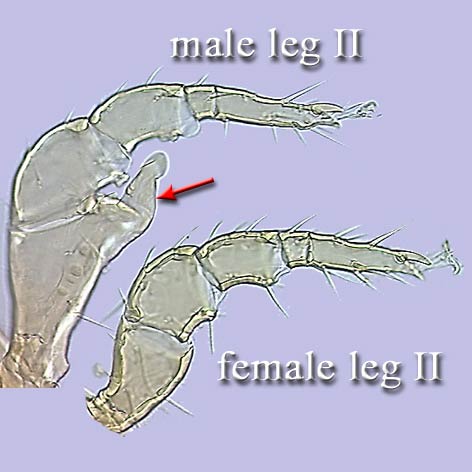
; leg II usually enlarged and tarsustarsus:
(pl. tarsi) the subdistal leg segment between the tibia and the pretarsus (apotele).
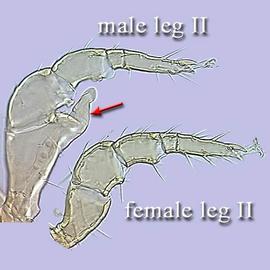
II sometimes with spine-likespine-like:
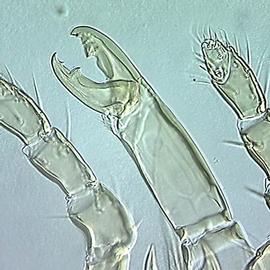
a seta or other structure that resembles a thorn or spine; spiniform.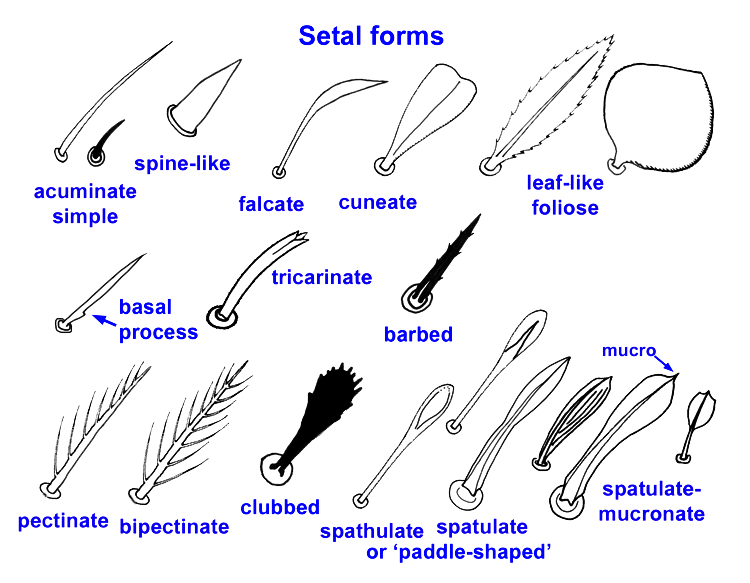 distal setae. Chelicerae chelate-dentatechelate-dentate:
pincer-like chelicerae with teeth.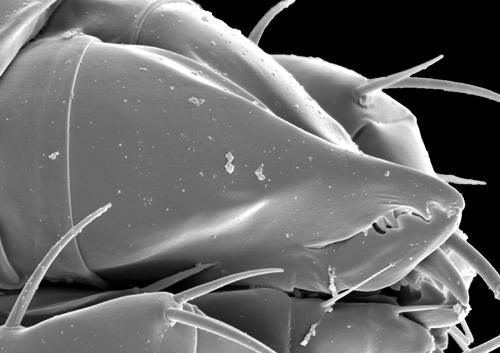 ; movable digit without excrescences, arthrodial coronaarthrodial corona:
(arthrodial coronet) a crown-like array of fine processes from the arthrodial membrane at the juncture of the fixed and movable digits in Mesostigmata.
not produced in a brush. Palppalp:
(= pedipalp) the second pair of limbs in arachnids, used in feeding and originating on either side of the chelicerae. In mites, the palps may be vestigial, with only a few segments, or have a maximum of 5 freely articulating segments (rarely the femur is subdivided) and a distal or subdistal apotele. genu with 6 setae, palp apotelepalptarsal apotele:
(= palp apotele, palptarsal claw) the most distal segment of the palp; absent in Acariformes, claw-like in Opilioacarida, and a subdistal, tined structure in the Mesostigmata. 2 or 3-tined; corniculicorniculus:
(pl. corniculi) (also, external malae) a usually horn-like process (sometimes toothed, bifurcate, trifurcate, spine-like, spatulate, or membranous) on the subcapitulum of parasitiform mites that usually supports the salivary styli. A toothed corniculus could be confused with a rutellum, a possibly homologous structure in Acariformes and Opilioacarida. Phytoseiid image is spatulate corniculus.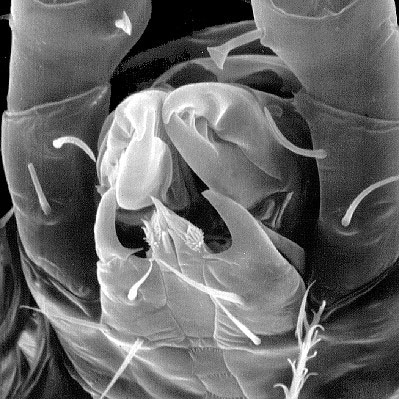 horn-like, often phytoseioid. Tritosternumtritosternum:
the sternum of the 3rd body segment (between legs I); produced as a biflagellate structure in Mesostigmata, although sometimes the flagellae (laciniae) are partially or completely fused. 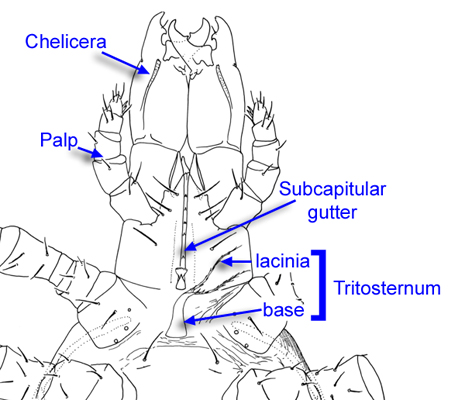 biflagellate with columnar basebase:
the usually columnar basal part of the tritosternum; sometimes expanded and rectangular or otherwise modified; the most basal part of any structure.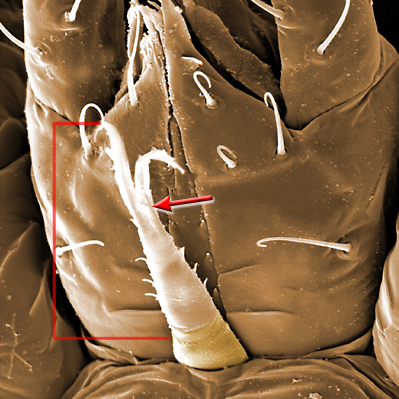 . Tectumgnathotectum:
(= epistome, tectum) an often membranous dorsal projection of the anterior margin of the basis capitulum in Mesostigmata; often diagnostic at family-, genus- or species-levels; also often difficult to see without high magnification and good optics.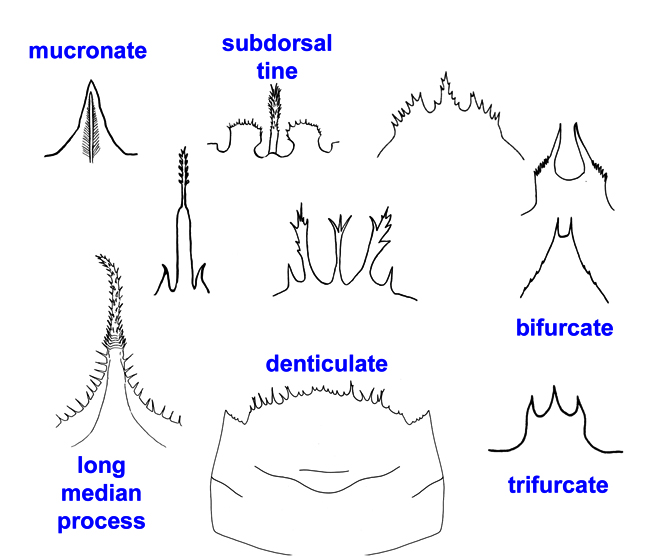 U-shaped with laterally denticulatedenticulate:
bearing small, sharp processes, e.g., the hypostome of ticks.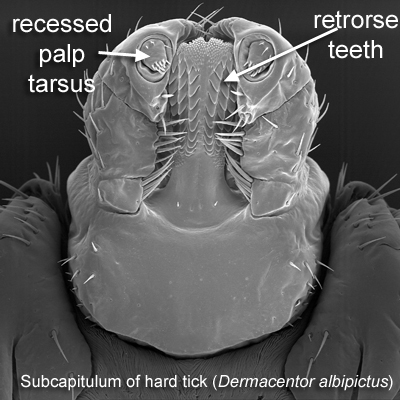 tines. Female sperm induction pores near bases of coxae III–IV. Males with genital opening at basebase:
the usually columnar basal part of the tritosternum; sometimes expanded and rectangular or otherwise modified; the most basal part of any structure. of tritosternumtritosternum:
the sternum of the 3rd body segment (between legs I); produced as a biflagellate structure in Mesostigmata, although sometimes the flagellae (laciniae) are partially or completely fused. in sternogenital shield; spermatodactylspermatodactyl:
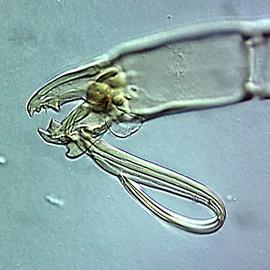
(also spermadactyl) the 'sperm finger' on the chelicerae of male dermanyssine Mesostigmata used to transfer sperm to the secondary sperm system in the female; spermatodactyls take various forms, from simple finger-like processes to very long, contorted structures. 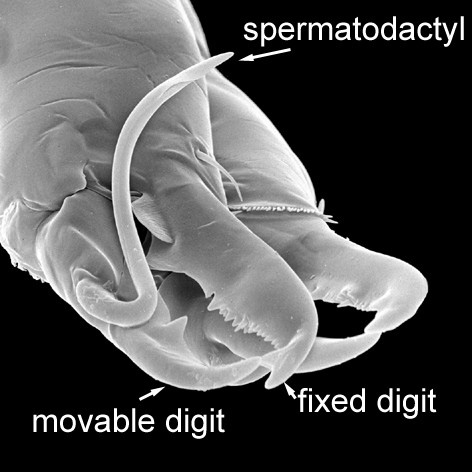 usually well developed.
Many pachylaelapids have sternal shields with 4 pairs of setaeseta:
(pl. setae, from L. = bristle) cuticular process composed of a hollow shaft (sometimes filled with a refractive material) produced from a membranous socket (the alveolus); the hair-like, spine-like, branched or variously expanded structures on the surfaces of the legs and body. Most setae function as mechanoreceptors, but others (e.g., solenidia) are chemoreceptors or have unknown or ambiguous functions., as in the Rhodacaroidea and in some Parholaspididae, but these mites usually have ventrianal rather than anal shields. Species of Zygoseius are superficially similar to ascid mites in the genus Lasioseius, but the latter never have st4 on metasternal-endopodal plates, a characteristic of the former. Some members of the Leptolaelapidae Karg may belong to the Pachylaelapidae.
Author: David E. Walter
Content last updated Sept. 2006, unless indicated otherwise
Lucid key player updated Sept. 2025
idtools.org