t
Lasioseius Berlese
Lasioseius Berlese, 1916a: 33. Type species: Seius muricatus. — Berlese, 1887, not Koch, 1839 (=Typhlodromus berlesei Oudemans, 1938, =Lasioseius aba Baker and Wharton, 1952), by original designation.
Aceoseius Sellnick, 1941: 149. Type species: Sejus muricatus Koch, 1839, by original designation. Synonymy by Evans (1958)Evans (1958):
Evans GO. 1958. A new mite of the genus Phytoseiulus Evans (Acarina: Phytoseiidae) from Southern Rhodesia. Journal of the Entomological Society of South Africa 21: 306–308..
Borinquolaelaps Fox, 1946: 450. Type species: Borinquolaelaps dentatus Fox, 1946, by original designation. Synonymy by Evans (1957).
Hyattella Krantz, 1962: 6. Type species: Hyattella epicrioides Krantz, 1962, by original designation. Synonymy by Lindquist and Evans (1965)Lindquist and Evans (1965):
Lindquist EE, Evans GO. 1965. Taxonomic concepts in the Ascidae, with a modified setal nomenclature for the idiosoma of the Gamasina (Acarina: Mesostigmata). Memoirs of the Entomological Society of Canada 47: 1–64.
Gnorimus Chaudri, 1975: 100. Type species: Gnorimus tabella Chaudri, 1975, by original designation. (preoccupied by Gnorimus Serville, 1825 (Coleoptera)). Synonymy by Walter and Lindquist (1997)Walter and Lindquist (1997):
Walter DE, Lindquist EE. 1997. Australian species of Lasioseius (Acari: Mesostigmata: Ascidae): the porulosus group and other species from rainforest canopies. Invertebrate Taxonomy 11: 525–547..
Lasioseius (Crinidens) Karg, 1980: 345. Type species: Lasioseius corticeus Lindquist, 1971, by original designation. Synonymised with Borinquolaelaps by Naeem et al. (1985).
Indiraseius Daneshvar, 1987: 32. Type species: Lasioseius parberlesei Bhattacharyya, 1968, by original designation. Synonymy by Walter and Lindquist (1997)Walter and Lindquist (1997):
Walter DE, Lindquist EE. 1997. Australian species of Lasioseius (Acari: Mesostigmata: Ascidae): the porulosus group and other species from rainforest canopies. Invertebrate Taxonomy 11: 525–547..
Superorder Parasitiformes » Order Mesostigmata » Suborder Monogynaspida » Infraorder Gamasina » Hyporder Dermanyssiae » Superfamily Phytoseioidea » Family Blattisociidae » Genus Lasioseius
More about Lasioseius on Bee Mite ID
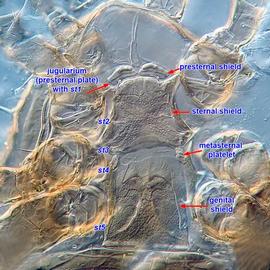
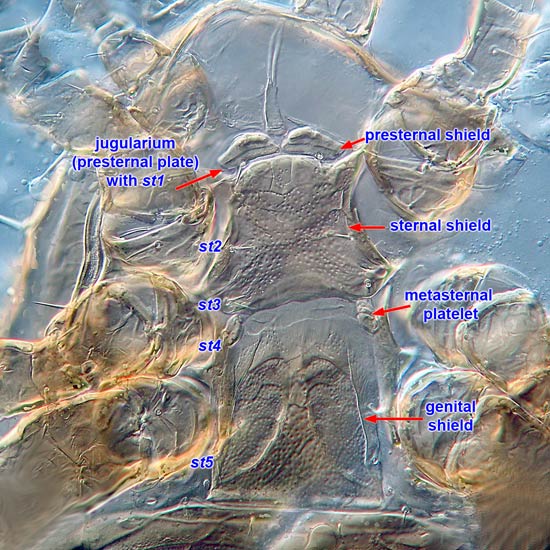
Species of Aceodromus are highly hypotrichous, with 11 pairs of setae on the podonotal region and 7–10 pairs on the opisthonotal region. Species of Blattisocius have few teeth on the fixed digit, simple dorsal shield setae, and approximate corniculi. Ologamasidae have sternal shields with 4 pairs of setae. Laelapidae usually have an anal shield and a flask-, tongue-, dagger-shaped or otherwise highly modified genital or opisthogenital shield. Ameroseiidae lack setae J5. Most Phytoseiidae have 21 or fewer pairs of dorsal shield setae. Podocinidae have long, whip-like legs I. Macrochelidae usually have recurved peritremes. Halolaelapidae have a 3-tined palp apotele. Species of Zygoseius (Pachylaelapidae) have the metasternal shield fused to endopodal elements.
Leg II of female often thickened, with strong, opposable spine-like setae on ventral surface on femur, genu, tibia, and tarsus; fixed chela multidentate, its distal extremity usually with enlarged rounded margin bearing a row of small rasping teeth; trochanter I with 4 or 5 setae (av1 absent); genu and tibia I each with maximum of 11 setae (pd3, av2 absent).............................. Hoploseius
- Leg II of female not thickened, without spine-like ventral setae; fixed chela with few to many teeth, its distal extremity not enlarged, without row of small teeth; trochanter I with 6 setae (av1 present); genu and tibia I each with 13 (rarely 12) setae (pd3 and usually av2 present).............................. 2
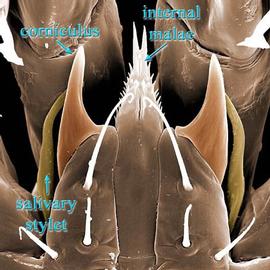
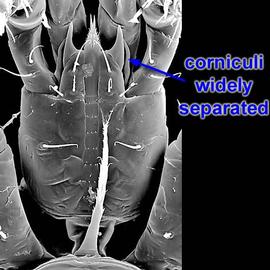
Corniculi narrowly separated, usually slender; epistome convex, smooth; fixed chela with few or no teeth; peritrematal shield slender, barely wider than stigma at level of stigma; female with humeral seta (r3) usually on soft cuticle beside dorsal shield; protonymph with 2 setae on palp trochanter.............................. 3
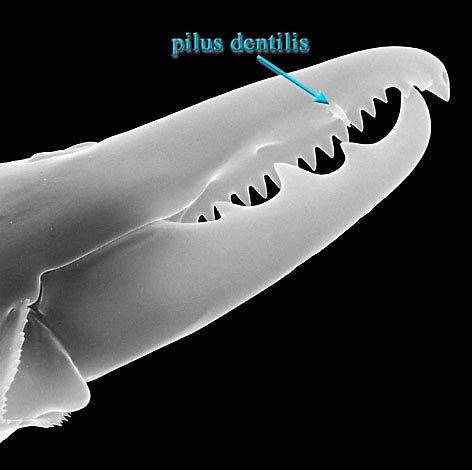
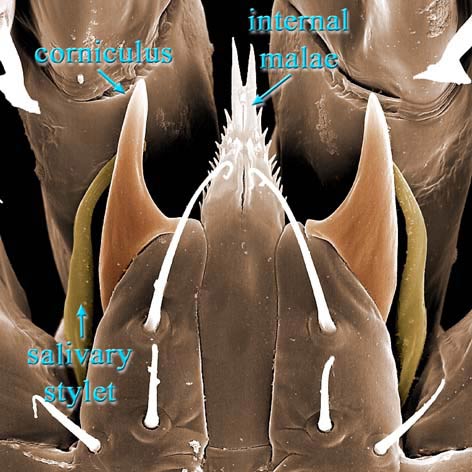
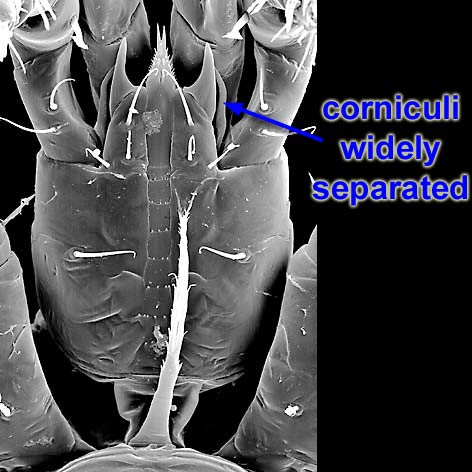
- Corniculi well separated, stout; epistome convex or triramous, smooth or denticulate; fixed chela usually with many teeth; peritrematal shield clearly wider than diameter of stigma at level of stigma; female with humeral setae on dorsal shield; protonymph with 1 seta on palp trochanter.............................. 4
Dorsal shield without midlateral incisions; opisthonotal region of dorsal shield holotrichous, with 15 pairs of setae; fixed chela well developed or reduced; female without isolated metasternal plates; male leg IV without enlarged, spine-like setae.............................. Blattisocius
- Dorsal shield with midlateral incisions; opisthonotal region of dorsal shield hypotrichous, with 12 pairs of setae (lacking a pair in each of J, Z, S series); fixed chela well developed; female with isolated metasternal plates; male leg IV with several enlarged spine-like setae.............................. Adhaerenseius
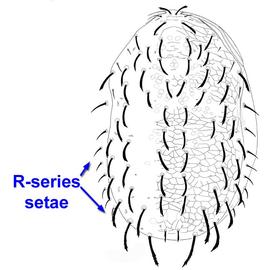
Female and male with all marginal r–R setae on edge of dorsal shield, opisthonotal region of shield with 20 pairs of setae; rows of deutosternal denticles narrow, each with 2–4 denticles; movable chela with ridge extending from para-axial surface to 1–2 denticles on proximo-ventral surface.............................. Orthadenella
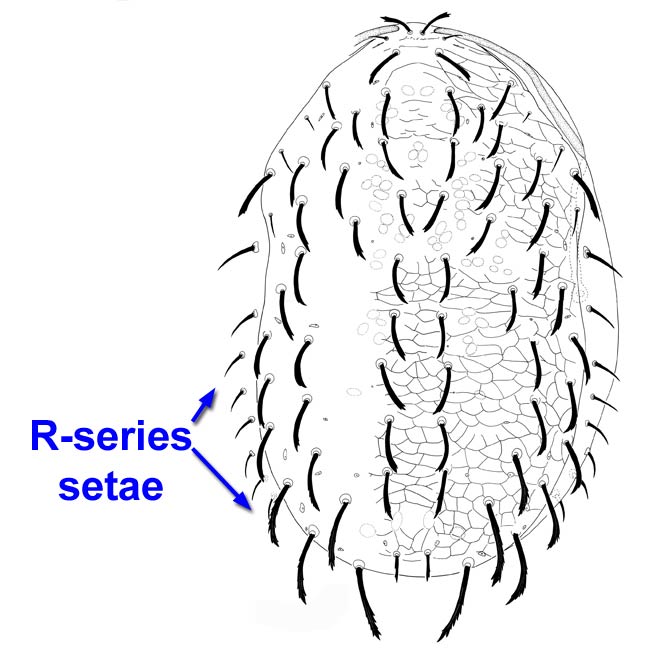
- Female and male with 1–9 pairs of marginal r–R setae on soft cuticle beside dorsal shield, opisthonotal region of shield with maximum of 15 pairs of setae in female, 17 in male; rows of deutosternal denticles moderately wide, each with 5 to many denticles; movable chela lacking ridge or denticles on paraxial and ventral surface.............................. 5
Adults with 1 pair of marginal setae (R1) on soft lateral cuticle; female metapodal plates incorporated into ventrianal or peritrematal plates, and ventrianal shield with 7 pairs of setae in addition to circumanals; male with holoventral shield.............................. 6
- Adults with 3–9 pairs of marginal setae (r–R) on soft lateral cuticle; female metapodal plates free on soft cuticle, and ventrianal shield with 6 or fewer pairs of setae in addition to circumanals; male usually with separate sternogenital, ventrianal and peritrematal-exopodal shields.............................. 7
Podonotal region of adult dorsal shield lacking setae z1, s1, s2; female with metapodal plates incorporated into ventrianal shield; female ventrianal shield lacking setae ZV1 but with JV5 on its posterolateral margins; genu III with 10, tibiae III and IV with 9 and 10 setae, respectively (pl–2 present on each of these segments).............................. Zercoseius
- Podonotal region of adult dorsal shield holotrichous; female with metapodal plates incorporated into posterior margins of peritrematal shields; female ventrianal shield with setae ZV1 but with JV5 inserted on soft cuticle behind its posterolateral margins; genu III with 9, tibiae III and IV with 8 and 9 setae, respectively (pl–2 absent from each of these segments).............................. Arrhenoseius
Female with 11 pairs of setae on podonotal region of dorsal shield (s5 absent) and 7–10 pairs of setae on opisthonotal region (Z1, J2 absent); epigynial shield rounded posteriorly; ventral setae ZV1, JV5 absent; cervix of spermatheca not sclerotized; movable chela with 4 teeth; genua II and III with 10 and 8 setae respectively (pv1 absent).............................. Aceodromus
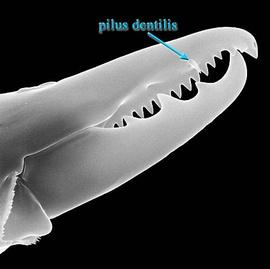
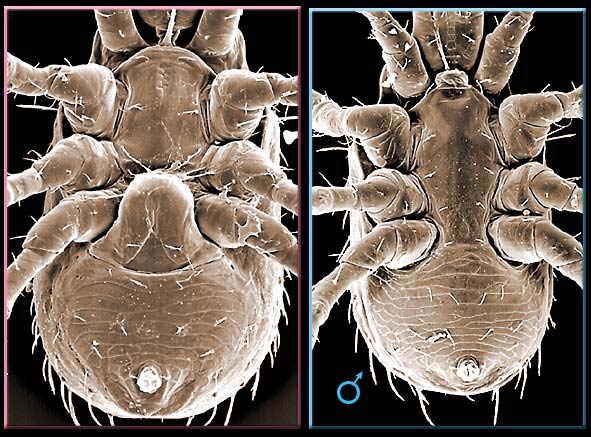
- Female with 12–23 pairs of setae on podonotal region of dorsal shield (s5 present) and 10–15 pairs of setae on opisthonotal region (Z1, J2 present); epigynial shield usually truncate posteriorly; ventral setae ZV1, JV5 present; cervix of spermatheca well sclerotised; movable chela with 3 teeth (rarely 4); genua II and III usually with 11 and 9 setae respectively (pv1 usually present).............................. Lasioseius
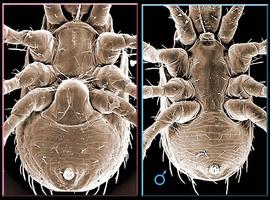
Species of Lasioseius are common in many habitats, including vegetation, flowers and in association with insects. More than 100 species are known.
Author: David E. Walter
Content last updated Sept. 2006, unless indicated otherwise
Lucid key player updated Sept. 2025
idtools.org