Mesostigmata
t
Taxonomy
updated 2025
Name
Polyaspididae Berlese, 1913
Children
Polyaspis Berlese, Dipolyaspis Berlese, Calotrachys Berlese, Pollaspidella Berlese, Dyscritaspis Camin
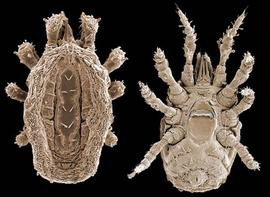
Diagnostic characters
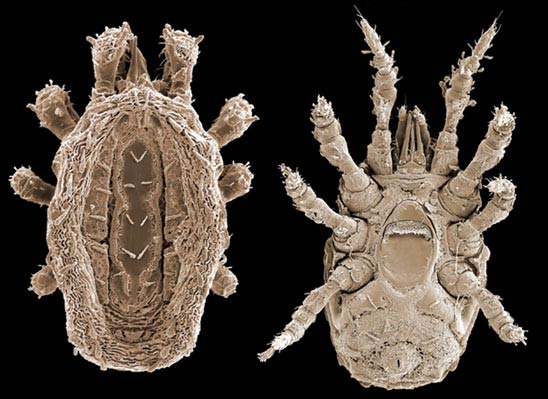
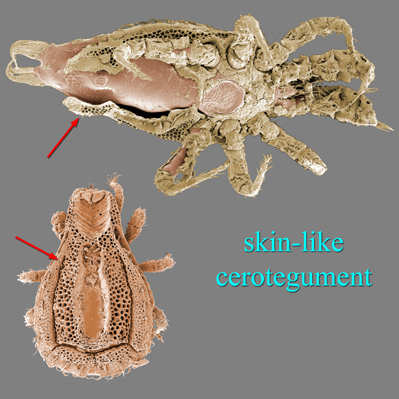
- Dense coating of cerotegumentcerotegument:
the outer layers of the epicuticle, including the wax and cement layers; often thin and inconspicuous, but sometimes very thick, ornamented, and obscuring the underlying cuticle; thick ceroteguments often can be peeled off to expose a very different-looking mite.
- Podonotal shieldpodonotal shield:
the anterior shield in mesostigmatans with divided dorsal shields.
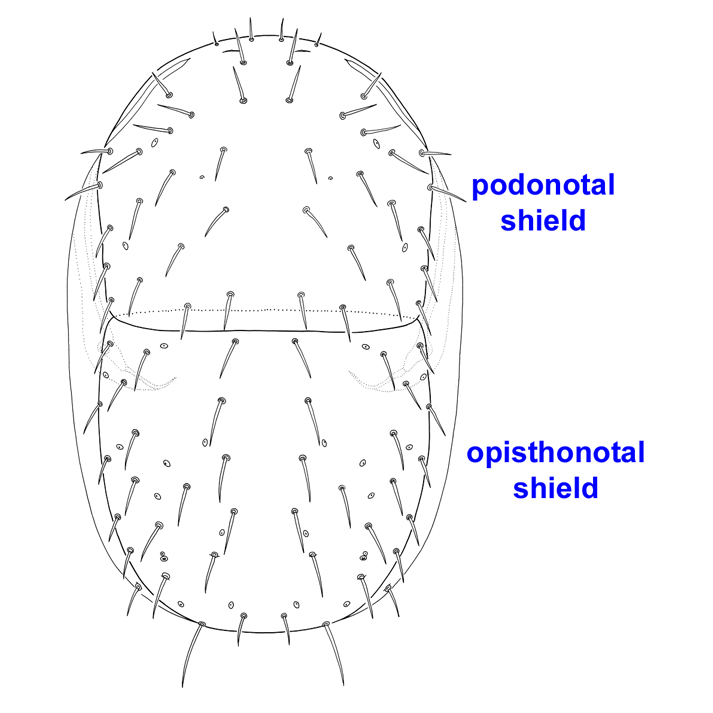 and free marginal seta (or small plates) and pygidial shields under cerotegumentcerotegument:
the outer layers of the epicuticle, including the wax and cement layers; often thin and inconspicuous, but sometimes very thick, ornamented, and obscuring the underlying cuticle; thick ceroteguments often can be peeled off to expose a very different-looking mite.
- <100 dorsal idiosomalidiosomal:
(idiosomatic) adjectival form of idiosoma.
setae
- Scabellumscabellum:
in Uropodina, a platform-like structure on the underside of the vertex that receives the withdrawn legs I.
and pedofossaepedofossa:
(pl. pedofossae) (= fossae pedales, fovae pedales) recesses into which the legs can be withdrawn.
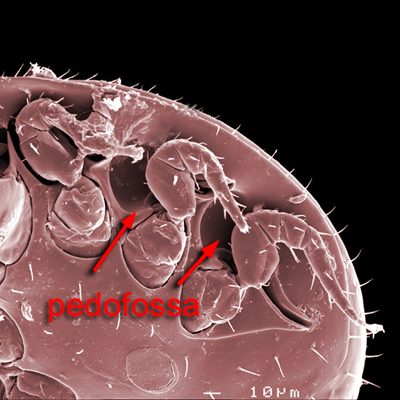 absent
- Sternal setaesternal setae:
in Mesostigmata, the five pairs of setae in the intercoxal region designated st1-5; st1-3 are present in the larva and usually are borne on a sternal shield in the adult female; st4, the metasternal setae, are added in the deutonymph, often are borne on metasternal platelets, and sometimes on the sternal shield; st5, the genital setae, are added in the protonymph and usually borne on or are inserted laterad the epigynal shield in the adult female.
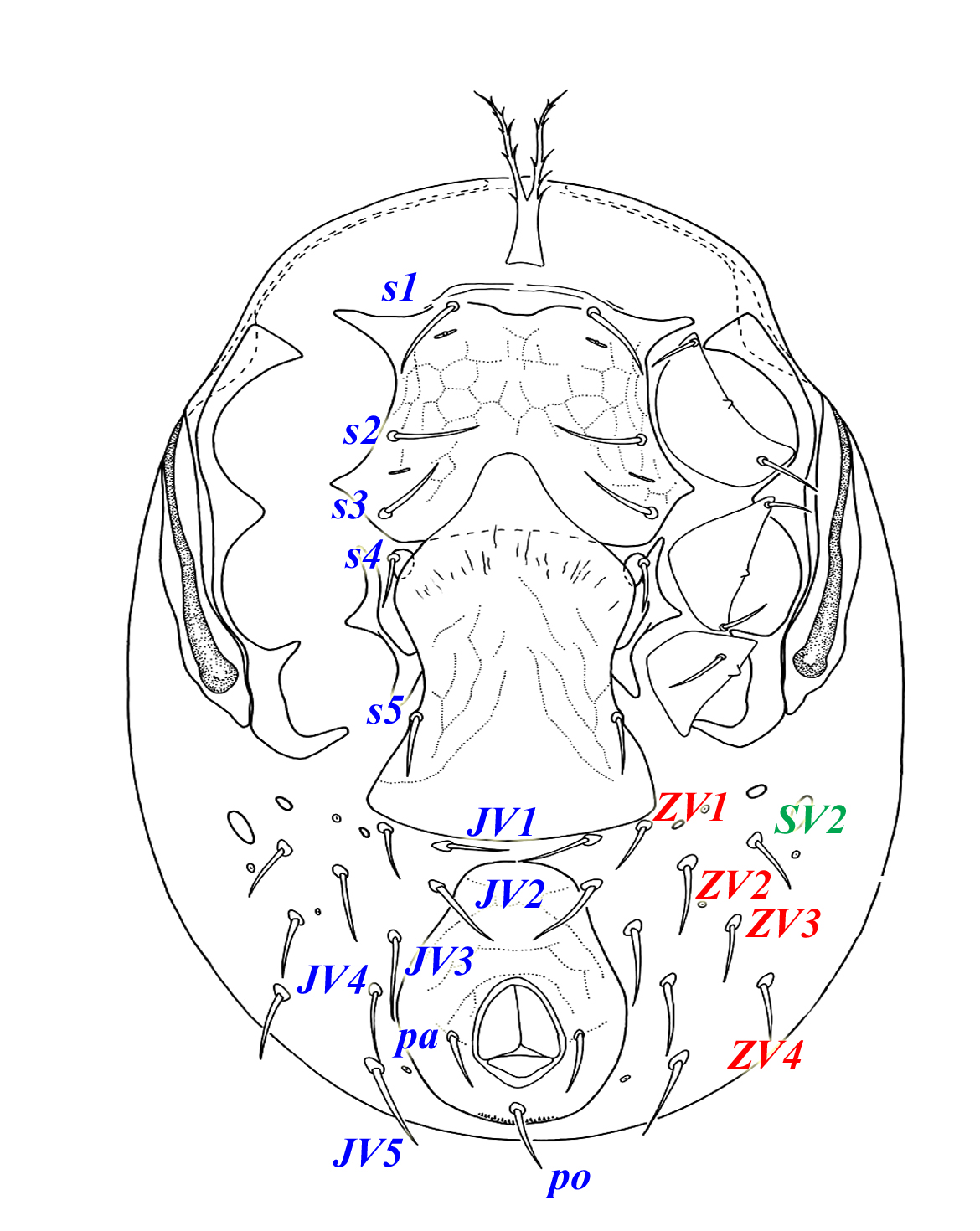 (st1–4) on sterno-parapodal-peritrematalperitrematal:
(peritrematic) of or referring to the peritreme; adjectival form of peritreme.
shield that encompasses the genital opening anteriorly and laterally
- st5 usually on small latigynial shieldslatigynal shields :
(also latigynial shields) a pair of sclerites laterad the mesogynal shield in some female parasitiform mites that help protect the genital opening; usually bearing one or more pairs of setae and sometimes fused to other genital or ventral elements. The single female genital shield in the Gamasina may represent a fusion of the latigynal and mesogynal shields.
(rarely fused to genital shieldgenital shield:
a shield or shields covering the genital opening; in female mongynaspine Mesostigmata this shield is usually called the epigynal (epigynial) shield.
)
- Anal opening on ventrianal shieldventrianal shield:
in Mesostigmata, a ventral shield bearing the anal opening, circum anal setae, and one or more pairs of ventral setae or pores (lyrifissures) [see anal shield]; maybe rather narrow or very broad and covering most of the gaster.
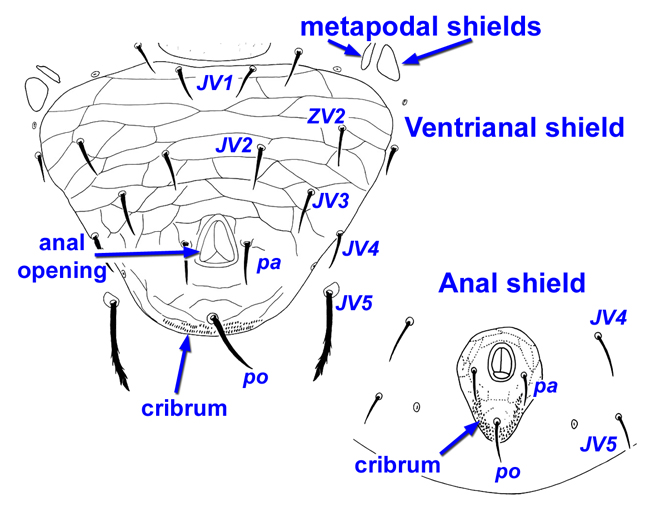 with 5 circumanal setaecircumanal setae:
in Mesostigmata, the three setae (postanal and pair of peranal) setae surrounding the anal opening.
- Genital shieldgenital shield:
a shield or shields covering the genital opening; in female mongynaspine Mesostigmata this shield is usually called the epigynal (epigynial) shield.
usually nude, entirely intercoxal, without anterior median process
- Legs I without ambulacra, coxae I enlarged, but subcylindrical and widely separated; trochantertrochanter:
the leg segment between the coxa and the femur.
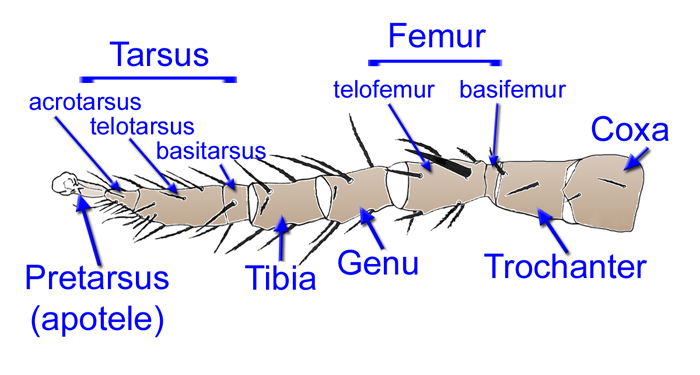 I with 4 setae; tibiatibia:
(pl. tibiae) the leg segment between the genu and the tarsus.
I with 4 (rarely 3) dorsaldorsal:
relating to the upper or back side; opposed to ventral.
and 2 ventral setaeventral setae:
in the Lindquist-Evans system used in the Mesostigmata, the ventral region has up to three longitudinal rows (Jv, Zv, Lv) with 1-5 transverse row designations.
; all genugenu:
(pl. genua) (= patella) the 4th leg segment, between the femur and tibia.
with 4 dorsaldorsal:
relating to the upper or back side; opposed to ventral.
setae; genugenu:
(pl. genua) (= patella) the 4th leg segment, between the femur and tibia.
II with 4 lateral setae.
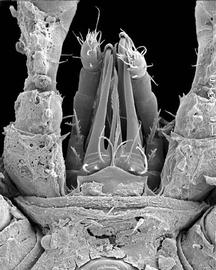
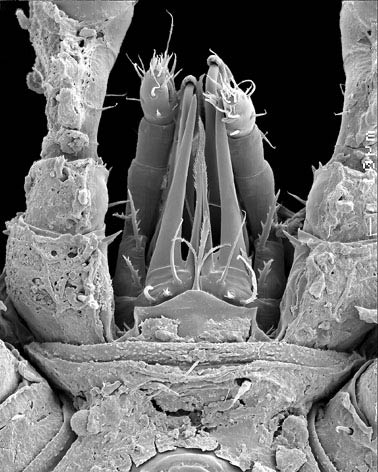
- Chelicerae typically robust, elongate, with long snap-trap digits; corniculi elongate, bayonet-likebayonet-like:
resembling a long, sharp blade used for stabbing, as in some corniculi; sword-like.
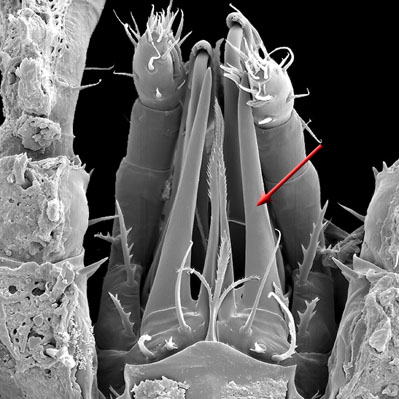 .
.
- Tectumgnathotectum:
(= epistome, tectum) an often membranous dorsal projection of the anterior margin of the basis capitulum in Mesostigmata; often diagnostic at family-, genus- or species-levels; also often difficult to see without high magnification and good optics.
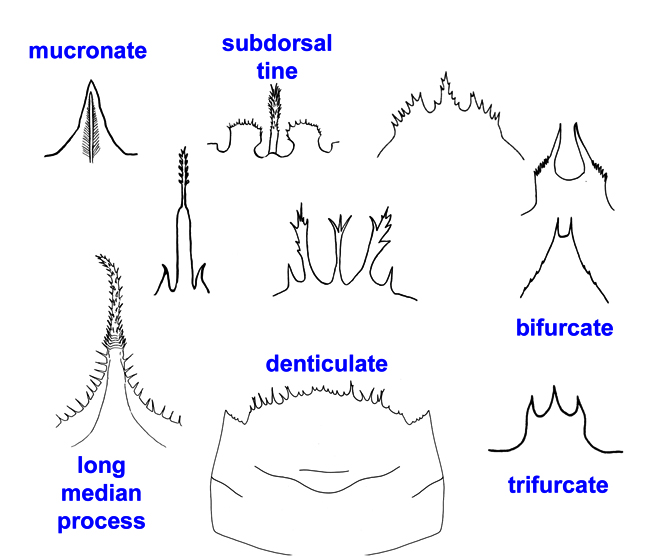 with strong median process; hypostomal denticleshypostomal denticles:
(teeth, retrorse teeth) the backwardly directed tooth-like projections on the elongate hypostome of ticks that are used to anchor the capitulum to skin while feeding.
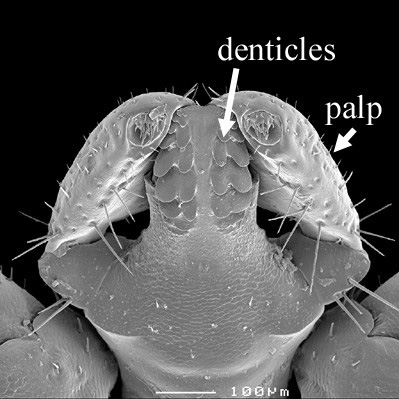 in rows to either side of furrow.
- Palp apotelepalptarsal apotele:
(= palp apotele, palptarsal claw) the most distal segment of the palp; absent in Acariformes, claw-like in Opilioacarida, and a subdistal, tined structure in the Mesostigmata.
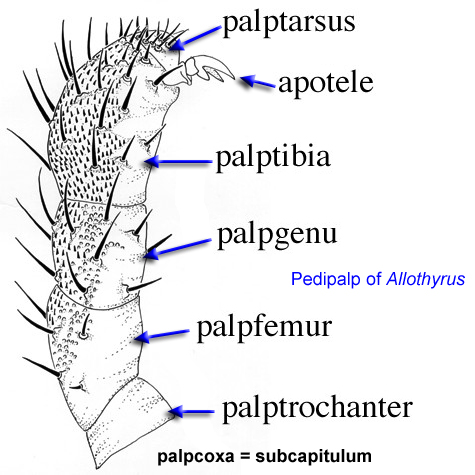 2-tined; palppalp:
(= pedipalp) the second pair of limbs in arachnids, used in feeding and originating on either side of the chelicerae. In mites, the palps may be vestigial, with only a few segments, or have a maximum of 5 freely articulating segments (rarely the femur is subdivided) and a distal or subdistal apotele.
genu with 4–5 setae, palppalp:
(= pedipalp) the second pair of limbs in arachnids, used in feeding and originating on either side of the chelicerae. In mites, the palps may be vestigial, with only a few segments, or have a maximum of 5 freely articulating segments (rarely the femur is subdivided) and a distal or subdistal apotele.
femur with 5 setae.
- Tritosternal laciniae typically fused, highly divided; tritosternal wider than long, usually rectangular
- Male genital opening intercoxal, valves without setae; chelicerae not obviously modified for sperm transfer
Key to adult females of common genera of Polyaspidoidea
-
Idiosoma and mesogynal shield oval to subrectangular; marginal shield fragmentedfragmented:
broken up, composed of several discrete parts rather than of a single unit.
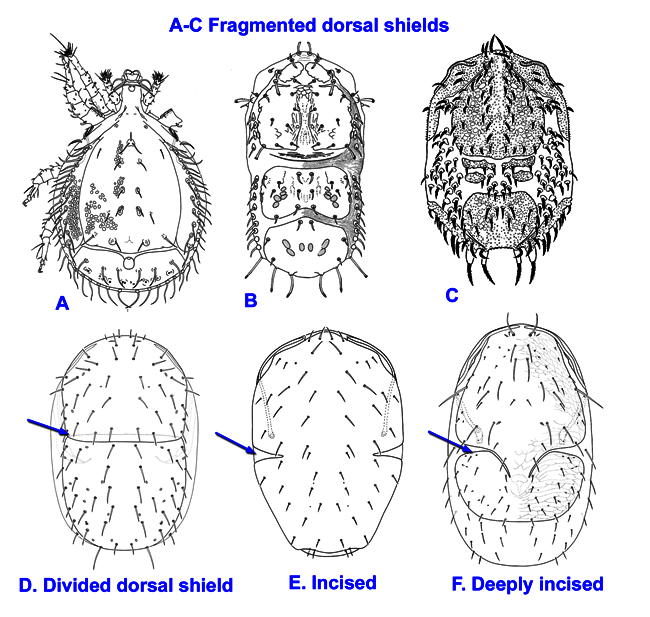 .............................. 2
- Idiosoma pyriform, mesogynal shield trapezoidal; marginal shield entireentire:
a shield or sclerite with a continuous margin without incisions.
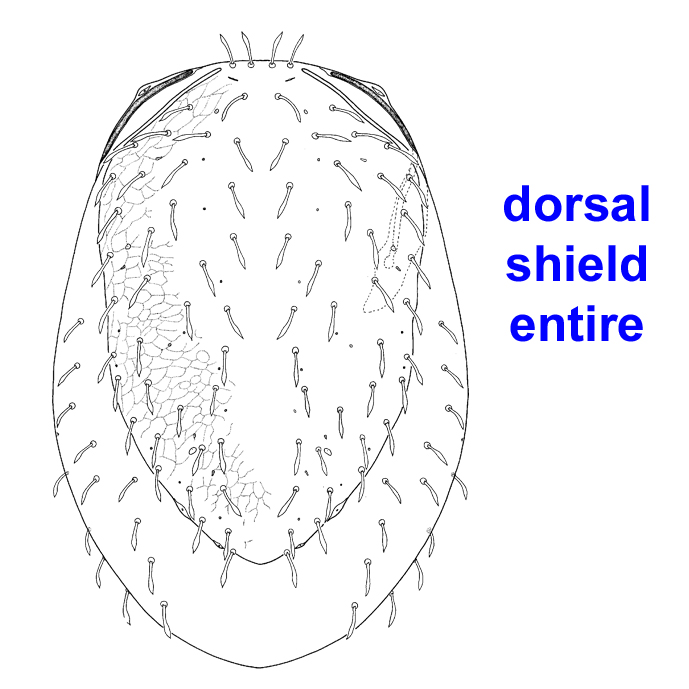 .............................. Trachytes
-
Genugenu:
(pl. genua) (= patella) the 4th leg segment, between the femur and tibia.
IV with two ventral setaeventral setae:
in the Lindquist-Evans system used in the Mesostigmata, the ventral region has up to three longitudinal rows (Jv, Zv, Lv) with 1-5 transverse row designations.
.............................. 3
- Genugenu:
(pl. genua) (= patella) the 4th leg segment, between the femur and tibia.
IV with one ventralventral:
relating to the lower or under side; opposed to dorsal.
seta.............................. Polyaspinus (+Uroseius)
-
Chelicerae and corniculicorniculus:
(pl. corniculi) (also, external malae) a usually horn-like process (sometimes toothed, bifurcate, trifurcate, spine-like, spatulate, or membranous) on the subcapitulum of parasitiform mites that usually supports the salivary styli. A toothed corniculus could be confused with a rutellum, a possibly homologous structure in Acariformes and Opilioacarida. Phytoseiid image is spatulate corniculus.
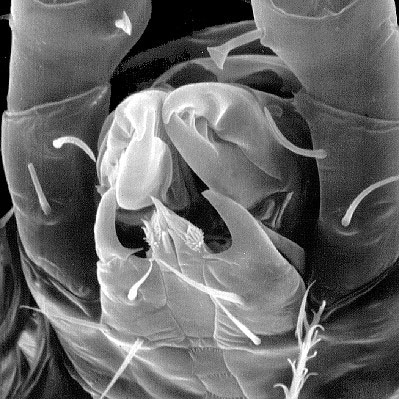 elongate, the latter reaching distaldistal:
towards the free end of an appendage.
end of palpgenu.............................. Polyaspis (+Dyscritaspis)
- Chelicerae and corniculicorniculus:
(pl. corniculi) (also, external malae) a usually horn-like process (sometimes toothed, bifurcate, trifurcate, spine-like, spatulate, or membranous) on the subcapitulum of parasitiform mites that usually supports the salivary styli. A toothed corniculus could be confused with a rutellum, a possibly homologous structure in Acariformes and Opilioacarida. Phytoseiid image is spatulate corniculus.
not elongate.............................. Dipolyaspis
Similar taxa
The combination of elongate snapping chelicerae, bayonet corniculicorniculus:
(pl. corniculi) (also, external malae) a usually horn-like process (sometimes toothed, bifurcate, trifurcate, spine-like, spatulate, or membranous) on the subcapitulum of parasitiform mites that usually supports the salivary styli. A toothed corniculus could be confused with a rutellum, a possibly homologous structure in Acariformes and Opilioacarida. Phytoseiid image is spatulate corniculus.
, and fragmentedfragmented:
broken up, composed of several discrete parts rather than of a single unit.
dorsal shields serve to distinguish Polyaspis from all others.
Ecology and distribution
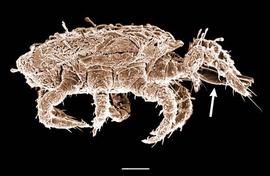
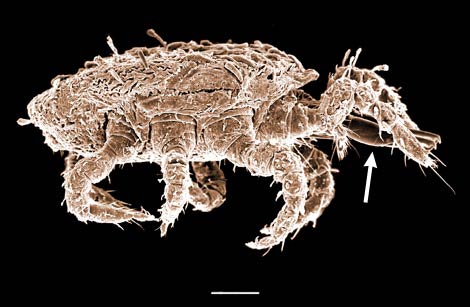
Polyaspis mites are slow-moving, but effective predators that use their elongate chelicerae to 'snap-trap' more active microarthropods such as springtails. Polyaspis will also feed on nematodes.
References
- Ainscough 1981Ainscough 1981:
Ainscough BD. 1981. Uropodine studies. I. Suprageneric classification in the cohort Uropodina Kramer, 1882 (Acari: Mesostigmata). International Journal of Acarology 7: 47–56.
- Athias 1976Athias 1976:
Athias F. 1976. Observations morphologiques sur Polyaspis patavinus Berlese 1881 (Acariens: Uropodides). 2. Morphologie et chètotaxie des appendices au cours du dèveloppement postembryonnaire. Acarologia 18: 194–216.
- Camin 1953Camin 1953:
Camin JH. 1953. A revision of the Cohort Trachytina Trägårdh, 1938, with the description of Dyscritaspis whartoni, a new genus and species of polyaspid mite from tree holes. Bulletin of the Chicago Academy of Sciences 9: 335–385.
- Camin 1954bCamin 1954b:
Camin JH. 1954b. Polyaspis berlesei, a new species of trachytoid mite (Mesostigmata: Polyaspidae). Bulletin of the Chicago Academy of Sciences 10: 25–33.
- Evans and Till 1979Evans and Till 1979:
Evans EO and Till WM. 1979. Mesostigmatic mites of Britain and Ireland (Chelicerata: Acari-Parasitiformes): An introduction to their external morphology and classification. Transactions of the Zoological Society of London 35 (2): 145-270.
- Gilyarov and Bregatova 1977Gilyarov and Bregatova 1977:
Gilyarov MS and Bregatova NG, eds. 1977. Handbook for the identification of soil-inhabiting mites, Mesostigmata. Zoological Institute of the Academy of Sciences, Petrograd.
- Karg 1989aKarg 1989a:
Karg W. 1989a. Acari (Acarina), Milben Unterordnung Parasitiformes (Anactinotrichaeta) Uropodina Kramer, Schildkrötenmilben. Die Tierwelt Deutschlands 67: 1-203.
- Krantz and Ainscough 1990Krantz and Ainscough 1990:
Krantz GW and Ainscough B. 1990. Mesostigmata. pp. 583-665. In: Dindal DL, ed. Soil biology guide. John Wiley & Sons, Brisbane.